Polyamory in the News
. . . by Alan M.


May 26, 2018

Brazilian soccer star Ronaldinho to "marry" two women in private ceremony


Several of you sent me this news item that's stirring up world soccer fans. From the version in the New York Daily News:


Brazilian soccer star Ronaldinho to marry two women in private ceremony

By Megan Cerullo

I, Ronaldinho, take you both to be my wives.

Brazilian soccer legend Ronaldinho Gaúcho will "wed" his two fiancées in a private ceremony in August, Rio de Janeiro newspaper O Dia reports.

Polygamy and bigamy are illegal and punishable by up to six years in prison in Brazil, so the union won't constitute a legal marriage.

Ronaldinho began dating Priscilla Coelho between 2012 and 2014, while he was playing for Atletico Mineiro, according to local media reports. He met Beatriz Souza in 2016 and began dating her as well.

The lovers have reportedly lived happily together in Ronaldinho's Rio de Janeiro mansion since December.

The threesome will "marry" in a small ceremony at their home.

Ronaldinho will likely establish a private contract that creates a set of rules for the family he forms with the women, according to Brazilian lawyer Michelle Viana.

The contract could cover financial responsibilities and repercussions should the civil union come to an end, she said. ...

--------------------

Brazil is in the process of reviewing its marriage laws — a National Council of Justice hearing on polyamorous unions was postponed Tuesday. So far, four council members have stated their opposition to legalizing the unions, while two voiced their support. Five council members have not yet cast their votes.

"Brazilian law is changing to adjust to society, but it might not be ready to accept polygamy," said Sergio Botinha, an international family lawyer based in Brazil.

In 2012, county clerk Claudia do Nascimento Domingues approved the first civil union between a man and two women.... Three years later, three women entered into a civil union, approved by another county clerk in Brazil. But the validity of those unions is up for debate. ...


The article (May 25, 2018). Scan down this list for news coverage of previous poly civil unions officialized in Brazil.

In reaction to the furor, Ronaldino insists that an actual group marriage (which would be illegal) is not happening. "It's the biggest lie," he says. Even so, according to other reports, the ceremony, planned for August, will include exchanges of rings.

Sports Illustrated says,


All three people live together in Ronaldinho's [palatial] Rio condominium. A small [ceremony] will be held in Ronaldinho's home, though his sister, who does not agree with his lifestyle, says she will not attend, O Dia reports.


From O Dia, one paragraph long: Ronaldinho Gaúcho vai se casar com suas duas mulheres (Ronaldinho Gaucho will marry his two women) (May 24).

Earlier, on March 29, the paper wrote ‘Poliamor’ pode colocar em risco pretensões políticas de ex-jogador Ronaldinho Gaúcho ('Polyamory' Could Endanger Political Hopes of Ronaldinho Gaúcho). The three have often been seen out and around together.

[Permalink]

Labels: , ,


January 31, 2016

More Brazil stories: "Polyamory practitioner teaches how to bring a third person into a relationship"


Following up on my last post, today's O Globo newspaper in Brazil features a young poly educator spreading the word. O Globo is part of the media company that owns GNT TV, which last year featured the ten-part, poly-heavy series "Free Loves", Amores Libres.

Some excerpts, courtesy of Google Translate:


RIO - How to introduce her boyfriend to her husband without hurting them? When your spouse goes out with someone new, is it okay to be jealous? If my girlfriend from another city is here at home, can she can sleep with me and my wife? Or simply: can you love more than one person at a time?

Sharlenn Carvalho

These are inconvenient questions in a monogamous marriage, but everyday for those who are (or want to be) in polyamory. Sharlenn Carvalho, 32, activist and practitioner of this model of simultaneous, consensual multiple relationships, specializes in answering them....

...'There is a dictatorship of monogamy, which we call "polifobia". It's hard to face in a natural, public, open way. Many need help on that path.'

...Sharlenn is thinking about professionalizing her project this year: 'It is an activity that I consider essential and don't want to stop doing. But I do it for love. If I could support myself as a "polyamory consultant" that would be ideal.'


The whole article, in the original Portuguese: Adepta do poliamor ensina como introduzir terceira pessoa na relação (January 31, 2016). Thanks to Claudia Domingues for the tip. Domingues is the notary who recorded Brazil's first certificate of polyaffective union; she tracks related news on her Facebook page.

---------------------------------

And on the news site UOL, the bestselling sex-and-relationship author and speaker Regina Navarro Lins writes,


Our ways of love and sex are evolving

Ilustração: Lumi Mae

I believe that in time fewer people will want a closed couple relationship, and most will opt for multiple relationships. Attentive to the signs, we see that to love and be loved by more than one person at the same time, so-called Polyamory, is gaining ground.

Regina Navarro Lins
The definition of poliamoristas: "This loving practice advocates relations rejecting monogamy as a principle or requirement. Polyamory, as an option or way of life, advocates practical and sustainable opportunities to be responsibly involved in intimate deep relationships, possibly long-term, with several partners simultaneously. "

No doubt, love is a social construction. If we analyze the various periods of our history, we find that it evolves. It is impossible not to ask the question: in a few decades will Polyamory prevail?


Her whole article: O comportamento amoroso e sexual está em evolução (January 19, 2016).


Update April 11: Another triad marriage ceremony is described in a story on Fox News Latino:
Polygamy is Brazil's latest contribution to sexual revolution
(April 11, 2016).

[Permalink]

Labels: ,


January 28, 2016

More poly developments from Brazil, as word spreads


At least eight certificates of triad unions have now been issued in Brazil, says the newspaper Folha de São Paulo:


"Couples" of Three or More May Obtain Civil Partnerships in Brazil

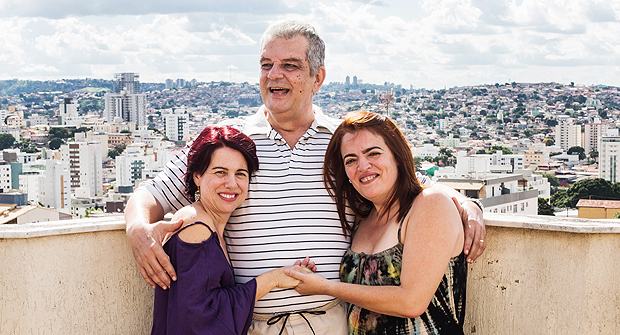
Audhrey loved Eustáquio, who loved Rita, who loved Audhrey. The three decided to live together eight years ago, and today they are a family.

A family from Belo Horizonte obtained a year ago a polyamorous civil partnership — official recognition of their situation. (Bruno Figueiredo / Folhapress)

...This is the story of a family from Belo Horizonte that a year ago obtained a polyamorous civil partnership — official recognition of their situation. At least eight such documents have been issued in Brazil.

Audhrey Drummond, 49, and Eustáquio Generoso, 57, got married in 1988 and had an on-off relationship until 1997. During that time they had a son, Iago, who is 23.

A year after they split up, Eustáquio began seeing Rita Carvalho, 45. But when Audhrey and Eustáquio met again in 2003, Audhrey admitted that she was still in love with him. "I told him that I didn't mind if Rita was in the picture," she says.

This is not a triangle relationship, but a ménage à trois, with Eustáquio living with both his wife and his mistress. He has his own room, with the women sleeping with him for a week at a time.

As well as obtaining rights to health insurance, polyamorous families also try to obtain recognition for their situation in order to add third (or fourth, or fifth) party to pensions and inheritance plans, for example.

Specialists are divided as to the validity of polyamorous civil partnerships. The public notary Fernanda Leitão believes that they are supported by a 2011 Supreme Court decision which equated homosexual civil partnerships with heterosexual marriage.

The lawyer Luiz Kignel disagrees. He says that the number of polyamorous unions is negligible in comparison to the number of heterosexual and homosexual couples, and as such, there is no indication of social change on this issue.


The original: PortugueseEnglish (January 26, 2016).

Once again, these "certificates of polyaffective union" are not legally recognized multi-marriages; they are the people's own notarized declarations that they meet the qualifications for being in a civil union. Normally in Brazil this creates a civil union on the spot. But whether this is true for multi-unions has not been tested in court.

-----------------------------------------

If Brazil is becoming more aware of such relationship possibilities, some credit goes to GNT TV and its documentary series "Free Loves" ("Amores Livres") that began last August. Here's an article about it that appeared in an end-of-year roundup on December 30th, on the news-and-entertainment site Catraca Livre. With help from Google Translate:


Polyamory: series tells the story of non-monogamous relationships

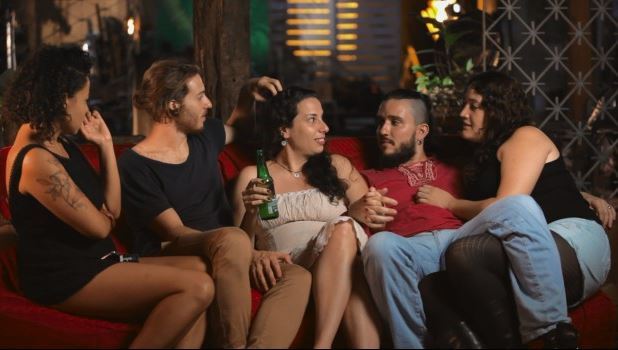
To portray different types of relationships that go beyond the standard "romantic love", GNT launched in August of this year a documentary series about polyamory, directed by João Jardim. Titled "Amores Livres", the program tells the story of non-monogamous relationships. It is available to watch online.

The 10 episodes of the series bring thinkers on the subject to give their testimony, as well as reports from people in various types of amorous setups.

The program's goal is to show that any form of love is worthy, whether polyamory, open relationships, polygamy, relationships virtual or long-distance, group sex, abstinence, and even the option of monogamy.


The original: Poliamor: série online conta a história de relacionamentos não monogâmicos (Dec. 30, 2016).

Carolina writes, "I'm a Brazilian reader of your blog. GNT is a Brazilian channel [associated with the O Globo newspaper] and I've found it interesting that they did this, considering that poly is not a big thing here and that most people are very traditional when it comes to relationship configuration."

You can watch a long video clip from each of the ten episodes for free at GNT: Amores Livres. The full 20-minute episodes are available for pay online.

Note: When you open a foreign-language site in Chrome, look for the tiny Translate icon (two squares) that appears in the very top-right corner.

-----------------------------------------

Also: At the end of the Catraca Livre article above are links to some poly docu-videos hosted on that site:

Documentaries talk about polyamory and its endless ways to say 'I love you'

Documentary shows day-to-day polyamory practitioners

[Permalink]

Labels: ,


December 7, 2015

And *another* civil union of three registers in Brazil


This is Brazil's third união poliafetiva — a poly family becoming officially registered as a civil union — that seems to have made the news. (Here are the first and the recent second.)

This does not mean multi-marriage is legalized in Brazil. As with the previous groups, the three swore out a document at a city clerk's office saying they meet the legal criteria for a civil union, including living together long-term and intermingling finances. The statement was notarized to establish that the civil union exists. This entitles them to some marriage-like rights.

Here's the story in (to pick one of many papers) the Jornal Meio Norte: Homem oficializa união com duas mulheres em cartório no Brasil.

With a lot of help from Google Translate,


Man officializes union with two women at Brazil notary office


Klinger de Souza, 31 and heterosexual, and bisexuals Paula Gracielly, 31, and Angelica Tedesco, 24, are living in an unusual relationship of three. On Monday [November 23, 2015] they managed to record their polyaffective union at the clerk's office in Jundiaí [São Paolo state], where they live.

This would be the third time that a union of three has been notarized in Brazil along the lines of a Domestic Partnership. Eventually they hope to celebrate a marriage....

The three are from Mato Grosso but live in Jundiaí, which ensures that they can lead normal lives, work, and also think about having a baby, which "Paulinha" expects to carry within about two years.

In addition to the child, another project that the trisal [triad] plans is to write a book about this broader way of relating — which still frightens, but, they assure, can be natural, ethical, truthful, honest and loving. That's poliamor.

Recognition of their atypical romance matters, they said, not only for division of inheritance, but also so they are not excluded from the civil rights afforded to any citizens. In addition, they're already thinking of the child's record and that it include all three parents: a father and two mothers.

To register the document, Klinger explained, he wrote it out in his own hand with the personal data for Paula and Angelica. The three signed the document, which had to be validated by two witnesses. After the signatures, everything takes around 30 minutes at any city clerk's office.

If any of the three leaves the relationship, he or she is entitled to 33% of the equity. As Klinger sees it the world has changed, and many people are still frightened by this way of relating. But the diversity of family types is irreversible fact.


Read the whole article (November 29, 2015). It appeared in many other outlets; for example on the news site Terra.com.br, as Poliamor: homem e 2 mulheres registram em cartório união a 3 (Nov. 24).

Here's the family's own Marriage of 3 (Casala3) Facebook page: Poliamor "Trisal" Angélica, Paulinha & Klinger. They explain (again with thanks to Google Translate):


Hi lovelies! We're here to show our day-to-day and to demystify a relationship of three, and to take questions from all you guys. We have already done some interviews with academics, newspapers and TV. Showing the form of love called polyamory in our everyday lives.


They and other polyfolks appeared two weeks earlier on Globo TV on September 30th, in a documentary series called Amores Livres (Free Loves); the episode is titled Amores Múltiplos (season 1 episode 9,  22 minutes). You can watch the whole episode on their Facebook page here, or watch the trailer below:


More coverage:

● Two weeks after that TV appearance, they were in Rio de Janeiro's O Dia: Homem namora duas mulheres: 'Ela quis outra pessoa na relação. Eu aceitei' (Oct. 16; also printed in Tribuna da Bahia and probably elsewhere.) This was still before they got their union registered. The article tells how they met and fell for each other.

● In Belém's Diário do Pará, "Trisal" mostra em página como é casamento a três (Nov. 21).

● In another news chain,  Relacionamento a três: união de "trisal" é reconhecida por lei (Nov. 24).

Lots more about the three. Love their attitude!


Update, December 16: The legal status of these documents has not yet been tested in Brazilian courts. Daniel Cardoso, a longtime polyactivist in Portugal, offers this assessment of what they may actually mean:


My understanding is that through the legal paths [the triads] chose, anything against which there is no law can be lawfully notarized. So, the public notaries have been using the ruling that the [Brazilian] Supreme Court made on same-sex unions to contend that Stable Polyaffectionate Unions (that's the best translation I can come up with) are equally encompassed and deserving of specific familial rights.

Now, some things you can already regulate without any fancy human-rights issues - three or more people could establish a commercial relationship that involved sharing costs, property, etc. Some of these can be considered "marriage-like".

What these documents are trying to do is to lawfully assert that they form a family, a stable union. Since there is no law against that, they may assert it freely and see it notarized. This is *not* the same as filing an application for a civil union, because in the case of a civil union you're asking the State to recognize that you fit into a State-created category, and the State ascertains that you do when the application is approved.

Things like social-security provisions and so on are *not* at the moment encompassed in any way.

What's basically happening, as far as I understand it, is that they're working to take advantage of a void in the legislation to set up the basis for future judicial [paths] to get their rights recognized. So, yes, in a way they HOPE those documents will grant them those rights that they, themselves, cannot reclaim (social security, parenting rights, fiscal framings), by having proof that they have a claim at being considered a family. But there is *no jurisprudence* whatsoever on this, and the Supreme Court, if eventually pressed for a decision (like them wanting to have parenting rights over one child, or wanting to file their taxes all together as a non-commercial entity), might or might not decide that they are, indeed, a 'civil union'. At this moment in time, the Supreme Court has ruled that same-sex (mono) families are civil unions, but has not ruled on this.

Again - I am not a lawyer and not a Brazilian, so some of the details might be off or unclear, but from my hours of reading and talking, this is what I get out of it.

So, technically, the fact that they have this notarized should, for instance, grant them rights to deal with social security as a family unit - meaning, that two people who did this exact same thing would see those rights recognized without any issue. Whether those rights will actually be recognized is still up in the air.


[Permalink]

Labels: , , , ,


December 29, 2014

Ambassadors to Brazil, and other poly news in Portuguese


If you only follow the internet in English, you're missing a lot of what's happening in the modern polyamory movement throughout the Western world. I used to post more foreign-language stories here but have fallen far, far behind.

For instance, a backlog has piled up of stories in Portuguese. Get ready for a data dump, prompted by this first item.

O americano Leon, entre as namoradas Fukumi e Kischa: elas se conhecem e aceitam o fato de que Leon gosta de ambas. (Foto: Jayme de Carvalho, Jr.)

Leon Feingold of Open Love NY had his poly life featured in Brazil (by way of a New York writer), in a high-status men's magazine that's actually named Status. The article, Quando Dois é Pouco, draws upon other Americans too, including Billy, Melissa, and Jeremy in Atlanta. The story conveys poly values well, judging by Google Translate (online July 14, 2014):


When Two Is Too Few

By Edu Graça, New York

...This dynamic has not only gained a name, it's gaining more and more fans in countries like the USA, Canada and Australia. This is polyamory, a way of love advocated by people opposed to monogamy [sic], with the acceptance of several people in the same relationship. The concept is reminiscent of "open marriage", in which each partner can relate to who they want, or "swinging", which allows the exchange of couples for sex, but the fact is that polyamory has its own rules. And how.

...Billy... met Jeremy Mullins, an information technology professional, in 2008. Jeremy and Melissa dated, and the relationship became serious enough that Melissa suggested they "officially" become a relationship of three. Billy tells that he had a crisis of jealousy, but that, in a way, he was also was attracted by Jeremy. Today the three share the same home, tasks, bills and even the raising of Billy and Melissa's daughter, age 9... [Billy] says the relationship is so natural and transparent that the daughter likes that the men are "both parents".

The loving arrangement of the group does not stop there. Besides being, for all practical purposes, married to two people at once, Billy is dating Lindsey, who in turn lives with Brian, also her boyfriend. "Time, or rather the lack of time, is a major obstacle in a polyamorous relationship. The logistics to deal with so many partners can be very complicated," admits Billy. He says jealousy attacks are rare, but still arise from time to time. "No one is immune to jealousy. The difference, I think, is that we polys are open to deal with this feeling productively, not destructively. In other words, if someone is not satisfied, talk about it, try to modify the rules, etc."

Theoretically, polyamory embodies all the ingredients needed for a relationship to work: mutual trust, space to discuss grievances, gender equality, freedom (albeit limited) to take on more relationships with the right to love two, three, and so on. "In real life, however, the human being is complex, whether monogamous or polyamorous," says the American sociologist Elisabeth Sheff.... "Polyamory can be extremely liberating, but it is not for everyone."...


-----------------------------------------


Eve Rickert just forwarded a nice piece that, this time, draws on Brazilian sources: Muito Amor in the magazine Tab, with happy art and animation.


Excerpts from Google Translate:


Lots of Love

By Lilian Ferreira

..."What is good [in monogamous relationships] is very good [in polyamorous relationships]. But what is bad is also bad," summarizes a poliamorista. He and his wife have a girlfriend. TAB talked with several fans [of poly] and everyone said that, jealousy aside, the problems that occur are common to any relationship: physical distance, and daily fights over lack of time, for example.

Andreza Hack de Abreu, 38, of Porto Alegre, has had an open relationship for two years. For three months, she and her husband lived with a friend of hers. "We lived three always together, bathing, brushing teeth, cooking. But when he was not with her, he did not help in the housekeeping activities such as shopping, washing, cooking. That was a major cause of fights."

...But not all polyamorous relationships require that the lovers engage 100% of the time. According to Franklin Veaux and Eve Rickert, authors of the morethantwo.com site and luminaries in the subject, usually the [partners'] activities are separated.

That's because polyamory is primarily poly relationships. It is the ability to have two or more concurrent partnerships, which include affection and sex.

The first polyaffective union [união poliafetiva] officially notarized in Brazil was recorded in 2012 [see stories at the time]. Five of them have been notarized to date, and, say experts, it is increasingly common for relations to be in this format. According to the anthropologist Antonio Cerdeira Pilão, expert on the subject at UFRJ (Federal University of Rio de Janeiro), the most common format is a man with two women. Regina Navarro Lins, psychoanalyst and author of The Book of Love, says in 30 years many more people will adhere to polyamory.

...In August this year, Brazil had its largest poly meetup [poliencontro] in Rio, with 180 people. On Facebook, Brazilian groups about polyamory number 10,000 members.

Rio Quartet

Sharlenn is dating Rafael, Will and Adamo. Rafael is the longest-term boyfriend, of just over three years. He, a polyamory activist, presented the idea to the other two. Sharlenn lives with Will, Rafael with Adamo, and all get along very well, thank you!

Trio in Ponte Aeréa

A is married to B. They live in Guarulhos and started dating C, a Rio de Janeiro university professor. The three are interconnected. And no lack of love and a little negotiation. Because of prejudice, they do not want to reveal their identities.

The End of Monogamy?

...In research by anthropologist Mirian Goldenberg, 60% of men and 47% of Brazilian women admitted they had already been unfaithful. According to Gilberto Freyre, from the beginning of its colonization Brazil was not monogamous but polygynous, meaning only the patriarch could keep more than one; it was unthinkable for women.

...55% of women poliamoristas say they are bisexual. Among men, 25% are bisexual.

...São Paulo, Rio de Janiero and Rio Grande do Sul have the greatest concentrations of poliamoeristas in Brazil.

...But not everything is perfect. Romantic love is good. Navarro says we love being in love, but this state can also bring some problems. You idealize the person, it creates addiction, a possession, a belief that one can only be happy by your side and vice versa.

The love of poliamoristas is more like what's preached in Buddhism. It's a love similar to what friends share. No exclusivity without possession. The search for individuality, very fashionable, is giving a boost to that kind of love. You can be "just" you, not everything that the other expects.

...Marriage as it is today — and based on monogamous romantic love — is losing steam and brings suffering to anyone who does not fit. More and more people have sought models that answer to what they feel and how they want to live. But against them there is still prejudice.


-----------------------------------------


In other Portuguese-language news,

• Leonie Linssen's book Love Unlimited has been published in Portuguese: Amor Sem Barreiras.

• In Portugal itself, Poliamor.pt.to has a page listing lots of coverage in print. Click the Imprensa tab.

PolyPortugal has an active blogsite, with Poliamor nos media listings in the sidebar. You can also search the site for posts tagged actualidad.

• The leading poly activist in Portugal is surely Daniel Cardoso, a sociologist at Universidade Nova de Lisboa, who co-runs the PolyPortugal site. He also maintains a webpage in English. In 2012 he sent me a roundup of poly in Portuguese media that I never got around to posting! Here it is at last (slightly edited):


2011

June brought the LGBT Pride Parade in Lisbon, and each organizing member has a few minutes to speak at the end of it. I spoke in representation of PolyPortugal, and it was recorded here (with English subtitles).

July 15th: a conservative LGBT sexologist (and somewhat shady activist), who has a weekly program about sexuality on a regional TV channel, spent almost an hour talking about polyamory and, specifically, me (in rather insulting terms). Here's the promo video, where it's clearly stated that polyamory doesn't exist and is also wrong. In the show, he made a point of mentioning that polyamory isn't something that's scientifically researchable, and is wrong because "some things aren't up for discussion".

Also in July, a group of Brazilian journalism students did a digital magazine on polyamory: Amor aos PedaÇos Poliamor.

August 29th: A Portuguese friend and former colleague of mine interviewed me for an article that came out in Macau, a former Portuguese colony on the coast of China [and now semi-independent like Hong Kong]. The magazine is called Ponto Final, meaning "Period." The article was named Ele tem dois amores (He has two loves). The intro reads: "In a land filled with stories of concubines, polyamory has no known supporters.... This relationship model, which allows one to date several people at the same time, is more frequent in the Western world. And it's been much discussed in Portugal." The article spends some time distinguishing polyamory from male-centered non-monogamies, as with concubines, due to Macau's historical connection to China.

September: Portugal imported the reality show "Secret Story", and one of the participants claimed to "suffer from polyamory" (as if it were a disease). So the word got around a lot due to that, but it quickly died down.

October 14th: Pepper Mint and I published on his blog Dialogue on Power and Ethics: the Polyamory and Queer Movements.

December: Polyamory was brought up in the Portuguese female magazine Happy Woman (its name is in English). They interviewed a Brazilian psychoanalyst, Regina Lins, in an article titled "Is Monogamy Over?"

So do you think women will be happier in their marriage if they accept that there is no such a thing as monogamy?

Of course! The issue of fidelity is a major source of suffering. From very early we're lead to believe that those who are in love don't feel any need to relate sexually to other people. And that's a lie, but if a person believes that, then they end up suffering when they discover that their partner is having sex outside the marriage — if makes them doubt about whether they're being loved or not.

...In that case, it's natural to want two people at the same time?

There's no doubt that we can love several people at the same time. And we can love them with the same intensity, in the same manner, or differently. It happens all the time, but no one likes to admit it. The demand to choose always pops up; the notion that one person has to be discarded in favor of the other.

Does that mean that we're going in the direction of polyamory relationships?

I believe so. There is an organized movement that broadcasts the idea of polyamory. That movement has grown, in the USA, in the last 20 years, and has been closely followed by movements in other countries. In polyamory, one person can love their steady partner and also love the persons with whom that person has extra-marital affairs, or even have multiple loving relationships where there is reciprocal love between all involved. One can do what one wants, with whom one wants, without exclusivity. Polyamorists say that they don't love with a possessive feeling, so they don't feel jealous. To them, jealousy is connected to the fear of loss. We have no way, yet, to weigh the pros and cons. But yes, we can surely say that the way we live love is deeply unsatisfactory.[...]"

The whole thing's here: A Monogamia Acabou? (Dec. 2011 issue).


December 19th: Following a public debate/ awareness-raising session in Oporto (Portugal's 2nd biggest city, famous for its wine) with me and one of my partners, Inês, the national Jornal de Notícias covered the event with an article called "Polyamory, the challenge to monogamy. Multiple consensual relationships up for debate in Oporto". It opens with this (actually a description of part of my poly constellation):

Inês is a lesbian and has a relationship with Daniel, who lives with Sofia, with whom he's been for 7 years now. They all know about each other and they're open to integrate others into their relationship constellation. A portrait of a polyamorous relationship, made yesterday in Oporto.

And it ends with this:

"What Daniel Cardoso doesn't like is the capitalist notion of love as a scarce resource that must be jealously guarded. 'If I have three kids, no one will criticize me for not having just one; if I have 10 friends, no one will think it's wrong. So why is it wrong to have more than one partner?'.
Inês Rôlo agrees that love is about multiplication, not division. That doesn't mean that feelings don't sometimes end up hierarchized or that polyamorous people never feel jealous. It's a 'deconstruction' of myths and preconcieved notions, she says. A way to fight mononormativity."

Here are the article and a recording of part of the debate.


2012

January 27th: Again in Oporto, two other PolyPortugal members (Juliana Azevedo and João Paulo) and I participated in a round-table debate on a regional TV channel. It lasted for an hour and a half, and the psychologist invited to comment was, in a way, "on our side". On the other side were a Catholic school teacher and a conservative manager and marketeer. Perhaps the best part was when the (married) conservative manager and marketeer said that it was better to cheat and not tell the spouse (to prevent suffering) than to be polyamorous, since polyamory seems "very confusing". At that moment, the conservative Catholic teacher jumped ship and sided with us... *grin*. The whole thing is available on YouTube and organized here: Em Foco no YouTube — Poliamor.

February 28th: One of my partners, Sofia, and I were invited to talk to psychology undergraduates at Évora University and lecture on "Polyamory and Psychology". It was recorded; all the info and the video are accessible here. It was an attendance record for talking about poly in Portugal, with about 70 people present.

...And that's it for now! There will be more stuff in the upcoming months! :D

Best,
Daniel


A particularly noteworthy flurry of events happened just last April. Daniel writes,


A really important newspiece came out on national TV, and had about 1.2 million people watching it (more than 10% of Portugal's population): Um caso de poliamor que assume a liberdade de escolha [April 25]. The piece focuses on the 40th anniversary of the last Portuguese revolution, and deals with non-common notions of "liberty" — a few of the other people interviewed included a Suicide Girl and a gender-bender. The piece focuses a lot on the 101 of what polyamory is, on equality for everyone involved. Besides myself, two women also speak about their experiences.

This piece was a joint venture between a TV channel and a weekly newspaper, and so this piece was accompanied in print: Revista do Expresso de 5 Abr. 2014, com a peça "Mural da Liberdade" onde se fala de poliamor.

Just before this one came out, a morning talk show also interviewed a polyamorous woman (accompanied by a very supportive anthropologist). The video: Queridas Manhãs
Afinal, o Que é o Poliamor?
[4 April].

Five days later, a partner of mine, myself and another person from PolyPortugal gave a public talk on polyamory in the context of the Braga Pride Parade preparations, and it also made the regional press: Tertúlia "Poliamor e o questionamento da mononormatividade" - gravação e notícias [10 April].

All the material is available on www.polyportugal.org — on the right column there's a section called "Poliamor nos media" with a list of links to every media appearance.


-----------------------------------------


• Finally, here are all of my own posts on Portuguese-language poly in the media (including this post; scroll down).

[Permalink]

Labels: ,


August 28, 2012

Three-person civil union sparks controversy in Brazil


"I think we have some news from Brazil that might be interesting," wrote Daniela, our correspondent there, a few days ago:


A poly family of three went to a Notary and Registry office to register their polyamorous union and make provisions about their assets, etc., a few months ago. This has just hit the news in the last couple of days. In Brazil you can live in "união estável" (stable union) and be recognized as a family under the law. People make a declaration in the Notary and Registry office to facilitate the recognition of the union.... The law is about a man and a woman living like a family, but recently same-sex couples started to declare their unions and fought for the same rights; the Federal court has ruled in their favour. This poly family is going through the same route....


The three write, “For the first time in history we got a document with a state seal/stamp (which means it’s suitable for legal purposes) declaring as legal a polyamorous relationship.”

Daniela sends these news stories about the triad's registration and its ambiguous legal status. Below each is a machine-English rendition by Google Translate:

-------------
União estável entre três pessoas é oficializada em cartório de Tupã, SP.
(Stable union of three people is officialized by notary of Tupã, SP.)
-------------
União afetiva entre três pessoas é oficializada em escritura pública.
(Affective union between three people is formalized in a public deed.)
-------------
Escritura reconhece união afetiva a três.
(Document recognizes affective union of three.)
-------------
Eu vos declaro marido e mulheres.
(I now pronounce you man and women.)
-------------
Cartório de São Paulo registra união estável de três pessoas.
(Notary of São Paulo registers a stable union of three people.)

According to these reports, other polyfamilies have been seeking out the notary in question for these "Deeds of Polyaffective Union."

-----------------------------

And now the BBC Latin America service has picked it up:


Three-person civil union sparks controversy in Brazil

A notary in the Brazilian state of São Paulo has sparked controversy by accepting a civil union between three people.

Public Notary Claudia do Nascimento Domingues has said the man and two women should be entitled to family rights.

She says there is nothing in law to prevent such an arrangement.

But the move has angered some religious groups, while one lawyer described it as "absurd and totally illegal".

The three individuals, who have declined to speak to the press, have lived in Rio de Janeiro together for three years and share bills and other expenses.

Ms Domingues says they have already opened a joint bank account, which is also not prohibited by any law.

According to Globo TV, the union was formalised three months ago, but only became public this week.

Nathaniel Santos Batista Junior, a jurist who helped draft the document, said the idea was to protect their rights in case of separation or death of a partner, Globo reports.

Ms Domingues, who is based in the São Paulo city of Tupã, said the move reflected the fact that the idea of a "family" had changed.

"We are only recognising what has always existed. We are not inventing anything."

"For better or worse, it doesn't matter, but what we considered a family before isn't necessarily what we would consider a family today."

But lawyer Regina Beatriz Tavares da Silva told the BBC it was "absurd and totally illegal", and "something completely unacceptable which goes against Brazilian values and morals".

Ms da Silva, who is president of the Commission for the Rights of the Family within the Institute of Lawyers, says the union will not be allowed to remain in place.

Some religious groups have also voiced criticism of the move.

While Ms Domingues has approved the union, it is not clear whether courts, service providers and private companies such as health insurance providers will accept the ruling.


See the original BBC article (August 28, 2012).

Update, August 29: Daniela now writes, "It looks like polyamory has become the topic of the month in the media in Brazil. There are stories, good and bad, everywhere: newspapers, weekly magazines, religious channels... But there is one that I find really nice. A magazine directed towards schools and educators has published an article explaining what is polyamory in a simple, clear and unbiased way:

Brasil Escola > Home > Sexualidade > Poliamor
(Brazil School > Home > Sexuality > Polyamory):


Polyamory is a movement that emerged in the eighties in the United States, with its first international conference held in 2005 in Hamburg, Germany. [News to me. --Ed.] Unlike romantic monogamy, it believes that it is more happy, healthy and natural for people to love and be loved by more than one person at the same time. Unlike the free love, this kind of relationship places more emphasis on friendship and companionship, not necessarily or only sex, not encouraging promiscuous relationships. Thus, it argues for the possibility of responsible, deep and lasting relationships with two or more partners simultaneously. Whereas one person cannot complement another in all respects, nor meet all needs, poliamoristas believe that their lifestyle avoids the need for the constant and obsessive quest to find someone perfect, recognizing the limitations of one another — and is therefore more sensitive/accommodating of defects and differences between partners. Also, [they say] polyamory breaks the fear of loneliness, abandonment and betrayal that they say is typical of monogamous relationships. Accordingly, they argue that their viewpoint allows romantic partners to be more honest with each other, and loyalty seen as synonymous with trust....


Update, August 29: BBC Brasil has published an interview with the public notary, Claudia do Nascimento Domingues:

'Estamos documentando o que sempre existiu', diz tabeliã que uniu três
("We are documenting what has always existed," says notary who joined three).


[Permalink]

Labels: , ,


March 6, 2011

More from Portugal

LuxWoman

Daniel Cardoso, a polyactivist in Portugal, has prompted a long, informative article in the glossy women's magazine LuxWoman (circulation 70,000; "lifestyle e informação para mulheres com atitude"). Some pieces, translated:


Love multiplied

By Vanessa Nunes

Polyamory offers an alternative to the traditional pattern of monogamous relationships. Daniel Cardoso, polyamorous himself and writing a thesis about polyamory as a member of the faculty of Social and Human Sciences, explains the concept: “Being poly means wanting or maintaining the possibility that you can fall in love with, or feel attracted to, and pursue a relationship with more than one person at a time, without breaking the rules of the relationships you're already in.”

It’s not about coming up with a lame excuse for cheating on your partner or having multiple partners carelessly. Quite the contrary. It’s also more than an ‘open’ relationship. […]

Meanwhile, scientists and specialists have been debating whether humans can actually love more than one person at the same time. The idea [that you cannot] may be a notion acquired through learning, rather than an intrinsic human behavior.

Inês Rôlo, 22 and polyamorous, makes a key point in this debate: “We’re conditioned socially to a lot of stuff. Girls are socially conditioned to play with dolls and develop maternal tendencies. Women are socially conditioned to not develop their logical thinking skills very much (since games are often marketed as being for boys, for example). All of these are social and cultural conditionings.”

[…] Anyway, the human being is free and that means “no conditioning is absolute, be it social or not. We’re certainly not born with the capacity of loving only one person, or multiple persons, just like it won’t be society alone to determine whom we can or want to love,” Daniel clarifies.

Jealousy is also seen in a more relaxed way. Basing on communication and respect, and without the added pressure of exclusivity, polyamorous relationships attempt to eliminate personal insecurities from everyone involved, since there's supposed to be full openness. Everything happens with everyone’s informed consent.

When it comes to marriage, Daniel says: “Much of the polyamorous movement, national and international, sees marriage (taken as a legal and financial, but not religious, institution) as a platform for breeding inequalities and privileges — first for people of the same ethnicity, then for heterosexual relationships, then monogamous ones, etc. — that would do well to disappear.”

But in the real world, this being a different lifestyle choice, members of the poly community often have to face the weight of discrimination. Daniel reveals what it means to escape the mold of being ordinary: “Going out in the street holding hands with two people at the same time can provoke a lot of unfortunate comments, gawking and discriminatory behaviors.”

And among family things can be worse. Inês is a case in point. She says that her relationship has been “ridiculed by my family, disrespected, made fun of” — a tough situation that ignored “any concern for my happiness. And it's clear that this prejudice came from a certain religious morality.”


See the whole article (images of the magazine pages; March 2011 issue).

Also: Cardoso has just published a history of the word "polyamory" and its related forms in the online journal Interact ("revista online de arte, cultura e tecnologia"), issued by the Center for Communication Studies and Languages at the New University of Lisbon. Here it is in the original (March 1, 2011) and machine-translated into English (rough but mostly understandable).

Here are all my posts about Portuguese-language items (including this one; scroll down). As you can see, Daniel is a major force here in describing what we're about.

P.S.: Some lovers' graffiti.

Update May 9, 2011: Daniel and his triad appear on Portuguese TV!


Poliamor, a história de uma vida a três

Daniel, Inês e Luísa vivem uma vida a três. Os poliamoros não têm barreiras para amar. Precisam apenas de tempo e sentimentos. Conheça o poliamor por quem vê o amor partilhado por várias pessoas.


[Permalink]

Labels:


January 31, 2011

Poly wins media notice in Portugal

Daniel Cardoso, a journalism teacher and polyactivist in Portugal, sends several poly-in-the-media items from a country that, like neighboring Spain, has successfully outgrown Fascist rule.

● An informative, 5½-page article titled "Love Cubed" appeared a couple weeks ago in Notícias Magazine, "a supplement magazine of one of the main Portuguese daily newspapers," Cardoso writes. It features him and his partners. From the table of contents (translated):


What is polyamory?

There are different ways of doing love relationships. Some people don't fit the traditional model and seek out new ways. Polyamory is one of them. To live in this manner requires a "great maturity", according to adherents of this model, who explain their way of life on page 32....


The article begins as follows:


Ines began what would become her first love relationship at age 21. Daniel Cardoso, [then] 24, was already dating when he met her. They became friends — and it was Daniel, a researcher and teacher of media and journalism, who introduced the concept of loving and dating however many people one wanted, in an honest and responsible manner. In other words, everyone involved would know "what was up with who."

"My first reaction was to think that was an intellectually interesting idea: to love many people, regardless of gender, allowing these people to have the same freedom to love whomever they wanted and be happy," says Ines. "At the time I said, 'It's an interesting new twist but not for me. I'm selfish and want someone just for myself.'"

Over months of conversations, however, the preconceived notion that polyamory was not a good fit for her gave way to curiosity. "I knew people in polyamorous relationships and saw how it worked, until one day the idea took hold as a genuinely possible alternative — one that suited my values of freedom and respect and would not force me to follow the herd, something I have never identified with doing."...


Read the complete article (Jan. 16, 2011). The link brings up the magazine pages; click to enlarge, then click on the right- or left-margin arrows to flip the pages. (The brief "history of polyamory" mentions Stranger in a Strange Land.)


● A national TV news channel in Portugal aired this report on polyamory (2:44), highlighting the same triad and explaining the basic concepts. The segment appeared on TVI's "Jornal Nacional" for October 25, 2010.


● In the GLBT magazine Com'Out:


Polyamory: A horizon of possibilities

...and a relationship model in which one can love more than one person at a time. We hardly see in monogamy an ideal of happiness. Being polyamorous does not require that relationships are maintained simultaneously, just that the option is left open.


Read the whole original (July-Sept. 2010). Again, you get magazine pages to flip. You don't need a translator for " 'Comunicar, comunicar, comunicar' seja um dos slogans do poliamor."


● The Portuguese edition of the newsweekly magazine Focus (based in Germany) ran a long story on the supposedly polyamorous future of Western society, translated from the article in the German edition last May. That was the one with the Rubens-esque nude puppy pile on the cover. The Portuguese edition includes a small amount of local material swapped in.


How we shall love — and if we love, with how many?

Several partners at the same time. Sexual potency into old age. The end of romanticism. Researchers describe how emotions, sex and our relationships will change in the future.

David, Ana, and Maria (not their real names) love in three dimensions. They love polyamorously — in which you have multiple partners, for head, heart and body. In 2030, Ana will be 45, Maria 52 and David 56. And maybe they will smile a bit about the fact that they had already anticipated the future in 2010....

Can we imagine a future of multi-dimensional love? And so, also, a future of other emotions in 3-D, as it were? For philosopher and writer Sven Hillenkamp, the lifestyle of David, Ana and Maria is a realistic possibility in the world of 2030. "Networks of people living polyamorously are renewing the idea of open relationship," he says. "These people believe that they can do both long-term: be in a partnership and have unlimited possibilities."


Read the whole article (June 15, 2010).


For more em Português, see the PolyPortugal website: polyportugal.blogspot.com.

And here are all my posts with the Português tag (including this one; scroll down).

[Permalink]

Labels: ,


June 29, 2009

More poly em Português

Jornal de Notícias (Portugal)

Several articles on polyamory have appeared in Portugal in the last year, such as this one:


Polyamory is a new model of relationship

By Helena Norte

Multiple relationships, simultaneous and consensual. Not just sex. Sex and affection. Multiple loves. Polyamory. A new concept for a practice that has always existed and that challenges one of the greatest taboos of our society: monogamy.

It's a new form of marriage partnership without emotional and sexual exclusivity, and with equal rights. This means that there is no room for betrayal, illusions or infidelities. Because nobody is being fooled.

It's not just sex, like swinging or agreed-upon sexual infidelity in which emotional involvement is prohibited. In polyamory, the affection is the most important dimension.

"Polyamory takes the excessive weight off of sex," argues Ana, or Antidote as she is known among nonmonogamy activists. She adds, "The commandment of monogamy — exclusivity — is replaced by the commandment of honesty."...

It's unknown how many polyamorists exist in Portugal. The concept was introduced to our country relatively recently. The "poly portugal" [Yahoo group] has about 60 participants, a number that does not reflect the real size of the community, explains Ana, one of the moderators.

Five years ago Lara created the site www.poliamor.pt.to, which gets about 170 visits per month. More recently, weekly meetings have started in Lisbon for people interested in this lifestyle.

To Gabriela Moita, a clinical psychologist specializing in sexuality, "Man is not monogamous or polygamous by nature. Socialization teaches us how to think and choose feelings, leading us to punish or allow certain types of emotions."...


Read the whole article (October 19, 2008). And the sidebar: "Relações em "V" e em triângulo". Or read a .pdf image of the printed pages, with pictures.

Two weeks later, a bemused elderly columnist expressed skepticism:


Is "Polyamory" the solution?

By António Freitas Cruz

I think readers have given deserved honors to the comprehensive work that Helena Norte published in the Sunday edition two weeks ago. I refer to the report on "polyamory," presented as a "new concept" that "defies one of the greatest taboos of our society: monogamy"... a brand new phenomenon, a "unique form of nonexclusive conjugality with equal rights."

In the scholarly opinion of a sociologist, "polyamory" signifies "a strategy of democratization of intimacy" — a statement that will be enough to accredit it to a broad layer of the political world, especially the youth faction, always eager for excuses to break down the barriers of values and principles....


Read the whole column (Nov. 2, 2008).

------------------------------------

Also: Antidote writes the Portuguese poly blog Our Laundry List. She tells us, "We have now a group of more people who tomorrow (June 28, 2009) will start a new poly blog, again in Portuguese. You can aim your feeder to PolyPortugal. As for me, I will continue with the Laundry List blog as before, writing in parallel on both projects."

Description of the new site: "É um grupo de discussão e apoio para pessoas que se interessam por e/ou praticam o Poliamor. Alguns dos membros interessam-se também por tornar activamente a sociedade mais amistosa para com o Poliamor em particular e para com a diversidade em geral."

Also: at Poliamor (www.poliamor.pt.to) is this roundup of other print articles and radio programs, most of which were new to me.

[Permalink]

Labels: ,


December 29, 2008

Poly in Mexico, Chile, Brazil

Opción Bi; Terra; Folha da Região

Based in Mexico City, Opción Bi is an online magazine by and for bisexuals. It has published a long interview with Gabriela Granados, a journalist specializing in alternative sexuality for over 15 years, titled El poliamor es otra cosa, aquí no hay seguridades (Nov. 4, 2008). Partial translation:


Polyamory is something else, with no guarantees

...Opción Bi: What is the reason for the cultural resistance against accepting [things like] polyamory and bondage?

Gabriela Granados: The problem with polyamory is a widespread myth, and it may not be a myth but the truth for many people, that love can only be real for a couple. As if the arrival of a new child inevitably reduces the love I have for the previous one. But I think it's a fact that opening up possibilities beyond the couple does make things more complicated (not necessarily more difficult), what with the insecurities of human nature.

The comfort and safety that swingers have in their polysexual adventures come from trying to reserve affection to within the couple, which shares the most important things in life. With this clear limitation, they are free to exploit their potential for physical pleasures.

But polyamory is something else: there are no guarantees. Literally anything can happen, including falling in love with someone else and ending the existing relationship. It's more risky. Much more. The opportunities are certainly greater, endlessly so, but not everyone will accept such a challenge....


Read the whole article.

Granados gives a plug to the website Polyamoria.com, which in turn describes several local groups in Mexico and one in Spain.

Another article appeared in Opción Bi on November 8th: Bisexualidad, infidelidad y poliamor.

Also on the site is a Spanish translation of a classic article from 2003 by Derek McCullough and David S. Hall: El poliamor, lo qué es y lo qué no es.

Also in Mexico: last August, El Universal TV broadcast a five-minute report on polyamory on its news show Código 2008.

----------------------


In Chile, an article just appeared in the newspaper Terra (in the women's section) titled Amantes experimentan el 'Poliamor' para huir de la monogamia.


Lovers try 'polyamory' to flee from monogamy

By Verónica Lavado

Imagine maintaining several relationships at once, with the approval and loyalty of each of your partners. If you've dreamed of it, be assured that many people consider that love should be shared — without any kind of ill will, and with full freedom.

Some men and women in the world have adopted a new form of relationship; being tired of maintaining a single partner, they have dared to share their lives with more than one person, leaving behind the concept of infidelity. Because what characterizes this movement is that everyone is aware of the other relationships, and therefore there is no place for jealousy or reproach.

This system is called polyamory, because the number of lovers is greater than two, rising to three, four, five or six pairs simultaneously, who may or may not be of the same sex, because for them the concept of love is so broad that there is no limit. They can share the same home, keeping certain rules of coexistence for everyone to live in fullness....

...For psychologist Sergio Vega Valencia, this trend has to do with the desire of some people to love and live in a different way....


Read the whole article.

----------------------


And in Brazil, the newspaper Folha da Região (in Araçatuba, SP) presents an article titled Possibilidades de amor (Dec. 17, 2008):


Nowadays, the phenomenon called 'Poliamory' is growing worldwide and has also won fans in Brazil....


(A subscription is required to read it; 30-day free trial available.)

And here are some other articles and poly links in Portuguese.

[Permalink]

Labels: , , ,


July 26, 2008

Portuguese poly roundup: "The winds of freedom are blowing"

Do you or polyfolks you know speak Portuguese? Some items of interest:

1. Estadão, the second largest newspaper in Brazil, recently published a long feature article on open relationships:


Amor sem amarras; Love without tethers

By Fabiana Caso

After the dictatorship of the traditional family, today the winds of freedom are blowing.... And contrary to the rule that possessiveness is part of love, some couples decide on open relationships. Unlike polyamory (poliamor), this is not about maintaining parallel/equal relationships, but having the right to be with other partners if there's physical attraction. Though in general these dating relationships do have rules and agreements.

The philosopher Jean-Paul Sartre and feminist writer Simone de Beauvoir were the most famous couple of the 20th century to adopt this model.... [Such couples] believe that despite having a stable relationship, they do not need to bypass opportunities that come their way....

"I was his first girlfriend [says young wife Ana], and I knew he had less experience than me. I made sure he felt free to try other people, and not be frustrated for the next 40 years by regretting what he had lost" by marrying early. But the agreement had rules: she did not want to hear about it.... "I am not jealous of what I do not know."...

In [the social-networking group] Orkut, the largest community of open relationships has 2,500 participants. Among them is Marcelo, a 30-year-old systems administrator in São Paulo who offers some interesting comments. He had an open relationship with a former partner the lasted almost eight years. They had a critical view of societal behavior-shaping, and discussed possessiveness in anthropological studies.... "We had a very strong loyalty in maintaining the relationship, especially after opening it."...


The article goes on to describe several people's open relationships, with different levels of nondisclosure, that broke up.

Read the whole original (July 20, 2008), and you can still seja o primeiro a comentar.

2. In Portugal, Público reported on Lisbon's annual GLBT parade and mentioned that, despite the talk of unity and solidarity, the polyamory contingent in the parade upset some of the more conservative gay marchers: 'Orientação sexual não é um tema “fracturante” '; see the last paragraph and the photo caption (June 28, 2008). In the comments, a poly organizer says the contingent was Poly-Portugal, which has been around for four years.

3. Poly-Portugal runs a Yahoo discussion group. A few months ago, organizer antidote73 announced, "We are trying to make a very concentrated effort to bring most of the polyamorous people living currently in Portugal onto the mailing list so that organisation and information about parties, discussions, meetings, dinners gets easier and more convenient."

4. The same folks run the Poliamor website, with Portuguese-language explanations and worldwide links.

5. See also the blogsite Our Laundry List (Nao-monogamia responsável e outras utopias possíveis): "Escreve-se aqui principalmente sobre POLIAMOR/POLYAMORY, nao monogamia responsável, mas também liberdade, GLBT, DIY, criatividade quotidiana e utopias definitivamente possiveis."

6. See also the Tamêra Community, "situada no Alentejo, Portugal. Tendo em vista a paz global, desenvolve várias actividades interessantes. Entre muitas coisas importantes, defende 'um amor sem ciúmes, sexualidade sem medo, alegria antecipada sem o medo secreto da impotência, uma fidelidade que não se desmorona por causa de "escapadelas", duração no amor e novos caminhos à parceria'. (English, Deutsch, Português)."

Updates, Dec. 17, 2008: A new website: Poliamor Brasil, "Para conceituar e viver amores sem fronteiras."

In the newspaper Folha da Região (Araçatuba, SP, Brazil; Dec 17, 2008): Possibilidades de amor: "Atualmente, o fenômeno chamado de 'Poliamor', cresce no mundo e ganha adeptos também no Brasil. Trata-se do envolvimento entre indivíduos que concordam com...." (Subscription required, 30-day free trial available).

See also poliamor.wordpress.com.

[Permalink]

Labels: , ,


December 30, 2007

"El poliamor, uno para todos, y todos para uno" (with translation)

Público (Spain)

Público, a new daily newspaper in Spain with a left/progressive orientation, has just presented a first-rate introduction to polyamory and its enthusiastic advocates in Spain. Juliette Siegfried of Barcelona, whose triad is is profiled in the article, is known on English-language poly discussion sites as Ktylove. Here is her translation of the article:


Polyamory: One for all and all for one

by ANTONIO GONZÁLEZ — Madrid — Dec. 26, 2007

A new emotional concept suggests the possibility of romantic, long term, honest relationships with various people, but without getting married.

Roland has been married to Juliette for more than 10 years. At the same time, he has maintained a romantic — and sexual — relationship for some months with Laurel, with the complete knowledge and approval of his wife, who gets along very well with her husband’s new girlfriend.

Both women can also have other relationships and Roland, apparently, doesn’t mind. No one would say that American Juliette Siegfried, 40, Britisher Roland Combes of the same age, and American Laurel Avery, 32, form a typical family (as they themselves affirm), but instead they are an ideal example of polyamory.

This concept, born in California in the 1960’s, describes an emotional relationship between various people, and is based on honesty and mutual sincerity, and in which jealousy, they say, has no place. Polyamorists are clear that their relationships are not merely sexual, as happens with swingers (partner-swapping), but instead involves relationships with an emotional connection.

The three have decided to go public in Público to help make this lifestyle known, which is quite the minority in Spain, where those confirmed to be polyamorous number around 500 but are expanding.

Juliette, who runs an internet polyamory group, has lived in Spain with her husband for almost five years, and she proudly confirms that in Barcelona, where they have lived since June, more and more people attend the monthly group meetings. However, Roland sees Spaniards as reticent about this new lifestyle and notes that “For many, the main obstacle is jealousy.”

No Secrets

Roland says that there is no “approval process” for someone to enter into a polyamorous relationship with them. “If Juliette falls in love with someone, that person will usually begin coming to our meetings or going out to eat with us. I will never say to my wife “I don’t like him,” because we have a natural confidence that we’re not going to choose inappropriate people or people that will be very bad for us,” Roland explains.

For Juliette it’s essential that there are no secrets, although she notes that in her case, she doesn’t want to know every detail of every encounter. Other polyamorists are interested in that kind of detail, and there is no standard model of a polyamorous relationship. Along the same lines, there are groups in which all the members are sexually involved with each other, particularly if there are bisexuals, and other groups in which all members are not physically involved, as in the case of Juliette and Laurel.

Juliette says that “There are no limits” to the number of people in a polyamorous relationship, but that it is impossible “to have time for many people,” particularly, notes Roland, “if you want to have a stable, loving, quality relationship.” “The fundamental concept is honestly, and the rest is very open,” says Roland, and he concludes by saying that he believes the government should support this type of union.

Along with the emotional aspects, polyamorists have to confront the consequences in terms of daily life and sexual health, of having multiple partners at the same time. Polyamorists maintain that the risk of suffering a sexually transmitted disease may be less than that of a monogamous couple, since, in their case, they have more frequent STD tests. In addition, all the partners know about the other partners, which doesn’t usually happen in traditional relationships.

“We are tested regularly, much more often than monogamous people,” says Laurel, who believes that in Spain, many women are not surprised about the possibility that their partners are being unfaithful. In any case, Juliette says that it’s “fundamental” to always use condoms or appropriate barriers with partners outside the primary couple, to avoid problems. Her husband Roland affirms “honesty protects us better than the hidden sex experienced in many monogamous relationships.”

In terms of children, Roland, Juliette and Laurel don’t have any, although they know polyamorous families that do. “We love the idea of raising children in households of more than two adults, in fact we don’t want to do it with only two, because it’s too much work. Family groups with children do very well,” says Juliette.

The Battle Against Prejudice

The majority of Spanish polyamorists only fully share and develop their way of life among those who think similarly. They keep it secret from their families and work environments, for fear of the possible consequences.

“There is a lot of sexual hypocrisy. If you know it will upset your parents or that they’ll criticize you at work, you keep quiet. We’re not trying to upset anyone or damage our professional credibility,” explains Ana (a false name), a 42-year-old physician from Madrid, who believes that there are “many more polyamorists than it seems.”

Ana has been married for 21 years to Juan, a 40-year-old graphic designer who also did not want to share his real identity, and who confirms that in the majority of monogamous couples, “they lie; they don’t tell the other what they are doing.”

For her part, Patricia, a 25-year-old bisexual sociologist who also prefers to give a false name, believes that all structures can be valid in polyamory. “There are trios, quads, and all can be involved with each other. However there are other groups that are more like a network based on one primary couple,” she explains.

Juan wants to be clear that polyamory is not some sort of sect, particularly since “there are no fixed norms” other than “honesty above all.” Regardless, he says, “jealousy can arise, but this also happens with monogamous couples.”

“Love without Limits”

For model Lilian Kimberly Jeronimo, from the Canary Islands, who has no problem revealing her identity for the cause, polyamory is “love without limits.” Lilian has a primary partner, with whom she has a 4-year relationship, and a secondary partner, a monogamous man with whom she’s been for a year, since they began living polyamorously.

At the same time, she has relationships with two special friends, with whom she maintains a friendship that is “deep and sincere, and can go beyond friendship.” Her dream is to build a “polyamorous family in the future,” and she doesn’t rule out having children.

Lilian Kimberly, who is also an animal rights activist, believes that polyamory in Spain could develop similarly to the gay movement, and she is willing to fight for it. The model, who recognizes that before becoming polyamorous she was “rather possessive,” concludes that when there is excellent communication between partners, jealousy disappears.


See the original article. Spanish speakers, join in the comments there!

Juliette in the article invites people to check out her Spanish-language polyamory site:


A few years ago I started a Yahoogroup in Spanish [Poliamor]. It has grown to include a couple hundred members, although not all in Spain — Central and South America are represented as well.

It's gone well enough that I am working on a new website in Spanish: www.poliamor.net. There is currently a HUGE demand for information in Spain, so I'm hoping it will be a valuable resource to offer.


She asks for volunteers to help with the sites.

------------------

MEXICO

There's also an active Spanish-language Yahoo group Poliamor en Mexico.

------------------

PORTUGAL / BRAZIL

Following Ktylove's example, antidote73 posted:


I would like to leave here some links and info pertinent for all poly-people or poly-interested living in Portugal or in portuguese speaking countries or who would like to share and discuss in portuguese:

Poliamor (http://www.poliamor.pt.to/): main portal, in portuguese, spanish and english, redirects to all other information resources.

Poly Portugal Yahoo group.

We are trying now to make a very concentrated effort to bring most of the polyamorous people living currently in Portugal in the mailing list so that organisation and information of parties, discussions, meetings, dinners gets easier and more convenient.


Labels: , ,