Polyamory in the News
. . . by Alan M.


May 17, 2022

Washington Post: For the wedding season, "How polyamorous people are marking commitment to multiple partners"


Just out at the Washington Post: How polyamorous people are marking commitment to multiple partners (May 16, print and online). Because it's spring wedding season.

"Polyamory is going mainstream," comments Michael Rios, who sent me the link. "This is from the Lifestyle section, and reads almost like talking about the latest in diet trends or evening wear."


María Alconada Brooks / Washington Post

By Suzannah Weiss

Sarah Brylinsky, a 34-year-old working in higher education in Ithaca, N.Y., is legally married to 36-year-old farm manager Brandon Brylinsky. Two years ago, on a camping trip a decade into their relationship, they met 35-year-old Matte Namer, the founder of a real estate firm.

All three of them fell in love.

The Brylinskys and Namer are polyamorous, which means they are open to romantic relationships with more than one person at a time. They started going on dates together, and soon after, Namer moved in with the Brylinskys. Now, the three plan to have a child, and they want to make their relationship official so that they can be recognized by their community as a family.

But how do you make a relationship official when there are three people in it?

Polyamory is a form of consensual non-monogamy — when people have more than one sexual or romantic partner at once with all partners’ permission. A 2021 study in Frontiers in Psychology found that one in nine single American adults had engaged in polyamory.


In legal terms, polyamorous people are unable to marry all their of partners: It is illegal throughout the United States to marry more than one person at a time. Somerville, Mass., is thought to be the first U.S. city to legally recognize polyamorous domestic partnerships, which it started doing in 2020.

However, people like Namer and the Brylinskys are utilizing an option that symbolically, though not legally, binds all three of them: a commitment ceremony.

Commitment ceremonies are events that celebrate any number of people’s commitment to one another, and they can look many different ways, according to Connecticut-based marriage and family therapist Kristen C. Dew.

She’s seen some that “resemble the typical monogamous couples’ weddings,” she said, while others are parties or outdoor gatherings. She also said that “many opt for handfasting ceremonies,” or choose unique items as symbols of their love.

The ceremony that Namer and the Brylinskys are planning will be similar to a wedding. They’re discarding some traditions: They’ll have a cookie table instead of a cake, for example. But they will all make vows to one another. In addition, the Brylinskys will create a joint vow just for Namer, and vice versa, they said.

“We met Matte as a couple; there was a relationship that came before them, and it’s both important to establish that we made a family together and to acknowledge that we transitioned our existing relationship to make room for that,” Sarah said.

Ambyr D’Amato, a wedding planner based in New York, is helping to plan this ceremony. She said she has worked with several other polyamorous people on commitment ceremonies: In one of them, a couple that was already married waited at the end of the aisle, and the third person walked down the aisle to symbolically join them.

“It was important to [the third person], since they were not legally married to anybody, that they had a ceremony where they could involve their family and have things be more in the open,” D’Amato said. The event took place in Central Park, she added, replete with flowers, champagne, oysters and live music.

...Rachael, a 37-year-old writer, and Tom, a 36-year-old tech adviser — both based in Santa Barbara, Calif. — were legally married for financial and logistical reasons in 2015, but they publicly became each other’s spouses during a commitment ceremony on the lawn of the Santa Barbara courthouse six months earlier. ...

[They] said they are non-monogamous and are open to committing themselves to an additional partner. Part of the reason they joined through a commitment ceremony is so that, if they do decide to hold another one with a third person, all three of them will be on the same footing, they said.

...Jessica Fern, a Boulder-based psychotherapist who works with polyamorous people, touted the potential benefits of ceremonies like this.

“When someone experiences legal marginalization for their relationship structure or style, commitment ceremonies can go a long way to deepen a relationship, publicly acknowledge its significance, and even assuage some of the pain and injustice that being a minority can create,” she said.

Fern’s clients who have undergone commitment ceremonies have reported feeling more secure in their relationships as a result, she said: “They have more of a structure that they can rely on that’s bigger than just them. They can lean on each other in hard times, like, ‘I made this commitment.’ ”

But many non-monogamous people say they don’t feel safe holding an event as public as a commitment ceremony, because of existing stigma. And while those in polyamorous relationships can work with lawyers to secure certain legal protections (Namer and the Brylinskys are working with the Chosen Family Law Center to ensure they all have equal status as parents of their future child), a commitment ceremony does not confer the same rights as a legal wedding.

Some non-monogamous people hope that this will change in the future. “We have the right to be with our loved ones and share the resources that we would normally get to share in a monogamous context,” Fern said. ...


Read the whole article.

●  Want more poly ceremony examples and ideas? Start at Offbeat Bride with its 44 articles featuring 44 polyamorous commitment ceremonies. All with gorgeous photography.

●  And for fixing up important legal stuff you may need as committed unmarrieds, check with the Chosen Family Law Center for information and referrals.

-------------------------------   

Back 14 years ago when the polyamorous possibility was still little known, the same Style section of the Post ran a groundbreaking feature article on the annual Poly Living convention, which I attended. The reporter they sent was sharp, brilliant, accurate, and knew how to pry critically without scaring her subjects off. They recognized a coming story when they saw it.

_________________________
 Don't miss Polyamory in the News!
 SUBSCRIBE by a feed, or
 SUBSCRIBE by email

_________________________

[Permalink]

Labels: , , , , , , , , ,


July 1, 2016

Four great poly reps do a TV morning show

WJLA-TV (Washington, DC)

Remember the cool folks who did such a great job representing for us in the Washington Post last February?

This morning (July 1), some of them joined additional friends for a nearly 8-minute appearance on Good Morning Washington, broadcast on the area's ABC affiliate:

Update: The video has expired, but here's a still:


The blurb on the segment's webpage:


GMW's panel on polyamory

WASHINGTON(ABC7) — Being in love or romantically linked with multiple people, otherwise known as polyamory, has received a lot of attention over the years. But those who identify as polyamorous often report a lack of understanding from those not with the philosophy. Bennett Marschner, Sam Brehm, Vex Chat-Blanc and Zephyr spoke with GMW to discuss polyamory and debunk some myths.


Thanks folks, you did great! And yay for plugging MoreThanTwo.com!

[Permalink]

Labels: , ,


February 20, 2016

"How polyamory boosts joy and self-discovery (when you do it right)"

Northern Virginia magazine

I’m at Loving More’s Poly Living convention in Philadelphia, about to go off to a room party where I have a date for a foot massage among brilliant people. Life is good.

At the convention’s opening last night, Loving More director Robyn Trask told the crowd (about 200 are registered) that Loving More is at a crossroads. Eleven years ago when Robyn took leadership of Loving More (then a print magazine, now an educational nonprofit), she made it a central mission to spread polyamory awareness: the realization that good, ethical multi-relationships are even possible, and that people are living this way successfully right now. In 2005 the idea was mind-bending; now it’s getting to be common knowledge.

What will be Loving More’s role in this new era? The public-awareness job still has a ways to go, but increasingly, Robyn said, Loving More will shift emphasis to supporting the poly community. This may mean legal and publicity responses to discrimination; helping to build networks of local poly groups run according to high ethical standards; generally making it easier to be out — or whatever the poly world says it needs. Watch for a community survey about this in coming months.

Nevertheless, when a video crew asks random people on the street, many still have never heard of the word or what it means. That’s gradually being whittled away by stories like this one, which appears in a glossy magazine for the well-off western suburbs of Washington, DC:


adobestock / kavafolio

How polyamory boosts joy and self-discovery (when you do it right)

By Jenny Cutler Lopez

...Swinging is a fresh-cut bouquet: a source of short-lived pleasure whose name doesn’t matter.

Polyamory is an orchid: something that is cultivated for long-term enjoyment.

Former NoVA residents Rebecca Rose Vassy, 42, and Sean Butler, 45, her partner of 21 years, moved to Maryland last year. They now live five minutes from Lydia, Sean’s other partner of 10 years. Lydia* is a married mother. Lydia’s husband, David*, has an extramarital partner.

Rebecca refers to her network of partners as a polycule (think molecule: a unit made of atoms held together by chemical bonds.) “When you first get into a polyamorous lifestyle, you’re like a kid in a candy shop, but now the benefits are more mundane,” Rebecca laughs. Lydia helps with errands; Rebecca and Sean babysit Lydia and David’s daughter.

Sean and Rebecca are primary partners, meaning they are each other’s relationship nucleus, and they work out issues around their other partners together. “If a person in a monogamous relationship is attracted to another person, they often think ‘there must be something wrong with me,’” says Rebecca, but her relationship with Sean is based on open communication. And Rebecca has dedicated years to understanding herself; if she and Sean were monogamous, “we would have lasted for a while, but I would have been dissatisfied in the long term.”

Counselor Leif Tine and clinical psychologist Florie Elmore are happy new parents. In May, they’ll reach five years together as a polyamorous couple.

Leif says about half his patients discuss secretive infidelity because of unmet needs or because they accidentally fell in love with someone else. Although many people express interest in open marriages, it can be a horrendous experience for couples trying to save their marriage. However, if a relationship is in a good place with a robust foundation, there is “such tremendous spiritual and emotional health for the people who do [polyamory] well,” says Leif.

A pattern emerges as you speak to polyamorous couples. Primary partners trust each other not inherently but because of concentrated levels of communication. Each person tends to undergo an independent metamorphosis by examining their feelings: “What happened to make me feel so insecure/scared/lonely with the person I love?”

Fairfax resident Celia Park*, 56, and her husband, Peter, 45, married in 2012. “A poly-lifestyle is transformative as a way to learn more about yourself. As a way to work through your anxieties, it is invaluable,” Celia says. “The qualities of people that make [polyamory] succeed are a high level of emotional intelligence and communication. There are conflicts, but they are addressed by everyone.”...


Read the whole article (online February 19, 2016).

P.S.: The next Loving More conference is Rocky Mountain Poly Living, April 15–17 in Denver.

[Permalink]

Labels: , ,


February 12, 2016

The Washington Post follows up: "A therapist, a lawyer and a sex educator answer our questions about polyamory"


That nice Washington Post story yesterday? Maybe it did well (thanks, all of you who helped spread it on Facebook etc.!) — because this afternoon the writer followed it up with another. She used the same lede photo.

She chose the therapist, lawyer, and sex educator in the title well. They're Tamara Pincus, Diana Adams, and Franklin Veaux.


Clockwise, from top left: Rachel Ruvinsky, 22; Sam Brehm, 21; Bennett Marschner, 26; and Hannah Schott, 22. The group of friends carry on multiple relationships simultaneously. (Photo by Nikki Kahn/The Washington Post)

By Lisa Bonos

Polyamory: No, it’s not cheating. Or similar to polygamy. Or even having a few “side pieces.”

...I spent some time in December with four 20-somethings in the Washington area to learn what it’s like to be young and polyamorous. (You can read about them here.)

In the course of my reporting, I spoke to several experts on polyamory. Here are some of their views on who’s drawn to consensual non-monogamy and what types of challenges arise when it comes to raising a family or creating a life with multiple partners.

1. What types of people are drawn to polyamory?

Franklin Veaux, a sex educator and co-author of “More Than Two: A Practical Guide to Ethical Polyamory,” has five partners — and all of his partners have other partners. He notes that he knows people in their 20s up through their 80s who are in polyamorous relationships.

“In my experience,” Veaux said in a phone interview, “there’s a huge range of people drawn to polyamory. The only thing they have in common is that they don’t want monogamy.”

And they often have non-traditional ideas about relationships, he added. “There’s a lot overlap with polyamory and BDSM, polyamory and swinging.”

That doesn’t mean, however, that polyamorists are always casual about relationships; they take them very seriously. “It’s not for people who are afraid of relationships,” Veaux said, noting that that’s a common misconception about polyamory. “That would be like saying mountain-climbing is for people who are afraid of heights. If you’re scared of relationships, you’re certainly not going to do multiple relationships.”

2. Why is polyamory becoming more popular with young people?

Increasingly, sexuality is being understood as more of a spectrum than a gay-straight binary. In a 2015 YouGov survey, for example, more than half of millennials agreed that sexuality is a continuous scale. I asked Veaux whether this understanding of sexual fluidity could also mean that young people are more apt to view relationships as fluid and therefore be less focused on monogamy. “Absolutely,” he replied. “Millennials are growing up in a world where polyamory is a choice among many [types of relationships].”

“The fact that the gay and lesbian community has been so mainstream,” Veaux said, means that “people are more aware of the variety that’s out there, that there’s more than one way to have a relationship.”

When Veaux started getting into non-monogamy in the 1980s, “we didn’t have a language, we didn’t have a community, we didn’t have a way to find each other.”...

3. What about jealousy?

“If you’re an extremely jealous person, polyamory might not be for you,” says Tamara Pincus, a therapist in the Washington area who works with a lot of polyamorous clients and is poly herself.

It’s helpful for people to figure out what their jealousy is about, she advises, whether it’s stemming from a fear of being replaced or feelings of inadequacy; both responses can arise when multiple relationships are involved.

Pincus sometimes suggests coming up with “an after-care plan,” of what to do when someone comes back from a date, for how they might comfort a partner who’s jealous.

“People expect to be jealous,” Pincus adds. “I think people are more surprised when they’re not as jealous as they expect.”

Of course there are those who want to be polyamorous but the jealousy undermines the whole thing, Pincus says. “They’re not prepared for the amount of emotional work that’s it’s going to be.”...

4. How do you deal with co-parenting when more than two parents are involved?

Franklin Veaux doesn’t have children, but one of his partners has a daughter, who was 7 when they started dating and is 17 now. He doesn’t take a parenting role with the child. “I never wanted kids,” he says. All of his other partners are child-free.

When it comes to custody of kids, U.S. legal policy is structured around the two-person nuclear family and isn’t well-suited to protecting polyamorous families with three or four adults in children’s lives.

Still, Diana Adams, managing partner of Diana Adams Law & Mediation in New York, works with polyamorous individuals to come up with creative prenuptial, co-parenting and co-habitation agreements to give them “as much financial and legal stability as possible in a legal system that does not recognize their family form,” she says.

“I’ve seen many poly families create stable co-parenting relationships,” Adams notes. “It’s critical they don’t rush into that situation without professionals.”

The problems, she says, arise in such situations as when a couple with a child might have a girlfriend move in and it’s unclear: Is she a third parent or just a cohabiting friend? “Those kinds of muddled relationships are where the real problems lie,” Adams says, “both in co-parenting situations as well in sperm-donor agreements.”

Since polyamorous families don’t necessarily have legal rights, “you may be up against the proclivities of a specific judge” in a co-parenting or custody dispute, Adams notes. She tries to create contracts that a court would enforce, “but ultimately the judge would be looking at the best interest of the child as well as whatever agreement came before.”

5. Does the legalization of gay marriage open the door to plural marriage?

In Supreme Court Chief Justice John G. Roberts’s dissent in the court’s gay marriage decision, he posited that legalizing same-sex marriage could lead to next allowing polygamy. But none of the polyamorists I spoke to are rushing to advocate for it.

Plural marriage would be “helpful, but I don’t think it’ll happen anytime soon,” Veaux says. “It’s not something most poly people are pushing for.”

Veaux currently wears two rings, signifying his deep commitment to multiple partners, but he’s legally single. With the law allowing only two partners in a marriage, he doesn’t want to marry one person and put any one partner over another, he says.

“Now that we’ve achieved same-sex marriage there’s an awkward shift,” Adams says, an acknowledgement that heterosexual marriage between two partners “is not the only valid family form.”

“At this point,” Adams says, multi-partner marriage “seems like a far-off potential because there’s already so much backlash continuing from same-sex marriage.”


Here's the complete story (February 12, 2016).

----------------------------

I praised the people featured in yesterday's Post article for representing us so well. One of them was Bennett Marschner. Today he posted a comment. In case you missed it,


Hi! I'm the Bennett in the article. Thank you for saying such nice things, I was unnervingly aware that we were representing not just ourselves in those interviews. We definitely weren't poly wise at the start, but Rachel and I are coming up on three years now!

Ms. Bonos had a very tight deadline to meet and I'm sure editing for space in the magazine cut it down a bit. Before researching for the article, I believe she said she didn't really know anything about poly. Considering that, I think she did a great job on the article and a fantastic job approaching the subject respectfully and with an open mind!

The bit about youthful optimism that may crash and burn later was one part of the article we found puzzling, as when asked about the future, we all replied that poly was definitely going to be a part of our lives and identities going forward. I personally know more than a few older, more settled poly people – couples, triads, and at least one ... uh, quartet?

There were a few turns of phrase I wasn't thrilled about and there's a lot more to ALL of it than could be included in the article. It's been already been a long, amazing, and often difficult adventure and it's only just getting started and I'm actually still nervous about it even existing as a thing on the internet with my name attached to it....


[Permalink]

Labels: , ,


February 11, 2016

Washington Post: "To be young and polyamorous in the age of OkCupid"

The Washington Post put up a feature article this morning that will be printed in the Love issue of the paper's Sunday Magazine. Sunday is Valentine's day.

The story profiles a local polyweb of young twenties. They seem remarkably wise, emotionally intelligent, and poly-intelligent. Thank you for representing us extraordinarily well.


To be young and polyamorous in the age of OkCupid

Clockwise, from top left: Rachel Ruvinsky, 22; Sam Brehm, 21; Bennett Marschner, 26; and Hannah Schott, 22. The group of friends carry on multiple relationships simultaneously. (Photo by Nikki Kahn/The Washington Post)

By Lisa Bonos

...Ruvinsky didn’t want anything super-casual, so she figured that would be it. But Marschner persuaded her to keep seeing him, reassuring her that it wouldn’t be a booty-call thing. They could both see other people. “I was like, ‘Okay, I like hanging out with you,’ ” she remembers saying.

The next time they discussed their relationship status was a few months later. Marschner told her his other relationships, with two other women, weren’t so casual; there was an emotional attachment. He’d been reading about polyamory, he said, and he thought it applied to their situation.

Ruvinsky did, too: “We knew it was more than casual, but we didn’t have a word for it.” Since then, the two go out with other people separately or hang in a group. “A lot of times,” Marschner says, “if you get more than one of us together, we’re going to sit on a couch and cuddle and make out.”

The Oxford English Dictionary defines polyamory as: “The fact of having simultaneous close emotional relationships with two or more other individuals, viewed as an alternative to monogamy, esp. in regard to matters of sexual fidelity; the custom or practice of engaging in multiple sexual relationships with the knowledge and consent of all partners involved.”

Polyamory in the United States has roots in the 19th-century Oneida Community in Upstate New York, where all members were considered married to one other, according to Deborah Anapol, author of “Polyamory in the 21st Century.” Modern versions came out of the free-love movement of the 1960s, but the term “polyamorous,” combining the Greek and Latin words for “many” and “love,” wasn’t coined until 1990 and was added to the OED in 2006. It draws adults of all ages, and online dating has made it easier for the polyamorous and poly-curious to find one another.

...Ruvinsky and Marschner keep each other in the loop on their other dates and relationships. Sometimes Marschner will screen OkCupid messages for Ruvinsky, deleting anything unwelcomingly vulgar, prompting her to jokingly call him her “sexcretary.”

...If one of them feels jealous, they try to pinpoint what insecurity or self-esteem issue might be to blame. “It’s important to realize that it’s valid” to be jealous or envious of another partner, Ruvinsky says, “but not necessarily true.”

More than jealousy, though, the emotion they talk about is “compersion,” a feeling of joy when one’s partner finds happiness with another. Ruvinsky says she feels it when Marschner texts her after a good date with someone else. He says he feels it when he meets women he thinks Ruvinsky might like and those instincts turn out to be right.

Marschner has a couple of primary partners, including Ruvinsky, and several secondary ones. He sometimes introduces his partners to one another and is happy for them to date each other as well. (Photo by Nikki Kahn/The Washington Post)

Over a year ago, Marschner introduced Ruvinsky and Hannah Schott. They gathered for a night of figure-drawing, each taking a turn as a nude model. Schott now lives in New Zealand, but Ruvinsky still has the picture Schott drew hanging in her bedroom.

Within the “web” of partners, one-on-ones, threesomes and orgies have been known to happen. (They test for sexually transmitted diseases every three months or when a new person joins the mix.) But Marschner says “polyamory isn’t necessarily about sex. Polyamory is about being in love with multiple people.”

Marschner and Ruvinsky say they are thrilled to be free of the constraints that can come with monogamy: They don’t have to be everything, sexually or emotionally, to each other; they can be open about their attraction to others. It might be fueled by youthful idealism that will crash and burn as she and Marschner get older, but for now they seem happy.

Ruvinsky’s eyes light up as she describes having so much love to give, and receiving it, too. “Even the love you feel, feels different,” she says, “not in terms of quantity or quality, just in how it feels.”

--------------------------

Asked to map it out for a reporter, Marschner drew a diagram of dozens of people. Straight lines connected people with ongoing relationships; long dotted lines for former relationships; short dotted lines for people who have “sexy times,” as Marschner put it, but aren’t in a relationship.

The connections are fluid, too. An ex of one of Marschner’s former partners is now housemates with one of his current partners.

When members of the web get together, it’s as if a group of high school or college friends is reuniting. Primary, secondary and past partners piled into a booth at Bar Louie in Rockville Town Square in late December.

Some are meeting for the first time. “Are you a hugger?” Zia Frazier asks, and waits for the go-ahead before embracing Sam Brehm, a 21-year-old model and fire performer who met Marschner at a medieval camping trip. (The poly community is big on consent, starting with something as simple as a hug.) At different times throughout the night, Marschner keeps a hand on Brehm’s leg while deep in conversation with Ruvinsky.

...Marschner asks Frazier, who is 23 and just finished her first semester of grad school in San Francisco, about a new guy she is dating who’s poly and straight.

“Is he pretty?” he asks.

“He’s tall as s---,” she says.

...They order extra cocktails before happy hour ends, eat off each other’s plates and offer one another sips and cherries out of their drinks.

When Frazier complains about having to write so many papers and the long lines at the DMV, Marschner says: “That’s what you get for going to California and leaving us all behind.”...

Lisa Bonos is the lead writer and editor for Solo-ish, a Washington Post blog about unmarried life. You can reach her at lisa.bonos@washpost.com.


Read the whole article (online February 11, 2015).

Update: It's been reprinted on the websites, at least, of the Chicago Tribune, the Calgary Herald, the daily Santa Fe New Mexican, South Africa's Independent online and The Star ("South Africa's Most Influential Daily Newspaper"), the Watertown Daily Times in upstate New York, and probably elsewhere.

[Permalink]

Labels: , ,


September 13, 2014

"A Counselor's First Experience Working with a Poly Family"


A therapist writes about a professional-growth experience, at the website of the (mostly kink-oriented) National Coalition for Sexual Freedom. Excerpts:


Guest blog: A Counselor's First Experience Working with a Poly Family

By Eric Jett, NCC, LPC

...During the first intake, we had gone over the typical counseling questions and discussed the importance of family counseling that we [would] start after a couple of individual sessions between me and their son. Mom and Dad were extremely cordial about the process, extremely concerned about their son, and you could see their investment in helping him grow and survive this situation; yet something was still off. There was something mom and dad were holding back....

...The parents asked me was what I was required to report to the state about child abuse.... My direct approach was to ask “Do you believe your son has been physical, sexually, or emotionally abused in some way?” The mom and dad instantly went to denying any occurrence of abuse, and I admittedly told them I was a little confused about their concern on the child abuse reporting laws for our state.

Dads’ response was, “We are polyamorous.”... For the remainder of the hour, we talked about their amazing family which included six adults, who their son and other 3 children got to refer to as parents. Mom and dad’s greatest fear was that as a professional, this would be reportable....

[In] our next family session all 6 adults attended, and it became very apparent to me as a counselor the opportunities we had to work really as an amazing support structure for this teen and help him through this difficult time of his life.

This [was] my beginning experience working with poly families, which I have continued over the past several years.... However as a counselor it was an important learning experience to remind me of the fear and concern which can often be with individuals because of societal expectations.... This family had lived as a family unit, with their ups and downs like every relationship, for over 20 years before stepping into my office.

...I worked with the family for over a year and during that course of time they educated me on not only their family but resources, books, articles, and even polyamorous meetups in the area with other families and individuals interested in relationships.

...I have been pleased and amazed to be able to present this particular client case to colleagues [who are] in the beginning struggle with the idea of working with a poly family, and often I see skewed views of what this means for the family and children. However, after we talk about and demonstrate the work we were able to do in family therapy and how the family having multiple parents actually strengthened my work with the teen, colleagues often leave with a changed view....


See his whole article (Aug. 30, 2014).

----------------------------------

● Remember, if you need to educate a therapist about poly (on their time, not yours), you can point them to the NCSF's 36-page booklet What Psychology Professionals Should Know About Polyamory.

● Here's a one-page version at GoodTherapy.org (last updated May 2014).

● If you're looking for a poly-aware therapist or coach, one place you can start is at Tristan Taormino's Open List, organized by state and internationally, on the website of her book Opening Up. It also links to other lists. If you're a professional who should be on this list, it tells at the bottom how to get on.

● Check the NCSF's famous Kink-Aware Professionals (KAP) directory, which also includes doctors, lawyers, and others.

● And the long-running Poly Friendly Professionals directory at polychromatic.com is finally back up again (after being down due to a corrupted data file).

----------------------------------

On the subject of therapists, last February the Washington Blade (“the newspaper of record for the LGBT community”) interviewed Tamara Pincus, a DC bi and poly awareness activist and community organizer:


Queery: Tamara Pincus


By Joey DiGuglielmo

Tamara Pincus has been out as bi since she was a teen. It took her many more years, though, to embrace her polyamorous side.

She and husband Eric have been married 11 years but she’s also had relationships with women. She also has a partner named James she’s been with two years. Eric has another partner as well.

Pincus, 37, was born in Seattle but grew up in Massachusetts and New York. She’s in private practice as a psychotherapist and sex therapist (tamarapincus.com) and also leads a monthly poly discussion group at the D.C. Center. It usually meets on the third Thursday of each month....

She says the LGBT movement should be open to less “heteronormativity.”

“I understand why the gay marriage movement has tried to make it look like we’re all just like you with two very normal looking white men with this happy little family, but we also need to be accepting of people who are different too,” she says. “You silence a lot of voices when you say, ‘We’re all just like you.’”

Pincus has two sons, ages 5 and 7 and lives in Alexandria. She enjoys board games and spending time with her family in her free time.

How long have you been out and who was the hardest person to tell?

I came out as bi at 16 and as poly three years ago. The hardest people to tell were definitely parents of my kids’ friends, one of whom ran into my husband when he was on a date with someone else. It hasn’t really been hard to tell people I’m bi....


And from there it turns unserious. Read the whole article (Feb. 26, 2014).

Here's an earlier, less frivolous interview with Pincus at HuffPost Women:


The Polyamorist On The Couch: Q&A With Tamara Pincus On What Therapists Should Know About Big Love

...Currently, there is not a lot out there for social workers about polyamory. A lot of them have never heard of it or think that it only happens when a couple is not doing well but not ready to break up. They don't understand the concept of poly identity and why people choose polyamory aside from a desire to have sex with more than one person.

This can lead to marginalization. A lot of poly clients in therapy don't come out to their therapists which means they don't work on a lot of the issues that come up. Also often when they do come out they feel judged by their therapists or misunderstood.

Often even the most well-meaning therapists will not understand polyamory so clients will end up spending their time educating their therapists which is not a service they should necessarily have to pay for....


The whole interview (Dec. 12, 2013).

[Permalink]

Labels: ,


July 22, 2014

The Atlantic: "Multiple Lovers, Without Jealousy"

A Summer Camp drum circle.
I just arrived home, bedazzled and in community love, from the Center For a New Culture's annual Summer Camp East. It's put on in the West Virginia mountains every July by poly activists Sarah Taub, Michael Rios, and other New Culture folks in and around the Chrysalis household near DC. I only wish I could go back four weeks from now, when they'll be putting on Endless Poly Summer: a new, five-day tribe-building intensive at the same site. (Schedule). They are damn good at this.

Then back home I turn on the computer and what do I see but Sarah, Michael, and Jonica, another Summer Camp organizer and a member of their intimate network, leading off a major feature article in The Atlantic online — one of the country's most prestigious news and public affairs outlets. The article is long, 5600 words. It has stayed #1 on the site's most-read list for two days now.

Excerpts:


Multiple Lovers, Without Jealousy

Polyamorous people still face plenty of stigmas, but some studies suggest they handle certain relationship challenges better than monogamous people do.

Graphic: poly triad on bicycle built for 3
Jackie Lay

By Olga Khazan

When I met Jonica Hunter, Sarah Taub, and Michael Rios on a typical weekday afternoon in their tidy duplex in Northern Virginia, a very small part of me worried they might try to convert me.

All three live there together, but they aren’t roommates — they’re lovers.

Or rather, Jonica and Michael are. And Sarah and Michael are. And so are Sarah and whomever she happens to bring home some weekends. And Michael and whomever he might be courting. They’re polyamorous.

Michael is 65, and he has a chinstrap beard that makes him look like he just walked off an Amish homestead. Jonica is 27, with close-cropped hair, a pointed chin, and a quiet air. Sarah is 46 and has an Earth Motherly demeanor that put me at relative ease.

Together, they form a polyamorous “triad” — one of the many formations that’s possible in this jellyfish of a sexual preference. “There’s no one way to do polyamory” is a common refrain in “the community.” Polyamory — which literally means “many loves” — can involve any number of people, either cohabiting or not, sometimes all having sex with each other, and sometimes just in couples within the larger group.


What this misses is their particular relationship: it's a form of Relationship Anarchy, in that they proudly tell the world they have no terms or agreements, not even for safe sex; each is responsible for handling their own precautions and everything else in life.


Sarah and Michael met 15 years ago when they were both folk singers and active in the polyamorous community. Both of them say they knew from a young age that there was something different about their sexuality. “Growing up, I never understood why loving someone meant putting restrictions on relationships,” Michael said.

“What I love about polyamory is that everything is up for modification,” Sarah says. “There are no ‘shoulds.’ You don’t have to draw a line between who is a lover and who is a friend. It’s about what is the path of my heart in this moment.”

They’ve been “nesting partners” for 12 years, but they’ve both had other relationships throughout that time. Jonica moved in three years ago after meeting Michael on OkCupid. She describes the arrangement’s appeal as “more intimacy, less rules. I don’t have to limit my relationship with other partners.”

The house is, as they describe, an “intentional community” — a type of resource-sharing collectivist household. They each have their own room and own bed. Sarah is a night owl, so she and Michael spend time together alone late at night. Jonica sees him alone in the early morning. They all hang out together throughout the day. The house occasionally plays host to a rotating cast of outside characters, as well — be they friends of the triad or potential love interests.

The triad works together, too, running a consulting nonprofit that puts on events “that teach skills for living together peacefully, such as clear communication, boundaries, what to do when you get upset,” Sarah said [think New Culture]. An added bonus of the living arrangement is that it cuts down on commuting time.

I initially expected the polyamorous people I met to tell me that there were times their relationships made them sick with envy. After all, how could someone listen to his significant other’s stories of tragedy and conquest in the dating world, as Michael regularly does for Sarah, and not feel possessive? But it became clear to me that for “polys,” as they’re sometimes known, jealousy is more of an internal, negligible feeling than a partner-induced, important one. To them, it’s more like a passing head cold than a tumor spreading through the relationship....

-----------------------

...Increasingly, polyamorous people — not to be confused with the prairie-dress-clad fundamentalist polygamists — are all around us. By some estimates, there are now roughly a half-million polyamorous relationships in the U.S., though underreporting is common. Some sex researchers put the number even higher, at 4 to 5 percent of all adults, or 10 to 12 million people. More often than not, they’re just office workers who find standard picket-fence partnerships dull. Or, like Sarah, they’re bisexuals trying to fulfill both halves of their sexual identities.


Says Sarah: "The one thing in the article I really wish I could correct is being portrayed as wanting to be poly because like many bisexuals, I'm 'trying to fulfill both halves of my sexual identity.' It’s such an old tired stereotype that bisexuals need 'one of each,' or have 'halves' of our identities, and it’s so unrelated to my reasons for being poly!"


...Polys differentiate themselves from swingers because they are emotionally, not just sexually, involved with the other partners they date. And polyamorous arrangements are not quite the same as “open relationships” because in polyamory, the third or fourth or fifth partner is just as integral to the relationship as the first two are.

Jackie Lay
...Despite lingering disapproval, there’s some evidence that Americans are growing increasingly accepting of open relationships. To be sure, the sanctity of two-person marriage still looms large: For decades now, most Americans — 90 percent, give or take — have told Gallup that having an affair is unacceptable.... However, an April study asked 1,280 heterosexuals how willing they would be, on a scale from one to seven, to commit various non-monogamous acts, such as swinging or adding a third party to the relationship. Depending on the scenario, up to 16 percent of women and up to 31 percent of men chose a four or higher on the scale when asked whether they’d willing, while still with their partners, to do things like have a third person join the relationship, or have “casual sex with whomever, no questions asked.”

-----------------------

...Bill and Erin don’t hide their outside relationships from Erin’s 17-year-old daughter. One day, the couple was watching the television show Sister Wives, which documents a polygamous family in Utah, when the daughter remarked that it was an interesting system.

Jackie Lay
“She was talking about Sister Wives, and I said, ‘What about brother husbands?’” Bill asked her. “I said, ‘Your mom and I date a guy.’ And she was like, ‘Cool.’”

...Cassie and Josh said their son, who is now 10, has grown up around his parents’ girlfriends, so he doesn’t find it unusual. He calls the women the couple dates “Ms. ‘Anne,’” and refers to them as “my dad’s [or sometimes mom’s] girlfriend” to others.

“We have friends who are poly, mono, gay, and lesbian,” Cassie said. “He doesn’t understand why people have a problem with people caring for and loving each other.”

-----------------------

...There’s a paucity of any sort of research on consensual, Western non-monogamy.... The nascent research that does exist suggests these modern polyamorous relationships can be just as functional — and sometimes even more so — than traditional monogamous pairings.

...Terri Conley, a professor of psychology and women’s studies at the University of Michigan who studies polyamory, has analyzed a sample of 1,700 monogamous individuals, 150 swingers, 170 people in open relationships, and 300 polyamorous individuals for a forthcoming study. She said that while people in “open relationships” tend to have lower sexual satisfaction than their monogamous peers, people who described themselves as “polyamorous” tended to have equal or higher levels of sexual satisfaction.

What’s more, polyamorous people don’t seem to be plagued by monogamous-style romantic envy. Bjarne Holmes, a psychologist at Champlain College in Vermont has found that polyamorous people tend to experience less overall jealousy, even in situations that would drive monogamous couples to Othello-levels of suspicion. "It turns out that, hey, people are not reacting with jealousy when their partner is flirting with someone else," Holmes told LiveScience.

Conley found that jealousy is “much higher” among monogamous pairs than non-monogamous ones. Polyamorous people also seemed to trust each other more. “For a long time I’ve been interested in whether monogamous relationships are all they’re cracked up to be,” Conley said.

Her findings, like Holmes’ and Sheff’s, are preliminary and limited. But if they hold up, it could mean that at least in some ways, polyamory is a more humane way to love....

Olga Khazan is an associate editor at The Atlantic, where she covers health.


Read the whole, much longer article (July 21, 2014).

It's getting a lot of public notice. Sarah in the story says, "This is my first time having so much about myself shared online, and I'm feeling exposed.... some of the comments are pretty fierce, and if folks are willing to comment, I would be grateful. The biggest bugaboo seems to be the age spread among Michael, Jonica, and me, and what it must certainly mean about why we are in this relationships configuration."

In fact, as I noticed during those ten days with them and 80 others, their age differences mean little when each is a free agent with their own life goals, other interests, and no strings. But many readers only know the polygamy stereotype.

Diana Adams, the lead character in The Atlantic's last big feature on poly, remarks that this one is "written in a bit of a scattered way, with a tone that poly people are 'the other' and seeming mystified by motivations of poly people." I'd agree.

More from Sarah: "Although there were some factual errors about our lives (apparently we live in a 'tidy duplex'), I'm reasonably OK with how I was portrayed and quoted, especially on working with jealousy."

Barry Smiler of BmorePoly (in whose home most of the interviews took place) says of the story, "While the writer definitely got some things wrong, from a big-picture perspective I think she did an okay job. It's great to see mainstream reporting on polyamory that's fact-based and not sensationalistic. As Pete Seeger used to sing, 'inch by inch, row by row...' "

-----------------------

A writer for the Time magazine website takes brief note:


The Atlantic argues that polyamorous people handle certain relationship struggles better than monogamous people do. “Bill says watching his wife have sex with another man induces compersion — basking in the joy of a partner’s success.” (I’m pretty happy when my wife gets retweeted.)


[Permalink]

Labels:


July 2, 2014

“Dan turned to me and whispered, ‘I have a good feeling about this one.’ ”


BT.com

It's standard poly advice: don't even think of trying to fix your marriage by bringing in a third. But there's no standard poly advice that some people somewhere don't successfully ignore. In particular, couples who are otherwise happy solve sexual incompatibility problems this way often enough to notice.

British Telecom (supplying TV and internet to 18 million U.K. customers and operating in 170 countries) runs a tabloidy website that today presented such a story. The people are in Maryland.


Real-life story: My husband let my boyfriend move in


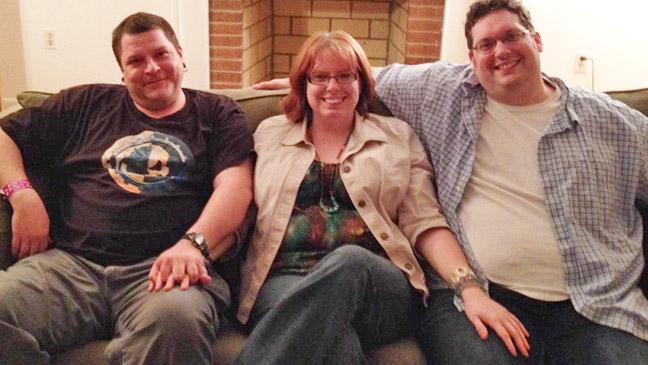
Being in a polyamorous relationship means Dan is happy to share his wife Holly with her boyfriend Tom.

Married for seven years, but incompatible in bed, Holly Ritchey asked her husband if he’d mind her dating other people.

So, with his blessing, the mum-of-three from Maryland, US, set about finding another lover.

And, last month, Dan – who doesn’t want to date anyone else – gave permission for his wife’s boyfriend to move in with them.

“Walking up the aisle in March 2006, there was no doubt in my mind Dan was the only man I’d spend my life with,” Holly, 36, says.

“In my long white dress and tiara, it was all pretty traditional. Now we’re anything but!”

...In 2013, she came across polyamory online. It means having loving relationships with more than one person.

Nervous, she broached it with Dan, but he actually thought it was a great idea. “He told me his goal in life was to make me happy,” Holly says....

-----------------------

...“As the three of us chatted, Dan turned to me and whispered, ‘I have a good feeling about this one,’” Holly recalls. Soon after, Tom stayed over....

...All their friends and family are fully supportive, and the trio couldn’t be happier with their little family....

Read the whole long article (July 2, 2014).

Hey you three, if you're reading this, is there anything you'd like to say about how the article turned out, and how it came to be? And if you're in Maryland, by any chance was it Bmore Poly that got you together?

[Permalink]

Labels:


July 29, 2013

The Washingtonian magazine:
"Married But Not Exclusive"


The glossy, trendy city magazine of Washington, DC, is just out with its August issue, which contains a much-awaited feature on area couples in open and poly marriages. One of the few people identified by her real name is Anita Wagner Illig, a DC polyactivist who recruited three couples for the writer. "I gave it a fast read standing in CVS and what I see thus far looks good," she writes. "I think Brooke treated the subject fairly."

Excerpts:


Married, But Not Exclusive

For some couples, one relationship is not enough

By Brooke Lea Foster

ALEX NABAUM
Kyle didn’t like the idea of watching his wife have sex with another man. While he wasn’t the jealous type — he could watch his wife flirt with another guy and not feel a thing — voyeurism didn’t turn him on.

But the rules of marriage were forever changed for Kyle, a stay-at-home dad, and his wife, Hope, a psychotherapist, when they decided to open their marriage to other romantic and sexual partners. It was Hope’s idea.

...That’s how Kyle found himself in the bedroom of another man two years ago; he’d insisted on tagging along on Hope’s date. Kyle, 42, prides himself on being a loving husband, and he wanted to make sure another man would treat his wife respectfully, tenderly even, during sex. “He’s very protective of me,” says Hope, 36.

This is the point at which most people start looking for holes in Kyle and Hope’s marriage, reasons why having multiple partners doesn’t make sense — or, for the less open-minded, why this suburban couple is off their rocker: Are they unhappy? Their sex life must be bad. They’ve got to be into some kinky stuff, right? But the answer — they swear — is no, no, and no.

Kyle and Hope have been married ten years. They have two little boys, a nice home in Alexandria, and a close relationship. They have sex no more than any other couple chasing around two kids does, but they are in love....

“We saw it all as a big experiment,” Kyle says. “We wanted to try it out and see what it was like.”

He struggled in the beginning. While Hope seemed to meet new boyfriends easily, Kyle hadn’t been confident dating in his twenties. Suddenly he was back to standing awkwardly at parties trying to make conversation with women. He scrolled through the “polyamorous” listings on Craigslist and OkCupid, looking for women open to dating multiple people at once. He tried to remember how to flirt....

Then he met Jane — a five-foot-ten, curvy woman with dirty-blond hair — at a party for polyamorous people. “We just clicked,” he says.... Hope encouraged Kyle; she really liked Jane....

...This is how he puts it: “If you look at the relationship Hope and I have, sex was the main connector. If I wanted sex, I had to get it from her. But when we could sleep with anyone, sex was no longer a reason to stay together.... Suddenly, we were asking ourselves: Why am I with this person now, if not for sex? That’s why this experience has made our relationship so much stronger. I’m still with Hope because I love her. She’s wonderful. We have children together. We built a life together. Sex is just one aspect of why we stay together.”

And sex is only one reason why couples practice polyamory. The word means “many loves,”...

------------------------

Polyamorists don’t think monogamy is wrong; they simply believe it’s not for everyone. But hearing “poly” couples speak of monogamy is like listening to an ex-con reflect on his years in prison....

Surprisingly, [sociologist Elisabeth] Sheff says, it’s often the women who flourish most in polyamory. Females tend to enjoy developing emotional connections with other partners more than men do, and they like the leverage it gives them in their marriage.

“A husband can’t do what he likes day to day and get away with it,” Sheff says. “Suddenly a wife has the power to vote with her feet.” For example, while a monogamous wife isn’t going to file for divorce because her husband didn’t load the dishwasher, a poly woman might feel annoyed and head to her boyfriend’s house to vent. Child care tends to be shared more equally because both partners are suddenly scheduling dates on a social calendar. Plus, women have the pick of the litter because there are fewer polyamorous women than men....

...“If you can derive joy from other people’s joy, even when you’re not the cause, then you can be poly,” [Kyle] says. “If not, you’re going to be at odds with it. It would have been very selfish of me to be upset at that moment. But I wouldn’t have known that unless I tried it.”


The long, 3,000-word article is not on the magazine's website. UPDATE: Now it is (July 30, 2013).

A comment from me. All of the people we see in the article are married couples embedded in conventional society. The article might have acknowledged that this is just one branch of poly, and that many other people treat it more radically — life-hacking new ways of community and tribal living for themselves and their intimates, farther outside of mainstream ways and assumptions.

I say this after coming back from 10 days at the Network for a New Culture's annual Summer Camp East not too far from DC. Summer Camp is an experiment in creating radically new ways of social relating based on transparency, curiosity, intimacy, compassionate sharing, self-examination, self-responsibility, and directness — helped along by busy sharing of work and play, daily ZEGG Forum, workshop presenters coming through to offer their stuff, and a pretty open sexuality among some of those mutually inclined. If I have seen the future, this version of it is damn impressive and I want to live there. Many of us found it sad and disorienting to drive away afterward back into the Dark Ages.

Kamala Devi and her partner Michael gave a workshop on polyamory at Summer Camp. She said that if there's one piece of advice she would offer for making poly succeed, it's this: "You need a tribe." You need a close community providing wisdom and support. That is quite missing from the worldview of the Washingtonian article.

[Permalink]

Labels: ,


February 9, 2012

Polyspokespeople on DC television

WJLA TV-7, Washington DC

Earlier this evening Sarah Taub wrote,


We're going to be on TV! Michael, Jonica, and I were interviewed for a piece on open relationships and polyamory that will air on WJLA Channel 7 in Washington DC. Anita Wagner Illig was also interviewed for the piece with her husband Tim [at center and left, with interviewer]. It will air in the 11 PM news.

The interviewer, Rebecca McDevitt, was interested and respectful, and we have high hopes for it being an informative and positive piece.


I just watched it. Yes indeed, 2 minutes 38 seconds of sweet representation. You done good, folks. Watch it here, where there's also a printed article (not an exact transcript). (Feb. 9, 2012).

Here's also a photo album from the show that the station put up.

Anita adds:


...The Newt Gingrich open marriage story has spawned tremendous interest in polyamory once again, and I and several other spokespeople have been fielding requests as fast as we can.

...I'm working with producers for ABC's news show 20/20, who are putting together an episode that addresses the current state of marriage in the US. At this point we are seeking a couple to be interviewed that has some kind of a "monogamish" arrangement, i.e. under certain circumstances it's OK for one or both to have sex outside the relationship. Obviously this is not anything close to true polyamory. If you know anyone who might be willing, please write me off list. Poly people to be filmed have already been lined up.


(You can reach Anita at imapolygirl AT yahoo DOT com. Michael is at mvr-pitm AT rios DOT org.)

Cheers to all these folks for explaining themselves, and by implication the rest of us, with clarity and courage.


(Sarah Taub and Michael Rios.)

[Permalink]

Labels: ,


February 8, 2012

"Valentine's Day For Non-Monogamists"

Huffington Post/ DC Around Town

Every mid-February there's an uptick in poly in the media, as writers and editors cast around for something new to say about Valentine's Day. And on top of the Gingrich-inspired attention to open relationships? You've got the opportunity if you choose to take it. Get listed with the Polyamory Media Association if you want to make it easy for media to find you.

One who took the opportunity was Tamara Pincus, a Washington DC psychotherapist who runs a local poly discussion group and a web-radio talk show. This article, in a local branch of the Huffington Post, came about by happenstance. A person at the LGBT Center where she holds the discussion group gave the local writer her name, and when the writer called, she decided to go for it. Pincus tells of the adventurous life that she and her husband have put together.


Q&A With Tamara Pincus: Valentine's Day For Non-Monogamists

WASHINGTON -- How do you celebrate Valentine's Day when your husband has two girlfriends, one of whom lives with you? How about when you've got two boyfriends yourself?

For answers, The Huffington Post turned to Tamara Pincus, a local psychotherapist who specializes in sexuality. Pincus hosts a call-in [online???] radio show, "Sex Talk with Tamara Pincus", and leads a discussion group for people in nonmonogamous relationships.

She also knows about Valentine's Day for polyamorists from personal experience. Pincus lives in Northern Virginia with her two children, her husband and one of her husband's girlfriends. Her husband also has one other girlfriend and Pincus has two boyfriends.

It sounds like a complicated group of people to share a box of chocolates and a candlelight dinner with every Feb. 14. Is it?

HuffPost DC: What does it mean to be in a polyamorous relationship?

Pincus: We are open and honest about having multiple relationships with multiple people. My poly family consists of me and my husband. We've been married for nine years. One of my husband's girlfriends lives with us, so she also helps out with childcare and house work, and that kind of stuff. And we also have outside relationships on top of that.

We were non-monogamous for the last four years or so. But we didn't start having real intense poly relationships until about a year ago. I'd experimented with being poly before. For my husband it was totally new.

HuffPost DC: Do you find the D.C. area to be welcoming to poly families? Are there particular places in the D.C. area that are more or less welcoming?

Pincus: Honestly, we're not very out. I think that's really true for a lot of people in the area. There's a big poly community, but most of the people are [either] younger and don't have kids -- or they're older and their kids have graduated and moved on.... The other poly people with families that I know, I don't find being that out about it.

HuffPost DC: How does Valentine's Day get celebrated in your family?

Pincus: Valentine's Day isn't really a big deal for a lot of us.... And that night I have my radio show. Strangely enough the show is going to be about sex addiction. I'm not sure that was the best choice.

HuffPost DC: So you wouldn't all go out for dinner together?

Pincus: No. We don't have the kind of relationships where we're all romantic with each other.... It might make sense for other groups. I know some triads [relationships involving three people] who would probably end up doing something like that. We did, actually, on New Years. We invited all our partners over with their kids. We all hung out, and let the kids run around. That was fun....

HuffPost DC: Does Valentine's Day heighten insecurities and anxieties in the poly community the way it seems to in the non-poly community?

Pincus: I haven't really seen that. I think that the December holidays seem to have more issues because you have to figure out who you want to spend them with....

...HuffPost DC: What are the upsides and the downsides of being in a poly relationship?

Pincus: We spend a lot of time trying to set aside time for our own relationship, to make sure we're still connecting with each other. My mom will take the kids for dinner once a week and my husband and I will just spend time with each other. I think that's really important for managing this kind of lifestyle. I think it's easy for people to fall for someone new, and then get so into the new person that they let the other relationships slide. I think when people don't think it through, disasters can happen. When you do think it through you make mistakes, but as you make mistakes you learn from them. Things that are really hard in the beginning get less difficult.

We've found that it works really well for us. It's not for everybody. We feel like having more adults is more helpful as far as raising our kids. And a lot of the outside people we're dating also have kids, so when we get together all our kids play, and run around, and have a good time. It's been great. I didn't actually imagine it would end up being this good.


[Permalink]

Labels: ,


July 31, 2008

Jenny Block gets us more good ink

Baltimore City Paper

Baltimore's big, much-read alternative newsweekly turns a book review of Jenny Block's Open into a long feature:


Redefining Intimacy

Jenny Block — and Other Spouses in Open Relationships — Refuse to Let Monogamy Ruin Their Marriages

By Heather Harris

Whom and how would you love if no one ever told you how it was "supposed" to be done?

...Think about it for a moment. Would you love men or women? Would you love for life? Would you love in series or in parallel? If you loved in parallel, would you tell each partner about the others? What would you do if you had to create the rules from scratch?

The circumstances of author Jenny Block's life led her to wrestle with these questions as few of us do. In her new book, Open: Love, Sex, and Life in an Open Marriage (Seal Press), Block traces her path from monogamy to infidelity to polyamory, being in an intimate relationship with more than one person....

Polyamory may have an established presence in urban "alternative" communities, but Block is telling her story from the suburbs. The thirtysomething girl next door, the one with the handsome WASP-y husband and the adorable young daughter... has her husband's blessing to engage in sexual relationships outside of their marriage. And what she has learned by flouting relationship convention so thoroughly is surprisingly, universally relevant.

...Block convinced her husband to try a threesome with her and her friend, a much-younger firecracker named Lisbeth. Christopher agreed, not without some reservation, and one night the girls tag-teamed him. "I was watching them," Block says on the phone from her home outside Dallas. "And I had this moment of, `Are you completely insane? She's 16 years his junior. She's hot. She's much more fun and entertaining than you are. How long do you think it's going to be before he leaves you for her?'"

But Lisbeth didn't want to be a wife and mother right then, and Christopher didn't want to be married to anyone but Block. So while their first foray into polyamory hit a few snags, it didn't threaten the integrity of the marriage or cause either spouse to question his or her desire to be there. It was a watershed experience for both of them.

...Block isn't trying to sell polyamory as some sort of utopia. "My husband can leave me just as easily as anyone else's," she says. "It's just that if he wants to see if the grass is greener, he can jump over the fence, that's all. In some ways I think being allowed that freedom keeps him from running off into the next pasture. There's no fantasy about what else is out there. Go ahead, look, have at it." She stops to think for a minute. "In the end, I think marriage and relationships all bear striking similarity to one another in that we all face the same issues once we settle down with one person. Yeah, you can leave your wife for your secretary, but it won't be long before your secretary turns into your wife."

..."I totally see why people follow convention," she says candidly. "People don't want other people to be different and they don't want them to be happy when they're different, because then the implication is that they could live differently, too. A lot of people just can't face that."

Block's larger goal for her book is to make it easier for people to live differently in all sorts of ways. Open doesn't just explore polyamory; it explores what it is to be a woman, a wife, a mother, a bisexual, a breaker of convention, and a married person in America. And with each exploration, Block suggests that people should have more latitude and responsibility to do what feels right and works for them.


Read the whole article (July 30, 2008).

Next up: in Charlottesville, Virginia, the alternative newspaper The Hook did a nice writeup prior to Block's appearance and reading in town:


"It was weird that it wasn't weird."

That's how Jenny Block, author of Open: Love, Sex, and Life in an Open Marriage, describes the first sexual encounter she and her husband had with a mutual friend as part of their open marriage. According to Block, the friend was "a younger, hilarious, intelligent woman," and their relationship lasted for years....


Whole article (July 17, 2008).

Here's a short interview with Block in the June 12th Quick DFW, a free weekly paper in her Dallas hometown (published by the mainstream Dallas Morning News).

Keep up with her media notices and book-tour adventures at her book blog.

She is also writing regular columns for Tango magazine and The Huffington Post.

Labels: , , ,


March 26, 2008

"How Many's a Crowd?"

The Diamondback
(University of Maryland)

A student newspaper features polyamory on campus with a big graphic on the top of its front page today:


By KRISTI TOUSIGNANT
March 26, 2008

...A growing relationship type among university students, polyamory is the practice of intimately and openly dating several people at once. Different from an open relationship, polyamory is not just about sex, nor is it about playing the field, say students involved in the practice. Instead, it’s about caring for several people at the same time — just in different ways.

“We are just trying to be open and honest about our ability to love more than one person at a time,” Marly Davidson, an event organizer for the Chesapeake Polyamory Network, said.

...“I’m so busy,” Rock said. “I kind of feel bad not giving the person enough attention as they deserve. In polyamory, it’s easier for the person to get the attention they need when I can’t provide it.”

...“I pretty much can do what I’m used to doing,” Moser said. “If I meet someone, I don’t have to be like ‘Oh my God, will my boyfriend not like me talking to this guy?’ I am able to not have to worry about the jealousy factor.”


Read the whole article. It was followed in a few days by this letter to the editor:


...What truly baffled me was that some of the statements made in the article do not promote polyamory, but instead take a critical stab at those of us who find a monogamous relationship completely satisfying.

Marly Davidson, an event organizer for a local polyamory network, is quoted as saying, "The whole idea of one person meeting all of their needs for the rest of their lives is very silly. It's not realistic." I personally found this assumption to be very silly and unrealistic, as it ultimately considers all people in a monogamous relationship to be secretly unhappy or in denial of their unfulfilled needs....


Labels: , , ,


February 13, 2008

The Washington Post covers the Poly Living conference

At Loving More's Poly Living conference outside Philadelphia earlier this month (I was there), a reporter for the Washington Post was busily in attendance. She had been accepted by the Loving More staff after signing an agreement about respecting attendees' privacy and boundaries. She introduced herself to everyone at the opening talk and remained for almost the whole weekend, studiously taking notes.

Today's edition has her very, very long story. Though a touch snarky in places, it is sharply insightful and generally spot-on. The Post does hire the best.


Pairs With Spares
For Polyamorists With a Whole Lotta Love, Three, or More, Is Never a Crowd

By Monica Hesse
Washington Post Staff Writer
February 13, 2008

I have a love whose name is Johnny
He is dating my best friend Bonnie


The audience members at the annual Poly Living convention — think hippies, retired science teachers, a high quotient of male ponytails — are singing, in round, what might be the only song ever written about polyamory. [Ed. note: not so.]

She lives with her sweetheart Jen
And Jen's husband whose name is Glenn


It's a lifestyle that has been alternatively misidentified as Swinging, Wife Swapping and Really Greedy.

Now they raise their kids together
And are happy more than ever.


[Lyrics copyright 2008 by Ben Silver]

Polyamory isn't about sex, polys tell you. It is about love. It is about loving your primary partner enough to love that they have a new secondary partner, even when their New Relationship Energy with that person leaves you, briefly, out in the cold. It's about loving yourself enough to acknowledge that your needs cannot be met by one loving person. It's about loving love enough to embrace it in unexpected form — like maybe in the form of your primary's new secondary! — in which case you may all form a triad and live happily together.

That kind of love.

And so some 100 people, a small fraction of the 15,000 polys on the mailing list of convention sponsor Loving More, have gathered at a Holiday Inn off the Pennsylvania Turnpike for two days of seminars with such titles as "Hap-Poly Ever After: Long-Term Poly Partnership" and "Kids and Poly Relationships: A Human Relations Primer About Melding All Your Loves."

Of course, sex is a part of love. Which is why the pastor leading "Love and Marriage in Bible Times" finds herself talking really loud to combat the noises coming from the tantric sex workshop next door. Which is why another workshop deals with the proper way to navigate a "threesome, foursome, or moresome."...

-------------------

"One thing I like to say is, polyamory ain't for sissies."

This is Anita Wagner, 54, a legal secretary with a buoyant Tennessee drawl, flowing clothes and cheerful lipstick. She has a comfy mom-ness about her that says: I give amazing hugs. [Ed note: Talk about spot-on.]

...Once the second divorce was over and the daughter was grown, she acknowledged something about herself: "I realized that, being the bighearted person I am, I was denying myself something that we all need."

That was love. Big Love.

"Many of us tried to make monogamy work," Wagner says. But monogamy, she says, often seemed to throw the baby out with the bath water, so to speak. Its practitioners would break off "perfectly good relationships" just because of intellectual incompatibility, for example, or because one partner liked ballet and the other liked bowling. Doesn't it make more sense, polys ask, to keep the good parts of a relationship, and find another boyfriend who likes "Swan Lake"?

...Thought: Maybe you can have it all. You just can't get it all from the same person.

It's the thought that illustrates a paradox in polyamory: Its practitioners have astonishing optimism for humans' endless capacity to love, to share, to forgive, to grow, to explore. But that optimism seems rooted in a cynical belief that the monogamous are stuck in a myth, one that leads to cheating, unhappiness or divorce court. They believe, as do some evolutionary biologists, that most humans do not have endless capacity to be faithful to just one person.

There's a vague aura of entitlement to polyamory. The concept that one deserves complete romantic fulfillment seems a decidedly Me Generation concept.

More than one presenter at Poly Living's sessions utters a variation of this statement, which is either an explanation, an excuse or an untruth: We're just doing what everyone else is doing anyway. The difference is that we're not lying about it.

-------------------

"Your turn!" Nicole says cheerfully to her partner Rebecca. The two women, both in their early 30s, are trying to eat lunch with their other partner, James, but the trio's toddler has chosen this moment to smear cake on his face and sprint toward the hotel restaurant's door. Rebecca hurtles out of her chair, cutting him off before he careens into a waitress. Nicole rolls her eyes toward the ceiling. "I have no idea," she says, "how people do this with just two parents."

Rebecca returns the boy to the table, handing him off to James as Nicole excuses herself to the bathroom. Morning sickness. Ugh.

...Nicole is the toddler's biological mother, though she fondly tells the story of how a classmate at his preschool assumed Rebecca was: They share platinum blond hair and nearly translucent skin, while Nicole and James both have brown hair and dark eyes. All three adults share a similar thick-through-the-middle build. When a reporter asks whether they all share a bed, Nicole bursts out laughing — she has a hearty and well-used laugh — and says, "Not until we lose some weight."

Though Nicole and James had jointly dated other people before, Rebecca, a paramedic with an efficient British accent, is the only one to mesh equally with both. For the triad's first date, James made Rebecca a plate of homemade Jammie Dodgers (one batch with strawberry jam, one with raspberry; he didn't know which she'd prefer). Rebecca brought them a plant. There was, says James, "a lot of courting," and a lot of evenings that ended with him and Nicole pillow-talking about how adorable Rebecca was.

...It's less about them wanting to fulfill personal desires, they say, and more about needing more people to meet the daily requirements of 21st-century life. As in, if it takes two incomes to keep up with the modern mortgage and school fees, then who is going to provide the kids with a stable environment at home? "Five hundred years ago," says James, " 'family' meant mom, dad, grandma, aunt, great-grandma — everyone."

...Nicole, James and Rebecca acknowledge that a group marriage requires work that a monogamous one does not. "At first, I felt interrupted all the time," says Rebecca. "We all have different communication styles."

"Sure, if I'm putting the baby to bed for two hours while they're having hot sex, I get annoyed," says Nicole. "But it's not because they're having sex without me. It's because I'm really tired and I've been putting a baby to bed for two hours."

-------------------

When you watch people interact at Poly Living, it can seem that we humans have no idea what makes people happy inside relationships, or what arrangements people need to navigate the world....

...[A] couple are sitting on a couch outside a conference room at the convention, waiting for a seminar on improving communication between personality types (he procrastinates; she doesn't). Victoria, who has long, thick hair and perfect, porcelain doll skin, rubs LaVasseur's shoulders. He absent-mindedly kisses her hand.

"It was hard," LaVasseur says. "I'd always identified my self-worth by my relationships. I felt really insecure that I wasn't enough for her."

They developed a system. If Victoria so much as thinks she's interested in someone else, she tells LaVasseur immediately. "Then, later, I'll say, 'I'm thinking about kissing them,' " says Victoria. "And then, 'I'm thinking about getting serious.' "

Ironically, what's helped LaVasseur's jealousy the most was meeting his girlfriend's other partner, with whom she lives. He recognized how different he and the other guy were, and realized that what Victoria got out of that other relationship would not compete with what they had together.

There is thoughtfulness, mindfulness, that goes into each one of their interactions. (A favorite poly joke: "Swingers have sex. Polys have conversations.")

...Later that night, Victoria and LaVasseur have signed up to be facilitators at a cuddle party — a nonsexual outlet for people of all ages to spoon, tickle, pat and snuggle each other. It requires facilitators because cuddle parties come with 40 minutes' worth of rules on how to snuggle respectfully.

The two of them aren't sitting anywhere near each other; in fact, LaVasseur is demonstrating proper cuddle etiquette with another woman, one old enough to be his mother.

Victoria looks on contentedly; she catches his eye and they smile.

They seem ridiculously in love.


Read the whole article. And here's the print-friendly text in a single long file. (If the story disappears from the newspaper's site, you can read the text here.)

My only real beef with the story is that she did not get into the serious attention that the poly community gives (by and large) to STDs and safer sex. This will be, quite correctly, one of the first questions that readers have.

But overall, Wow, say I.

P.S.: Anita Wagner, featured in the article, blogs about her experience working with the reporter here.

Update, same day: Already the right wing is up in arms about this article. "In what can only be described as a Valentine to immorality and provocative behavior," writes Kristen Fyfe in the NewsBusters blog, "the Post ran a 2554-word feature on polyamory that describes a practice most readers — even the liberal fans of the Post — would find disturbing."

God help us that a newspaper would print something disturbing. Even worse: "The fact that this feature ran in the same section as the KidsPost (the page the Post dedicates to younger readers) was also irresponsible."

Update: A shortened version of the article appears in the Feb. 21st Toronto Star.

[Permalink]

Labels: , , , , ,