Polyamory in the News
. . . by Alan M.


September 23, 2018

"Untrue": New pop-anthro book reclaims women's non-monogamous desires


Wednesday Martin's new book Untrue got a lot of media notice this past week. The title has two meanings. It's about female infidelity, yes; Martin assembles evidence that women have always cheated and engaged in other forms of non-monogamy — or wanted to — about as much as men. And, she denounces as untrue the whole patriarchy-inspired mythology of women's weak, demure, second-tier sexuality. The book is subtitled "Why Nearly Everything We Believe About Women, Lust and Infidelity Is Wrong and How the New Science Can Set Us Free."

Martin is a pop-anthropology writer with previous books about stepmothers and rich mothers. Now she seems to be picking up where Sex at Dawn (2010) left off: focusing on modern women rather than the ancient multipartnering roots of the human race as a whole.

● First, Bustle published an early summary of what the book is all about: 'Untrue' By Wednesday Martin Will Challenge What You Think About Women & Sex (April 16, 2018):


...When it comes to women and sexuality, stereotypes are presented as truth more often than the actual truth. Women are confronted with a combination of poor sex education and the societal effects of slut shaming, and all of that has a real impact on the way individual women experience sex and lust and love. ...Martin deconstructs many of the false beliefs that have negatively affected the way women's sexuality is viewed — including the deeply entrenched notions that women are the more naturally monogamous sex or that women's sex drives are shrinking violets compared to men's.

...This book turns everything we think we know about women and sex completely on its head, essentially undressing the falsehoods of female sexuality to reveal what lies beneath the layers of distortion women operate under. ...


● Early this month Martin published a 4,000-word excerpt from the book in Psychology Today: A Natural History of Female Infidelity  It appears in the print issue (September 2018 issue) and online (September 4):


"Untrue" women threaten modern notions of coupledom and propriety. But new research suggests that polyandry is far from novel or unnatural in human history, and may even suggest a path into the future.

By Wednesday Martin Ph.D.

Wednesday Martin
"So here's something kind of interesting. My wife has two husbands."

Tim is a good friend and trusted confidante whom I see whenever he is in town. He is several years older than I am, dark-haired and fit, calm and positive, generous and centered. ... They had great chemistry, and one date led to another and another. Lily was direct and honest, more than any woman he'd ever been with, but she was also a great compartmentalizer. Tim was smitten.

A few weeks before their wedding, Lily told Tim, in effect, that whatever his dreams were, he should follow them, and that he had freedom to do as he wished. "She said to me then and has always said, 'Whatever it is that is a dream for you, you will be able to pursue your dreams if you're married to me. ..." It never occurred to Tim to offer anything less, once she opened the discussion. In their marriage vows, they removed "forsake all others."

Their understanding, Tim explained, was explicit, and its bedrock was the agreement that their relationship had priority. "If she ever asked me to stop seeing someone, I would, in a second," he said. Lily never asked. Tim never asked Lily, either.


So, hierarchical with a veto provision (despite Lily's grand statement above) and bordering on a don't-ask-don't tell. But after 10 years it became clear to Rick that Lily was getting really serious with someone else.


...Over time, Tim learned that Rick was everything Tim was not—big and strapping, a physical laborer who also loved to cook. After several months, the two men met. Tim was relieved that he did not dislike Rick. Many years later, when Tim was back at work and his career was booming, Rick moved into Lily and Tim's second home, where he became caretaker, chef, and a kind of "uncle" to their kids.

Tim has long had relationships with other women but says that what has kept his marriage going is a sense that he and Lily are allies. And he says the most important thing is that in their first conversation when things got difficult, "there was no feinting, no dodging, no machismo on my part. There wasn't room for it." There had been a learning curve to their open relationship, he says, but "she's my friend, and she's a protector of me and of our marriage."

While Lily occasionally fools around with other men—she particularly enjoys being pursued by younger guys—she has remained committed to her marriage for more than 25 years, and to her boyfriend for a decade and a half. ...

Illustration by Eddie Guy
Their arrangement may strike others as unnatural, a departure from traditional values, or even a corruption of how things are supposed to be between men and women. But we would be wrong to think of Tim and Lily as aberrant. Their strategy is informed by and consistent with the flexible social and sexual strategies that helped Homo sapiens flourish. In the words of the late anthropologist Marjorie Shostak, who famously studied the !Kung, hunter-gatherers of the Kalahari Desert, gender inequality is an aberration in the long calendar of human history. So is dyadic monogamy for life, and many of our gendered assumptions about sex.

...This momentous change was put into motion 10,000 to 12,000 years ago in the Jordan Valley, where hunter-gatherers began to domesticate plants, increasingly depending on food they grew rather than food they foraged. This was a watershed moment—the rise of agriculture. ...

...And the shift changed everything between the sexes. Multiple mating had established and continually reinforced social bonds, so there were low levels of conflict. Enhanced cooperation meant all were more likely to look after one another and their young, thus improving each individual's reproductive fitness—the odds that their offspring would go on to produce offspring. There's ample supporting evidence of this theory in historical documents about aboriginal peoples everywhere from North America to the South Pacific, as well as among present-day hunter-gatherers and foragers, many of whom raise their young cooperatively and whose mating patterns are less strictly monogamous than our own.

...As sociologist Rae Blumberg has pointed out, it is only for less than 3 percent of Homo sapiens history that women have been transformed from competent, relatively autonomous primary producers into secondary producers who are, in some circumstances, fundamentally dependent. ...

...Couples like Tim and Lily go against the grain of modern coupling, but they are also paving a way forward. Their open relationship has kept them together over the long term, and provided practical benefits—another pair of hands to help in the home, another set of watchful eyes to keep the kids safe, another driver. Their arrangement also provides Lily variety and novelty, which experts increasingly tell us are necessary not just for a man's sexual satisfaction but for a woman's too. ...


Read the whole article.


● A long and not very flattering profile of the author appeared in the New York Times: Wednesday Martin Dares to Call Her New Book ‘Untrue’ (online Sept. 15).


An Rong Xu / New York Times


After a scoffed-at but successful pop ethnography of Park Avenue, she turns to the topic of infidelity.

By Ruth La Ferla

Looking improbably dainty in a white summer frock, Wednesday Martin stepped to the front of a glass-enclosed room in Sag Harbor, N.Y., wielding a mandrake-like piece of pink plastic. “This is your clitoris,” she told her mostly female listeners.

In a childlike singsong, she went on to inform them that the seat of female pleasure is not the size of a button, as has long been supposed, but closer to a full-grown zucchini.

...Legs crossed, arms self-protectively pressed to their chests, they were rapt as Ms. Martin, chirpily reassuring, sought to address that eternal, and eternally vexing, question: Just what is it women want?

It’s not intimacy, she suggested. Wasn’t it time, after all, to ditch that hoary, male-perpetuated chestnut about women deriving sexual pleasure from gazing moistly into their partners’ eyes? Is not the female libido equal to, if not more robust, than the male’s?

...Aware that her scholarly reputation is in question, Ms. Martin, 52, this time around carefully cites a roster of prominent social anthropologists and female primatologists to bolster her argument that women are not and never have been naturally monogamous. ...

Ms. Martin conducted more than 30 interviews with eminent social scientists, psychologists and primatologists. She cites, among others, the primatologist Sarah Blaffer Hrdy, who studied female langurs mating sequentially with as many males as possible to ensure the safety of their offspring.

The sociologist Alicia Walker also makes an appearance, arguing that many women deliberately pursue extramarital affairs; so does Lisa Diamond, who has written about female sexual fluidity; and Amy Parish, known for her studies of bonobos, a hypersexual, female-dominant species closely related to chimpanzees.

Even buttressed by such academic bona fides, Ms. Martin allowed a flicker of uncertainty about how “Untrue” will be received when it is released on Sept. 18.

“People assume that if you’re writing about female infidelity, that there’s something wrong,” she said. “They hang on to this idea that women who write about sex are doing it for attention. That they are exhibitionists, that they’re pathological, that they must have questionable motives.”


● Newsweek: 5 Things You Didn’t Know About Female Sexuality, From Wednesday Martin’s ‘Untrue’ (Sept. 14). The article's five headings are,


1. The gender gap is closing between husbands and wives who cheat.
2. Young women are just as sexually adventurous as young men—maybe more.
3. Long-term relationships may negatively affect female desire more than male.
4. More men are on affair-finding websites, but more women use them to meet up for sex.
5. Women, like men, get erections.


● Time magazine's website presents another excerpt from the book, about the time she attended a seminar on ethical nonmonogamy for marriage counselors: Here's How a Therapist Coaches Couples Who Decide to Have Sex With Other People (Sept. 17)


Getty
“Working with Non-Monogamous Couples” was held at a nondescript family services center in a nowhere neighborhood in Manhattan. ...I knew I would be surrounded by therapists who were there for certification credits and to learn from an expert in their field about the best approaches to issues that were likely to come up in their work. I also knew a little bit about consensual non-monogamy: I knew that it was for people who didn’t want to be monogamous, and who didn’t want to lie about it.

As I checked in with Michael Moran, one of the program’s organizers, he described a recent uptick in his practice and in general of heterosexual couples seeking solutions to their monogamy quandaries. “It’s pretty incredible that people commit for life, that they get married, without even discussing the issue of sexual exclusivity,” I offered by way of chitchat, realizing as I said it that my husband and I had committed for life, and that we got married, without even discussing the issue of sexual exclusivity. Monogamy and marriage, for straight people in much of the U.S., go together like a horse and carriage. Or they used to. Or maybe not. ...

Featured speaker Mark Kaupp, a licensed marital and family therapist, defined consensual non-monogamy for us.... Kaupp instructed us to break into groups of three or four [and] put a slide up on the projector. There were four bullet points, each ending in a question mark.

What would it be like to watch your partner/spouse have sex with someone else . . . and see them really enjoying it?
What feelings would come up?
What meanings would you make from their enjoying the sex?
What if they fell in love?

I turned back toward my group. We stared at one another in silence. ...

One of my group members and I decided that if we watched our partner having sex with someone else and really enjoying it, we might feel jealous, turned on, hurt, angry, curious, excited, gutted and more. We might derive meanings from it, including: I am not good enough; he/she is bored with me; something is wrong with me or our relationship; being with someone new is exciting and that’s no reflection on me. If our partner fell in love with this other person, we might feel confused, sad, threatened and devastated. I added that I might also feel homicidal.

...Kaupp quickly got to work puncturing our sense of what, exactly, might help us feel in charge of the imaginary situation we were confronting....

“I very rarely see that rules create security in these situations. How can we possibly anticipate all the possibilities? It’s an attempt to control, but it might make people feel more out of control,” he said. He told us that in his work with couples practicing CNM, he kept the focus on their attachment bond and let them come up with the rules without getting too involved in that himself. In his experience, he said, the rules might change or even fade out in time if the relationship security is sufficiently strong. “My job is to help people who have decided not to be monogamous keep turning back to each other if they feel insecure or flooded with fear. That way a negative becomes a positive. What might weaken or sink a relationship strengthens it.”

Kaupp then told us there are three primary types of [consensual] non-monogamy, and while they might overlap, their practitioners belonged to quite different tribes. There are people in “open relationships,” arrangements in which the couple agrees to see others but might not want to talk about it, or even know.

Meanwhile, swingers are committed to having sex with others, both individually and as a couple. They talk with each other about what they are doing, they do things with others together and sometimes separately, and they might go to conventions, cruises or sex clubs...,

Then there are the polyamorous, or poly, people. Polyamory is the practice of having multiple romantic, sexual and/or intimate partners with all the partners’ full consent, Kaupp explained. Those who practice polyamory believe they can love more than one person and be in more than one relationship simultaneously. Sometimes those who practice it have verbal or written contracts — drawn up by lawyers and therapists who specialize in such matters — to keep things clear and fair. And polyamory requires conversation, ground rules and plenty of disclosing and “checking in.”

To state the obvious, non-monogamy is exercising a pull on us because monogamy isn’t working for everyone. ... In fact, it turns out that when it comes to our sexual selves, women have been sold a bill of goods. In matters of sex, women are not the tamer, more demure or reticent sex. We are not the sex that longs for or is more easily resigned to partnership, to sameness, to familiarity. Nor are we goody-goodies relative to men when it comes to fidelity, after all.


● She also wrote a guest column for Hollywood Reporter: Time's Up for the Great Sexual Awakening in Hollywood (Sept. 15)


There is something big happening right now, an earthquake of sorts, that will shake up our world and our beliefs about men, women and sex. I... call it The Great Correction.

...Arguably, The Great Correction is just getting going. Much of it is happening in Hollywood, which has recently been convulsed by the reversals of power by both #MeToo and the undoing of the film-TV hierarchy, which undergirded all the town's cultural logic until yesterday, when prestige streaming kicked it to the curb. On the tails of those two massive shake-ups, there's more to come. The establishment is officially on notice. ...


● Another excerpt from the book, on Flavorwire: ‘Untrue’ Challenges Dated Thinking on Female Sexuality (Sept. 19)


...But perhaps most surprisingly, the majority of women in [researcher Alicia] Walker’s sample reported that they were otherwise happily partnered or married, and that these affairs were a way for them to remain in their primary relationships. They were not looking for an exit strategy or a new husband. They did not seek emotional connection or companionship. They wanted a solution to a dilemma: they felt unable or were unwilling to end their sexless or sexually unsatisfying partnerships or marriages, but they also wanted great sex. ...


● Lots more.

[Permalink}

Labels: , ,


May 19, 2015

"Equality and polyamory: Why early humans weren't The Flintstones"

The Guardian


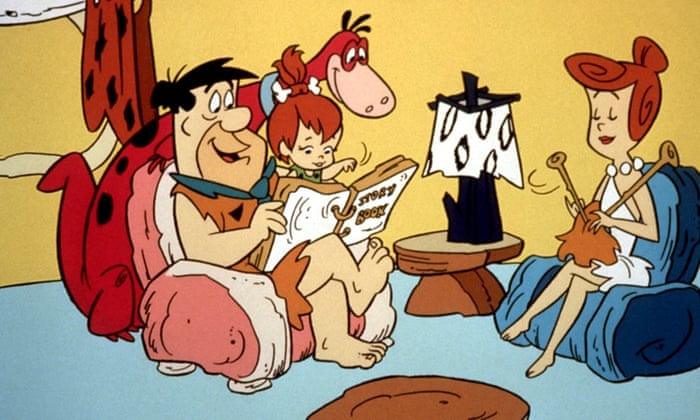
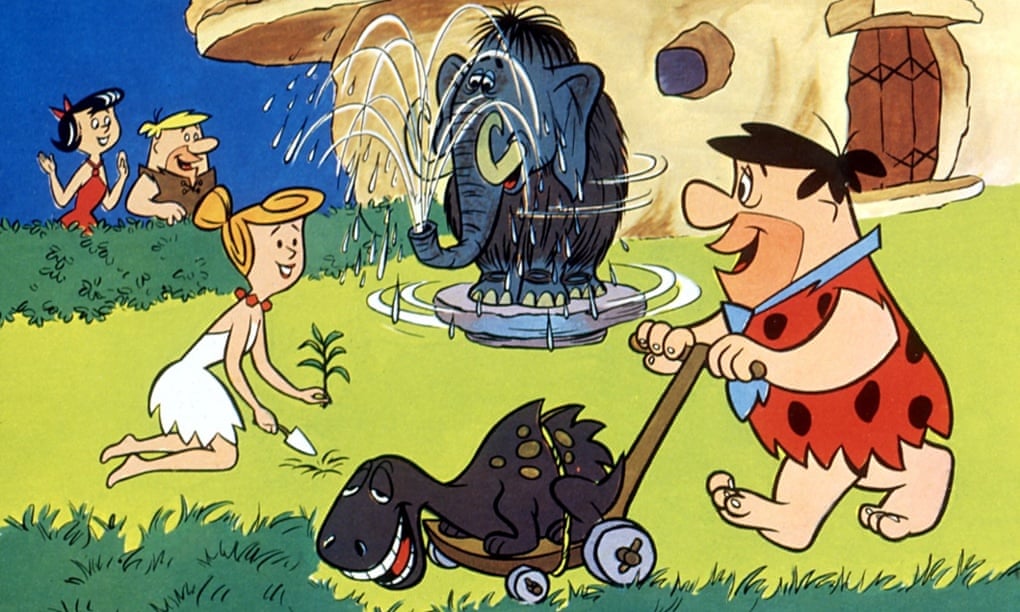
Caption: The “standard narrative of prehistory” presents the idea that, like Fred and Wilma, men have always gone out to hunt/work and women care for home and children. (The Guardian / Everett Collection / Rex Features)

The year 2010 marked a turning point for the polyamory movement, partly due to the publication of Sex at Dawn by Christopher Ryan and Cacilda Jethá. More on this later. Memorably, the book zinged anthropology's "Flintstonization" of stone-age families — the timid, ridiculous assumption, never really stated or defended, that our prehistoric ancestors, who shaped our inherited traits, evolved in 1950s nuclear families like Fred and Wilma Flintstone.

And only had across-the-hedge chats with Barney and Betty Rubble.

This morning's Guardian uses the Flintstonization zinger to begin a long report on some new research just out. The article then takes a wider look at the likelihood that we are literally born and bred for multi-partnering.


Equality and polyamory: why early humans weren't The Flintstones

A study released last week presented evidence that prehistoric men and women lived in relative equality. But is the truth even further from the nuclear narrative?

By Simon Copland

Last week, scientists from University College London released a paper presenting evidence that men and women in early society lived in relative equality. The paper challenges much of our understanding of human history, a fact not lost on the scientists. Mark Dyble, the study’s lead author, stated “sexual equality is one of the important changes that distinguishes humans. It hasn’t really been highlighted before.”

Despite Dyble’s comments, however, this paper isn’t the first foray into the issue. In fact, it represents another shot fired in a debate between scientific and anthropological communities that has been raging for centuries. It’s a debate that asks some fundamental questions: who are we, and how did we become the society we are today?

Our modern picture of prehistoric societies, or what we can call the “standard narrative of prehistory” looks a lot like The Flintstones. The narrative goes that we have always lived in nuclear families. Men have always gone out to work or hunt, while women stayed at home to look after the house and the children. The nuclear family and the patriarchy are as old as society itself.

The narrative is multifaceted, but... can probably be traced back to Charles Darwin’s theory of sexual selection.

The Guardian / Everett Collection / Rex Features

...Yet, for centuries many have questioned the logic, and the biology, of the standard narrative.

The first real splash in this arena came from the anthropologist Lewis Morgan, and his book Ancient Society [1877]. In the book Morgan presented the results of his study of the Iroquois, a Native American hunter-gatherer society in upstate New York. The Iroquois, Morgan observed, lived in large family units based on polyamorous relationships, in which men and women lived in general equality.

Morgan’s work hit a broader audience when it was taken up by Friedrich Engels (most famous for being the co-author of The Communist Manifesto) in his book The Origin of Family, Private Property and the State. Engels drew on Morgan’s data, as well as evidence from around the world to argue that prehistoric societies lived in what he called “primitive communism”. Other anthropologists now call this “fierce egalitarianism”: societies where families were based on polyamory and in which people lived in active equality (i.e. equality is enforced).

Morgan and Engels were not painting a picture of a “noble savage”. Humans were not egalitarian nor polyamorous because of their social conscience, but because of need. Hunter-gather societies were based largely on small roaming clans where men engaged in hunting, while women’s roles focused around gathering roots, fruit and berries, as well as looking after the “home”. In these societies community was everything. People survived through the support of their clan and therefore sharing and working within their clan was essential. This crossed over into sex as well.

Polyamory helped foster strong networks, where it became everyone’s responsibility to look after children. As Christopher Ryan states: “These overlapping, intersecting sexual relationships strengthened group cohesion and could offer a measure of security in an uncertain world.”....

-------------------

On top of Dyble’s study last week, new anthropological and scientific evidence backs up this challenge to the standard narrative. In 2012 Katherine Starkweather and Raymond Hames conducted a survey of examples on ‘non-classical polyandry’, discovering the phenomenon existed in many more societies than previously thought.

In another example Stephen Beckman and Paul Valentine examined the phenomenon of ‘partible paternity’ in tribes in South America: the belief that babies are made up from the culmination of the spermatozoa of multiple males. This belief, which is common in tribes in the Amazon requires polyamorous sexual activity by women, and that men share the load of supporting children.

And then there is the example of the Mosua in China, a society in which people are highly promiscuous and where there is no shame associated with this. Mosua women have a high level of authority, with children being looked after by a child’s mother and her relatives. Fathers have no role in the upbringing of a child — in fact the Mosua have no word to express the concept of “father”....


Read the whole article, with many links (May 19, 2015).

It includes a sidebar link to a Guardian article about modern polyamory: Being polyamorous shows there's no 'traditional' way to live (Aug. 20, 2013).

Five days ago The Guardian published another story on Dyble's research: Early men and women were equal, say scientists. "Study shows that modern hunter-gatherer tribes operate on egalitarian basis, suggesting inequality was an aberration that came with the advent of agriculture." (May 14, 2015).

-----------------------

More on the significance of Sex at Dawn:

Sex at Dawn made quite a splash in the summer of 2010 and briefly got onto the New York Times bestseller list. It drew on anthropology, primate studies, and human anatomy to built a case that nuclear-family monogamy is unnatural to our species, dating only from the invention of agriculture and settled property about 10,000 years ago. The previous 99% of our evolution as a species shaped us to live a naturally polyamorous life of "fierce equality" between the sexes, living and interbreeding in hunter-gatherer bands. This remains the pattern in the few surviving hunter-gatherer societies today that continue their prehistoric way of life.

Some anthropologists and others criticized Sex at Dawn for cherry-picking its evidence, misrepresenting some of it, and overstating its case. However, its core argument has held up pretty well.

The book's impact on the poly movement was immediate. We had always labored under the dismissive criticism — and the self-doubt it raised in our own lives — that what we were doing could never really work because everyone knew that happy polyamory was contrary to human nature. I wrote at the time that Sex at Dawn


blows away the conventional wisdom that multiple relationships are unnatural or cannot fit with how humans are built. In fact, it reverses the human-nature argument 180 degrees.


It followed The Myth of Monogamy by David Barash and Judith Lipton (2002) and other works and research trending in the same direction. Since 2010, it's the remaining innate-monogamy defenders who've been thrown back on their heels, and polys have become the ones confident and on the offensive. To continue:


For most of the polyamory movement's 30-year history, advocates who have sought to give poly a theoretical foundation have generally turned to New Age or spiritual philosophies, involving things like the limitless nature of love, the spiritual heart of the universe, and other concepts that I find fairy-taley and unproductive. By unproductive I mean that theories built on them never seem to lead anywhere predictive or useful, as a good theory must.

Ryan and Jethá have now given us a theoretical underpinning that is concrete and evidence-based. They make the case that polyamory matches what human nature actually evolved to be. Seen in this light, the modern, ethical, egalitarian version of poly offers a path to a saner future — in which humans are not so perpetually conflicted with themselves, and are less driven by the insatiable needs and neuroses that in many ways are causing us to ruin the world.


[Permalink]

Labels: ,


October 6, 2010

Sex at Dawn making more waves

I'm excited to be meeting author Christopher Ryan — and a lot of you readers! — at the Poly Living conference coming up in Seattle in two weeks (October 22–24; spaces still available; see the end of this post for more info1.) We owe Ryan bigtime for changing the intellectual landscape around us — as Kamela Dolinova writes on her Boston Open Relationships Examiner:

"For polyamorists, swingers, and other practitioners of open relationships, America just became a slightly better place,"


thanks to the publication of Sex At Dawn, the new popular anthropology book that has been tearing up the blogosphere and major news outlets for several weeks now. Since no lesser light than Dan Savage called the book "the single most important book on human sexuality since Kinsey unleashed Sexual Behavior in the Human Male on the American public in 1948," word about husband-and-wife duo Christopher Ryan and Cacilda Jethá's work has been spreading like...well, like prehistoric women's legs.


Some background:


According to Ryan and Jethá, the overwhelming physiological and archeological evidence shows that our pre-agricultural ancestors were not monogamous, nor even serially monogamous as some more liberal thinkers claim. Instead, these hunter-gatherers lived in "fiercely egalitarian" societies where everything was shared: food, shelter, parenting, and yes — sexual partners. The common mode of living in early human bands was apparently closer to a communal marriage than what we think of as a "traditional" one, in which paternity certainty was unimportant and women — as well as men — had sex as often as they wished with as many as they wished.


There is controversy:


Predictably, a few misguided idiots and plenty of random internet commenters are responding to the book with a certain amount of vitriol. But more surprising is that the first three pages of today's Google search for the book's title are full of praise for the work — a wave of mainstream media acceptance of the idea that maybe, just maybe, our species isn't naturally monogamous after all.

Ryan himself (clearly the public face of the book) has repeatedly said that people shouldn't take their findings as carte blanche to cheat on their spouses, or that everyone should be polyamorous. In fact, it's impossible to say at this moment what the impact of the findings might be on the lives of people who now, 10,000 years after the advent of agriculture, live so very differently than their ancestors did.

Nonetheless, as Alan at Polyamory in the News points out, the popularity of this book and its scientific underpinnings are a huge step in the literature for those of us who have refused to buy into the monogamy deal. The idea that jealousy is not an inherent human state, that the exchange of sexual exclusivity for security and support is a cultural construct, and that the natural state of human sexuality is much more complicated than the overculture would have us believe may not go over well with everyone, but it is a great leap forward from the slew of evolutionary psychologists and other authorities from Darwin onward who have insisted on our species' "natural" propensity for pair-bonded monogamy....


Read the original (Sept. 3, 2010).

Dolinova went on to interview Ryan for Carnal Nation. Excerpt:


KD: I live and write in a loose-knit community of polyamorists, and know many people who make it work beautifully. What do you think is the next step for modern romance and family life?

CR: I suspect the next few decades are going to bring a radical reconfiguration of American society. Romance and family rituals generally follow and adapt to economic conditions, so we may well see realignments resulting in multi-family homes and off-the-grid communal situations. Some of these could involve some form of group parenting, home schooling, and so on. But a lot of this depends on what happens economically and politically in the US. Crisis brings opportunity for change, and major crisis looms ever larger these days.


Read the whole interview (Sept. 22, 2010).

An editor of the highbrow Atlantic Monthly is peeved with the book:


I'm in the middle of Sex at Dawn, the book that's caught the attention of a number of commentators... and so far, I'm disappointed to say that it reads like horsefeathers.... The language is breathless rather than scientific, and they don't even attempt to paper over the enormous holes in their theory that people are naturally polyamorous.

For example, like a lot of evolutionary biology critiques, this one leans heavily on bonobos (at least so far). Here's the thing: humans aren't like bonobos. And do you know how I know that we are not like bonobos? Because we're not like bonobos....

More.


Ryan is aggressive about wading into a good food fight; here's from his reply:


Over the years of cocktail party conversations that proceeded the publication of Sex at Dawn, Cacilda and I have witnessed many reactions to our proposal that monogamy doesn't come naturally to most people....

[Sometimes] you get someone who feels so personally threatened by the very idea that they don't give a damn about "your so-called evidence" (they assume you're making it all up anyway).... Stand back, because you're likely to get wine in your eye as they sputter and spray their indignation.... The trick is to learn not to take any of it personally, because they're not really talking about you, or your book. They're talking about themselves, often quite revealingly, at that.

...It's pretty clear Ms. McArdle hasn't read even the first half of the book very closely. Pages 77 and 78 contain a table listing some of the major similarities between humans and bonobos, many of them unique to these two species....

I'm not holding my breath because I don't think she's responding to the substance of the book at all; she's responding to what it makes her feel, which is something entirely different.

More.


[Permalink]

Labels: ,


September 22, 2010

Mono, poly, and the anthropology of jealousy

Psychology Today online

If we've been shaped by the fact that our ancestors evolved in polyamorous mate-sharing tribes for hundreds of thousands of years — as argued in the hot new book Sex at Dawn: The Prehistoric Origins of Modern Sexuality — then why do humans the world over seem to have come out of those hundreds of thousands of years hardwired for jealousy?

The conventional answers are simple. Men who carry the trait of driving other men away from their women are more likely to spread their own genes — including that trait. And, women and infants were more likely to survive and reproduce if a woman stopped her man from giving scarce resources to someone else; this selected for the jealousy trait in females.

But those two answers are built on an unspoken assumption that the Sex at Dawn authors call Flintstonization: the assumption that our stone-age ancestors lived in compartmentalized monogamous families like the Flintstones, "the modern stone-age fam-il-eee." In reality (anthropological findings indicate), people in isolated, stone-age hunter-gatherer tribes interbreed so thoroughly that they perpetuate very similar genes no matter who they mate with inside the tribe. And secondly, child-rearing is such a communal activity that the identity of the birth father hardly matters and is often not even known.

-------------------------

NEWS! Christopher Ryan,
Sex at Dawn co-author, will appear at Loving More's Poly Living West conference near Seattle on October 23, for an evening speech and book-signing! Day passes available. See the end of this post.

-------------------------


Dropping the Flintstones assumption explains another age-old question: why wasn't homosexuality quickly bred out of humans ages ago, since gays tend to not pass on their genes at all? Yet homosexuality continues to exist all around the world, and as far back as is known.

A poly-tribe explanation for this is clear. Females in the tribe had abundant mates; semen-scarcity was not the limiting factor for successful reproduction. The limiting scarcities were things like food, resources, defense against predators, and other things that depend on cooperation and loyalty within the tribe — for which gay bonding works as well as the straight kind. Darwinian selection happens at all levels — groups as well as individuals.

But what about jealousy? In particular, what about jealousy among gays and lesbians? Why does gay jealousy persist when it has nothing to do with breeding?

Jesse Bering, a blogger for Scientific American, challenged Sex at Dawn co-author Christopher Ryan about this last month in a much-quoted essay on why jealousy and heartbreak exist. He challenged the "polyamory chic" that Sex at Dawn and its like are creating, and argued that the powerful human traits of jealousy and heartbreak torpedo Ryan's thesis.

Last week he and Ryan met in person (and shared a dinner of octopus). Following their no-doubt animated (and tentacular?) discussion, Ryan posted his rebuttal on his Psychology Today blogsite. In short: jealousy as we know it is not really about sex. Symptoms of mate-jealousy in modern society, where available mates tend to be scarce, are remarkably like childrens' fear of abandonment where there is a scarcity of invested parents. Writes Ryan:


On Gay Jealousy:
How to explain jealousy in same-sex couples?


Jesse Bering recently wrote a typically insightful and entertaining blog piece in which he explores the possible evolutionary origins of sexual jealousy. He begins by asserting that, "Heartbreak is every bit as much a psychological adaptation as is the compulsion to have sex with those other than our partners, and it throws a monster of a monkey wrench into the evolutionists' otherwise practical polyamory."

He goes on to dramatically buttress his case that our evolved capacity for empathy, a signature feature of our species, makes us very sensitive to the suffering our sexual indiscretions may cause our primary partner:

"We may not be a sexually exclusive species, but we do form deep romantic attachments, and the emotional scaffolding on which these attachments are built is extraordinarily sensitive to our partners' sexual indiscretions. I also say this as a gay man who, according to mainstream evolutionary thinking, shouldn't be terribly concerned about his partner having sex with strangers. After all, it isn't as though he's going to get pregnant and cuckold me into raising another man's offspring. But if you'd explained that to me as I was screaming invectives at one of my partners following my discovery that he was cheating on me, curled up in the fetal position in the corner of my kitchen and rocking myself into self-pitying oblivion, or as I was vomiting my guts out over the toilet for much of the next two weeks, I would have nodded in rational Darwinian assention while still trembling like a wounded animal.

...Bering argues that while this emotional/psychological response may have originally been related to biological concerns (paternity assurance for men, resource flow for women), its ubiquity among homosexuals shows that the response is now deeply embedded in the human psyche, concluding that, "sexual jealousy in gay men can only be explained by some sort of pseudo-heterosexuality mindset simulating straight men's hypervigilance to being cuckolded by their female partners."

I'm not buying that.

Where's the proof that sexual jealousy (experienced as heartbreak) is an unavoidable response to a partner's extra-pair sexual activity? If it were a genetically encoded behavioral response, there would be very few, if any exceptions to this pattern. Yet every major city (and plenty of small towns) have sex clubs where couples have sex with extra-pair partners with no discernible emotional consequences at all — at least not negative ones.... Most surveys of these so-called "swingers" indicate that they are more satisfied with their marriages than couples in more conventional arrangements. Add to this the large number of men who actually find the notion of being cuckholded very appealing (described by fellow PT blogger, David Ley in his fascinating book, Insatiable Wives). Then add the societies we describe in Sex at Dawn in which a party without extra-pair sex is like breakfast without coffee, and the genetic argument starts looking very wobbly indeed.

Let's consider the possibility that much, if not all, of this heartbreak is a learned response.

The separation anxiety Bering describes bears striking similarities to that experienced by a baby who feels abandoned by its mother. We live in a society that greatly amplifies that innate fear of abandonment by ignoring the baby's need for 24/7 maternal contact in the first few years of life.... The association between mother-love and lover-love is enhanced through a constant media onslaught ("Oooh baby, baby") and a freakishly childish understanding of mature sexual love.

...Loss is loss, regardless of sexual orientation. We all fear rejection and abandonment. It's a harsh and lonely world out there, and we're a tender, vulnerable species. So it's not surprising that gay men cherish their deepest connections and fear losing them just as much as anyone else does. It's not really about sex at all, at the deepest levels. It's about intimacy and love [when these are scarce –ed.]. We just find this fear often expressed in the sexual arena because that's where we've relegated so much of our intimacy in our fractured, conflicted world.


Read the whole article.

The anthropological studies behind this stuff, by the way, aren't just about mating and relationships. Just out from the University of Notre Dame: Research Shows Child-Rearing Practices of Distant Ancestors Foster Morality, Compassion in Kids.

-------------------------

Breaking News: Loving More has just snagged Christopher Ryan for its Poly Living West conference on the outskirts of Seattle October 22-24. Ryan will speak on Saturday evening, October 23, from 7 to 8. This will be followed by an author's reception from perhaps 8:30 to 11:30 along with three other poly-book authors, as a fundraiser for Loving More (which desperately needs funds). Ryan is witty, fast and funny and should be quite an attraction.

He has not had much to do with the poly community up to now, but he has become very interested in learning more about us. This means you. C'mon, show up! I'll be there too.


[Permalink]

Labels: , ,


August 27, 2010

Sex at Dawn, quickie version

Counterpunch and elsewhere

Not to keep dwelling on this book (see my post Sex at Dawn and the future of the polyamory movement), but amid the continuing media attention it's getting, here's a particularly good summary of it if you don't want to tackle all 400 pages.

The article is by sex therapist Susan Block. She ends by saying,


This is not to suggest that we should all live in polyamorous households. Personally, I love being married — to just one husband. And the Sex at Dawn authors, themselves married for over 10 years, aren’t overtly advocating anything except opening our minds to the evidence of our innate promiscuity and the way in which it influences our lives.

But that doesn’t mean that others won’t use Sex at Dawn to validate their open marriages and polyamorous adventures.

More power to them.


Audio: If you prefer listening, here's a 52-minute interview with Christopher Ryan on a public radio station (WLRN, South Florida). Click on the August 25th show.

TV interview with Thom Hartmann (who claims to be "the nation's #1 progressive radio talk show host"). Hartmann has become another enthusiast of the book. (9 minutes).

[Permalink]

Labels:


August 13, 2010

Sex at Dawn and the future of the polyamory movement


"Sex At Dawn is the single most important book about human sexuality since Alfred Kinsey unleashed Sexual Behavior in the Human Male on the American public in 1948."
—Dan Savage
(read more).


This summer a new book, Sex At Dawn, created something of a pop-anthropology craze. The co-authors Christopher Ryan and Cacilda Jethá — a husband and wife duo — argue that the human organism is designed to seek sexual variety and cite adultery amongst our ancestors across all cultures and eras....
—The Independent, London
(read more).


Whether or not this book will really make such a splash in the wider world, I believe it is the most important thing to happen for the polyamory-awareness movement in a very long time.

Brief recap: Sex at Dawn: The Prehistoric Origins of Modern Sexuality makes a well-documented case that for a million years or more, our hunter-gatherer ancestors evolved with an easy-going, egalitarian, polyamorous approach to sex and relationships. This crucial aspect of human nature was overridden and denied beginning relatively recently, when the invention of agriculture got large-scale civilization going. But modern anthropology has exposed our past and our evolved nature and made them undeniable, overthrowing the "standard model" that humans are naturally monogamous — much the way (says co-author Christopher Ryan) that accurate measurements of how the planets moved finally overthrew the increasingly awkward pre-Copernican model of the solar system. See my previous post.

Despite its fast, breezy style, the book provides a massive scientific underpinning to what we polys have been saying for years. It blows away the conventional wisdom that multiple relationships are unnatural or cannot fit with jealous human nature. In fact, it reverses the human-nature argument 180 degrees. No future discussion of the anthropology of sex will be able to ignore this work.

Why does it matter so much to us?

For most of the polyamory movement's 30-year history, advocates who have sought to give poly a theoretical foundation have generally turned to New Age or spiritual philosophies, involving things like the limitless nature of love, the spiritual heart of the universe, and other concepts that I find fairy-taley and unproductive. By unproductive I mean that theories built on them never seem to lead anywhere predictive or useful, as a good theory must.

Ryan and Jethá have now given us a theoretical underpinning that is concrete, scientific, and evidence-based. They show that polyamory matches what human nature actually evolved to be. Seen in this light, the modern, ethical, egalitarian version of poly offers a path to a saner future — in which humans are not so perpetually conflicted with themselves, and are less driven by the insatiable needs and neuroses that in many ways are causing us to ruin the world.

Yes, it's an important book.

Its impact on the poly awareness and acceptance movement isn't yet fully felt. Look in the book's index, and the word polyamory only appears on a few pages in the last chapter where the authors speculate about the future. In interviews, Ryan has said repeatedly that they don't really know what their findings imply for how people should handle their lives. Except they do say that couples should discuss from the start whether they want an open or closed relationship, and that everyone should realize that choosing monogamy means choosing a path that will become inherently difficult (though achievable), rather like choosing a life of celibacy or vegetarianism (both of which are unnatural but achievable).

Sound familiar? The need to have forthright relationship discussions, and to make deliberate relationship choices, is what the poly-awareness movement advocates. For instance, that's the gist of the position that the Polyamory Leadership Network agreed upon at its meeting last February. If anything, we are readier than Sex at Dawn to say that monogamy is the natural, hard-wired choice for many people.

At any rate, I think we're a little ahead of the Sex at Dawn authors in exploring how our true, ancestral nature can fit happily right into modern civilization. And perhaps make modern civilization itself a little more sane.

----------------------------

I won't try to keep up with the all the media attention the book is getting. Use Google News and see Ryan's Facebook page. But here is one article that goes into more depth than most. It's the cover story of the national news magazine of New Zealand, The Listener, for August 7-13:


By Hamish McKenzie

Here's the truth about sex: monogamy isn't natural, most libido-deprived marriages are no one's fault, and we like to do it in groups. A new book says we have been at war with eroticism for centuries, suppressing biological imperatives while attempting to abide by a societal structure set down by religious, political and scientific forces that have misinformed us about our sexuality. In service of the monogamy myth, marriages have been needlessly broken, families torn apart and political leaders from Bill Clinton to Don Brash humbled and humiliated. "By insisting upon an ideal vision marriage founded upon a lifetime sexual fidelity to one person — a visit most of us eventually learn is high unrealistic — we invite punishment up (ourselves, upon each other, and upon our children" writes psychologist Christopher Ryan....

...In the mid-1990s, Ryan was at San Francisco's Saybrook University casting about for ideas for his PhD thesis in evolutionary psychology.... [Ryan] had just read The Moral Animal, Richard White's best-seller on evolutionary psychology.... He started to see that the standard narrative [that humans are monogamous by nature] was naive in many ways. "It equated human beings with birds while ignoring the sexuality of chimps and bonobos, who are right next to us on the evolutionary tree." Ryan figured if he took that narrative and shifted it so the core principle became that humans evolved in groups that shared everything, including sexual pleasure, then everything started to make sense. "All of the different things, which, in the standard model have individual, mutually contradicting explanations — in our model they all fit into the same argument, and they're mutually reinforcing."

To turn his dissertation into a book, he spent five years reading up on primatology, anthropology and anatomy. What he ultimately found challenges or contradicts a slew of heavyweight intellectuals, including Steven Pinker, Helen Fisher, Napoleon Chagnon, Thomas Hobbes, and even Charles Darwin, who, though otherwise unimpeachable on evolution, apparently didn't know much about sex....

...The idea that monogamy isn't natural might not come easily to us. "It's normal that people are going to feel threatened by this," Ryan concedes, "because a lot of people, especially people who haven't read the book, think we're saying, 'Hey ladies, you should just let your husbands screw around and go back to the 50s when nobody made a big deal of it' — which isn't quite what we're saying." On the contrary, Ryan presents strong arguments for preserving marriages and useful advice for saving them. He talks about the power of "soul passion" over "sexual passion" and points out that all available statistics show single-parent kids do worse in life than kids with two loving parents. He is, in fact, married — to psychiatrist Cacilda Jethá , a Mozambique-born Indian with a Portuguese passport who shares an author credit for Sex at Dawn. Ryan and Jethá are simultaneously comforted and unsettled by the book's conclusions, but they hope they help, rather than hinder, marriages.

"We're not advocating anything except a candid and honest assessment of what we are, as animals," says Ryan. "Our greatest ambition for Sex at Dawn is that it will encourage and empower people to clarify their sexual nature and their sexual compatibility before they sign on to a long-term commitment that can't be renegotiated later without a huge amount of suffering for everyone involved."

...Ryan offers a sharp distinction between love and being in love. The former is deep and real, he argues, while the latter is probably just pleasantly delusional, a hasty misinterpretation of the hormonal frenzy that comes with initial, and ultimately fleeting, sexual passion (which lasts about two to four years).... But none of this is to say that love is doomed and there's no hope of finding a meaningful lifelong companion with whom to share intimacy... "We equate being in love with building your house on December ice," he continues with Northern Hemisphere-centric metaphor. "It's going to shift. It's not a very good idea. You're building on something that's not going to last very long. That's sexual passion. But there's a passion of the soul that doesn't dissipate with age and isn't touched by sexual attraction to other people...."

Ryan allows that his book's premise may not necessarily be right, but he did spend five years looking for a reason it was wrong and didn't find one. "If it is truth," says Ryan of his theory, "then it's completely predictable that the process of arriving at a life that incorporates that truth is going to be disruptive, because what you're doing is replacing one paradigm with a different paradigm, and that's always disruptive." But coming to terms with our sexual nature is, Ryan concludes, "ultimately liberating and invigorating". If he is right, then Western society, among a few others, may need to do some serious soul-searching....

...Of course, one of the big unanswered questions is why is jealousy such a powerful emotion, especially if monogamy was never meant to be such a big deal, and paternity certainty isn't as paramount as we at first thought. The standard evolutionary explanation holds that jealousy helps to ensure paternity certainty — making a man more sure about whether a child who emerges from a new mother's loins is his own. But Ryan argues this is a cultural construct with an economic justification. In its basic form, he says, jealousy is just fear of losing something that seems essential. "If you look at sexuality as a commodity — as it is now and has been for 10,000 years, more or less — it makes perfect sense that people are very afraid of losing it, because like all other commodities, it exists in the context of scarcity," he says. "So we fear losing our lover or relationship because we can't imagine ever replacing that feeling that we get from that person — that feeling of security, that feeling of intimacy. "If you imagine a society in which sexual pleasure — and intimacy and companionship and help with the kids and all the rest of it — was not a commodity and was not a scarce commodity, then people wouldn't be scared of losing it."...


The whole long article will be available online after August 28, 2010.

[Permalink]

Labels: , , , , , ,


August 10, 2010

Sex at Dawn, New Culture, and the roots of polyamory

This post is kind of important to me.

I recently came back, dazzle-eyed and amazed, from the ten-day Network for a New Culture Summer Camp East in the mountains of West Virginia. Summer Camp East is mostly the creation of cultural activists Michael Rios and Sarah Taub, well known in the poly world. Both of them come from hard-science backgrounds. Summer Camp is an experiment — a sort of cultural petri dish in the woods designed to explore new models of human community based on radical transparency, communication, trust, intimacy, and self-responsibility.

Most days at Summer Camp revolve around various workshops that engender, expose, and test these values — laboratory exercises in community-creation. The setting is partly clothing-optional. Attendees are expected to "co-create" the camp experience, in a supple environment of curiosity, individual choice, and non-attachment to particular outcomes.

It works. The New Culture movement is growing and spreading. At the core of its success is a group meeting/sharing process known as ZEGG Forum. This process evolved over the course of three decades in the German ZEGG commune as a means of intimate disclosure, trust-building, and a way to uncover and examine conflicts that arise in a communal, tribal setting. The Forum practice is spreading among intentional communities in the U.S.

About 80 people from various backgrounds attended Summer Camp. Although New Culture events are not explicitly poly, at least half the folks were, often actively so within the group. I came away dazzled, awed, joyous, and utterly at home in finding my tribe — and in experiencing the way of life I felt I was born for.

I mean, literally. I had energy and alertness day after day that I didn't know I possessed. I felt serene, happy, enthusiastic about joining in chores (work-sharing is used both for community-building and keeping costs down), and enthusiastic about co-creating good things for my new people.

I felt this was exactly the life I was born to live.

In the mail when I got home was a new book explaining exactly why.

----------------------------

Sex at Dawn: The Prehistoric Origins of Modern Sexuality, by Christopher Ryan and Cacilda Jethá, is gaining a lot of mainstream attention and has edged onto the New York Times bestseller list. It explains, in breezy language and massive detail, the reason why humans the world over are failures at monogamy. It also examines the roots of human nature in other key regards.

The central thesis: For most of the last million years, we lived as hunter-gatherers shaped by evolution to live in "fiercely egalitarian" tribes and bands sharing food, resources, mates, and child-rearing. Among hunter-gatherers there was (and often is today, where such cultures survive mostly untouched) very little property; few sex-role distinctions; widespread easy partnering, re-partnering, and multi-partnering on the initiative of both men and women; public and sometimes group sex; and for much of the time, a surprisingly light workload required for everyone to stay fed.

The invention of agriculture, starting around 8000 B.C., changed everything. Humans found themselves pitched into a world for which they were literally not born and bred — with settled communities large enough that not everyone knew each other intimately; surplus food and settled life leading to accumulations of property, wealth, and power; the rise of class distinctions; and, particularly important for relations between the sexes, a desire to pass property to known blood heirs.

But enough from me. Ryan himself summarizes the book in an article on CNN's site (July 29, 2010):


Monogamy unnatural for our sexy species

By Christopher Ryan, Special to CNN

(CNN) -- Seismic cultural shifts about 10,000 years ago rendered the true story of human sexuality so subversive and threatening that for centuries, it has been silenced by religious authorities, pathologized by physicians, studiously ignored by scientists and covered up by moralizing therapists.

In recent decades, the debate over human sexual evolution has entertained only two options: Humans evolved to be either monogamists or polygamists. This tired debate generally devolves into an antagonistic stalemate where women are said to have evolved to seek male-provisioned domesticity while every man secretly yearns for his own harem. The battle between the sexes, we're told, is bred into our blood and bones.

Couples who turn to a therapist for guidance through the inevitable minefields of marriage are likely to receive the confusing message that long-term pair bonding comes naturally to our species, but that marriage is still a lot of work.

...This is a problem because there is no reason to believe monogamy comes naturally to human beings. In fact, for millions of years, evolutionary forces have cultivated human libido to the point where ours is arguably the most sexual species on Earth.

Most foragers divide and distribute meat equitably, breast-feed one another's babies, have little or no privacy from one another, and depend upon each other every day for survival. Although our social world revolves around private property and individual responsibility, theirs spins toward interrelation and mutual dependence. This might sound like New Age idealism, but it's no more noble a system than any other insurance pool....

...Research from primatology, anthropology, anatomy and psychology points to the same conclusion: A nonpossessive, gregarious sexuality was the human norm until the rise of agriculture and private property just 10,000 years ago, about 5 percent of anatomically modern humans' existence on Earth.
The two primate species closest to us lend strong — if blush-inducing — support to this vision. Ovulating female chimps have intercourse dozens of times per day, with most or all of the willing males, and bonobos famously enjoy frequent group sex that leaves everyone relaxed and conflict-free.

The human body tells the same story....


Ryan has been giving a lot of interviews. Here's one with Salon (June 27, 2010). Excerpts:


"Sex At Dawn": Why Monogamy Goes Against Our Nature

...You paint a bleak picture of the state of marriage in the West, particularly in the United States. What makes it so bad?

Marriage in the West isn't doing very well because it's in direct confrontation with the evolved reality of our species. What we argue in the book is that the best way to increase marital stability, which in the modern world is an important part of social stability, is to develop a more tolerant and realistic understanding of human sexuality and how human sexuality is being distorted by our modern conception of marriage....

One of the central ideas of much biological and genetic theory is that animals will expend more energy protecting those they're genetically related to — siblings, parents, offspring — as opposed to those they're not related to. Why wouldn't that apply to humans?

There are many, many exceptions to that rule in nature.... And in terms of animals that are much more closely related to humans, when you look at bonobos and their promiscuous interaction, it's virtually impossible for a male to know which of his offspring are related to him biologically. So to say that there's this inherent concern with paternity within our species, I just don't see evidence for that.

...We don't argue that people didn't form very special relationships — you can see this even in chimps and bonobos and other primates, but that bond doesn't necessarily extend to sexual exclusivity. People have said that we're arguing against love — but we're just saying that this insistence that love and sex always go together is erroneous.

...So if monogamous marriage isn't the right arrangement for us, what is?

We're not really arguing for any particular arrangement. We don't even really know what to do with this information ourselves. What we're trying to do in the book is give people a more accurate sense of where we came from, why we are the way we are, and why certain aspects of life feel like a bad fit....

All we're really hoping for is to encourage more tolerance and more open discussion between men and women about sexuality and about marriage, and to come to see that marriage isn't about sex. It's about things that are much deeper and more lasting than sex, especially if you have children. And the American insistence on mixing love and sex and expecting passion to last forever is leading to great suffering that we think is tragic and unnecessary.


From an interview in Canada's Globe and Mail (July 29, 2010):


...You end with a mention of a long-term triad relationship — Scott, Larry and Terisa [Greenan, members of a very public poly family in Seattle]. Do you think people in open relationships are better off? A lot of the book seems devoted to dissing the monogamous marriage.

Ryan: I don't think we diss monogamous marriage. I think we diss the lie that monogamous marriage comes naturally to Homo sapiens. That's what we keep banging away at.... It would never occur to me to diss people who make a decision to forsake all others and follow through with it.... We're not saying that everybody should be polyamorous or into group sex....


In Lemondrop, AOL's online women's magazine (July 28, 2010):


Ryan: Adultery has been documented in every human culture studied, including those in which fornicators are routinely stoned to death. In light of all this bloody retribution, it's hard to see how monogamy comes "naturally" to our species. If monogamy were an ancient, evolved trait characteristic of our species, like the myth says, adultery wouldn't be an issue. No creature needs to be threatened with death to act in accord with its own nature.

One of the things that really propelled us to write this book was the feeling we got that the standard narrative [that monogamy is the natural human state] is like the pre-Copernican version of the solar system. It's so complicated, and it's layer upon layer of explanation that doesn't fit together. [Emphasis mine.]


Says Newsweek (July 26, 2010):


Forget what you think you know about the origin of species. Sex at Dawn sets out to prove that our prehistoric ancestors were happy and healthy, thanks in no small part to lots of egalitarian, polyamorous, noisy group sex.


Here's an extensive review and analysis on Less Wrong, a website of the Future of Humanity Institute at Oxford University.

Washington Post review (May 30, 2010).

Review by Seed magazine.

A rare negative review at The Smart Set, by the founder and editor of Bookslut.

You can google up lots more reviews and commentaries.

I'm waiting to see a serious rebuttal of the book from the ranks of the anthropologists whom Ryan and Jethá take to task, often with ridicule and one-line zingers. Should be interesting.

Here is the book's facebook page.

Here are Ryan's Huffington Post and Psychology Today blogs about the book.

Here's the book's website, including excerpts and an extensive FAQ about its claims and the intent behind it.

More on all this to come.

[Permalink]

Labels: , , , , ,


July 25, 2010

Deborah Anapol's Polyamory in the 21st Century

Ask longtime polyfolks about Deborah Taj Anapol, and you may get very different reactions.

Anapol was one of the founding mothers of the modern polyamory movement in the 1980s and 1990s (along with Ryam Nearing; see my history of Loving More). Her 1992 book Love Without Limits, expanded in 1997 as Polyamory: the New Love Without Limits, was often called the movement's bible. For a while it was practically the movement's only book. If you've wondered why so many poly movers and shakers today are women, or why the community has a strong feminist character, or why it contains a strong subcurrent of New Age concepts, sacred sexuality, and tantra, you're seeing a sociological founder effect stemming in part from Anapol.1

Her enthusiastic book, articles, talks, media appearances, and workshops inspired countless people to embrace a poly life. Others were browned off. If you wonder why emotional reactions erupt in the poly world when someone mentions that they think poly is "more evolved," or against people in the movement making "woo woo" New Age health claims, you're seeing a reaction to things Anapol helped set in motion.

During the last decade she largely withdrew from the poly scene, turning to larger topics of spiritual philosophy and the relevance of wider models of love to humanity's survival and future. She moved to Hawaii, raised coffee, continued to lead occasional personal-development retreats, and published the small book The Seven Natural Laws of Love (2005).

Now she is back — older, wiser, and more detached, even skeptical. Polyamory in the 21st Century: Love and Intimacy with Multiple Partners takes a careful, sociologist's view of the movement that she helped create, recognizing the ways that it has and has not lived up to her initial hopes. The book may surprise her critics with its level-headed academic approach; she cannot be accused of woo-woo here.

In a blurb I wrote for the publisher, I called the book


an insightful examination of the growing polyamory movement and the people in it — their ideals, motivations, backgrounds, and actual practices....  Anapol draws on her nearly 30 years at the heart of the movement, including her experience counseling thousands of poly and would-be-poly clients and her many discussions with the movement's movers and shakers. She also examines how poly people and families deal with such issues as jealousy, time management, child rearing, and how closeted or out to be in a sometimes hostile world.

Anapol provides a straightforward examination of polyamory's costs and benefits, as well as the personality traits and good-relationship practices that have proven most likely to lead to a successful poly life. And she looks ahead to where the movement may be going, and to the benefits that this wider paradigm of loving may yet have for the future of humanity.

Recommended... both for scholars of the polyamory movement and for would-be polys seeking a good look at what they hope to join.


Click to read the book's introduction, table of contents, and part of Chapter 1.

Here's the book's Facebook page.

Here's Anapol's new "Love Without Limits" blog at Psychology Today.

Here are four short videos (2 to 5 minutes) of her speaking at the book launch about the biological basis of monogamy and polyamory, the shadow side of polyamory, polyamory and community, and poly and the next generation.

--------------------------------------------------------------------------

1 If you've also wondered why polyamory and neopaganism seem to go together so often, you're seeing another founder effect: from Oberon Zell-Ravenheart and friends. They advocated for polyamory starting about 40 years ago (and co-invented the word 20 years ago) while also doing much to create and shape the Neo-Pagan religious movement with their Stranger in a Strange Land-inspired Church of All Worlds.

And, do you ever wonder why the poly world is so full of computer geeks and IT professionals? One of the reasons, I'm sure, is a third founder effect: from the Kerista community in San Francisco in the 1980s, the utopian polyamorous commune that invented the words polyfidelity and compersion. Kerista inspired many key people in the West Coast social network that originated today's poly movement, including Ryam Nearing — while building a booming business selling and servicing those newfangled Apple computer thingies. At its height, reports Wired magazine, Kerista's computer business Abacus


generated $35 million in sales, employed 125 people, and serviced dozens of blue-chip corporations like Pacific Gas & Electric, United Airlines and Pacific Bell. The company ran a pair of plush training centers in San Francisco's financial district and in Santa Clara. It operated three big repair facilities and a giant warehouse. It had consulting divisions for networking and publishing, and even ran a computer temp agency.

"It was a fascinating company that people couldn't put their fingers on, for good reason," said a former commune member who asked to be referred to by his commune name, Love. "It was run by flamboyant, hippie types, who tended to be young and good looking. But they were very good at evangelizing the Mac."


...right alongside evangelizing for Keristan group marriage, even while visiting corporate workplaces. (The company's motto: "A vision with a business.") For a while Kerista was the largest Macintosh dealer in northern California and was featured three years running in Inc. magazine. As a result, utopian polys and the new breed of computer geeks intersected heavily at this formative time and place for each. A social historian would surely say this is partly why, when you talk to someone at a meetup who's brand-new to poly and may have barely been born in Kerista's time, he or she is likely to tell you, "I work in IT." Today's oaks stand where acorns once fell.

[Permalink]

Labels: , , ,


March 6, 2010

The Non-Monogamous Male Couples study

San Francisco Bay Times

Open committed relationships are much more common and understood in the gay world than in straight society, though same-sex marriage campaigners are sometimes embarrassed to say so. Such arrangements can often work very well, according to a recently completed study of non-monogamous gay couples.

What factors make for success? Members of long-term open gay couples in the study often cited communication, honesty, transparency, respectful negotiation about needs and boundaries, and various forms of conscious relationship work. Sounds familiar.

The study included 86 couples who had been together for at least 8 years (the average time together was 16.2 years) and who were currently non-monogamous. The two authors themselves fit this category. They have posted a comprehensive summary, "Beyond Monogamy: Lessons from Long-Term Male Couples in Non-Monogamous Relationships" (78-page .pdf document), and have set up a website with overviews.

The San Francisco Bay Times reported on the study Thursday:


Long-Term Non-Monogamous Male Couples

By Tom Moon, MFT | March 4, 2010

Blake Spears and Lanz Lowen have been together for over 34 years. They told me that they still have great sex, contradicting the common belief that sexual interest inevitably wanes in a long-term relationship. How do they do it? “One reason,” Lanz said, “is that we’ve been in an open relationship from the very beginning. If we hadn’t been open, we wouldn’t have been able to grow individually or as a couple.” But, they write, this was a journey they took “without a roadmap… Information about how couples navigate this terrain is surprisingly lacking. We were curious about the experience of others and assumed many long-term couples might offer valuable perspectives and hard-earned lessons.”

So, a few years back, they decided to use their combined training and experience in research and psychology to do an independent, in-depth study of other long-term open gay male relationships.

They hoped to provide the community with an accurate picture of what non-monogamy actually looks like in the lives of gay men....

This study is a fascinating read because the authors largely avoid speculation and let the participants speak for themselves. One finding that fascinated me was the many varieties of “openness” that the couples practiced. Some only played together, some only separately, and some did both. Some only allowed anonymous outside encounters, while others allowed “friends with benefits” and still others built polyamorous families with multiple partners. Some (about ten percent) had no rules at all governing outside sex, while at the other end of the spectrum others created detailed ground rules and contracts. Every imaginable kind of “openness” seemed to work for someone.

The study includes a summary of previous research on non-monogamy, in which the authors report that “Most research shows that approximately two-thirds of long-term male couples who have been together for five years or more are honestly non-monogamous,” and that “Multiple studies have found no differences in relationship quality or satisfaction between samples of sexually exclusive and non-exclusive male couples.”

Despite those findings, they had a hard time recruiting participants. They had no trouble finding non-monogamous couples, but relatively few who wanted to talk about it. One man who chose to participate said “Having an open relationship feels like a funny way of being in the closet again. Family and friends expect that we’re monogamous, and we don’t tell them we’re not. It’s like a secret….In our community and society, it feels like something huge isn’t being talked about or studied or understood.”

It’s no wonder. Non-monogamous relationships may be common in our community, but I still frequently hear gay men criticize them as pathological, immature, and destructive. I’m sometimes confidently assured, as if it’s self-evident, that open relationships are less healthy, loving, responsible, or honest than monogamous relationships; that if you’re having outside sex, something must be wrong with the love or the communication in your partnership; that outside sex causes you to lose your focus on one another other; and that once you “start straying” it’s “the beginning of the end.”

Blake and Lanz came to different conclusions. While they concede that “…we had a study population skewed towards the positive,” they believe their work shows that “...it is reasonable to conclude that non-monogamy for gay male couples is a viable option. When partners find enough common ground in their inclinations and perspectives toward non-monogamy, sanctioned outside sex is a sustainable and satisfying possibility. If a couple is willing to be forthright and to problem-solve as needed, non-monogamy isn’t by nature de-stabilizing. In fact, the results of this study would suggest the opposite – many study couples said non-monogamy enabled them to stay together. The average length of relationship for interviewed couples was 16 years – double our minimum requirement. Given the difficulties we had in recruiting participants, this figure suggests a positive correlation between longevity and non-monogamy. At a minimum, it destroys the myth that opening the relationship is the ‘beginning of the end’.”

On the other hand “…for most couples, there was a price of admission. Non-monogamy came with risks and required maintenance.” Most participants found that making it work required “clarifying values and making certain they are mutual; appreciating and accommodating differences; holding steadfast to agreements and a commitment to honesty; growing greater capacity to process and manage their own emotional reactions; learning to voice their desires, concerns, and uncomfortable feelings; becoming increasingly vulnerable, trusting, forgiving, generous; partnering to constructively problem-solve and find resolution for unforeseen and possibly highly charged issues.”

Wow! That’s a tall order. As I read this, it occurred to me that this may help explain why non-monogamy gets a bad rap from some gay men. Too many men go into open relationships expecting that it will be a lot easier than monogamy, providing them, more or less effortlessly, with “the best of both worlds.” That may be one of the most important myths this study destroys. It provides a much-needed dose of realism: successful open relationships require commitment, patience, and hard work.

(Tom Moon is a psychotherapist in San Francisco. His website is www.tommoon.net.)


Here's the original article (March 4, 2010).

Lowen and Spears point out that the study participants are a skewed sample because they were willing to talk about their open relationships; most non-monogamous gay couples that the researchers approached declined. But with that in mind, here are some interesting statistics:


Beneficial Impacts — Key Themes
(percent of all study participants naming this as a significant impact)
78% - A sanctioned sexual outlet
48% - Stimulates our sex life, e.g. titillating, energizing
40% - Different needs met
34% - Brought friends, new experiences into relationship
33% - Encourages & reinforces honesty
27% - Provides variety, sense of freedom
26% - Brought perspective & greater appreciation
24% - Encouraged sexual growth (expertise, repetoire, awareness)
23% - Increased intimacy & commitment
20% - Encouraged personal growth
15% - Wouldn’t be together without it

...

Most Commonly Mentioned Difficulties
21% - Jealousy (markedly less than what is often assumed in the research)
20% - Getting too emotionally involved
12% - Becoming comfortable with non-monogamy
9% - Dishonesty
8% - Issues related to drug/alcohol use
7% - Lack of sensitivity
20% - “Nothing has been difficult.”


Update, July 2010 Here's a conservative response.

[Permalink]

Labels: , , ,