Polyamory in the News
. . . by Alan M.


April 19, 2024

A 20-person polycule have their say, at length, in the NY Times Magazine. For queer peeps "Is Monogamy Cool again?" And more.


Multilove amazement?

●  Coming up in the New York Times Magazine this Sunday, April 21: Lessons From a 20-Person Polycule (online April 15). It's a long, photo-rich series of interviews and personal tales, which were clearly distilled way down to concentrate the insights, complexities, hopes and dreams. The article is part of the magazine's "Modern Love" issue.

The extended polycule live in the Boston area. Their stories and perceptions make a powerful and impressive read. Much may resonate with your own life experiences.


How they set boundaries, navigate jealousy, wingman their spouses and foster community.

Interviews by Daniel Bergner
Photographs by Anne Vetter

...It’s not clear when the word [polycule] was coined, but it seems to have started catching on around 15 years ago to suggest an intricate structure formed of people with overlapping deep attachments: romantic, sexual, sensual, platonic. It’s difficult to describe a polycule. Words like “family” and “network” are used, but neither on its own captures it. Perhaps it’s best left to a polycule itself to offer descriptions. ...

These photographs were taken at a gathering of the polycule in Cambridge, Mass., in March. Some people pictured or interviewed asked that they not be identified and are using a middle name or a nickname.

Describing the Polycule

Katie: The polycule is like this weird family.

Ann: It’s chosen family. It works like complex kinship networks work — just a little kinkier. It reflects radical queer values.

Katie: Our polycule is large, 20 or a little more — people in their mid-20s to mid-40s. There are self-identified males who identify as heteroflexible, heterosexual, bisexual. There’s a nonbinary person. Every femme-presenting person or woman identifies as queer. A lot of people are married and have primary partnerships. They’re coming to it from the opening of a monogamous relationship.
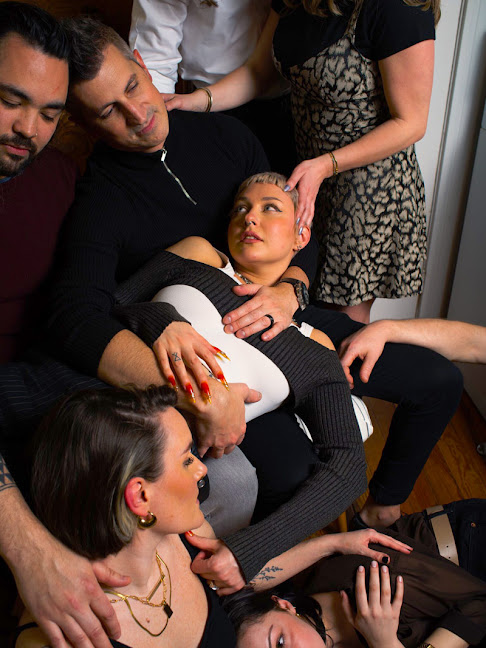
About six well-dressed, young to middle-age people cuddling and caressing in a pile.
Anne Vetter

Ashley: A bunch of couples met in the summer of 2020. Over the next year, we were all dating and developing friendships with several couples and individuals that eventually blossomed into this community. It’s an evolving organism that looks entirely different from everyone’s perspective.


...Nico: Our polycule is female-run. It’s the female-identified people who spearhead. We convene, we plan, we call the shots. It’s a bunch of queer women who say we’re not going to follow the rules.

Katie: It’s freedom. I am so grateful to be a part of it. I have this abundance of love to give. I feel so in my power. We all approach ENM, ethical nonmonogamy, differently. Everyone is so deeply in love with each other, whether or not it’s romantic love.

Relationships With More Than One Person

...M: (Katie’s main partner) I identified as a single guy. I went from that to dating nonmonogamously. And I fell in love with someone who was already in love with more than one other person. The fear of abandonment that I’d been programmed from Day 1 to expect, I had a huge amount of stress about that. And of expressing too much anxiety. I spent a lot of time suffering alone during the first months because I didn’t want to overwhelm my new partner and have them realize, Hey, you know what, this is just too much of a pain in the ass, and I need you to do more work to reach the level where you need to be.

...Ann: I’m 34, and I feel like I’ve been on and off nonmonogamous much of my life, even though I didn’t have the word. When I was 17, 18, I said free love. Around 2018, 2019, I swore off monogamy forevermore. I use the word “polyamorous,” though relationship anarchist is probably a more accurate representation.


Listen up as she goes on: 


My husband and I are very, very different, which is our strength. He’s a frat bro who loves sports, and I’m a radical alien witch academic nerd. In the beginning, we did all the typical stuff. Read the books on nonmonogamy, did the relationship check-ins. We’d sit down, take notes. We did every exercise in the books, listened to every podcast. We learned a strategy from the Multiamory podcast called “agile scrum,” which was adapted from business-meeting models. We utilized that format. We did that for a year and a half, at least once a month, sometimes six to 10 hours of hard poly-processing. That gave us great communication tactics.

Robert: (Ann’s husband) We have this motto: Feelings are not facts. That gets us through the hard times. ... I would ask her questions, and she would be like, No, I don’t feel that way; and I would be like, I know you like being with him more than me; and she would say, I’m not lying to you, it’s different, but it doesn’t make me love you less, you provide so much more to my life than just sex. I totally get it now. That was the first instance of feelings are not facts. They feel like it. But they ain’t facts.

Setting Boundaries

Bine: ...We had discussed opening up our relationship to a potential third, because I identified as bi, and that was important to me. And then five years into our marriage, he was the one to start talking about ethical nonmonogamy. At that point we were saying, 'Let’s just have some fun, but ours is really the primary relationship.'

There were a lot of restrictions. I felt very insecure, like if we’re going to do this there’s going to have to be a laundry list of rules. It can be a one-night stand, but we’re not going to see this person again. It can’t be a friend. But it became clear that these rules didn’t make any sense. We felt deeper connections with people beyond the sexual. We had to shift things, and we kind of drifted into the polyamorous space in 2018.

Resources always help, books like “The Ethical Slut” and “Polysecure.” But undoing the monogamous script, the socialization, is really, really difficult.

Katie (left) is dating Alex (second from left). Alex is legally married to Ashley (third from left). Chris (lower right) is legally married to Bine (not pictured), and Chris and Bine date Alex and Ashley as couples, while Bine has also dated Ashley individually. (Ann Vetter photo)


Katie: There’s a lot of boundary-setting. Broken rules can be really damaging. Adhering to other people’s boundaries is a big part of being in the polycule. That’s paramount. In the polycule it ranges from people who really don’t have rules, to we’re only going to date people together, or we’re going to participate in the group only as friendships, or as sensual friendships, or we’re only going to be sexually intimate at gatherings, and outside of that we’re not going to date anyone individually. We keep track in group chats. We also gather as a group for parties that are sometimes intentionally sexual but sometimes not at all, and that is a time for people to communicate about their interests. But group chats are big.


‘‘It’s an evolving organism that looks entirely different from everyone’s perspective,’’ one person who is part of the polycule says.

Making Time for Multiple Partners

M: The capacity to love is not a finite thing. But time is. You can’t do two things at once.

Bine: Scheduling can be very tricky. Making sure there’s still one or two evenings every week when we spend quality time together. Overnights is something we’re discussing now. We don’t sleep over individually with anyone we’re dating; we only do that when we’re dating someone together.

Ann: My husband, my nesting partner, is the person I own a home with. I also have life-partnership friends, I call them my wives, who are core members in the polycule. One of their husbands is one of my best friends and occasional sexual partner, and I do have sex with my wives, but we’re not romantically involved. But I love them.

I don’t ask anyone’s permission on anything. I spend 60 percent of my time in my house with my nesting partner and about 25 percent of my time with another partner, and although I technically have one home right now, I’m in the process of building homes with multiple partners. There are check-ins, but the check-ins aren’t for permission. It’s, "I’m doing these things, I’m going to be gone for these two weeks, what do you need from me?"

Katie: Poly-saturation is different for different people. For me, the maximum seems to be three partners at once, especially because I gravitate toward long-term committed in-depth relationships. I mean romantic partners. We have play parties that are intended to be a sexual space but more of a casual connection, and I’m not only with my partners there.

Benefits of the Polycule

Robert: We have a lot of compersion — being happy seeing your partner happy with one of their other partners — for each other. There are times when my wife will meet someone she knows I’ll be attracted to, and she’ll say, You have to meet my husband. She’ll wingman me. Or I’m talking to this guy, and I think, She would really like this guy. We do that for each other.

Bine: There’s something that feels radical about it, that feels liberating, that really speaks to empowerment, especially for women or queer or nonbinary individuals. It’s loving people in a very unapologetic way, not conforming to norms. We know why monogamy is still the dominant structure. The patriarchy. The lack of rights women had. As a woman, and as a queer woman, being able to live my life as authentically as possible without needing my husband’s permission, that’s empowering.

Nico: I was in a very bad car accident in the fall, and I felt so supported. I had 20 text messages from people in the polycule — this is the doctor I know, this is the lawyer I have, this is the physical therapist, so many resources.

Ann: I have one partner now with three kids. He is transmasc, and he’s radical about the way he raises them. They’re radically home-schooled. They’re 17 and nonbinary, 6 and 5. They know everything in age-appropriate ways. They’ve seen their mommy undergo the transmasc experience, seen their mom become who they really are.

I was up late last night with him in a hotel room, and the 17-year-old was in the room snoozing, so we just sat on the bathroom floor chatting about our relationship all night, and while that was happening my husband was texting to say, Oh, I got a last-minute match, so I’m going to meet this girl for a date. And then I get a text while we were still on the bathroom floor vibing, it was 4 in the morning, and he said, We had a great date, a great connection, she’s looking for friends with benefits, we had sex. And I was smiling. You know you’re really poly when you’re with one of your partners talking about how much you love each other and you’re so happy your husband had this awesome night. ...

Katie: Last night I was at a party that was full of poly people, and at the end of the night we wound up in this big cuddle pile. There were eight of us fit together like puzzle pieces, snuggling. It felt so cozy, so much oxytocin flowing. We were all envisioning living together, not having to worry about individual mortgages, just having some big house. Can’t we just do that? Why can’t we do that? An adult sleepover camp, that’s the vibe. It is my mission to make that happen for me and whoever wants to join me.


And lastly,


Poly as an Identity or a Movement or Both

Ashley: Whenever you veer outside the confines of the status quo, it is political. We’re really intentional about the way we want to connect, really questioning why one type of relationship has to be more significant than others. For the first time in my life, I’ve found community, in a true sense. These are people who really show up for each other in beautiful ways, people who aren’t guarded around each other. It’s just pure love. I can’t imagine my life without it now.

Ann: It is very much about social change. It is about making the world a better place. I want to be in relationships and be with people who make me live in this world better.

Nico: Some of us are survivors of sexual assault and have reclaimed what it means to be a sexual woman, to be radically and unapologetically ourselves. Some don’t really ever have sex — I think there is a power in female sexuality that doesn’t necessarily mean having a lot of sex; I don’t know how to explain that. It’s about making decisions for yourself, how you want your relationships to look.

...What has been valuable is being around men who want to be around empowered women, who aren’t intimidated. It’s not like they’re wimpy guys — to me, they’re strong because they’re not threatened.

...Katie: I hope this is a social movement. I hope people will feel more freedom about how they want to live and about pooling resources and living their best life. The structure of the nuclear family, the nuclear marriage, needs to shift. It’s really hard to afford a house. Some of us are thinking of moving into a place with four or five bedrooms where eight or nine of us could live together. We could share the burden of bills. It’s just more realistic. And it would be a community space. We would hold events and gather and play and have this endless sleepover. If I get to do this, I will have achieved something great — great emotionally and great in terms of social transformation.


The day after the story appeared online, the tabloid New York Post, a Murdoch-owned competitor for the New York market, condensed and reprinted a lot of it while inserting slimy spins: Inside a ‘radical’ 20-person polyamorous relationship where wild sex is always on tap (April 16). I see editorial envy. At least they acknowledge that it was a Times story, not their own.


●  Also in the Boston area, Esther Perel (Mating in Captivity) did an interview with the Boston Globe (April 4) while on the road with a tour she’s calling “The Future of Relationships, Love, and Desire.” Poly was the first topic that came up:


Q. In Greater Boston, there’s a lot of talk about polyamory — mostly because Somerville became the first municipality in the country to pass an ordinance where you can have more than one domestic partner. Now other communities [Cambridge, Arlington] are following suit. Is polyamory something that’s coming up more for you? Are people checking in to see how you feel about it?

Esther Perel
A. I wrote about consensual non-monogamy and polyamory in “The State of Affairs” and in “Mating in Captivity”... from the point of view of how it helps us reconcile the improbable duality between independence and belonging. It was one of the ways people were answering the question of “How do I straddle the need for security and the need for freedom?” ... But in addition, I think that polyamory, more and more, has become an answer to questions of community building. ... I’ve said before, the nuclear model is too insulated and isolated. We demand too much from one person to give us what the whole village is to provide. I’ve said before that gay couples have long understood the difference between emotional monogamy and sexual promiscuity — and they understood that monogamy is a primary commitment to a primary relationship that may or may not involve sexual exclusiveness. ... Polyamory is a philosophy. It’s a practice. It’s a relational arrangement. It’s not just a solution to the mishaps of infidelity. It needs to be done in a context that demands enormous equality. It can’t be a power maneuver.


●  For his Cosmopolitan column "Navigating Non-Monogamy," Zachary Zane interviews two people in a brilliant poly partnership of many years: Let This Couple Prove that Polyamory Actually Can Last Long-Term


...Just take it from Diana, 45, and Ed, 49, who’ve been polyamorous for 17 years. Like every couple, they experienced their own growing pains, but these two are happy, in love, and raising their eight-year-old daughter together. ...


Two days later Forbes published a profile of Diana by Ashoka, a nonprofit that spotlights social entrepreneurs: How Expanding The Legal Definition Of Family Helps Us All (April 2)


Q: Your other legislative push is around family status non-discrimination. Why is this needed?

A: Many neighborhoods are zoned for couples—even though, as we’ve discussed, the majority of Americans are doing something different. Some people are not getting houses rented to them if they want to live with, say, their best friend and kid and mother. A property owner can say, I was looking for a traditional couple. So, every time we pass one of these laws, we're able to raise awareness that 80% of us are doing something different and our laws need to reflect this reality. In fact, I encourage us to get away from saying “traditional” or “non-traditional” family because living in extended and multi-generational families and communities is what is traditional.

Q: What about the argument that children need stability?

A: Children absolutely need stability of parental figures, as numerous psychological studies have shown. But in the past, those researchers made the logical leap that stability needed to be a married mother and father. Now, we’re clearer that stability can also be mom and grandma, a same-sex couple, include a step parent, and beyond. These families can absolutely provide stability and children in them thrive.


● On Slate's "Care & Feeding" podcast of parenting advice: Parenting While Polyamorous (April 15).


On this episode: Elizabeth sits down with Jess Daylover and her metamour, Ash, of the Remodeled Love podcast, to talk all things polyamory and parenting. There are a lot of misconceptions out there about what polyamory is and isn’t — so we think you’ll love hearing about how it works as a parenting co-op.


Jess and Ash are part of a long-term quad household raising two kids. Listen (49 minutes). Transcript


●  Elle UK presents Is This the End of Monogamy? by controversial open-marriage memoirist Molly Roden Winter (paywalled; it's in the May 1 print issue). The story is in a section titled Is This How We Date Now? The section starts, "Apps are over. Meet-cutes are back. Polyamory is mainstream. Love has no boundaries."

The cover teases, "Radical love: A new era of relationship rules."

A fashion magazine gonna see things as fashion.


●  A healthy counter to the "everyone is doing it" wave of stories comes from Gabe Dunn, a well known queer polyamory activist, writer and producer for at least a decade who's now transmasc. Among queerfolk, he writes, Is Monogamy Cool Again? His long report appears in the lesbian/queer online magazine Autostraddle (April 17).

Remember, people — the consensus in the poly-awareness movement is to spread understanding of the polyamorous possibility and its best practices, and to support people in whatever relationship structure they find is right for them. The point is not to imply that poly is right for most people (it's not), or is a trend you gotta join, or that you can't change your mind about it or be ambiamorous. Rigid doctrine creates trainwrecks; that's true in any movement. (Are you listening, cancel-culturists?)


Gabe Dunn
I haven’t been monogamous since high school, and even then, my relationships were never fully closed. So when I learned about polyamory at 22, I was thrilled. There was a word for what I was!

The lifestyle and my relationships helped me to eliminate so much sexual shame and provided my first experiences of gender euphoria. Of course, I’ve also contended with judgment for being multi-amorous in a world built for two. Luckily, I was also queer, and to me, queerness felt intrinsically intertwined with non-monogamy. They were in the same polycule, if you will.

I’m single for the first time in five years, and back on the dating apps (as opposed to the hook up apps). Imagine my surprise to find that in my absence, all these queers have become monogamous!

“If you are partnered and poly, swipe left.”

“I don’t have the mental energy for poly.”

“We’ll get along if: You want monogamy too.”

It’s a non-negotiable! When I was single in 2019, the monogamous cuties I’d run across would sometimes bashfully try to play at maybe being interested in trying poly — just for me. I’d have to cut them off at the pass for their own good. Now? They’re cutting me off first! With pride!

It’s not just on the apps. The person who taught me what polyamory was is now in a monogamous relationship. The last few T4T [trans looking for trans] couples I’ve inquired about joining in on have been closed for funny business. 

...I’m being cheeky. Monogamy isn’t the same as uncontrollable jealousy, nor is it inherently unenlightened. It’s also not a stagnant state. There are times when someone might be one or the other, or some combination of the two.

But my overall working thesis in general? Monogamy is back on trend for queers!

Consider my writing about this on par with the New York Times’ insistence that only cis people report on trans issues. Only I, a famous polyamorist, could possibly investigate a resurgence of monogamy without bias. That’s how journalism works, folks.

---------------------------------

...More people tried it. For some it worked. For some, it didn’t. Polyamory is not inherently easier or harder than monogamy, but in the end, monogamy is what’s familiar. There’s more of a social roadmap to follow. It’s comfortable.

“There are ways through this discomfort,” single non-binary lesbian Anna Hope told me when I put out an Instagram call for monogamists to explain themselves. But that hard work isn’t for everyone. Hope has been polyamorous before, but said in 2024, they’re looking for monogamy.

“[Polyamory] feels liberating for some, but scary and chaotic for others,” Hope said. “It’s only fair to choose the way back instead, if monogamy also works for you.”

It works for monogamous queers like BJ and Harmony Colangelo, wives who co-host the feminist film podcast This Ends At Prom. Until recently, they felt like outliers, because as a cis lesbian and trans woman whose “sexuality is whatever,” respectively, their being monogamous seemed outlandish.

“The response is always some form of shock that we’re not poly,” BJ said, “because it’s become almost assumed that if you’re queer or trans in 2024 – especially in Los Angeles – that you’re also dismantling relationship structures.”

It’s a reasonable enough assumption. When you’re going against society’s defaults in one way, why wouldn’t you adopt some of the other ways?

...“I guess I am monogamous because there is no one else out there that makes me feel the way I do with BJ,” Harmony said.

BJ agreed, “Anyone else just feels redundant.”

Nicole Kristal, a bisexual woman who has been monogamous with another bi woman for the past six years, said being with someone who is also bisexual eliminated the temptation to act on other opportunities. She can be honest about her outside attractions, she said, without her girlfriend feeling insecure, and thus the temptation fizzles.

Kristal, who is also the founder of Still Bisexual, said it took her 20 years of searching to find this kind of healthy monogamous relationship in the queer community. ... “We joke that someday we might get a pool boy,” Kristal said, “but overall we are just enjoying being monogamous.”


He offers some provocative insight:


So what changed?

It once behooved queer couples to present as similar to the average heterosexual pairing. ... When monogamy was the default, polyamorous people were the ones who had to specify [themselves] so that no one was wasting their time pursuing incompatible matches. Now it’s the other way around.

...Recently, on @openrelating, an X account run by relationship coach Roy Graff, he suggested that maybe there aren’t actually less [queer] poly people, so much as ... poly people have stopped talking about being poly. ... We non-monogamous folk have had our moment in the spotlight and have quietly stopped trying to prove anything or call attention to ourselves.


BTW, as we straight cis polyfolks age, I've noticed that we also tend to settle in with one long-term anchor partner and have other intimate relationships rather the way  an ordinary married couple might have dear friends. 


----------------------------------------------------------------------------------


Meanwhile, as the larger world stage darkens. . .


because he or she is about to vote on whether to tilt the 21st century toward free societies or toward their fascistic conquerors. It's that stark. Look up your rep's phone / email.


UPDATE April 22: "The pro-Russian caucus inside the GOP was defeated on Saturday, and with it Putin's dream of quickly occupying Ukraine.
"Now the US and Europe need to seize the moment to win, and end, the war."
                                                                                     --Anne Applebaum


Here is why I've been ending posts to this polyamory news site with Ukraine: I've seen many progressive movements die out because they failed to scan the wider world accurately and understand their position in it strategically.

We polyamorous people are a small, weird minority of social-rule breakers. Increasingly powerful people call us a threat to society — because by living successfully outside of their worldview, we expose its incompleteness.

Our freedom to choose our relationship structures, and to speak up for ourselves about the truth of ourselves, is just one way we depend on a free and pluralistic society that respects people's dignity to create their own lives, to access facts, and to speak of what they know.

Such a society is possible only where people have reasonably good power to govern themselves, combined with legal structures that are at least supposed to guarantee the rights of all.

Vote for Ukraine Aid protest signs outside the US Capitol
Innovative people, communities, and societies who create their own lives, and who insist on the democratic structures and legal rights that enable them to do so safely, infuriate and terrify the authoritarians who are growing in power around the world and in our own United States. Now with direct mutual support, which is increasingly unhidden.

Such rulers and would-be rulers seek to stamp out other people's freedom to choose their lives — by intimidation, repressive laws, inflammatory disinformation and public incitement, weaponizing police abuse, or eventually, artillery.

For what it's worth, Polyamory in the News received more pagereads from pre-invasion Ukraine over the years (56,400) than from any other country in eastern Europe.

You can donate to Ukraine relief through this list of vetted organizations (last updated Oct. 2023). We're giving to a big one, Razom, and to a little informal one, Pizza for Ukraine in Kharkiv, the project of an old friend of my wife.

But that is only the start. For those of us born since World War II, this is the most consequential war of our lifetime. Because we have entered another time when calculating fascism, at home and abroad, is rising and sees freedom and liberalism and social tolerance as weak, degenerate, delusional  inviting easy pushovers. As Russia thought it saw in Ukraine. The whole world is watching what we will do about it.


The coming times may require hard things of us. We don't get to choose the time and place in history we find ourselves born into. We do get to choose how we respond to it. 

Need a little help bucking up? Play thisAnother version. More? Some people on the eastern front trying to hold onto an open society. (TW: war is awful.) Maybe your granddad did this from a trench against Hitler's tanks— for you, and us, because a world fascist movement was successfully defeated that time, opening the way for the rest of the 20th century.

But the outcome didn't look good for a couple of years then, either. Popular history remembers the 1945 victory over the Nazis and the joyous homecoming. Less remembered are the defeats and grim prospects from 1941 through early 1943.

Remember, these people say they are doing it for us too. They are correct. The global struggle between a free, open future and a fearful revival of the dark past that's shaping up, including in our own country, is still in its early stages. It's likely to get worse before it gets better. The outcome is again uncertain, and it will determine the 21st century and the handling of all its other problems.

----------------------------------

PS: Ukraine should not be idealized as the paragon of an open democratic society. For instance, see If Ukraine Wants To Stand for Liberty and Democracy, It Should Rethink Some of Its Wartime Policies. And it has quite the history of being run by corrupt oligarchs — leading to the Maidan Uprising of 2013, the Revolution of Dignity in 2014, and Zelensky's overwhelming election in 2019 as the anti-corruption candidate. So they're working on that. And they're also stamping hard on the old culture of everyday, petty corruption.  More on that.  More; "Ukraine shows that real development happens when people believe they have an ownership stake in their own societies."

Now, writes US war correspondent George Packer in The Atlantic, 


Here was a country with a tragic history that had at last begun to build, with great effort, a better society. What made Ukraine different from any other country I had ever seen—certainly from my own—was its spirit of constant self-improvement, which included frank self-criticism. For example, there’s no cult of Volodymyr Zelensky in Ukraine—a number of Ukrainians told me that he had made mistakes, that they’d vote against him after the war was won. Maxim Prykupenko, a hospital director in Lviv, called Ukraine “a free country aspiring to be better all the time.” The Russians, he added, “are destroying a beautiful country for no logical reason to do it. Maybe they are destroying us just because we have a better life.”


They have a word there, with a deep history, for the horizontal, self-organized, mutual get-it-done that grows from community social trusthromada. Learn that word. It's been keeping them going  to the extent they've been able. We polyfolks often dream of creating something like that community spirit in miniature, in our polycules and networks. Occasionally we succeed.

----------------------------------

Social attitudes in Ukraine are mostly traditional, rooted in a thousand years of the Orthodox Church. But not bitterly so like often in the US; in the last generation the ideal of modern European civil society has become widely treasured, and social progressivism has room to thrive. The status of women has fast advanced, especially post-invasion. More than 43,000 women volunteer in the armed forces, flooding traditionally male bastions — including as combat officers, artillery gunners, tankers, battlefield medics, snipers, and infantry. (Intimidating video: "Thus the Witch has Said".) Ukraine has more women volunteering in combat positions than any other armed force in the world.
  
Some LGBT folx in the armed forces display symbols of LGBT pride on their uniforms, with official approval, whereas in Russia it's a prison-worthy crime for even a civilian to show a rainbow pin or "say gay." A report on Ukraine's LGBT+ and feminist acceptance revolutionsAnotherAnotherAnother. War changes things.

And in December 2022, Russia made it a crime not just to speak for LGBT recognition in Russia or occupied Ukraine, but to speak for "non-traditional sexual relations." Belarus, a Russia subject state, has followed suit. Pre-invasion, Russia had a visible polyamory education and awareness movement.

Polyfolks are like one ten-thousandth of what's at stake globally. Ukraine must have our full material backing for as long as it takes them to win their security, freedom, and future. Continue to speak up for it.
                                     
A Russian writer grieves: "My country has fallen out of time."


Ukrainian women soldiers in dense undergrowth
Women defenders near the eastern front

PPS:  U.S. authori-tarians, such as Sen. Ted Cruz, are saying that allowing women in front-line roles is a woke plot to weaken America's armed forces. Ukraine puts that shit to bed. Do you have a relative who talks like that? Send them this video link to Vidma, who commands a mortar platoon, recounting the story of one of their battles near Bakhmut.

Update April 22, 2024: A year and a half later Vidma is still alive, still with her mortar unit in the Bakhmut region, and posting TikToks. They are now at the front in, it looks like, the battle for Chasiv Yar ("Quiet Ravine"), a strategic  town west of Bakhmut that will soon, unfortunately, be in world news. A young girl who looks high-school age has showed up to join themAnother. Their lives, and their promising society, depend on us. 

And maybe our own? Says Maine's independent Senator Angus King (Jan. 31, 2024),


Whenever people write to my office [asking why we are supporting Ukraine,] I answer, 'Google Sudetenland, 1938.' We could have stopped a murderous dictator who was bent on geographic expansion…at a relatively low cost. The result of not doing so was 55 million deaths.


Labels: , , , , , , , ,


October 7, 2022

Mouse puppets voice a polyamory documentary on the BBC. Georgia's first queer nonbinary polyam Iranian elected official and their triad. And other poly in the news.


●  Here's something different. The BBC's online streaming channel BBC-3 aired a television documentary with members of the UK's polyamory community, using mouse puppets to speak their voices. This gives the interviewees both cuteness and anonymity. Filmmaker Emily Morus-Jones says a a reason for the idea was to separate the viewers from making automatic judgments against humans on display. It's titled Diomysus  — More than Monogamy. Watch below. (If the embed won't play, watch it here.)


The 5-minute piece aired on BBC-3 yesterday, October 6. It certainly holds attention, and the interviews themselves are lovely.

An article about it yesterday: Creature Comforts meets Jim Henson in new BBC polyamory doc (on the site It's Nice That, "championing creativity since 2007"). Excerpts:


Capturing a community on the rise – one at best misunderstood, at worst vilified in society – Diomysus floats fresh perspectives on polyamory.


By Liz Gorny

...Emily [the filmmaker] turned to the combination of soundbites and puppeteering so famously utilised in Creature Comforts, this time reaping a particular reward from the approach – anonymity.

...Diomysus certainly discusses sensitive themes. The film presents interviews with a range of people who are polyamorous, discussing their relationships and the backlash they’ve run into when sharing their polyamory with their circles. “Polyamory, although certainly slowly making its way into mainstream culture, is for many people quite a challenging concept to get their heads around, and we live in a very aesthetically driven society,” Emily explains. Puppetry gives space to Diomysus’ contributors to speak freely but also to the audience to absorb challenging concepts in a welcoming format and look beyond the people presenting the ideas.

...“I wanted to find a creature that was sex-positive,” Emily explains. After deciding against other more obvious choices – dolphins, the bonobo – the director finally arrived at mice. “I read somewhere that house mice very often raise their pups as a group,” the director reveals. To Emily, this seemed to speak to what polyamory is all about; working together with your partners to “survive the, often turbulent, world which we live in”.

...Diomysus is ultimately an experiment in unconscious bias. It aims to both shift the narrative around polyamory and see if puppetry can help provide some space for empathy and nuanced thought around the subject. As Emily says: “One of the most joyful things about puppets is that they can get away with a lot of things that people can’t and the audience accepts it. ...

...“I think society at large can learn a lot from the polyamorous community if it takes the time to really understand the depth of the ideas that they are trying to get across.”


●  This one's getting a lot of attention all over:  Georgia lawmaker comes out as nonmonogamous: 'I'm in love with two wonderful people' The story below is from the "NBC Out" subsite of NBC News (Sept. 28)


Atlanta City Council member Liliana Bakhtiari, the first queer Muslim person to be elected in Georgia, has two partners, and the three of them plan to build a family.

Liliana Bakhtiari (center) with Sarah Al-Khayyal (left)
 and Kris Brown. Cats: Moo (left) and Rugrat.


 By Jo Yurcaba

When Atlanta City Council member Liliana Bakhtiari won the 5th District seat last November, it represented two major firsts: Bakhtiari was the first queer Muslim person elected in the state of Georgia and the first nonbinary councilmember of a major U.S. city.

But Bakhtiari, who uses they and she pronouns, wasn’t entirely out of the closet at the time. While they had been with their partner, Kris Brown, for 10 years, the duo kept quiet about what they’ve both described as one of the best parts of their lives: They are nonmonogamous, and are in a relationship with a third person, Sarah Al-Khayyal.

Now, a year after Bakhtiari’s election and two years into their relationship with Brown and Al-Khayyal, the three of them have decided to come out in an exclusive interview with NBC News as they plan to build a family.

Bakhtiari said that too often stories like theirs will come out “in a scandal.”

“But we’re openly showing it and proud of it,” Bakhtiari, 34, said during a video interview, as Brown and Al-Khayyal sat on either side. “It should be destigmatized. It’s a very valid familial structure that people should embrace.”

...Bakhtiari met Brown in Atlanta in 2012 the old fashioned way — at a gay bar. When the two started dating, Bakhtiari said they were upfront with Brown that they are nonmonogamous, meaning they prefer to date and form relationships with more than one person.

“I was like, ‘That’s cool with me,’” said Brown, 33.... “It was the first time that I had been with anyone who didn’t want to be monogamous. For me, it was kind of a relief as well to be like, ‘OK, I don’t have to be this person’s everything all the time. I can be as much of their life as works for us, and we can have this fluidity,’ and I really liked the feeling of that.”

Bakhtiari said their relationship with Brown was the first serious relationship they had, and they were coming into it at a difficult time in their life. 

“I grew up in an overbearing household that didn’t allow for a lot of independence to happen,” Bakhtiari said. ...

Their friends and community members saw how positively the relationship affected Bakhtiari, they said, and it became publicly romanticized. But, Bakhtiari said, that meant “when people would find out that we were open or nonmonogamous, it was like someone destroyed a fairytale for them.” 

...In the fall of 2020, Bakhtiari met Al-Khayyal through a virtual nonmonogamy support group. Al-Khayyal is a policy manager at a nonprofit and is on the Atlanta mayor’s LGBTQ advisory board. 

...“This is the sort of thing that a political opponent or someone who has some ax to grind might pick up on and twist around and turn into something negative, and we want to claim it upfront, and say this is the best thing about our life,” Brown said. 

Bakhtiari said that when they tell people about their relationship, people often respond in two ways: with support and/or curiosity. ... Their families have also been supportive, Bakhtiari said. ...

In addition to allowing them to live openly and address stigma, Brown said that they hope coming out will allow them to raise awareness of barriers that nontraditional families still face.

For example, Brown was in the hospital this year, and only one person was allowed in the hospital room with them.

“There’s an opportunity for us to kind of shed light on that, and be like, ‘Hey, there are nontraditional families out there,’” Brown said. “We’re going to grow our family, and we want those kids to also be able to navigate the world how they want to navigate the world.”


Another example of the coverage: in The Advocate, Queer Lawmaker Liliana Bakhtiari Comes Out as Nonmonogamous (Sept. 30). 


●  Triad interaction patterns. A triad is the simplest polycule that contains an interrelationship bond (since it has three links, as opposed to a vee with two separate ones). This naturally means that triads — never mind whether all three bonds are sexual — are the commonest poly interrelationships you see. 

Any relationship of three people, whether they're friends, siblings, co-workers, or poly partners, tends to develop certain characteristic behaviors, writes polyfamily researcher Elisabeth Sheff on her Psychology Today blogsite: Common Interaction Patterns Among 3 People (Sept. 27). 


...Interactions among three entities—individuals, groups, institutions—are incredibly common. From two older siblings ganging up on the youngest one, to the “theater geeks” and the “stoners” creating an informal coalition to prank the “jocks” in their high school, or the United States attempting to broker a peace deal between the Israelis and the Palestinians... common patterns of interaction appear between three units.

In 1890s Berlin, foundational sociologist Georg Simmel hosted cocktail parties and salons where he would observe interactions among the partygoers. Through decades of such observations, Simmel developed his ideas of social interaction on an interpersonal level and created theories about those at the larger social level, including topics like money, fashion, games, and the social life of urban centers. Many of Simmel’s ideas explore social distance and placement, which he called social geometry.

...These patterns reappear so often that they function almost as archetypes for interaction, not only among individuals but at every social level.

Patterns among three entities take several primary forms: all three united together, two forming a coalition against the remaining one, or one mediating between [or bossing?] the other two.

...When all three entities are together, they strongly align their ideas, behaviors, and goals.

[In] a dynamic of two against one, two of the three collaborate to present a united front....

In other cases, one member of the threesome will mediate between the other two.

...These triadic dynamics will vary tremendously in consensually nonmonogamous (CNM) relationships, depending largely on the type of CNM, the people involved in the interactions, the boundaries they have negotiated, and the distribution of power within the threesome.

The dream for many polyamorists is the three-for-all dynamic when every triad member shares a strong agreement about boundaries and goals, and all are equally invested in the long-term well-being of the relationship and its members.

While that level of connection and agreement can be delightful, it can also be quite challenging to establish and sustain—especially if two members of the threesome had an established relationship before connecting with the third. ...

Some triads create an alternative to the two-for-one ["couple privilege"] dynamic, in which both members of the pre-existing relationship focus on the third person who has joined them. When done manipulatively to get the third person to bond with the existing couple and forsake outside connections, that joint attention might be better understood as love bombing. If it is an authentic attempt to honor and celebrate the newcomer, then a two-for-one dynamic can spur the transition to three-for-all.

Another common expression is the one-between-two interaction, in which one partner wants to be with two other people, but those people are somehow at odds with each other. ... Done manipulatively, the hinge distorts information in translation to control the situation. More often, at least in my research data, the hinge feels caught between the two partners, buffeted and pulled rather than in control of the interactions. In many resilient polyamorous relationships, the two partners of the hinge establish a friendly relationship in which they can communicate directly if needed.

Sometimes these [endpoints of a vee] develop polyaffective relationships, coming to see each other as chosen family members like a sibling, dear friend, and/or co-spouse. Over the years, several of the polyaffective triads in my longitudinal study have transitioned from a congenial one-between-two to a three-for-all dynamic without the sexual relationships changing at all. ...


●  Also by Sheff, just up: What Makes a Resilient Throuple? (Oct. 7). "How Gen Z is changing the stereotypical norms of consensual non-monogamy."


...Rather than the stereotypical one man with two women triad, my findings indicate that the most common and stable form of polyamorous triad among the parents in my [25-year] research sample (primarily the youngest Baby Boomers and Gen X) is composed of a woman with two male partners. In contrast with the one penis policy common in some FMF throuples, these triads with two men and one woman very rarely have a "one vagina policy." Much more often, all members of the triad are able to date others of any gender they desire.

...At their best, the men develop an intimate bond with each other outside of their connection to the woman. This bond between the metamours (the men who are each partnered with the woman but not in a sexual relationship with each other) is so important to the stability of these triads that I named them polyaffective relationships and identified that bond as the core of the stable polyamorous family or polycule. ...

Among the Millennials and Generation Z, the stereotypical one-man-with-two-women triad is less common for an additional reason. Not only do these younger people tend to have a less rigid power hierarchy associated with gender, but many of them also reject stereotypical gender completely.

...Zoomers and Millennials are changing the face of gender, sexuality, relationships, and the associated power hierarchies that go with these complex and intertwined categories. In so doing, they have also largely reconstructed the stereotypical FMF polyamorous triad into something much more fluid.


● And more Poly 101 in pop media: Common Mistakes When Trying Non-Monogamy (Ask Men, Sept.  30). Below are the subtitles. Each gets a paragraph of explanation and one of "What to do instead." The advice is brief but worth passing on to the curious.


By Alex Manley

...So many people are new to this stuff; there aren’t a ton of existing cultural scripts to guide people. 

...AskMen spoke to three non-monogamy experts about common mistakes to avoid. Here’s what they had to say: 

1. Pressuring a Monogamous Partner to Open Up...
2. Not Knowing What You Want from Non-Monogamy...
3. Assuming Non-Monogamy Will Fix a Monogamous Relationship... 
4. Thinking Non-monogamy Is All About Sex...
5. Trying to Avoid Your Emotions:
...“If you want to work through an emotion,” [Jess] O’Reilly says, you could consider these strategies:
    -- Consider how it shows up in your body. 
    -- Look for ways to assuage the physical sensations/manifestations. 
    -- Write down/reflect upon how you’re feeling and why you think you’re feeling that way.
    -- Write down/reflect upon how you want to feel. Consider what it would take for you to feel that way.
    -- Don’t feel pressure to analyze every single feeling.
6. Making Assumptions About What It Will Look Like...
7. Assuming You’ll Get Laid a Ton...
8. Decreasing Communication Over Time...
9. Not Thinking About Scheduling...


●  The newspaper advice lady "Ask Annie" (Annie Lane) comes around. She's published a followup to her column a month ago in which, you may remember, a person signing themself "Three's Company" complained "My future in-laws’ polyamorous relationship makes me not want to be around them."  Annie more or less sniffed off the idea of any triad having a future. Now she takes poly relationships more seriously in a new column: Three's Company followup (Morning Journal, Lisbon, Ohio; Sept. 30).

That's because of a very thoughtful letter someone sent her. Was it one of you? 


Dear Annie: I’m writing regarding “Three’s Company,” who feels uncomfortable around her future brother- and sister-in-law and their girlfriend who now lives with them and their children. You were correct to say that only the people involved know what really goes on in a relationship. I am sure you will hear from others, but polyamory can mean long-term, committed relationships. Just because they don’t look like what the concerned sister-in-law believes they should look like doesn’t make them wrong and it doesn’t mean they are doomed. ...

Many poly people actively spend time learning to better communicate with their partners. I have been in a loving polyamorous relationship for 24 years. My partners care for me and support each other when I have been seriously ill. Even the nuns in the nursing home I was in for a while said they had never heard of it before but that I had the best support system they had ever seen.

Three’s Company should consider supporting her sister-in-law, and maybe she will learn that love may look different for the thruple, but that doesn’t make it wrong. Also, the children may now have another trusted adult to turn to when they need help with homework or are frustrated with their parents. Love is beautiful in many forms. — Pleased to Be Poly

Dear Pleased: Thank you for sharing your insights. You’re right that there is an abundance of love out there, and it looks different for everyone. There are certainly details about the thruple’s situation that we don’t know. I hope their dynamic is as loving and supportive as the one you have with your partners.


●  Podcast on Somerville's multi-domestic partnership law. Meredith Goldstein is a super-popular advice columnist in my hometown Boston Globe. She also has a podcast, "Love Letters," and just up on it is Welcome to Polyamory City (29 minutes; Season 7, Episode 3).  "Polyamory City" is Somerville next to Boston.  


In 2020, Somerville, Massachusetts became the first municipality in the country allowing polyamorous relationships to qualify for domestic partnership status. Meredith talks to one of the first people to register for the new designation. They discuss what it means – and what it doesn’t. Meredith also talks to a [local] legal expert [Kimberly Rhoten of the Polyamory Legal Advocacy Coalition, PLAC] about the broader social and legal implications of the Somerville ordinance.


I learned something new from this: You don't have to live in Somerville to get its certificate of multiple domestic partnership!

No, it's not legally valid elsewhere. But if you have that document, you not only have something to frame and hang on your wall, it will also be evidence of your serious, committed multiple relationship at the time of issuance, if you ever need this in family court, housing court, a custody dispute, or who knows what. And of course, if you have kids it could become an heirloom for generations.


●  I note this one because of the headline: The Era Of Ethical Non-Monogamy Is Here. But Are We Just Blindly Following A Fad? (Hauterrfly, a women's-products influencer site, Sept. 27). Despite the headline it's a positive little Poly 101, but the writer lays out the bad experiences she had with today's scene.

If you're "just blindly following a fad" you really shouldn't be doing this thing.


●  A similar reminder: Some — many? — people you'll meet these days talk the ENM talk but don't walk the walk. Ethical non-monogamy is a farce, I know because I tried it. This appeared Oct. 6 in the "Body & Soul" subsite of Murdoch's News.com.au.


Not all ethical non monogamous relationships are as bright and shiny as they may seem from the outside. From a lack of trust to STIs and being ghosted, Shona Henley pens the reality of these (often glamourised) partnerships.


------------------------------------------------------

Meanwhile, much bigger shit gets real.

Why have I been ending most posts to this polyamory news site with the Ukraine war?

Because I've seen many progressive movements become irrelevant and die out by failing to scan the wider world correctly and understand their position in it strategically.

We polyamorous people are a small, weird minority of social-rule breakers. Some influential people call us a threat to society — because by living successfully outside their worldview, we expose its incompleteness. Our freedom to choose our relationship structures, and to speak up for ourselves about the truth of ourselves, is just one way we depend on a free and pluralistic society that respects people's dignity to create their own lives, to access facts, and to speak of what they know.

The Russian family-cartoon series Masyanya
turned dissident. Watch. The cartoonist has fled.
 
Such a society is only possible where people have power to govern themselves, combined with legal structures that are at least supposed to guarantee the rights of all.

People, communities, and societies who create their own lives, and who insist on the democratic structures and legal rights that enable them to do so safely, infuriate and terrify the authoritarians who are growing in power around the world and in our own United States.

Such rulers and would-be rulers seek to stamp out other people's freedom to choose their lives — by intimidation, repressive laws, inflammatory disinformation and public incitement, or, eventually, artillery.

For what it's worth, this site has received more pagereads from Ukraine over the years (56,400) than from any other country in eastern Europe.

For now, you can donate to Ukraine relief through this list of organizations vetted by the Washington Post, or many others. We're giving to a big one, Razom, and to a little one, Pizza for Ukraine in Kharkiv, a project of an old friend of my wife.

----------------------------------

But that is only the start. For those of us born since World War II, this is the most consequential war of our lifetimes.

The coming times are going to require hard things of us. We don't get to choose the time and place in history we find ourselves born into. We do get to choose how we respond to it. Buck up and be ready.

Need a little help bucking up? Play thisAnother version. More? Just some guys in Kharkiv (our Pizza for Ukraine town) helping to hold onto a free and open society, a shrinking thing in the world. The tossed grenade seems to have saved them. Maybe your granddad did this across a trench from Hitler's troops — for you, and for us,  because a world fascist movement was successfully defeated that time, opening the way for the rest of the 2oth century. Although the outcome didn't look good for a couple of years there.

Remember, these people say they're doing it for us too. They are correct.  The global struggle between a free, open future and a fearful revival of the dark past that's shaping up, including in our own country, is still in its early stages. The situation is likely to get worse before it gets better. The outcome is again uncertain, and it will determine the 21st century and the handling of all its other problems.

We'll have a better idea after the election. Whatever else you do, vote.

BTW:  The single most cost- and time-effective thing you can do to Get Out The Vote is urge your friends and family to vote.

----------------------------------

PS: Ukraine should not be idealized as the paragon of an open democratic society. For instance, see If Ukraine Wants To Stand for Liberty and Democracy, It Should Rethink Some of Its Wartime Policies. And the country had quite a history of being run by corrupt oligarchs — until the Maidan Uprising of 2013, the Revolution of Dignity in 2014, and Zelensky's overwhelming election in 2019 as the anti-corruption candidate. So they're working on that.

Now, writes US war correspondent George Packer in The Atlantic (Sept. 7),   


Here was a country with a tragic history that had at last begun to build, with great effort, a better society. What made Ukraine different from any other country I had ever seen—certainly from my own—was its spirit of constant self-improvement, which included frank self-criticism. For example, there’s no cult of Volodymyr Zelensky in Ukraine—a number of Ukrainians told me that he had made mistakes, that they’d vote against him after the war was won. Maxim Prykupenko, a hospital director in Lviv, called Ukraine “a free country aspiring to be better all the time.” The Russians, he added, “are destroying a beautiful country for no logical reason to do it. Maybe they are destroying us just because we have a better life.”


They have a word there, with a deep history, for the horizontal, self-organized mutual get-it-done that grows from community social trust: hromada. Learn that word. It's getting them through. We polyfolks often dream of creating that sort of community spirit in miniature, in our polycules and networks. Occasionally we succeed.

Social attitudes in Ukraine are generally traditional, but not bitterly so like often in the US; the ideal of modern European civil society is widely treasured, and social progressivism has room to thrive. More than 40,000 women volunteers reportedly serve all roles in the armed forces, including as combat officers, platoon leadersartillery gunners, tankers, and snipers. LGBT folx in the armed forces openly wear symbols of LGBT pride on their uniforms, whereas in Russia it can be a crime for even a civilian to show a rainbow pin. Writes kos in the big lefty news site Daily Kos (July 29),


I find [this] particularly salient given American conservative hostility toward women serving in our military. People like Ted Cruz praising the supposed manliness of the Russian army, while claiming ours is weak because of “woke culture.” Ukraine puts that bullshit to bed, not just with the women serving in its ranks, but with gay soldiers very publicly sewing unicorn patches on their uniforms to denote their pride.


He retweets a meme from a military blogger on the plight of the abused gay Russian draftee:


To hell with any conservatives who impugn anyone’s service as somehow less effective or honorable than white straight men. 


_________________________
 Don't miss Polyamory in the News!
 SUBSCRIBE by a feed, or
 SUBSCRIBE by email

_________________________

[Permalink]
 

Labels: , , , , , , , , , , , , ,