And another city! Berkeley just banned discrimination for "family or relationship structure"

|
|
Berkeley City Hall (City of Berkeley photo) |
Last night Berkeley, California, prohibited landlords,
schools, businesses serving the public, city officials, or "any person or
agent or employee thereof" from discriminating "against an individual on the
basis of that individual’s family or relationship structure."
The Berkeley law applies to, and defines, four areas for this protection:
housing, educational institutions, city and
city-supported facilities and services, and use of business establishments. It also specifies some exceptions.
Here is
the law's
full text
(starts on page 6).
For decades this kind of discrimination has plagued people in polyamorous
relationships, costing them their homes, jobs, and other things as found in
surveys of the poly community.
Two-thirds
of polyamorous people say they have experienced discrimination because of their relationships.
Berkeley joins neighboring Oakland as well as Somerville and Cambridge,
Massachusetts, in enacting similar measures in the last 14
months.
The Berkeley group
PolyActive had
tried to pass something like this starting seven years ago. City Council
member Terry Taplin, the bill's author, said PolyActive "played a pivotal role
in the advocacy for the initial 2017 bill and continued to support the current
efforts. Their local insight and community mobilization efforts underscored
the immediate need for legal protections within Berkeley."

|
| Members of PolyActive on July 15, 2023, OPEN's first international Day of Visibility |
But the big credit goes to the legal and policy whizzes at the national
Polyamory Legal Advocacy Coalition (PLAC), who crafted the law. In addition, the international Organization for Polyamory and Ethical Non-monogamy OPEN) helped PolyActive mobilize the local community. The groups worked
proactively with the Berkeley City Attorney's office to ensure that there were
no legal glitches in the legislation. The City Council approved the bill
unanimously on "first reading" May 7th, then again on "second reading" May
21st, thereby enacting it into law.
In December 2017 PolyActive got a similar measure past first reading in
Berkeley — it would have been the first in the country — but that one didn't
make it to second reading. This time, with experience and PLAC's expert legal
work, the ducks were in a row.
Where will be next? Contact PLAC
if you'd like to try to get this measure or something like it passed in your
city or town.
------------------------------------------
As it happens, Sparkle Moose and I
attended a reception put on by PLAC at the Harvard Law School last
Saturday evening. The six PLAC principals were just off their second annual
high-intensity, in-person planning retreat, hosted by Harvard Law's LGBTQ+
Legal Advocacy Clinic. They were full of plans and ideas — for
non-discrimination ordinances in more cities, involvement in other areas of
the legal system, recruiting more lawyers and volunteers for various projects,
building out their anemic social media presence and website, and hiring office
staff. They are beating the bushes trying to fundraise for all this.

|
|
Five PLAC principals celebrating outside the Somerville, MA, City
Council chamber on March 23, 2023. From left: Kimberly Rhoten, Heath Schechinger, Alexander Chen, Diana Adams, and Andy Izenson. (Matthew J. Lee/ Boston Globe) |
The larger picture here goes beyond polyamory and non-monogamy. The
ordinances also protect traditional multigenerational families living under
one roof, single-parent families, platonic co-op households of mutual
support, and others. With housing in cities becoming ever pricier and in
shorter supply, and with the isolated husband-wife-kids home becoming an ever
smaller fraction of reality, alternatives must be allowed to grow. Polyfolks
have kick-started these legal initiatives but will be a minority of those who
benefit.
A new force in this direction will be the
Modern Family Institute, a project of Heath Schechinger and others that seeks to raise $5 million
for research and policy efforts over the next three years. It is explicitly
about this larger picture:

MFI logo Families and relationships come in all shapes and sizes.But our society is not designed to support how people are structuring their families and relationships today.Our laws, built environment, and cultural norms were established to support a monogamous nuclear family structure that does not reflect the needs of families and relationships today. Families that don’t center two married adults often face significant infrastructural, legal, and financial hurdles, as well as stigma and discrimination.The Modern Family Institute seeks to bring about a world where families and relationships are defined by their function, not their form.Our vision is to improve relational, mental, and physical wellbeing by ensuring everyone has access to resources and systems of care supporting their unique family and relationship structures. Our research drives systemic changes in legal, financial, housing, and social systems through supporting media representation, policy reform, and professional practices that help people build and sustain flourishing communities of care.

------------------------------------------
● OPEN just put out a
press release:
The good news just keeps coming! ...Our gratitude to Berkeley Councilmember Terry Taplin, who sponsored the bill, and to our friends at the Polyamory Legal Advocacy Coalition, which drafted the ordinance. Coalition partners also included PolyActive... The Modern Family Institute, Chosen Family Law Center, Harvard Law School LGBTQ+ Legal Advocacy Clinic, and Asexuality Visibility and Education Network, and the many community members who added their voice....There can be no doubt that this is our moment, and that the future of this growing movement is bright.But let's be clear: the population of these four cities represent a fraction of a percent of the total US population. The unfortunate fact is that most people are still not protected from stigma and discrimination on the basis of their non-monogamous identity or their family structure. There is much more work to do...And we're here to do that work. OPEN is collaborating with coalition partners to develop new tools and resources to help community members like you bring these protections to your city or town. We're speaking with community leaders and elected officials in multiple cities to keep the momentum going. We're talking with the media to spotlight this issue and the growing power of our movement. ...
And, they too need money.
● The local Berkeleyside published a long article
on the measure's passage, highlighting an eight-person co-op family that, with
multiple incomes, can afford a house in the pricy Berkeley Hills neighborhood, ranked as
one of the most desirable locales in the state: Berkeley law extends legal protections to polyamorous people and
non-nuclear families (May 22)

Housemates Steph Tranovich (left), Lily Lamboy, Alexei Savtchenko and Kmo Mogg
chat in their co-op kitchen before dinner. (Ximena Natera, Berkeleyside/CatchLight)
By Ally Markovich...Dave Doleshal... began organizing conferences on polyamory in Berkeley at a time when it was less accepted than it is today. ... Being open about his polyamorous identity, he was often turned down by landlords. At conferences, he heard stories of people being evicted, fired or passed up for promotions at work based on their relationship structure. With other polyamorous people, he considered advocating for a law to protect their rights, but didn’t get far.Over time, Doleshal has seen polyamory and other diverse relationships become more accepted in Berkeley. “People who were polyamorous a long time ago, just gradually have started talking about it and being more visible,” said Doleshal, who has lived in Berkeley since the 1990s. He said the ordinance was a major step forward, making other legal protections possible. ......The Berkeley law has limited purview. It doesn’t extend to other areas where polyamorous people face discrimination, including the workplace and courts, which would need to be addressed at the state or county level....Advocates behind the new law said they hope it starts conversations about the way that monogamy and the nuclear family structure are baked into the legal and social fabric, from healthcare benefits to hospital rules. Eventually, they aim to bring a nondiscrimination bill to the California state legislature.

● Slate, in anticipation of the Berkeley law passing,
published a look at the larger polylegal picture: L G B T… P? (May 6)
Polyamory is everywhere these days—except protected under the law. But some advocates have an idea about how to change that.
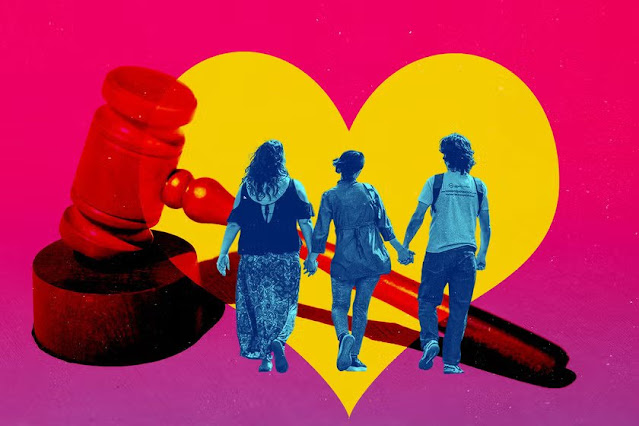
Slate/ Tingey Injury Law Firm/Unsplash/ Ronaldo Schemidt/AFP/Getty
By Abigail MossIn case you hadn’t noticed, polyamory is all the rage right now. ... And, lest you think all this hubbub is some ginned-up PR campaign, consider that 4 to 5 percent of people in the U.S. are in consensually nonmonogamous relationships (not always the same thing as polyamory, but pointing in a similar direction), which is comparable to the number that identify as LGBTQ+. Research from the Kinsey Institute shows that as many as 1 in 6 people are interested in exploring polyamory.For polyamorous folks like myself (I’m in a throuple), there’s definitely a feeling that the tide is changing. ...Yet, despite all this social progress, the law hasn’t been as quick to catch up with the rise of these kinds of “nontraditional” relationships. And that’s a big problem, because major, negative misconceptions persist among the non-poly public, most of them stemming from the reduction of these relationships to a sexual kink. This, in turn, leads to the belief, for example, that a polyamorous environment is not a safe one for a child, or that a poly relationship is not a serious or valid family structure. For those on the outside, polyamory can still seem like a wild and irresponsible lifestyle—and unfortunately, it’s people on the outside who are making laws and policy for the rest of us.Indeed, legally, we polyamorous people find ourselves on very shaky ground. ... Depending on where they live, a polyamorous person could be evicted from their home or denied housing because of their relationship style—I know firsthand that private landlords may be less likely to want to rent to a throuple, for example, than a monogamous married couple because of false assumptions that a polyamorous group will be inherently unstable and unreliable. And a poly person could be fired or denied promotions at work due to bias against polyamory (whether that’s the stated reason or not) —without the company facing the same legal ramifications they likely would if they terminated someone’s employment on, say, the basis of sexuality.Which raises an interesting question: Should polyamory be recognized as a sexuality under the law? And what might be gained, or lost, by such a recognition? There is a lot of debate in the polyamorous and LGBTQAI+ community as to whether poly should “count” in this way. But with so many poly folks believing that their polyamory is not something they chose, but rather an innate part of themselves, running a legal gauntlet on an everyday basis can feel exhausting and more than a little censorious....Dr. Eli Sheff is a sociologist and expert witness on cases involving families who have unconventional setups, including polyamorous ones. She explains that while the legal changes happening at a local level are an important step in the right direction, there are limits to how much they’re impacting polyamorous people’s lives nationally: “The changes in Somerville, for example, only apply to city employees. Somerville can’t legislate that a national corporation must recognize your polyamorous relationship. So poly people remain extremely vulnerable.... On the national level, it’s wholly inadequate.”Andy Izenson knows firsthand how this feels. “It’s been an expensive year,” they say, referencing medical bills that they and their two partners have all had to deal with after suffering different illnesses. They faced limitations on how much they could claim from their insurance companies because they are not in a more traditional relationship. Izenson, the senior legal director at the Chosen Family Law Center, is an attorney and mediator specializing in representing queer families, including polyamorous ones, and transgender people. I asked how polyamorous people might begin to advocate for themselves. Izenson explains that often, dealing with situations in a personal, one-to-one way is best. “For example, if three parents need to be able to pick their kid up from school, going to the school, speaking to the principal, trying to work things out that way is sometimes the best. You have to think about what systems in society you really need to be interacting with.”...[In states ] such as Florida and Alabama, polyamory is effectively criminalized through bigamy statutes. And considering cases of parents losing custody battles because of their polyamorous relationships, a person might rightly think very carefully before coming out to a school principal, boss, or co-worker.This is a shame, because we really don’t have anything to hide. Dr. Heath Schechinger, co-founder of the Polyamory Legal Advocacy Coalition... [asked] 175 people engaged in nonmonogamous relationships to list the benefits of their relationship structure. Responses included gaining a greater social and support network, fostering greater honesty in their relationships, and having greater autonomy and independence in their lives. Sex-related benefits ranked as only the eighth most-cited reason. Polyamorous people such as myself already know this—my partners and I argue over what to watch on Netflix and remind each other to feed our cats, just like any married couple. But while these misconceptions persist, they’re a major blocker to legal reform.Schechinger says that although it may not be possible for everyone, visibility is a vital first step in improving rights for polyamorous people: “I think if you have the privilege of being able to come out as polyamorous, it’s important to consider doing so,” he says. “We are in an era where we’re on a precipice of significant change.”...Schechinger feels that the dam is about to break. “We are putting together a packet that people can take to their city councilperson and advocate for similar policies to be taken up in their city,” he said. These materials will form a toolkit that will be available in the coming months, and have been created in collaboration with the Organization for Polyamory and Ethical Non-monogamy, Polyamory Legal Advocacy Coalition, Harvard Law LGBTQ+ Advocacy Clinic, and the Chosen Family Law Center. The toolkit will include relevant research and educational information, case examples, legal insights, and advocacy strategies....“It’s comparable to where LGBTQ advocacy was in perhaps the early ’90s,” says Schechinger. And people are getting behind this advocacy in droves.“One of the problems, one of the beautiful problems, that my colleagues and I have right now is that there are countless numbers of people reaching out and asking how they can get involved and asking how they can offer support. Up until now, a huge part of their lives and their identities was going unrecognized. Finally, now there’s hope for progress. It’s only a matter of time before we see this start to scale.” And after all, what is poly if not the belief that things like understanding and love are capable of growth?

● Also in anticipation, Yahoo News 360 rounded up opinions
pro and con: Should the law recognize polyamorous relationships? (last updated May 20)

(Cute graphic, but how does this thing work?)
By Mike BebernesPeople in polyamorous relationships could soon have new legal protections in the San Francisco Bay Area if a bill currently under consideration by the city council in Berkeley, Calif. is passed. ...Why there’s debate
The words “family” or “partnership” can mean myriad things to people colloquially, but when it comes to the law, they have very specific definitions that typically only allow for two adults in a relationship.Poly advocates argue that laws limiting a family or domestic partnership in this way leaves those outside that mold vulnerable to discrimination. Nearly everywhere in America right now, there's nothing to stop a polyamorous person from being fired, denied housing, or blocked from receiving certain benefits — like health care — because of their relationship structure. There are also examples of poly people missing out on inheritance or even losing custody of children....Though public perception of polyamory does appear to be shifting, that same YouGov poll found that a majority of people still believe polyamory is morally wrong and oppose legal recognition for poly relationships. Opponents frequently suggest that poly relationships are inherently unstable and may be especially turbulent for children in multi-partner households. Many also argue that recognition of polyamorous relationships in things like housing law would be merely the first step of a larger campaign to expand marriage beyond two-person couples.Perspectives
The question of poly rights is too important to be ignored“Limited definitions of family are all over the legal system. Laws for domestic violence, rent control, insurance, and … inheritance rely on narrow understandings of the term, which often prioritize biological and marital relationships, and relegate other kinds of relationships.” — Michael Waters, The AtlanticThe law is built around harmful misconceptions about how poly relationships actually work“For those on the outside, polyamory can still seem like a wild and irresponsible lifestyle—and unfortunately, it’s people on the outside who are making laws and policy for the rest of us.” — Abigail Moss, SlateSociety doesn’t have to legitimize every relationship style people conjure up“Polyamory’s proponents censure those who remain unconvinced that mainstreaming such sexual perversions serves the public interest. We must celebrate each and every sexual aberration green-lighted by the academy, but condemn and exclude any whom the gatekeepers declare persona non grata for their sins against wokeness.” — Casey Chalk, American ConservativeDenying poly people rights isn’t going to make them go away“I think it's just important for mainstream audiences to recognize that just because you don't understand it, doesn't mean it doesn't exist. There are people who are capable of having multiple romantic connections at the same time, and that is just a thing that is always going to exist, whether you like it or not.” — Leanne Yau, polyamory educator, to USA TodayPolyamory poses a very real threat to traditional two-person relationships“We are at risk — culturally and legally — of monogamy becoming a continuously negotiated agreement between partners rather than a universally understood axiom of marriage. When that happens, monogamy gets harder for everyone to ask for and expect; it gets easier to question and devalue. Marital monogamy will recede along with the benefits it offers families and society. That’s a price we don’t want to pay.” — Alan Hawkins and Daniel Frost, Deseret NewsAll poly people want is to legitimize the commitments they’ve already made“If people want to take legal responsibility for each other, that’s a good thing.” — Alexander Chen, lecturer on LGBTQ+ civil rights at Harvard Law School, to Boston GlobeWithout legal protections, polyamorous people have to hide who they really are“This lack of social and legal acceptance has compelled many polyamorous people to hide their true identity from their coworkers, family, and even closest friends. The danger of living openly means that … polyamory hasn’t found a foothold in mainstream culture, which in turn has created a cascade of confusion about it that needs to be corrected.” — Caroline Rose Giuliani, Vanity Fair
Poly relationships are fundamentally unstable“Jealousy is not an emotion invented by men in the 1950s or 1800s to control women. Both men and women are jealous creatures, especially about romantic partners, and we have been since the beginning of recorded history. … This is why every polyamorous community throughout history … has failed. Polyamory just doesn’t work.” — Conn Carroll, Washington Examiner

● Canada's national CBC News reports, Polyamorous relationships are on the rise in Canada. The law is still
catching up (May 8).
"...In 2018, three unmarried adults in Newfoundland and Labrador were declared the legal parents of a child born within their polyamorous family — a legal first in Canada, CBC News reported. Then in 2021, a B.C. Supreme Court judge ordered that all three members of a polyamorous triad should be registered as parents of the boy they were raising together as a family."Put bluntly, the legislature did not contemplate polyamorous families [in designing current law]," Justice Sandra Wilkinson said in the decision. ..."
Labels: #Polyamory, #PolyamoryActivism, #PolyamoryintheNews, #PolyamoryLegislation, #PolyamoryRights, #PolyLegal, #PolyRecognition, #PolyRights, activism, legal, legal; #PolyBerkeley, SF Bay Area
posted by Alan |
0 comments


