Polyamory in the News
. . . by Alan M.


May 26, 2015

A harsh rollercoaster of poly lessons: *The Husband Swap,* by Louisa Leontiades


A book is often bigger than the book itself. It may spread its ideas to millions of people who will never open it — through media coverage, author appearances, and buzz. The buzz really spreads if the book symbolizes some new idea, or discovery, or lesson that's easily talked about — boosted by media attention and the air of importance that the book's existence implies.

Louisa Leontiades
Louisa Leontiades's memoir The Husband Swap: A true story of unconventional love (second edition) has been out for less than a month, and sales can't amount to much yet. But already she has reached millions of people through media coverage of her story. More on that below.

The book's talkworthy Big Idea, however, will be quite different to different people.

Leontiades is a polyactivist writer, a widely published blogger, and chair of the National Polyamory Association in Sweden. The Husband Swap is the story of the tumultuous, catastrophically failed quad that introduced her and her husband to poly, broke four hearts and two marriages, and set her on the way toward her current joyous poly life with two men and two children.

This is Thorntree Press's heavily edited remake of the book's first edition, self-published in 2012, which was frankly an overlong first draft. As the title implies, it's the tale of two couples who combined into an unstable polycule that fissioned into two new couples flying off in different directions. Or in the poly reaction patterns described by Deborah Anapol two decades ago, a case of 2 + 2 => 2 + 2. The book unsparingly examines the volatile chemistry that took place within that reaction arrow: dazzling love, deep discovery, raging insecurities, careless bulldozing of unstated boundaries, paralyzing fear, plain nastiness (Leontiades does not spare herself in this regard), and real growth and development. This last is especially clear in the case of Louisa's nebbishy, indolent husband, who under the influence of his powerful, perfectionist bulldozer of a new partner, did a slum clearance on himself and redeveloped into the capable, successful man he should have been all along.

If you're looking for a happy poly story, this ain't it. You can see its Big Idea as being one of miserably hard trials setting brave pioneers onto better life paths with the mates they needed — or as a warning that polyamory is simply insane, and you'd be a fool to touch it.

Louisa is getting quite a bit of TV and newspaper attention, mostly in the UK where she grew up and where much of the story takes place. She is dwelling on her current excellent poly life and the message that staying true to herself and her dreams was worth it in the end.

Louisa, her current partners and daughter today. Photo: The Times (of London)

As she describes, normal people who've read the tale — or who watched the events unfold in person — were full of I-told-you-so's and are amazed that she has stuck with such a seemingly exhausting and difficult way of life. "As [a friend] trailed off trying to think of a reason [why normalcy is better]," she writes in the epilogue, "I smiled secretly to myself. You could throw anything at me now and I could undermine your argument—snap—like Miss Piggy's karate chop.

"Polyamory isn't for the faint-hearted. It can only be borne in the long term by those committed to sorting out their demons and growing almost beyond what we recognize as the basis of our humanity. But as a utopia, I still believe in it and in my life I still swear by it."

Whew.

---------------------------

Selected to write the Foreword was Noel Figart, another public poly figure who came out of an exploded quad. Figart dispenses advice as The Polyamorous Misanthrope and leads the PolyFamilies Yahoo Group, which is 15 years old this month. "The love that will allow you to avoid these mistakes," she writes at the front of the book, "is a love that involves knowledge of yourself, deep understanding of your partners, a willingness to set appropriate boundaries and a huge helping of honesty — starting with yourself.

"The polyamorous community often hears that polyamory isn't easy. That's a bit disingenuous. The reality is that good relationships of any sort aren't easy. It's not necessarily that the relationships are work. It's that good relationships require you to ruthlessly and tirelessly work on yourself.

"Read this book carefully. There are excellent lessons in it, like a lovely coral reef below turbulent waves."

---------------------------

Louisa's epilogue to The Husband Swap wasn't enough of an epilogue; there was still too much tumult. So she was moved to write a chapter-by-chapter companion guidebook to this edition: Lessons in Love and Life to My Younger Self. It's available as an e-book; the print edition comes out this fall.

Here she speaks across seven years to her beloved former self, like a mother to a child in a dark place, who of course cannot hear — not so much advising about the specific incidents in each chapter, but how to be the better, more insightful kind of person who would have known better the ways to navigate herself and shape her utopia.

The two books are so closely interrelated that I wish they were bound together. The next printing of The Husband Swap cries out to be one of those double-sided, turn-it-over books. The kind with the front and back being the front covers of two books, each ending where you hit the end of the other one printed upside down. At any point you can turn the book over like a stone, top to bottom, and read inward from the other front. The convenience of having the seven-years-later chapter reflections right at hand would be nice — but the symbolism of physically turning over the story, back and forth, would be arresting.

---------------------------

Okay, now about that media coverage. To help me get this piece posted, Thorntree Press co-publisher Eve Rickert and associate editor Roma have shared their record of the book's publicity so far. Here it is (with a few additions):

News Stories

● Polyamory - I love you, you and you, Lea Sauer, Café Babel, October 14, 2014.

Summary: Introduces poly to a new audience. Quotes from Louisa and Christopher Gottwald, the spokesperson for the Polyamorous Network of Germany.

Quote: “A large revolution of love will likely not take place. Monogamy is the standard and will most likely remain that way for a long time. And that's also okay. Polyamorists, after all, aren't fighting against monogamy, but rather — according to Leontiades and Gottwald — for the "freedom to decide for oneself." What's most important is tolerance and acceptance for all forms of relationships. Whether monogamous or polyamorous, open or strictly faithful. After all, a little bit of openness never hurt anyone.”


● What this woman learned from opening her marriage to another couple, Dina Rickman, website of The Independent, UK. May 1, 2015.

Summary: Interview with Louisa, asking general questions about poly and other people’s perception of it. Also gives a short summary of the book.

Quote (from Louisa): “For those it offends, any change or any difference in lifestyle or inclination that threatens the norm does threaten the establishment. Many of the minority movements have basically the same battle, where their choices, simply by being different have threatened other people’s sense of their own rightness. The mind sometimes equates being right with surviving, in order to survive people like to be right.”


● The polyamorist’s diary: why I agreed to a ménage à quatre, Carol Midgley, The Times (of London), April 27, 2015. Behind paywall. Comments Louisa, "After the sensationalism, not a bad framing of polyamory."


● Interview with This Morning on ITV (UK), May 5, 2015.

The video is only viewable in the UK, but from the opening: “To most, the thought of their other half making love to someone else is unthinkable. But to Louisa Leontiades it's a pre-requisite.”


Summary: A written version of the This Morning interview. Sensationalist.  Has incorrect stuff, says Louisa.


● Me & my two boyfriends, The Sun (UK), Feb. 2, 2015. Behind paywall.

Summary: A sweet article filling a two-page spread in the print issue.

Quote: ‘When my boyfriend Christian and I arrive at the school gates to pick up my five-year-old daughter Freya, she shouts: ‘My mummy’s here! Oh and look, there’s Christian, Mummy’s special friend!’
The other parents don’t bat an eyelid, although I don’t know what they say behind closed doors. This is because I make no secret of the fact I’m in a committed relationship with not only the father of my children, Gosta, but also Christian, who I’ve been seeing for 18 months.


● Polyamour en Suède: mieux aimer... à plusieurs? French article and video; Géopolis, February 14, 2015.

Summary: Looks like a description of Louisa’s life with her two partners and children. Includes a quote from Christian’s mother (rough translation): “This is simply a way to start a family. They love each other. Christian and Gosta are friends; Louisa loves them both  it works!”

● Las grandes lecciones que aprendió esta mujer de su matrimonio 'abierto': Louisa Leontiades, presidenta del poliamor. El Confidencial (Spain), May 16, 2015.

Quote: En "The Husband Swap" ("El intercambio de marido"), su autora rememora lo que ocurrió cuando, intentando revitalizar su vida matrimonial, decidió intercambiar a su esposo con otro hombre.

● Radio interview, The Ray D’Arcy Show (Ireland).

Summary: Pretty basic questions about poly, including how they decided who would sleep with whom, and did they get jealous, etc. About 10 minutes.

On April 29th Louisa posted,


With the storm of email that's hit my inbox over the past few days thanks to The Times article, so many magazines have contacted me. I reply with a 'That would be lovely, and I'm very willing to discuss polyamory, logistics and loving relationships etc. but I won't be going into any inside the bedroom details.' And they don't say 'We respect your privacy and understand.' Instead they say, 'Sorry, we're a populist title, so if you won't discuss your sex life, Bye Bye'.


Book Reviews

● Book Review, Barry Smiler, Electronic Journal of Human Sexuality, Volume 18, February 21, 2015.

Summary: Positive review focusing on the relatability of the story.

Quote: “The description of these deeply personal interactions is what gives this book its power. And power it does have. As the story of the quad's journey unfolds, this book's well-crafted dialogue and characterizations offer solid insights into, not just these four people, and not just polyamorous people, but any of us, in any sort of relationship.”


● Book Review, The Sassy She, Lisa Lister, May 11, 2015.

Summary: Positive review, and interview with Louisa. Writer is in a monogamous relationships, and talks about how reading this book challenged her perception of relationships.

Quote:I’m GLAD her story challenged me, if I didn’t want to be challenged I’d read freakin’ Danielle Steel novels, right? We all need our perspectives challenged + our hearts opened by the real stories of women and their experiences. Louisa is a powerful storyteller –  emotional,  curious and crazy amounts o’ honest, and she sheds much-needed insight into a world most of us have only experienced through press stories, or if, like me you have a girl-crush on Chloe Sevigny, and have watched back to back Big Love.”


● Book Review, Polyamory on Purpose, Jessica Burde, Feb. 11, 2015.

Summary: Positive review, author relates back to her own experience.

Quote: “This is not a happy poly story. This is not a tale of how polyamory works, or how much more “advanced” polyamory is. Fans of HEA romance will likely be disappointed in both the ending and the brutally simple way Louisa tells her story, without the dramatics or flair of plot-driven fiction. Fans of polyamory will likely be disappointed in the ending of the relationship, the failure of the book to be a flag-waving paean to the wonders of poly life.”


● Book Review, The Brunette’s Blog, May 5, 2015.

Summary: Positive review, talks about how this books differs in that it doesn’t focus on what “mistakes” were made, but rather just tells the story of what happened.

Quote:While reading it, I experienced bubbles of delight and identification — at the weird-this-isn’t-weird feeling of coming down to breakfast with your lover and your husband and his lover, at the terror of falling in love when your relationship involves more people than just yourselves, at the back and forth of sympathy, anger, alliance, and threat you can feel toward a close metamour. It left me wanting more — more poly stories, more people writing about the specific feelings and situations that I know so well, that are so rarely reflected in literature. It felt so, so good to read someone telling a story that, while nothing like any of my stories, has many of the same notes and moments underlying it.”


● Book Review, Loving Without Boundaries blog, by Kitty Chambliss, April 8, 2015.

Quote: "I felt like I found a very close, dear comrade within the pages of that book – a friend who has shared some of my own heartache, pain as well as joy in choosing to live a polyamorous life, and then diving in courageously and unapologetically to see what happens next."


● A book review in Russian.


● The 6 Steamiest Books To Read On The Beach, Red, April 15, 2015.

Summary: Other authors on the list of 6 are Jackie Collins, Nancy Friday, Erica Jong, Shirley Conran and Janet Evanovich.

Quote: “This is an unusual one, but stay with us.” 


--------------------------------------------------------------------------

Here are excerpts from both books.

Louisa's Facebook page.

[Permalink]

Labels: , ,


August 31, 2014

All 42 nonfiction books on modern polyamory


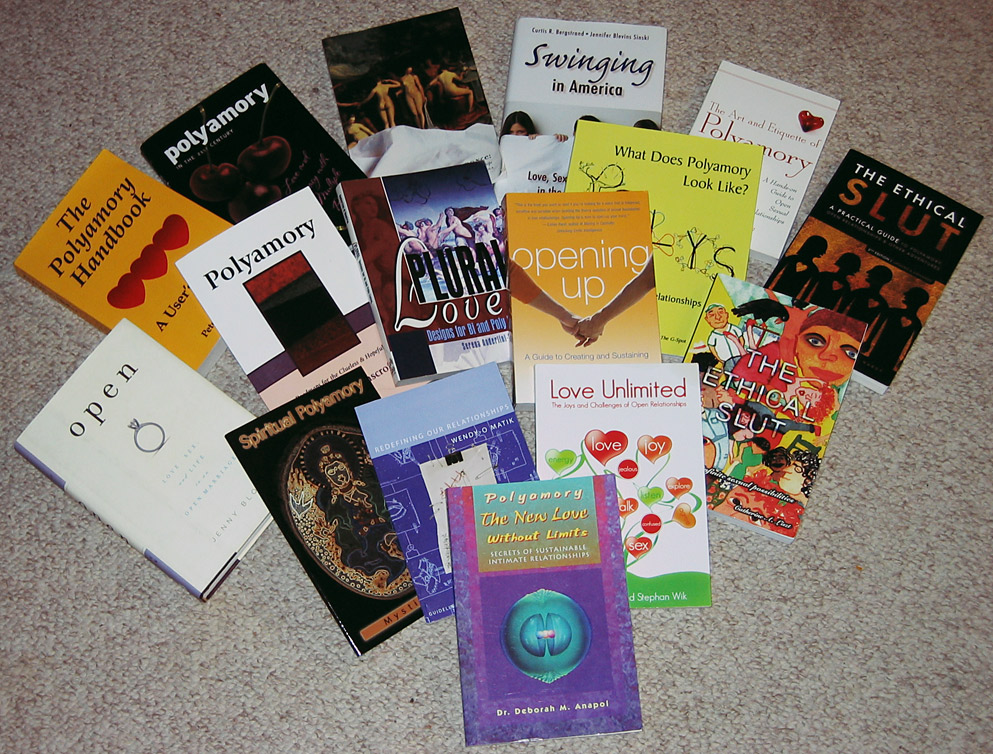
The covers of 16 polyamory books
Sixteen of 'em.

Last updated June 25, 2015.

Here is a descriptive list of every nonfiction book on polyamory published since the movement took shape in the mid-1980s (a few years before the word was coined in 1990 and 1992).

The criteria for inclusion are:

"Nonfiction books entirely or substantially about polyamory as it's understood by today's movement, published since 1984, in English, in a printed edition."

Too many to choose from? I've highlighted my top general-interest recommendations with green bullets.

The titles link to my own reviews and roundups for ten of them, otherwise directly to Amazon or the publisher. The descriptions are mine except as quoted.

This is a much-updated repost of the booklist I created a few years ago. I plan to keep this list up to date forever (now with this same URL).

Interesting statistic: Of all the authors and co-authors, 33 are women, 11 are men, and 1 is FtM trans. That's nearly a 3-to-1 ratio of women to men.

In reverse date order:

The Game Changer: A memoir of disruptive love, by Franklin Veaux (Thorntree Press, September 2015). This is the author's poly relationship autobiography, describing the people and experiences that led him, over the course of his life, to develop the philosophy and principles of ethics that led him to become the world's most-recommended polyamory blogger and co-author of the latest "poly bible," More Than Two. From the publisher's description: " 'I have a question,' Amber would say. And what came next would send a wrecking ball through Franklin and Celeste's comforting illusions. Amber was the first of Franklin’s polyamorous secondary partners to insist on being treated like a person, and the first to peel back the layers of insecurity and fear that surrounded their relationship. Amber was a game changer.

This book is the true story of a game-changing relationship that changed not only Franklin and Celeste’s lives, but the face of the modern polyamory movement."

Fraught Intimacies: Non/Monogamy in the Public Sphere (Sexuality Studies Series), by Nathan Rambukkana (University of Washington Press, June 2015). From the publisher's description: "Non-monogamy is everywhere: in popular culture, in the news, and before the courts. In Fraught Intimacies, Nathan Rambukkana delves into how polygamy, adultery, and polyamory are represented in the public sphere. His intricate analysis reveals how some forms of non-monogamy are tacitly accepted, even glamourized, while others are vilified and reviled. By questioning what this says about intimacy, power, and privilege, this book offers an innovative framework for understanding the status of non-monogamies in Western society." This is an expensive book from an academic press; get your university library to do the buying.

The Husband Swap: A true story of unconventional love, second edition, by Louisa Leontiades (Thorntree Press, May 2015). Louisa Leontiades — born in Cyprus, raised in England, and living in Sweden — is a passionate, prolific, articulate writer on the poly internet. This is her novelistic memoir of the tumultous, intimate, but ultimately failed quad that launched her and her husband on their current poly trajectory. A reviewer comments, "For my solo poly lifestyle, I find the story aching with couple- and poly-normativity, but really, this can be forgiven since this is a memoir and it's highly unlikely that anyone entering into polyamory for the first time wouldn't try it this way." This is Thorntree Press's edited, faster-paced condensation of the first edition, which was published in 2012.

Love's Refraction: Jealousy and Compersion in Queer Women's Polyamorous Relationships, by Jillian Deri (University of Toronto Press, March 2015). Publisher's description: "In Love’s Refraction, Jillian Deri explores the distinctive question of how and why polyamorists – people who practice consensual non-monogamy – manage jealousy. Her focus is on the polyamorist concept of “compersion” – taking pleasure in a lover’s other romantic and sexual encounters. By discussing the experiences of queer, lesbian, and bisexual polyamorous women, Deri highlights the social and structural context that surrounds jealousy. Her analysis, making use of the sociology of emotion and feminist intersectionality theory, shows how polyamory challenges traditional emotional and sexual norms. Clear and concise, Love’s Refraction speaks to both the academic and the polyamorous community. Deri lets her interviewees speak for themselves, linking academic theory and personal experiences in a sophisticated, engaging, and accessible way." 155 pages.

More Than Two: A Practical Guide to Ethical Polyamory, by Franklin Veaux and Eve Rickert (Thorntree Press, September 2014). For more than 15 years Franklin Veaux has run one of the world's most read and linked-to poly advice websites (now named More Than Two). But the material in the book is new. This is the first practical guide aimed directly at what Franklin calls the "second wave" of the poly movement: the growing influx of people since about 2010 who have been learning of poly not through alternative cultures but through more mainstream channels, and who are therefore blundering into every stereotypical mistake. (He gets mail. Lots of mail.)

More Than Two is a firmly grounded presentation of the poly-community wisdom that has evolved, through bitter trial and error, about what works and doesn't. And especially, why. Short version: Self-knowledge, communication, and high ethics (defined largely as respect for other people's agency) are not nice extras, they are nearly mandatory for walking the multidimensional tightropes of poly webs without crashing. At 496 pages, the book delves deeply into many topics and strategies based on the authors' experiences and mistakes (which they tell in lots of interspersed stories). These experiences, and those of many other people, led them to derive their foundational philosophy for good relationships of any kind, monogamous included. See the book's website. Disclosure: I'm biased; I edited the book.

Eight Things I Wish I'd Known About Polyamory (Before I Tried It and Frakked It Up), by Cunning Minx (Do The Work, July 2014). Cunning Minx is the creator and hard-working host of the popular Polyamory Weekly podcast, which she began in 2005; it's about to hit its 400th episode. She presents workshops and seminars on ethical non-monogamy at poly conferences and other sex-positive venues, and has counseled thousands of people on the air and in person. One of her most popular classes is "Eight Things I Wish I'd Known About Polyamory (Before I Tried It and Frakked It Up)," about lessons learned in her first years of it. She expanded the notes of the talk into an e-book, then self-published it as this 84-page paperback.

It's snappily written, covers a lot of poly wisdom fast and efficiently, and flows as smoothly as her podcast sounds. Topics include “poly as a custom job,” “write your user manual” (with a template for doing so), “Minx's hot communication tips”, “emotional ownership”, “make guidelines not rules”, “NRE is fun”, and “you don't have to do it alone.” Here's a review by poly author Louisa Leontiades. The printed edition's internal design bears the common stigmata of self-published books (smallish type, too-wide margins, etc.).

Love Alternatively Expressed: The Scoop on Practicing Polyamory in Canada, by Zoe Hawksworth Duff (Filidh Publishing, March 2014). This is the self-published "story of a woman who, along with her partners, has been a Canadian public face for the cause of legal recognition for the loving poly families who raise healthy children in homes where many adults share one love. Her affidavit along with members of four other Canadian families was presented to the BC Supreme Court in the 2010 reference case on Section 293 of the Criminal Code of Canada (the Polygamy law). She shares her experiences and wisdom in an entertaining and informative read" (publisher's description). Contains much on the 2010–11 legal saga establishing that informal polyamory (unlike polygamy) is legal in Canada. The design has the common problems of self-published books (small type, too-wide margins, etc.).

The Polyamorists Next Door: Inside Multiple-Partner Relationships and Families, by Elisabeth Sheff (Rowman & Littlefield, Nov. 2013). In this long-awaited book, sociologist Elisabeth Sheff presents her conclusions and insights from 15 years of studying poly people and households, and especially their children. While the subjects of her book sometimes show their flaws and awkwardnesses in the clarity of word-for-word-transcripts, overall she finds the adults of her study to be highly capable and mature and their children to be at least as thriving and robust as the average, probably more so. Here's more.

The Jealousy Workbook: Exercises and insights for managing open relationships, by Kathy Labriola (Greenery Press, Sept. 2013). The poly movement has long outgrown its early utopian idea that good polys don't get jealous. Today the community universally teaches that jealousy is normal, and what matters is how everyone understands and handles it. The conventional wisdom is that breakthroughs can come from examining and analyzing it: sometimes by rooting up your own fears and insecurities to analyze under bright light — and sometimes as a valuable early-warning signal that some real problem exists external to you, sensed by the gut before your conscious mind sees it.

Kathy Labriola has professionally counseled hundreds of poly individuals and groups in the Bay Area for more than 20 years. Drawing on this long practice, she has compiled a big (8½ by 11 inch) open-relationship jealousy workbook. It presents 42 practical exercises. They are embedded in chapters on figuring out whether an open relationship is right for you, understanding your jealousy and its roots, determining its triggers, determining whether it may be rational for the situation at hand, and intervention strategies both for managing jealousy and for addressing common external problems. The book includes chapters on best-practice communication skills for polyfolks, and jealousy tips and techniques from other professionals with expertise in open relationships.

Not Your Mother's Playground: A realistic guide to honest, happy, and healthy open relationships, by Samantha Fraser (Creative Junction, May 2013). Samantha Fraser is an outspoken poly activist in Toronto, organizer of Toronto's annual Playground conference, and keynote speaker at Canada's first PolyCon. She and her husband proudly represent the swinger/poly interface. This book presents her many insights on the practicalities of making open relationships work, drawn from her abundant personal experience. If you don't like small print, get the Kindle or ebook edition.

Polyamory and Pregnancy, by Jessica Burde (CreateSpace Independent Publishing Platform, March 2013). Burde is the mother of three children born into polyamorous relationships, has lived in polyfamilies for much of the last 10 years, and has seen a great deal of the good and the bad. She discusses many  considerations you may not have thought of, starting before conception and continuing through birth. Burde runs the thoughtful Polyamory on Purpose blog of practical information and advice. The book is the first in a series of Polyamory on Purpose Guides that she plans to publish. Future titles, she says, include The Poly Home, Safer Sex for the Non-Monogamous, and Raising Children in Polyamory.

Rewriting the Rules: An Integrative Guide to Love, Sex and Relationships, by Meg Barker (Routledge, September 2012). This is an insightful self-help guide to digging out unexamined social assumptions that govern your relationship life, looking at them directly, and deciding which to keep and which to remake. Barker has long been a poly activist as well as an academic and relationship therapist. The mono-or-poly choice is only one of seven relationship topics that she presents for readers to examine, but all of them are important for poly living. Review by Louisa Leontiades.

The Art and Etiquette of Polyamory: A Hands-on Guide to Open Sexual Relationships, by Françoise Simpère (Skyhorse Publishing, February 2011). Simpère is a widely published and quoted open-relationship advocate in France. This is a translation of her Aimer Plusieurs Hommes (2003). Writes Franklin Veaux: "Describes the author's process of coming to her own polyamorous arrangement, and talks about the rules and ideas that keep her relationships healthy and happy. It's written from a very specific perspective (long-term couples who want lovers on the side), and as such describes only one particular kind of polyamory."

Power Circuits: Polyamory in a Power Dynamic by Raven Kaldera (Alfred Press, December 2010). From the publisher's description: "Power Circuits is an alliance between two alternative lifestyles: polyamory... and power dynamics: relationships that choose to be consciously and deliberately unequal in power, such as dominant/submissive or master/slave.... Navigates the waters of effective polyamory and power exchanges, with many essays from the brave practitioners who swim there."

Love in Abundance: A Counselor's Guide to Open Relationships, by Kathy Labriola (Greenery Press, October 2010). Labriola is a nurse and counselor in the San Francisco Bay Area who has professionally advised hundreds of poly families and groups and observed the poly scene for more than 20 years. She offers distilled practical advice for poly problems from this long experience. See review by The Unlaced Librarian/ Leandra Vine (Jan. 5, 2015).

What Does Polyamory Look Like? Polydiverse Patterns of Loving and Living in Modern Polyamorous Relationships, by Mim Chapman (iUniverse, August 2010). When people say "I'm poly," they may mean very different things. This is a lighthearted but serious guide to navigating among five major styles of polyamory widely practiced in the community today.

Love Unlimited: The Joys and Challenges of Open Relationships, by Leonie Linssen and Stephan Wik (Findhorn Press, August 2010). A relationship coach in the Netherlands who specializes in multipartner counseling describes the commonest recurring patterns and problems among her clients, and means to their resolution. She devotes 12 chapters to 12 composite case histories, with very different people and situations.

Polyamory in the 21st Century: Love and Intimacy with Multiple Partners, by Deborah Anapol (Rowman & Littlefield, July 2010). One of the founding mothers of the modern polyamory movement in the 1980s and 1990s takes a careful, sociologist's look at the state of the movement she helped to create.

Border Families, Border Sexualities in Schools, by Maria Pallotta-Chiarolli (Rowman & Littlefield, June 2010). A health and social-development professor in Australia "explores the experiences of bisexual students, mixed sexual orientation families, and polyamorous families in schools."

Understanding Non-Monogamies, edited by Meg Barker and Darren Langdridge (Routledge, 2010; in paperback 2013). An academic collection of 25 papers and essays on styles of open relationships in various cultural contexts, especially in different parts of today's poly culture.

Beyond Monogamy: Lessons from Long-Term Male Couples In Non-Monogamous Relationships, by Lanz Lowen and Blake Spears (free ebook February 2010; issued in paperback March 2012). This is a comprehensive report on the authors' famous Couples Study of gay couples and their approaches to nonmonogamy. A small number were living in triads or other poly families, and a larger number had considered such arrangements. The authors' description: "Although non-monogamy is prevalent in the gay community, information about how couples navigate this terrain is surprisingly lacking. As a long-term couple (36 years) we had experienced ups and downs and an on-going evolution in our approach to living in a non-monogamous relationship. We were curious about the experience of others and assumed many long-term couples might offer valuable perspectives and hard-earned lessons. The study summarizes data from the 86 couples we interviewed and provides many verbatim quotes illustrating themes, issues and things to consider."

Swinging in America: Love, Sex, and Marriage in the 21st Century, by Curtis R. Bergstrand and Jennifer Blevins Sinski (Praeger, November 2009). The first 40% of this book is a study of the swinger subculture and the people in it. The second 60% is a critique of monogamous ideology in Western society, and this, Bergstrand has told poly conferences, he considers to be the most important part of the book.

Many Hearts, Many Loves, Many Possibilities: The Polyamory Relationship Workbook, by Christina Parker (Alfred Press, 2009). From the publisher's description: "This book provides a tool for everyone seeking to look beyond their fears, fantasies, and stereotypes and step into the reality of polyamory relationships.... A combination of information, insight, and detailed questionnaire, it is designed to help people get a clear understanding of who they are, what they want, and what they need in order to maintain a fulfilling relationship of any kind."

Gaia and the New Politics of Love: Notes for a Poly Planet, by Serena Anderlini-D'Onofrio (North Atlantic Books, September 2009). This ethereal, philosophical polemic for multiple love as an opening to saving the world spends much of its time diverted into embarrassing New Age HIV denialism.

The Ethical Slut, Second Edition; A Practical Guide to Polyamory, Open Relationships & Other Adventures, by Dossie Easton and Janet W. Hardy (Ten Speed Press, March 2009). Expanded by 30% and now aiming for a wider audience, this is a new edition of the 1997 word-of-mouth classic published by Greenery Press (for which Hardy used the pseudonym "Catherine A. Liszt"). It is still the most popular book on the networked or "free agent" model of poly — though it now includes an added chapter on opening an existing couple relationship.

Opening Up: A Guide to Creating and Sustaining Open Relationships, by Tristan Taormino (Cleis Press, May 2008). If The Ethical Slut was the bible of free-agent "single" poly, Opening Up became the top choice for couples looking to open an existing committed relationship — of whatever sort. Tristan Taormino, a brassy star among America's sexerati, did exhaustive work interviewing more than 100 people and couples in a dizzying variety of open and poly arrangements successful and not. Learn from them.

Open: Love, Sex and Life in an Open Marriage, by Jenny Block (Seal Press, May 2008). With a husband, daughter, and long-term girlfriend, Dallas writer Jenny Block fearlessly puts herself out as an exemplar of successful open marriage and bold Texas feminism.

The Polyamory Handbook: A User's Guide, by Peter J. Benson (Author House, March 2008). A longtime poly-community stalwart and activist compiles a big, workmanlike guide to every Poly 101 and 201 issue you can think of.

Open Fidelity: An A-Z Guide, by Anna Sharman (Purple Sofa Publications, September 2006). A small book (36 pages) from England. From the cover description: "A brief introduction to most of the important issues around monogamy and non-monogamy, honesty and fidelity. It covers all the plus points of honest open relationships and many of the potential problems, from jealousy and time management to telling your kids – in a simple alphabetical format, with cross-references for easy navigation and quotes from those with lived experience of Open Fidelity." (Now available free online.)

Polyamory Many Loves: The Poly-Tantric Lovestyle: A Personal Account, by Janet Kira Lessin (Author House, 2006). The controversial creator of the New Agey "World Polyamory Association" publishes many of her internet pieces in book form.

Pagan Polyamory: Becoming a Tribe of Hearts, by Raven Kaldera (Llewellyn Publications, 2005). Publisher's description: "Relating polyamory to astrology and the elements (air, fire, water, earth, and spirit), the author addresses all aspects of the polyamorous life, including family life, sexual ethics, emotional issues, proper etiquette, relationship boundaries, and the pros of cons of this lifestyle. Kaldera discusses polyamory as a path of spiritual transformation and shares spells, rituals, and ceremonies." Pete Benson comments, "There is also plenty of good wisdom here about polyamory in general, so if Paganism is not your spiritual path, do not be turned off."

Plural Loves: Designs For Bi And Poly Living, edited by Serena Anderlini-D'Onofrio (The Haworth Press, January 2005). A collection of 18 substantial academic and general-audience essays that, according to the introduction, "point to the effervescence in current bisexuality and polyamory discourse and the benefits of having them resonate with each other."

Polyamory: Roadmaps for the Clueless and Hopeful, by Anthony Ravenscroft (Fenris Brothers/ Crossquarter Publishing Group, 2004). This book is idea-rich, opinionated, idiosyncratic, and resolutely hard-headed — bordering on cynical — but it needed an editor; it's wordy and overwritten. Contains food for thought if you can work past its annoyances. (The bibliography, with commentary, includes books important to the development of poly thought earlier than this present list, from James Ramey back to Joan and Larry Constantine to Robert Rimmer to Wilhelm Reich to Judge Ben Lindsey to... Niccolo Machiavelli??)

The Sex and Love Handbook: Polyamory! Bisexuality! Swingers! Spirituality! (and even) Monogamy! A Practical Optimistic Relationship Guide, By Kris A. Heinlein and Rozz M. Heinlein, no relations to science fiction author Robert A. Heinlein (Do Things Records and Publishing, 2004). I haven't seen this; others call it lightweight and carelessly edited. Publisher's description: "Explores the most sensual sexual organ: the human brain. Explore the emotions, philosophies, risks and rewards of reaching toward your next sexual level. Nothing is out of bounds except dishonesty and hypocrisy." Swinger oriented.

Poly Communication Survival Kit: The Essential Tools for Building and Enhancing Relationships, by Robert McGarey (Human Potential Center, 2004, 2001, 1999). "The goal of this book: to provide in brief and usable form all the basic tools you need in order to communicate well, even in difficult circumstances." McGarey helped to spread learnable methods for excellent communication that the poly culture now widely holds as ideals. Currently available in a new printing (2013) and as an e-book. Says poly coach Dawn Davidson, "It's still good solid information."

Spiritual Polyamory, by Mystic Life (iUniverse, 2003). A small collection of the author's essays and musings to "help you to open your mind and heart to a fresh approach to intimacy."

Redefining Our Relationships: Guidelines for Responsible Open Relationships, by Wendy-O Matik (Defiant Times Press, 2002). An important early poly book among punk, anarchist, and radical street cultures, especially in the Bay Area, where Matic remains active today inspiring and guiding people in alternative relationships. Presents thoughtful guidelines for do-it-yourself relationship structures. Says Franklin Veaux: "Explores the realities of day-in, day-out nonmonogamy, particularly as a conscious political and social act."

The New Intimacy: Open-Ended Marriage and Alternative Lifestyles, by Ronald Mazur (iUniverse, 2000). From the publisher's description: "Now is an opportune and urgent time to give voice to the intimacies of alternative lifestyles, including open marriage.... It is to non-traditionalists, to those ready for new life and love affirmations, that this book is offered with joy. The evolution of human consciousness prepares the way for the unfolding of our universal polyamorous potential. Let the pioneers be unafraid to move beyond the ancient limits of relationships to the new intimacy of responsible erotic freedom."

The Lesbian Polyamory Reader: Open Relationships, Non-Monogamy, and Casual Sex, edited by Marcia Munson and Judith Stelboum (The Haworth Press, 1999). From the publisher's description: "If your own lesbian relationship lies outside the traditional monogamous couple model, you're definitely not alone. You'll find successful models of relationship styles from cover to cover.... Calls upon a broad scope of writers, professional women and academics.... Focuses on the social implications of this love phenomenon, bringing it into a more inclusive circle of discussion for lesbians, educators, and students of sociology and sexology."

Lesbian Polyfidelity: A Pleasure Guide For All Women Whose Hearts are Open to Multiple Sexualoves, or, How to Keep Nonmonogamy Safe, Sane, Honest and Laughing, You Rogue!, by Celeste West (Booklegger Publishing, 1996). Comments Sex Geek blogger Andrea Zanin: "Upbeat, quirky, explicitly feminist, and sprawling in scope, this one’s a mishmash of advice columns, conceptual musings, practical advice and personal insights. A bit essentialist but full of yummy ideas nonetheless."

Polyamory: The New Love Without Limits: Secrets of Sustainable Intimate Relationships, by Deborah Anapol (IntiNet Resource Center, 1997; a revision and expansion of her original Love Without Limits: The Quest for Sustainable Intimate Relationships: Responsible Nonmonogamy, 1992). Deborah Anapol's book was the bible of the early modern poly movement and for some time was practically its only book. She takes a spiritual approach to love and sex that continues to resonate with some people and not others. Introduced seminal insights on jealousy and how to handle it.

Breaking the Barriers to Desire: Polyamory, Polyfidelity and Non-Monogamy – New Approaches To Multiple Relationships, edited by Kevin Lano and Claire Parry (Five Leaves Publications [Nottingham, UK], 1995). From the introduction: "This book will aim to show that 'responsible non-monogamy' can be both a positive choice at a personal level and a radicalising current in society, providing a true alternative to the dependence and exclusion of traditional monogamy and the lack of responsibility and honesty in covert non-monogamy." Writes a reviewer: "There are personal stories, some chunky theoretical pieces, a history of non-monogamy, an article about the life of a non-monogamous woman in the early 1800s, and an exploration of Christian theological justifications for monogamy and polygyny... all in 137 pages."

Loving More: The Polyfidelity Primer, 3rd edition, by Ryam Nearing (PEP Publishing, 1992, 1989, 1984). If there was one central instigator of the modern polyamory movement, Ryam Nearing would be it. Focusing especially on closed polyfidelity, she was the sparkplug who built Loving More magazine and its conferences, the movement's central nexus before the internet. Her early how-to manual The Polyfidelity Primer went through several editions and is now a hard-to-find collector's item.

Permalink

Labels: , , , ,


November 25, 2012

New book: poly activist Meg Barker's Rewriting the Rules

Meg Barker self-portrait.
Meg Barker is a lecturer in psychology at the UK's Open University, a sex-and-relationships therapist, a much-published researcher, co-editor of the journal Psychology & Sexuality, and for many years a poly-awareness activist. She's co-organizer of the UK's annual Polyday and the cartoonist for its website.

Barker has now brought out a deeply radical self-help book: Rewriting the Rules: An Integrative Guide to Love, Sex and Relationships (Routledge, September 2012). It's radical in that it guides readers to discern roots: to dig up unexamined social assumptions that govern your relationship life, look at them in the light, and decide which to keep and which to remake.

From the introduction:


This book takes various key aspects of relationships and, for each one, explores what the existing rules are and why they might not always work so well. It then considers people and groups who have stepped outside those existing rules and what they are doing, exploring what we might learn from such alternatives. However, it also explores the limitations of any new rules and how they can become problematic themselves if held too rigidly. Finally, it explores a third alternative to either grabbing onto existing rules or desperately seeking new ones. This involves staying in the uncertainty of not having clear rules and finding a way to go on which doesn't require grabbing hold of anything.

If that sounds a rather tall order, in reality it means that at least we try to notice when we are grasping onto rules and thus attempt to hold them more loosely.


To illustrate how even the most freethinking people unconsciously take unrealistic templates as their standards, she writes:


We have an image of a normal relationship in our heads in the same way that most people, when asked to draw a picture of a house, draw pretty much the same thing as one another. Try it for yourself.

In the same way that hardly anyone lives in anything that looks remotely like this picture [you just drew], so none of our relationships look much like our idea of 'normal'.


In nine chapters she leads the reader in examining and rewriting the rules of your self-identity; of who you should be attracted to and whom you can attract; of how love is to be done; of sex; of gender; the choice of monogamy or some form of polyamory; how conflicts are done; how breakups are done; and setting the meanings of commitment. She closes with a chapter of practical suggestions for rewriting your rules consciously. This is a deep, thoughtful book — not a quick read but something to take in bites and come back to again and again.

The book has been getting a fair amount of media notice. In the UK's Guardian newspaper for Nov. 9, 2012:


...[Barker] isn't suggesting that we junk monogamy, rather that we realise that long-term monogamous relationships as currently configured aren't so much fulfilments of love's young dream as disasters waiting to happen. In such circumstances, mere monogamy surely cannot bear so much weight.

Should we adjust our parameters? Should we pursue what relationship counselors call the poly grail? Does sex matter to the health of a long-term relationship? Is it OK to give it up?

"We increasingly look for lots of different things in one place – namely the monogamous relationship," says Barker. Why? "Because we have become more and more atomised, work has become more precarious, community bonds have weakened and there has been a decline in religion, so we hope to get everything from one other person."

...Barker... finds in monogamy's very indeterminate rules a space for confusion about what is permissible within a relationship. "One person may think it's all right to stay friends with an ex-partner. Another may think it's all right to flirt with or have sex with another person. Another may think it's OK to look at porn. What's important is communicating so you know what the other expects."

How important is sex in a long-term relationship? Barker says many of the couples who come to her seeking sex therapy expect that she will teach them how to have the great sex they had at the start of their relationship or have never previously enjoyed. "Sex is our whole idea of the barometer of a relationship's healthiness. So sex becomes this imperative. It needn't be."

...Is she saying it's OK not to have sex in a long-term relationship? "For some couples that may work, but not others. One possibility I address in the book is making a 'yes, no, maybe' list of all the sexual and physical practices that they are aware of, and whether they are interested in them. That may help."

Barker counsels periods of solitude in order to work out what you want from a relationship – or if you want out. "It's easy not to think critically about what's happening. It helps to create space to reflect on what you want."...


In another major UK newspaper, The Independent (Sept. 25, 2012):


...[Barker] says there are several differences in today's long-term committed relationships that underpin the need for change. "Number one is that people are living to be a lot older – so a long-term relationship is a much longer deal," she says. "And another thing that's changed is expectations: we require so much more from a relationship than people did in the past.

"There's been a huge growth in the recent past of this idea that you need one perfect relationship; that you will get everything from it – romance and children and financial stability and friendship and a great sex life. No other generation had such huge hopes invested in just one relationship and it is an enormous ask."


On the feminist website Cliterati (Sept. 12, 2012):


...Are all love relationships about two people? Are friendships and romances really that different? Is sex vital to a ‘healthy’ relationship? How important is it to be ‘normal’? Is there such a thing as ‘The One’? Is it realistic to promise that anything will last forever? All these questions are considered but, crucially, Meg doesn’t offer any set answers (cos that would kind of be going against the whole point, see?).

If you’re already in or considering some form of non-conventional relationship, whether non-monogamous, kinky, queer, asexual or otherwise, I would also strongly recommend this book. As Meg herself points out, people who challenge conventional rules can often make the mistake of grasping onto their own alternative ‘rulebooks’ as tightly as do those in the communities they left behind. This book tackles that, offering plenty of practical tips for working out what you really want and how you can make sense of that with the people in your life, without getting drawn into just another role that doesn’t really fit.


At the blogsite Sex Critical (Nov. 20, 2012):


In a particularly brilliant passage, Barker uses her experience of place and time to suggest analogously a different way of thinking about the value of maintaining constancy within relationships, and thereby to question the universal value of monogamy and life-time commitment:


I think about my own relationship with cities. When I moved out of London, for example, I found that London and I were much better together when we were in a long-distance relationship than when we rubbed up against each other every day.

Consider times of day: I used to have a relationship with the time between midnight and two in the morning: a loose, rumpled time of fuzzy edges, drunken camaraderie with strangers and greasy gutters. We broke up and I hardly ever see that time any more, but I do have a new relationship with the time between six and seven a.m.: it is a sharp, silvery grey, raw and empty time, but I am growing to love it.


Such passages are genuinely subversive in their at once light and suggestive, yet ideologically devastating, destabilization of the dogmas by which so many live — and suffer.


In the Wales Art Review (November 2012):


Barker then explores how in fact, there are continua in regard to how much sexual and/or physical contact a couple has, how close they are emotionally to one another and to others outside their relationship, how much they might disclose, what sort of boundaries they have, how much freedom people in relationships have, and so on. She writes that where problems may occur in relationships is that people assume that they are at the same place on the various continua, and then discover that they are not. It turns out that the assumptions they thought they shared were not shared at all.


At The Dinah Project (Oct. 10, 2012):


...The unrelenting order of each chapter got a bit tedious: what are the rules, why question the rules, alternative rules, and beyond the rules. Whereas this may be a good structure for a presentation, I found that it forced the author to state the obvious too many times.

Some chapters worked particularly well; the chapter on sex, the one on commitment and the conflict chapter were excellent, perhaps because she negotiates these tricky areas very skillfully and with a good deal of openness to their wide range of possibilities. In other chapters, such as gender and love, the result is simplifications of very complex issues which do not go beyond the superficial.


Here are links to many more reviews and notices, at the book's website.

Most of this is happening in Great Britain. Rewriting the Rules deserves more attention here in the US.

Here's Barker discussing the book on Tristan Taormino's "Sex Out Loud" podcast (Nov. 30, 2012) and on the Feminist Current podcast (Dec. 14, 2012).

------------------------------------

Two years ago Barker co-produced another poly-related book, Understanding Non-Monogamies (edited by Meg Barker and Darren Langdridge; Routledge, 2010). This one is an academic collection of 25 papers and essays on styles of open relationships in various cultural contexts, poly culture in particular. The introduction, table of contents, and large bibliography are online (click "see inside").

------------------------------------

Added December 2013: She does a TEDx talk, including the Repeating Crab Bucket phenomenon versus Embracing Uncertainty (12 minutes).

[Permalink]

Labels: , , ,


May 15, 2011

Recent Poly Books, 3:
Love Unlimited

Six new books on polyamory have come out in the last year and a half (as far as I know). I've reviewed two of them so far:

Polyamory in the 21st Century: Love and Intimacy with Multiple Partners by Deborah Anapol, and

What Does Polyamory Look Like? Polydiverse Patterns of Loving and Living in Modern Polyamorous Relationships by Mim Chapman.

The others are:

Love Unlimited: The Joys and Challenges of Open Relationships, by Leonie Linssen and Stephan Wik,

Swinging in America: Love, Sex and Marriage in the 21st Century, by Curtis R. Bergstrand and Jennifer Blevins Sinski,

Love in Abundance: A Counselor's Guide to Open Relationships, by Kathy Labriola, and

The Art and Etiquette of Polyamory: A Hands-on Guide to Open Sexual Relationships, by Françoise Simpère.

Let's take a look at the next on this list:

--------------------------------

Love Unlimited: The Joys and Challenges of Open Relationships, by Leonie Linssen and Stephan Wik. Findhorn Press, 2010.

Leonie Linssen is a relationship coach in the Netherlands, bi and poly herself, who specializes in clients with multi-relationship situations. She has counseled hundreds of people, and certain repeating themes stand out. Love Unlimited, coauthored with Stephan Wik (translated from their Dutch edition) presents the detailed stories of 12 representative individuals, couples, and groups who came to her with multi-love problems. Each gets a chapter, following how Linssen and her clients examined situations and worked toward resolutions.

Each chapter ends with a list of questions you might ask yourself in similar situations, and tips for progressing on a particular problem highlighted. Wik adds sections looking at larger philosophical, historical, or spiritual aspects of the topics that have been raised.

A Special Calling

Linssen found her way to her counseling role late. "I grew up in a small Dutch village with an upbringing based on monogamy, strict rules, and the Catholic faith," she writes. As a result, "My childhood concepts of love and relationships were rather romantic and bore no relationship to who I actually was." Not until age 40 did she face up to her bisexual and poly nature and start consciously constructing her life.

"Someone who wants to live a life based on true personal authenticity first has to have the courage to be who he or she really is," she continues. "For many of us, this is an in-depth process that first involves discovering how to come in contact with our own inner source of truth, our own being." Her own transformation was so powerful and difficult "that I decided I would like to share my experiences and, if possible, be of service to others grappling with the same issues."

So she went back to school, earned a degree in counseling, and in 2005 opened her own coaching practice, Verander je Wereld ("Change your World"). She is now a pioneer in poly coaching in the Netherlands and has made many media appearances.

The case studies come from both avant-garde and mainstream society. They include a women seeking to make a successful poly-and-single life for herself with her several very different lovers; a conventional woman in a conventional marriage confused and devastated by falling in love with someone else; couples recovering from cheating; a married woman attracted to other women whose husband disapproves; a couple opening their marriage together; two couples investigating swinging together and perhaps more; a mono-poly couple breaking up; an otherwise fine marriage that has gone sexless, with a possible agreement for one spouse to go outside for sex; and a full, three-way poly triad seeking to construct their pioneering way of life.

In each case Linssen is careful to put her clients' interests ahead of her assumptions or agendas. For instance, a woman with a conservative Christian husband ultimately decides to put aside her unexpected love for another and to cleave to her husband and the way of life she has sworn herself to. Linssen helps guide her to resolution in making this choice.

Each case study is presented at length, possibly more length than you'd like unless you're really interested in people. But that's who the book is for — especially those who face similar problems in their own lives, and especially other therapists who want to see how a variety of poly and extramarital situations can be handled in a non-judgmental way based on the clients' own wishes, needs, and values.

Anyone can benefit by considering the self-examinations and exercises suggested at the end of each chapter. Examples are the "see it through my eyes" exercise, tips for developing autonomy, tips for setting boundaries, making clear agreements, active listening, recognizing codependence, and developing an effective complementary sexual relationship even with different desires and needs. And some of the characters portrayed along the way may stick with you forever.

You can read the (very detailed) table of contents and more of the book online.

Here are some audio interviews about the book that Linssen did in the U.S. (with Monika Thomas and Susan Block) and in the U.K. (with Mike Vitalis and Julia Armstrong).

She and the book have appeared in many more articles, radio, and TV reports in the Netherlands; for links see the entire right-hand sidebar here.

[Permalink]

Labels: , ,


February 6, 2011

Recent Poly Books, 2:
What Does Polyamory Look Like?

Six new books on polyamory have come out in the last year or so (in English), as far as I know. In July I reviewed Deborah Anapol's Polyamory in the 21st Century: Love and Intimacy with Multiple Partners. It's high time I got on with the others. They are:

What Does Polyamory Look Like? Polydiverse Patterns of Loving and Living in Modern Polyamorous Relationships, by Mim Chapman (iUniverse, August 2010).

Love Unlimited: The Joys and Challenges of Open Relationships, by Leonie Linssen and Stephan Wik (Findhorn Press, August 2010).

Swinging in America: Love, Sex and Marriage in the 21st Century, by Curtis R. Bergstrand and Jennifer Blevins Sinski (Praeger, November 2009).

Love in Abundance: A Counselor's Guide to Open Relationships, by Kathy Labriola (Greenery Press, October 2010).

The Art and Etiquette of Polyamory: A Hands-on Guide to Open Sexual Relationships, by Françoise Simpère (Skyhorse Publishing, February 2011).

I hope to get to all of them in the coming weeks.

--------------------------------


Let's start with What Does Polyamory Look Like?

Mim Chapman is one of the liveliest presenters I've met at poly conferences. She's a former Alaskan fishing-boat captain, marine salvager, civil rights activist, schoolteacher, middle-school principal, creator and star of the "Vagina-Penis Dialogues," board member of Loving More and of Unitarian Universalists for Polyamory Awareness, lifelong observer of the poly world, and all-around character. If you saw the six-foot-tall vulva costume walking around Burning Man, that was her inside it.

"I really wrote this book to expand our vocabulary," she told the crowd at a book-signing dinner at the Poly Living conference in Seattle in October 2010. "I've discovered there can be as much difference between two visions of poly — two ways of doing it — as there is between poly and mono. And if I didn't have a vocabulary to explain my vision of polyamory, there were probably other people in the same boat."

To fill this need, the book describes "five of the more common relationship formats that I've observed in the poly world," gives them cute names and initials, and devotes a chapter to each. They are:

P: Plural Poly Pairs. This is the most common form. It's the one in which a couple, usually a husband and wife, remains primary. One type of Plural Poly Pair is the open marriage, in which two life-bonded people also have secondary pairings. But the category, as Mim defines it, includes anyone who prefers to stick with dyads (regardless of how many of them), with each being its own entity and not having much to do with the others. "Think of the things that change for you when 'I' becomes 'me and thee,' " Chapman explained to the audience. "Yes, you lose some freedom. But you have that wealth of having another mind, another body, another outlook on the world." "P" people experience a variety of separate partners bringing their different outlooks and experiences of life.

O: Old Fashioned Grok. Chapman calls this the "We Poly" model: a circle of people all in it together, a communal group like Stranger in a Strange Land waterbrothers. In such a group, Chapman said, "when things interact they build on each other exponentially." (For both joy and misery, I might add.) This is her own poly dream situation, and mine too. People live together as family, or nearly so, often sharing resources, child rearing, each other, and pretty much all of life. New members are brought in by consensus. Members of the group often have little time or inclination to pursue outside relationships.

L: The Loving Triad. Think of a Grok circle of just three. Sexually it's likely to be a vee rather than an equilateral triangle; even in the bisexual-rich poly world, the odds (at least on paper) are only 15 to 20 percent that two random same-sex people in a triad will both be bi [1]. But regardless, in this model the two ends of the vee share a kinship bond as chosen family. Like a larger "O" Grok circle, they may live together and share finances and child-rearing. The Loving Triad may enlarge into an "O" or split out into a "P," but Chapman claims that it's generally the most stable poly form.

Y: Yikes — Lots of Poly. Most people call this "network poly." It seems to be the fastest-growing kind, and it's the variety that seems to me to be the most stable overall. In this model a partner is likely have other partners who have others who have others, in a large relationship web or "polycule." Much of the network may all socialize together, so that even people with several degrees of separation know each other as part of the community. With so many relationships in the network, some are likely to be forming and ending at any given time, but a large enough network can absorb such readjustments without breaking — especially because network poly necessarily puts a high premium on good behavior and getting along well with exes. Gossip spreads, and someone who violates those norms tends to find him- or herself left out in the cold. Sometimes, close examination will show that there's a core person or group making the network cohere.

S: Sensuous Poly Snakes. This is a less interlocked version of a network. Think of an N, a W, or longer zigzags. Person A is linked to B who's linked to C who's linked to D, and so on. Beyond two or three degrees of separation, people may have little or no knowledge of each other.

For each of these five models, Chapman gives detailed accounts of what she has seen over the years: the benefits of the model, its characteristic difficulties, the agreement issues that it tends to involve (such as STI protections and protocols), the most effective ways of introducing new members, the model's particular etiquette, and the ways it most commonly morphs into another form.

I found this systematic comparison rather clarifying. It will certainly help newbies understand what to realistically expect and, more importantly, help them decide what they're actually looking for. When someone just says "You're poly? I'm poly too!", this doesn't come close to telling the things you need to know about their actual goals, hopes, and expectations.

The book's next chapter, "Choices: Dreams, Fantasies, Life Goals," addresses this problem head-on. Poly life comes in so many forms that each relationship is a do-it-yourself construction. Are you a free-agent poly single? Look for positions as a secondary to "P" couples or part of a "Y" network, suggests Chapman. Are you a family-formation poly, with dreams of a shared home, lives, and kids? Look for fellow "O" and "L" polys. Are you okay with a partner taking a new lover without consulting you, or not? Do you adore puppy-pile sleeping arrangements, or do you find more-than-twosomes distracting? Ask.

Chapman ends with practical strategies for collaborative decision making, and some fun celebrations and rituals — including the fluid-bonding ceremony she and her two triad partners performed together in 2002. "Props: 1 condom, unrolled; 3 candles; a lighter or matches; scissors; a bottle of wine or water; a nice pottery cup; background music; video camera; cell phone." Read the book to learn how it went.

------------------------

You can read the first several pages online at Amazon.

An excerpt from a little farther in:


Polyamory is sometimes described as many ways of loving, not just many loves.

...In the first chapter, I shared my personal history and how I discovered the word polyamory. Unfortunately, once I discovered the word, I had a precise picture of poly in my mind. It was what I’d been fantasizing about and working toward for my entire adult life.... My dream was of five or maybe seven loving people living in a big round house where each person had a small private space linked to the inner common living room, kitchen, library and music room.... Together, we’d learn and love and brainstorm great plans....

Then I actually met some poly people, and fell in love with a couple who also knew exactly what poly looked like, and it wasn’t my hippie commune!

At a poly conference in California, I met a charming polyamorous man who fell in love with me.... He also knew exactly what poly looked like... him and two hot bi babes who would live with him on his sailboat and be sister galley slaves. There would be no debate or conflict, because they would love and obey their wonderful Master, and together they’d sail the world in euphoric bliss.

In doing relationship coaching with a wide variety of couples across the country, I’m starting to hypothesize that the difference between the dreams and goals of two people with different visions of polyamory can be just as far apart as the difference between two people whose dreams are of monogamy and of polyamory. Not only are the goals diverse, but the partnership agreements, the commitments, and the social etiquette related to things such as how a new person is brought into relationship all vary with the type of poly relationship.

...As I got to know more people and to see the types of relationships they had formed, some patterns started to emerge. I realized that if we became aware of the rich diversity within poly and had a vocabulary to describe the types of poly relationship models that we wanted, we would more readily be able to communicate our dreams to potential new partners, and to ourselves.


Here's another review of the book, by a type "L" guy in an MFM triad who consider themselves married. He runs the blog Polyandry Press.

[Permalink]

Labels: , ,