Polyamory in the News
. . . by Alan M.


April 19, 2016

"Polyamorous women aren’t just ‘pleasing their man’ – it’s a choice"

The Guardian

Author Laura Smith, writing from a feminist viewpoint in today's Guardian, defends polyamory against some classic criticisms from the clueless.

With an emphasis on the most-famous-ever feminist open couple.


Polyamorous women aren’t just ‘pleasing their man’ — it’s a choice

The open relationship between Simone de Beauvoir and Jean-Paul Sartre is frequently and wrongly written off. Such arrangements have women-friendly roots.

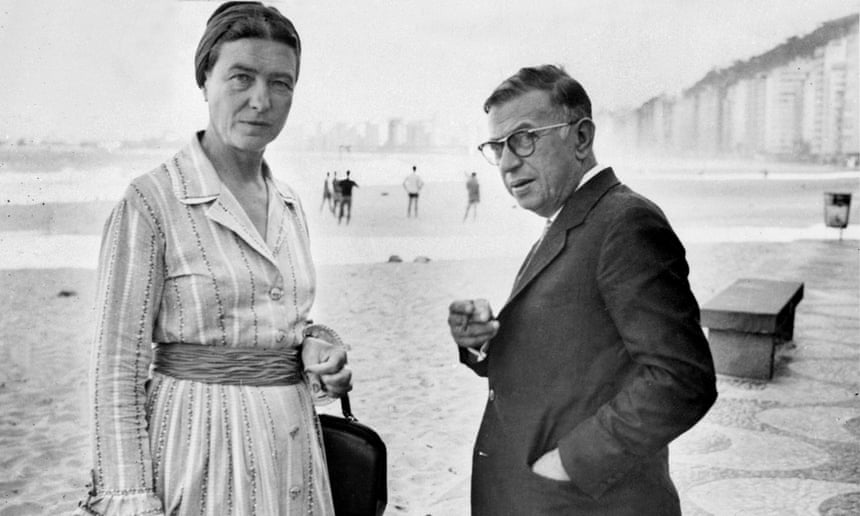
Simone de Beauvoir and Jean-Paul Sartre were together for 51 years, until Sartre’s death in 1980. (STF/AFP)

By Laura Smith

“People have had open marriages for ever … But they never end up working long-term.”

That statement by the biological anthropologist Helen Fisher must have been news to Simone de Beauvoir, the famously non-monogamous French feminist existentialist.

Fisher’s pronouncement, quoted in the New York Times recently, would also be questioned by the numerous celebrities said to have “arrangements”, and the half million or so of Fisher’s fellow Americans giving polyamory a try.

De Beauvoir considered her open relationship with Sartre the “one undoubted success in my life”. In terms of longevity, they had about half of us beat: their relationship, which allowed for affairs while they remained essential partners, lasted 51 years until Sartre’s death in 1980. Now, 30 years after De Beauvoir’s death, many of the criticisms of polyamory are rooted in the same stifling beliefs about female sexuality that she strove to dismantle in her day.

Take for example, the bias that “women only open up their relationships to please variety-seeking men”, which Anna North admitted was often assumed to be the case in an article on why we should be less “freaked out” by polyamory.... At the core of the assumption that non-monogamous women are doing what men want – not what they want – is a more pervasive assumption about female sexuality: it is men who have complex sexual needs, not women.

But as Libby Copeland argued, polyamory has woman-friendly roots: “Free love rejected the tyranny of conventional marriage, and particularly how it limited women’s lives to child-bearing, household drudgery, legal powerlessness, and, often enough, loveless sex.”

In an article on straight poly-relationships in Seattle, Jessica Bennett writes that, “the community has a decidedly feminist bent: women have been central to its creation, and ‘gender equality’ is a publicly recognised tenet of the practice”.

The actress Mo’Nique says that her open relationship was her idea. Simone de Beauvoir didn’t see herself as a tag-along polyamorist either. Attracted to both men and women, her open relationship meant that she didn’t have to choose between them. She felt the “urge to embrace all experience”, saw the ability to act on desire as essential to liberating oneself from male sovereignty, and was seeking to answer the question that we still grapple with today: “Is there any possible reconciliation between fidelity and freedom?” Polyamory, according to Copeland, was not just about sex, but about “remaking one’s own little corner of the world”, a terrifying prospect to those who want the world to remain the same, especially when it comes to established gender roles....

Read the whole article (April 19, 2016).

[Permalink]

Labels: , ,


November 24, 2008

Jean-Paul Sartre's play No Exit as a poly fable

So a while ago Sparkler and I went to see a production of the play No Exit. Even if you've never heard of it, you've probably heard Jean-Paul Sartre's signature line from it:

"Hell is other people."

I came away thinking something I've never seen anywhere: that Sartre surely wrote the play with a polyamory theme in mind, which reviewers and commentators have missed over the years because they didn't lead Sartre's poly life.

So here goes. (If you're not into lit-crit type stuff, move along now, nothin' to see here....)

---------------------

The play goes like this. Three strangers, freshly dead and just arrived in Hell, are escorted by a demon valet into a nice hotel room, where they will be sealed up together for all eternity. They are a man and two women, one of them a lesbian. Within the first hour and a half they are trying to kill each other and themselves, using a letter-opener that the managers of Hell thoughtfully left in the room for them. Only to discover that in Hell, you can't even die. Bwahahaha!

I'd never seen the play performed before. But I knew about it ever since I had deep discussions of it in high school with my first love, when I was 16. (Sartre was taught in high school back then.) I insisted to her that if hell is other people, heaven must be too. The difference is all up to us.

Watching the play, it became clear that the hotel room is meant to be not a hell but a purgatory, a place where salvation is still possible — if the characters could only get it together. For instance: early on, when the characters realize that they are intended to be each others' torturers (no demons required), the man proposes that they can beat the system and save themselves by sitting silently apart from each other in the corners and contemplating repentance.

Of course they can't keep this up for long. The lesbian behaves as a vicious domme toward the bubblehead socialite girl; the socialite displays stupid hots for the guy; the guy is disgusted with her but goes along with it in order to spite the jealous lesbian to her face.

Along the way, we learn that a defining sin for each of these three people in life — a reason why each one has been sent to Hell — was his or her behavior in a truly horrid triangle relationship of one sort or another. And here they are locked together forever, in another three.

Now, Sartre had one of the first famously open relationships involving threesomes: with his lifelong partner, Simone de Beauvoir (though he's often judged to have treated her poorly.) I looked up some biography, and found that the two of them at times brought a third partner into their couple relationship. In fact, says a recent biographer, de Beauvoir's own first novel, She Came to Stay, "was based on the trio that she and Sartre formed with a younger woman called Olga Kosakievicz." And if I'm reading the history right, Olga was apparently in the first group of three actors to rehearse No Exit when Sartre wrote it!

So Sartre was quite familiar with living and functioning in MFF threes (yes, de Beauvoir was actively bi). And even when not in one, he and de Beauvoir (their relationship lasted 50 years) famously agreed to tell each other everything about their other lovers.

This had to affect his thinking and writing about bound-together, sexually interested threes.

I say that No Exit has a little-noticed poly message that's quite different from the unrelenting bleakness that most people see in Sartre. If the characters were literally at each others' throats 90 minutes after their arrival in the room, where will they be after a year in there, or 20 years, or 600? Their hell was arranged to fit their sins. It is up to them to redeem themselves: by learning to treat partners in a triad with the love and kindness and devotion they failed to show in life, and thus create their own salvation there in that room — since they'll be in it for eternity. If they want to get to heaven, this is where they must make it, themselves.

Consider: Sartre makes a big point of stating that the room is furnished with no mirrors, and that even the women's make-up mirrors have vanished out of their purses. Therefore, as he has a character say, the only way they can ever see themselves again is by the tiny reflections that show when they look deep into one another's eyes. There's a message of redemption here overlooked by critics who lack Sartre's poly life experiences (even considering how dysfunctional those experiences sometimes were). Because if hell is other people, heaven is too.

Heck, if it was just a man and a woman in the room, and they'd been sent to Hell for their bad behavior as parts of couples, every reviewer would say it's obvious they're supposed to save themselves by learning to love well as a couple. Duhh.

And then, I found a statement by Sartre himself (in the preface he narrated for the Deutsche Grammophon recording of No Exit), that the characters in the play are indeed supposed to be able to create their own redemption:


What I wanted to suggest is precisely that many people are encrusted in a series of habits and customs... but that they don't even try to change.... I wanted to show by way of the absurd the importance freedom has for us, that is, the importance of changing our actions by acting differently. No matter what circle of Hell we're living in, I think we're free to break out of it.


Okay, opinions from any Sartre fans out there?

[Permalink]

Labels: , , ,