Polyamory in the News
. . . by Alan M.


February 16, 2016

"To Unicorn Hunters, From an Ex-Unicorn"


...Not that there's anything inherently problematic about a couple looking for a hot bi third, to follow up yesterday's post. But you need to discuss and negotiate the relationships thoroughly, respect that things may change, and value the autonomy and agency of everyone. Especially yourself.

In the lesbian online mag Autostraddle, Chelsey Dagger offers a friendly, sympathetic guide to navigating these waters. She runs the poly-education site PolyFor.Us, where this pair of articles first appeared, and co-moderates reddit's polyamory subreddit, now 32,000 strong.

Here are bits to give the idea; click the titles to read.

Part 1: To Unicorn Hunters, From an Ex-Unicorn


Dear Newly Poly Couple,

Welcome to exploring the world of non-monogamy! It’s exciting, scary, exhilarating, tense, thrilling, and any other word you can think of in the rollercoaster of emotions. You’ve already talked about what you want, laid down groundwork, and set rules to make sure that each of you are comfortable. You may have even had a threesome or two already! Now, you’re all set to find a bisexual woman to join your relationship, love both of you, and be just what you both need. Right?

Not really.

...The main difference between people looking for a triad and Unicorn Hunters is that Unicorn Hunters tend to look at the third partner as an addition to their relationship, instead of realizing that you’re creating a brand new relationship, with three people instead of two.

Interrelated Relationships...

Triads are complex.... When you’re in a relationship with three or more people, it doesn’t just mean you have one more person, you have two more relationships, and your relationship with everyone else’s relationship. Sound confusing? It is.

...The point is, everyone gets to decide for themselves, [including as time goes on and things change], and they don’t get placed in a role they didn’t have a part of creating.

Rules, Boundaries, Agreements

There is one big difference between rules, boundaries, and agreements: Rules are set beforehand, without involving the person that has to follow the rules, whereas agreements are negotiated to make sure things are fair for everyone involved....

How To Protect Your Existing Relationship

You don’t.
...

Be Fair

If you remember nothing else from this article, remember this: Fair does not mean equal.
...

Date Separately

Yes, this is exactly what you don’t expect to do. But it is important to build relationships with individuals, as individuals....


Part 2: To Unicorns, From an Ex-Unicorn


Hello, this article is for other bisexual women who are interested in dating a couple! You may be brand new to the idea of a relationship with multiple people, or you may have been polyamorous for years now. Maybe one particular couple has approached you, or you might have your eye on a couple yourself. Or maybe you just like the idea of a triad in the first place. Congratulations, in any case! Triads can be happy, healthy, caring relationships. However, there are a lot of pitfalls to watch out for on your way....

...Many times these [mistakes] are not malicious, and if you start a discussion with a couple that displays one or two of these, it can be fixed before it becomes a problem. However, if these are not addressed, they are extremely likely to cause a problem, sooner rather than later.

1) “We want to add a woman to our relationship”...

The problem with this phrase is that it assumes that a woman would be grafted on to the existing relationship. What actually happens when a healthy triad is formed is that a brand new relationship is created between three people. The third person is not just added as an afterthought, but rather each person in the relationship evaluates where they are and where they want to be in the relationship. Everyone has to have an equal say in how the relationship is formed [and stays formed]...

2) “Primary” and “Secondary,” and “Protecting the Relationship”

I deliberately used quotes around the terms “primary” and “secondary”...

3) “If she doesn’t like the rules, she can leave!”...

4) You’re supposed to love them both equally...

5) You can’t have sex with only one of them (but they can have sex without you)...


Go read the whole articles.

She also suggests this long advice piece by David Noble: So somebody called you a unicorn hunter?

That page has further links, including Franklin's So What Is Couple Privilege, Anyway?

A foundational document underlying all of this is Eve and Franklin's Relationship Bill of Rights. It grew out of Franklin's much older A Proposed Secondary's Bill of Rights, which was bitterly controversial at the time (2003); now it's the standard wisdom.

[Permalink]

Labels: ,


February 15, 2016

Calling out OkCupid's poly couple centrism


As poly ideas percolate from our community out into the wider culture, they can combine poorly with the culture's unexamined relationship assumptions.

That's why couple centrism has become a big topic on the polywebs, and why More Than Two (published in 2014) deconstructs couple privilege at such length compared to the earlier so-called poly bibles, The Ethical Slut (1997) and Polyamory: The New Love Without Limits (1997, 1992).

Last month OkCupid tweaked its dating app slightly to make it easier for someone in an open couple to display their partner when seeking dates. The resulting explosion of media attention continues. But only within the poly community is the couple centrism of the feature being called out, as far as I've seen.

For instance,

● Eve Rickert, co-author of More Than Two, commented at the outset,


What's interesting is that OKCupid itself — where, as I understand it, many of the developers are poly — is not advertising the new feature as being for poly people. The words "polyamory" and "polyamorous" don't appear in any of OKC's own announcements or descriptions of the feature, which seems obviously targeted to unicorn hunters & swingers. They describe the feature only as "couples linking." Most poly people I know have rejected this feature outright, since it forces you to choose one "real" relationship.

It's the media that have been linking this idea to polyamory — and we've been failing to effectively challenge it. To me, more than anything, it's a sign of how badly stereotyped & misunderstood we are, and how much work we have left to do.


● Miri Mogilevsky writes on Brute Reason, hosted at Freethought Blogs: Who Benefits From OkCupid’s New Polyamory Feature? (Jan. 18, 2016):


...When are non-poly people going to understand that polyamory is not about “your partner,” “the couple,” or “the relationship,” but rather about “your partners” and “your relationships” and the people in those relationships? This sort of couple-centric language may seem like an innocent holdover from everyone’s monogamous days, but it can have serious implications for how we treat partners who are more short-term, casual, or recent than others.

Sure, some people are totally fine with “joining the relationship.” I’m not writing about those people. I’m writing about those of us who dislike being solicited to become some straight couple’s fun queer sex toy, and those of us who are not interested in relationships where we are treated as intrinsically lesser because someone else got there first.

...OkCupid already lets people list their relationship style preference, and it lets you link to other users’ profiles in the text of your own profile....

...Certainly not all “unicorn hunters” (as they’re called in the poly community) are as objectifying, entitled, and heterosexist as the prototypical example, but in my experience, even the nicest and most consent-oriented ones are operating under a lot of flawed assumptions about queer women and what constitutes an equitable, mutually satisfying relationship....

Calling unicorn hunting “polyamory” feels to me a bit like calling same-sex marriage “LGBTQ equality”....

...Even in an arrangement like that, the woman is not being “added.” She is forming two new relationships, one with each person in the preexisting couple, and each person in the preexisting couple is forming a new relationship with her. This is an important distinction.

...One very small and easy thing OkCupid could do (as could Facebook) would be to allow people to list multiple partners rather than just one.


● By Ozymandias: OKCupid’s New Feature Does Not Help The Polyamorous (Jan. 10):


...That’s right. OKCupid does not seem to understand that poly people date multiple people.

OKCupid’s new system works great for people with partnerships like mine: a single, committed primary relationship, where both partners sleep with and casually date other people. But what about the triad or quad who have merged finances, married each other as much as they legally can, and are planning on buying a house together? What about the woman who considers herself to be equally committed to two people: her spouse that she lives with and is raising children with, and her cowriter whom she’s written several books with? What about the relationship anarchist, who doesn’t distinguish between friendship and romance, primary and secondary relationships?...

It’s not like this is impossible to implement. Fetlife, for years, has allowed someone to be in a relationship with multiple people....


● By Neil Wehneman of Poly Columbus: OkCupid Remains Couples-Centric:


...One of my many goals as a poly organizer is I want to build a poly culture that remains sensitive to the needs of folks that are GLBT. One of the current problems we face — and I say this after talking with many many bi / pan / queer women — is that the potential thirds in these situations often feel dehumanized and hunted. We even have a term for this: unicorn hunting.

...I think that actually carrying this out in a way that is respectful of all involved is very, very difficult for newbies. Our broader monogamy-centric culture just doesn’t teach us how to deal with jealousy, autonomy, and similar issues in a manner conducive to polyamory. We have to relearn a lot if we’re going to do poly successfully and in a way that respects all involved...


● By Zachary Zane at Pride: What This Means for the Poly Community (Jan. 11)


...Polyamory doesn’t typically exist in isolation, with one couple being polyamorous; it typically exists in the larger context of a group of like-minded individuals. A community. [OkC's] linkage doesn’t facilitate that community — again, just men and women looking for threesomes.


● By Sarah Sloat, on Inverse: OkCupid's Polyamory Push Is About Threesomes and 'Unicorns,' but Mostly Data (Jan. 12):


The polyamorous are concerned that their arrangements are being de- or re-contextualized. And, yes, that's what is happening.

...Traditionally, polyamory isn’t predominantly a sexual arrangement, which is why the option of only linking to one partner is problematic and the implication that polyamorous relationships tend toward the threesome is — at least rhetorically — dangerous.

The debate of whether OkCupid is depicting what it really means to be polyamorous probably resonates very little with OkCupid itself. OkCupid’s business are these unicorns because unicorns are what the people, or at least, the data, says the people want. Studies show that about 4 to 5 percent of the United States population identifies as polyamorous. What OkCupid’s data says, according to The Atlantic, is that 24 percent of its users are ‘seriously interested’ in group sex and 42 percent of them would date someone in an open or polyamorous relationship.

These numbers, eight percentage points up from five years ago, don’t necessarily mean OkCupid is opening its big data-driven arms to polyamory — it means the company knows that there’s a rapid increase in users who want non-monogamous relationships.

...Data is in part what has made OkCupid so successful.... OkCupid programmers take their user’s raw data — not including their identifying information — and comb through it to identify behavioral trends....

But it’s this very data that could potentially bury, not benefit, the polyamorous community’s efforts for respect and recognition....

It will take more numbers — like the increased visibility of polyamorous people — to convince the company to provide further polyamorous-friendly services.


[Permalink]

Labels:


June 9, 2013

"How polyamory is saving some couples"


Calgary Herald, Edmonton Journal, maybe others


Maybe I'm grumpy today, but I've got a bunch of problems with this nice, well-meaning article:


Let's start with the headline.

1) "Marriage in trouble? Add more people!" is an eyeroll snark in the poly world. (It's even a Poly Bingo square.) Yes it occasionally works — maybe in an otherwise good, companionable marriage where one person has strong special desires, or sexual dislikes or inabilities. (As a friend of mine in a 16-year triad says, "Some people get into poly so they can have more sex. Some get into poly so they can have less sex.") But more often, the add-more-people cure for a troubled marriage bombs spectacularly.

The newspaper writer might have done a little more research and said, "The standard advice you hear in the polyamory world is to get your present relationship into excellent condition before even thinking of opening it."

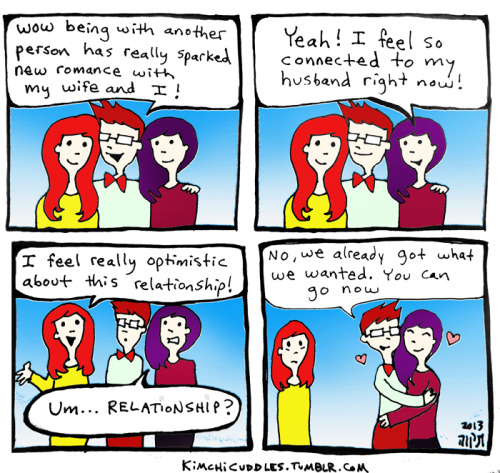
2) Even if the poly cure works for a couple, what about the third party? If it's about saving the couple, is the third just some kind of kleenex to come into? Some secondaries seek out the role because it fits their life they way they want it: as a solopoly free agent. Many don't. Either way, secondaries have feelings too.

Unicorn's Dilemma, by Kimchi Cuddles (used with permission).

3) All of this exposes issues of couple privilege and polynormativity that most readers of the Calgary Herald and Edmonton Journal (in Canada's red provinces) probably haven't seen discussed much.

But on with the story:


Modern love: How polyamory is saving some couples

Going outside of a monogamous relationship is far from the norm, but experts says such arrangements can work if everyone involved is committed and communication is kept up.

By Shani Krammer, for the Calgary Herald

Two years into their marriage, David and Alyssa were struggling with their sex life. Alyssa felt unsatisfied and David felt he couldn’t meet her needs. Rather than break up, however, the couple decided that Alyssa would start having sex with other men.

That was six years ago. The couple, whose names have been changed in this story to protect their privacy, says their new arrangement may seem strange, but it works for both of them. Alyssa’s sexual needs are fulfilled, and David says he finds it sexy to think about his wife with other men.

“We keep things creative and we’re always trying new things,” he says. “Alyssa wants to push it further to see what happens. A lot of people just do the same things (sexually) over and over and it gets boring.”

This kind of relationship, sometimes called polyamorous, is far from the norm, but relationship experts says such arrangements can work if everyone involved is committed and communication is kept up. Those involved say their lives are proof that not everyone needs to adhere to society’s traditional approach to monogamy to be in a happy relationship.

David says he and Alyssa’s relationship takes jealousy and conservatism out of the equation. He knows this might seem strange to an outsider, but he and his wife are happy with their current agreement.

“We talk about things we want to do beforehand, and question it, and try things out to see what the person likes, and then we do it,” he says. “Our relationship is messed up in comparison to what other people do, but we’re happy. To me it’s fine.”

...“We are monogamous as far as the relationship is concerned,” David says. “She’s only having sex … She doesn’t have relationships with other guys, it’s just sex.”


4) So, that means their marriage is "open" rather than "polyamorous." Sex on the side with touch of cuck, rather than multiple love relationships. I wish sloppy journalists wouldn't gum up our defining word! Two OKCupid commenters nailed it a few days ago. Said one:

Open = can fuck outside of relationship.
Polyamorous = multiple people inside of relationship.

To which another added,

"Or deep relationships with multiple people. Someone can have a deep and intimate relationship where their other partners are not really involved." Journalists please take note.

5) Anyone who says out loud that jealousy is "out of the equation" steps into the crosshairs of the Karma Fairy's bombsight. I say this as a low-jealousy person who didn't get whammed with it until 13 years into my poly life.


...Kate Nielson, a Registered Psychologist at the private practice of the Family Psychology Centre, says society has slowly begun to embrace what she refers to as “alternative relationship styles.” Some spouses she has encountered are bisexual and they allow one another to have sex with both genders, while some couples agree to allow sexual relationships with others.

While some of these relationships work, they take constant work to maintain, she says — it isn’t two people working on a relationship, it is two people working on multiple relationships.

...She says that, to be polyamorous, there must be ample communication, and both spouses have to agree on the openness of the relationship.

...She says that monogamy and polyamory are both valid relationships styles, but it takes a lot of communication to figure out which style works the best. In polyamory, she says both members must agree on the terms and rules; for instance, there is full disclosure of all extramarital sex, and the who, the when and the where of these encounters. These types of couples have a sense of openness and honesty, so they don’t consider it cheating.

...Noel Biderman, CEO of Avid Life Media, the founder of the website Ashley Madison, a dating site for people looking for extramarital affairs, says the success of the site shows that cheating is more natural for people than society has traditionally allowed.

Biderman founded his website on the principle that humans are not naturally monogamous. He says that, based on research done by his company, married people are more comfortable lying to their spouse and keeping extramarital sex a secret, and he doesn’t think polyamory is a realistic idea.

“About one to two per cent of people (surveyed) were into the polyamory,” he says. The rest of them said they were more comfortable cheating without consent, because there was less likelihood of judgment or possessiveness on the part of their spouse.

Biderman says that sometimes experimenting with new lovers illicitly can rekindle the original love within a relationship, and actually cause people to appreciate their souse even more.

“The majority of marriages survive infidelity,” Noel Biderman says. “There’s this myth that you should pick up and leave.”

Psychologist Kate Nielsen, however, says that, given the choice, polyamory is a better option than cheating because it promotes honesty.

“There is always the possibility that cheating could bring a couple closer together, but usually that’s an exception. Usually, that trust is broken (when a spouse cheats). It can be very hard to regain trust once it’s been broken,” Nielsen says....


Read the whole article (June 7, 2013).

Later.... by Kimchi Cuddles (used with permission).

[Permalink]

Labels: