Polyamory in the News
. . . by Alan M.


October 30, 2016

A victory for the Hartford intentional family charged with zoning violation
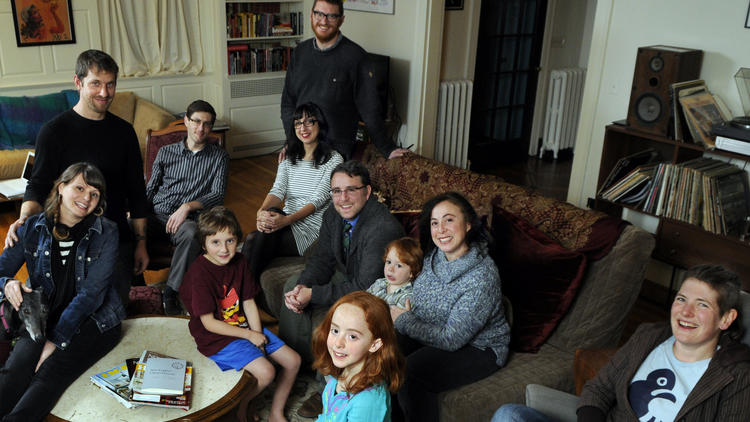

The Scarborough 11. (Stephen Dunn / Hartford Courant) 

It's not over yet. But the intentional family of eight adults and their three kids who bought a fixer-upper mansion in Hartford, Connecticut, then were threatened by the city with daily fines for violating the neighborhood's single-family zoning, seems to have out-stubborned the city.

The year-plus standoff has drawn wide community support for the family, and attention from media around the country, as more and more people seek to live in groups as "functional families" — whether for economics, sharing of labor and child care, friendship, belief in intentional community, or polyamory. (The Hartford group is not poly.)

The family claims the right to be defined as a functional family even if more than two member are not related by blood or marriage. Residential zoning is a hot issue in many towns and neighborhoods where residents fear groups of students or immigrants — or anyone, no matter how settled and white, who might set a precedent for groups of students or immigrants.

From the Hartford Courant:


City Of Hartford Withdraws Suit In 'Scarborough 11' Case

A group of friends bought the nine-bedroom mansion at 68 Scarborough St. in Hartford in August 2014. A battle with neighbors and the city followed.

By Vanessa de la Torre

The group of West End residents known as the "Scarborough 11" can stay in their home now that the city has pulled its enforcement threat against them, bringing the two-year zoning dispute closer to a resolution.

On Wednesday, city lawyers quietly withdrew a suit that the city of Hartford brought in March 2015 against the homeowners at 68 Scarborough St., where three children and eight adults live together in a case that tested the city's definition of family and sparked a wave of national attention.

In its suit, the city had sought a court ruling that would allow it to enforce its cease-and-desist order and hand down civil penalties against the residents for violating the neighborhood's strict single-family zoning. The group of friends have countered that they are an "intentional family," even if not all of them are related by blood or marriage.

Howard Rifkin, the city's corporation counsel, said Thursday that Hartford's legal fight against the Scarborough 11 had proved costly and that "continuing to pursue an enforcement action against this household is not the best use of the city's time or resources."

"We concede that the issues in this case have engendered hard feelings between the residents of 68 Scarborough and their neighbors, not to mention notoriety," Rifkin said in a statement released through Mayor Luke Bronin's office. "It is our hope that we can find a way forward, but to further litigate this matter will only increase costs and divert us from some of the critical matters on which the city must focus."

Peter Goselin, an attorney representing the 11-member household, said Thursday that the city's latest action means his clients no longer have to fear daily fines or eviction from their home. And if Hartford's planning and zoning commission further changes its regulations to allow the Scarborough 11, and residents like them, to live together in a single-family dwelling, the case can finally come to an end, he said.

Goselin said he believes the commission is working on such language.

"From our point of view, the people at Scarborough and the city are pretty much on the same side," Goselin said. ...

...The [city's] 2015 suit, under the past administration of Mayor Pedro Segarra, was filed after Hartford's zoning board of appeals rejected the Scarborough 11's appeal of the cease-and-desist order. The city said that "time for compliance has passed."

The Scarborough 11 immediately filed a federal suit against the city, contending that their civil rights were being violated because the city refused to accept them as a family and was trying to evict some of the occupants who are not related. Goselin said his clients also faced fines of $100 a day.

Earlier this year, however, the city's planning and zoning commission approved the first major overhaul of Hartford's zoning laws in nearly half a century. The definition of family is gone, and now there is reference to a household unit: "A collection of individuals occupying the entire dwelling unit, sharing a household budget and expenses, preparing food and eating together regularly, sharing in the work to maintain the premises, and legally sharing in the ownership or possession of the premises."

West End neighbors had argued against the approval. But the current regulations don't solve Scarborough 11's zoning problem because they define a household, in part, as "up to 3 persons all of whom are not necessarily related to each other ... ." The number of unrelated people living in the mansion still exceeds three....

...If Hartford's zoning code is changed to include a "functional" family like the Scarborough 11's, the group's federal suit essentially becomes moot, Goselin said.


Read the whole article (October 27, 2016), with video and links to previous articles.

Meanwhile, a federal court just rejected the family's federal lawsuit against the city, on the grounds that the family had not yet exhausted all local remedies:


Federal Court Won't Define 'Family' In Scarborough 11 Case — Yet

By Vanessa de la Torre

HARTFORD — A federal judge dealt a legal blow to the "Scarborough 11" this week, granting the city's motion to dismiss the constitutional case but holding the door open for a second review.

The city argued that the federal court has no jurisdiction over a local zoning issue, while the plaintiffs — the eight adults who live in a Scarborough Street mansion, in a household that includes three children — say their plight transcends zoning and comes down to personal freedom over how to live as a family.

In Wednesday's ruling, however, U.S. District Judge Janet C. Hall said that the Scarborough group did not exhaust all city options to resolve the zoning dispute before it resorted to a federal challenge.

Hall gave the plaintiffs 21 days to file an amended complaint that attempts to prove that the city's zoning board of appeals would have denied a variance if the Scarborough group had sought one. If they convince her, the judge could reopen the case.

"It's a setback, but it's definitely not over," said Peter Goselin, the attorney representing the Scarborough 11.

Goselin said Thursday that his clients plan to file a more robust complaint arguing that seeking a variance from the city would have been futile.

City officials said they are not evicting anyone from 68 Scarborough St., at least not yet.

"We understand that this is a difficult situation — these are people's lives and you want to be compassionate," city spokeswoman Maribel La Luz said Thursday night. "So we're not considering taking action until the process has played out, until the case is finalized and settled. ... There's still a process that has to be followed."...


Read on (October 15).

Many in the poly world have been watching this case with concern. It's a reminder that until functional families become a legally recognized thing, poly families should learn the local zoning codes before buying property or remodeling. You can apply for a variance, which legally clears you but may be denied if neighbors object or the local zoning board sees no reason to grant it. Or you can try to live below the radar, at the risk of having family members ordered to move out, and/or the owner(s) being ordered to undo the remodeling at their own expense.

If you live below the radar, have a backup plan to move or establish a second residence if necessary. And do no remodeling (additional entrance, additional bathroom, bedroom, etc.) without getting a building permit that approves it.

And, know the local definition of "residents" versus "guests." A tiny rented room elsewhere, where the offending people receive their mail, register to vote, pay bills, and occasionally spend time, may (or may not) be all that's needed. Consult a local lawyer. For instance, is it really your legal residence if you overnight there less than 50% of the time?

Article in the Connecticut Law Tribune: Hartford Gives Up Housing Suit Against 'Scarborough 11' (Oct. 28).

----------------------------------

UPDATE: Federal Judge Grants Motion To Reopen 'Scarborough 11' Zoning Case In Hartford (Oct. 27).


Josh Blanchfield, left, serves as spokesman for the Scarborough 11, while Peter Goselin, center, is their attorney in the family's zoning battle with Hartford.
 (Patrick Raycraft / The Hartford Courant)

A federal judge has agreed to reopen the "Scarborough 11" case after accepting new arguments from the West End group that is suing Hartford over its definition of family.

U.S. District Judge Janet C. Hall initially ruled in the city's favor and dismissed the suit on Oct. 14, ruling that the Scarborough Street clan, embroiled in a bitter zoning fight with city officials, had not exhausted all local options before raising a constitutional challenge in federal court.

But Hall, in a move that gave the plaintiffs hope, said she would reconsider the case if they could prove why seeking a variance from the city would have been futile. They apparently succeeded.

On Tuesday, Hall granted the Scarborough 11's motion to reopen the case. ...


[Permalink]

Labels: ,


December 18, 2015

Brooklyn's poly housing project: video doc looks at how it's turned out


Remember Leon Feingold's poly-friendly redevelopment of an apartment building in Brooklyn last year that made runaway news across New York?

Bushwick filmmaker Brian Vines, of BRIC-TV, just released a video documentary on the people now filling Hacienda Villa and how this idea has worked out. Spoiler: mighty well, thank you.

It's in two parts (12 minutes total):


This afternoon The Gothamist put up a short article about the documentary, with pix. Excerpts:


Step Inside This Bushwick Polyamory House

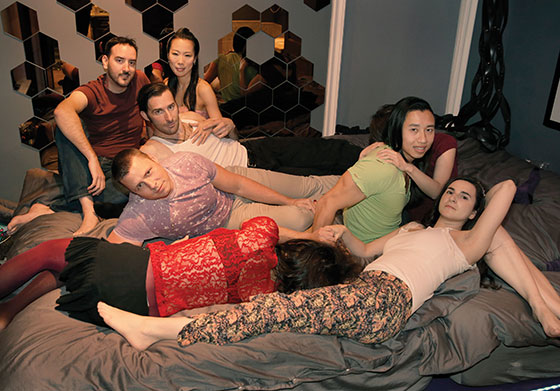
What is there to say about this BRIC TV video on Bushwick's polyamory house that wasn't already said with lingering shots of curved faucets and supple hands wrapped around goblets of wine?

"What's the garbage situation?" the embedded reporter asks the group, comprised of comely 30-somethings all lounging on a mattress covered in fake (?) furs. It's collected on Monday, Wednesday and Friday, but look! Poly houses: They're just like us.

"I thought it was going to be like a bad MTV reality show," says housemate Deniz Akyurek, who said he first became acquainted with the place as a subletter. "It was better than any roommate situation I've ever been with."

The buried lede is that the inhabitants of the home — called Hacienda Villa — don't actually sleep with each other, which actually makes perfect sense and shame on us (fine, me) for making the snap judgment that "polyamorous" is just a euphemism for "relentless sex parade." The Bushwick abode is simply a community of people who practice non-monogamous relationships, within whatever context that fits into their particular lives.

...In all seriousness, everyone seems very sane and well-adjusted and happy. Who knew that anything so positive could exist in rat-infested Bushwick?

And since it's Friday, ditch your spreadsheet and give in to the allure of the Casual Sex Project. It's all you get for now: Hacienda Villa is full and has a waiting list.


The backstory is that a creative developer gutted an old building and rebuilt the interior to a more communal plan with polyfolks in mind. The private spaces are small but spiffy, the community spaces are large, and residents select new members from applicants. I haven't learned the economics of the project, but if it filled immediately and has a waiting list even when priced to make a New York profit, it must be a financial success.

So will the Hacienda Villa model spread? There must be a hundred thousand people in New York pining to live like this.

[Permalink]

Labels: , ,


August 5, 2015

"These Five People Are About to Have a Baby Together"

Vice

An interesting thing about this story is that it treats nonmonogamy as a minor component. The five people are a couple and a triad. They're treated as friends who decided to commit to live as a family.

The media are seeing a trend toward such arrangements: millennials who, partly driven by economic forces, are turning group houses into true long-term communities, families even. Three days ago the New York Times ran a feature on the trend and on real estate developers' efforts to cash in on it: The Millennial Commune.

But this bunch takes it further (even though they live in two domiciles).

Vice picked up the story from its Netherlands edition. I guess that means Vice's other recent group-relationship stories have done well.


These Five People Are About to Have a Baby Together

By Noor Spanjer

Clockwise from top: Dewi, Sjoerd, Jaco, Sean, and Daantje in front. (Photo: Raymond van Mil)

...Another new, lesser known family structure that has emerged is that of multi-parenting — or raising a child with more than two legal parents. For instance, a lesbian couple and a gay couple bringing up a child together as a single family, but in separate households.

That's more or less the family unit that two couples — Jaco and Sjoerd, and Daantje and Dewi — have decided upon. The four have known each other for ten years, and have been considering the possibility of having a child together for about six. That possibility is going to become a reality this week, when Daantje gives birth.

Both couples are married, but Jaco and Sjoerd's relationship also involves a third person: an Australian named Sean who's been their partner for the last three years. "Three and a half," Sean shouts from the kitchen when he hears me asking Sjoerd how long they have been together. Sean is such a big part of their relationship that he will play an equal role in raising the gang's future son.

"Five parents with equal rights and responsibilities, divided across two households — those are the terms of the agreement that we all signed and had notarized," says Dewi....


The laws surrounding parental rights have improved significantly for gay parents in the Netherlands over the past few years, but the issue of multi-parenthood is still a complicated one. In the case of this particular five-parent family, Jaco has taken on the role of legal parent number two — replacing Dewi, who initially held the position because of her marriage to Daantje.

"We wanted to make sure that there was one legal parent in both households, because we're splitting the upbringing equally," explains Dewi.

"The advantage of that is that us men can take our son on vacation without customs stopping us for traveling with a child that, legally speaking, isn't ours," agrees Sjoerd.

----------------------------

The vast family (the baby will have five parents, 11 enthusiastic grandparents, and 21 aunts and uncles) seem to be ready for whatever issues that may arise while they're raising the child together. "We're ridiculously well-prepared," says Sjoerd. "We've already picked out schools. It's mainly people around us that expect problems, but that whole myth about the more people being involved with something the harder it being to come to a decision, isn't true. With us, there isn't a lot of room to be irrational — if it's just the two of you, you can easily get stuck in an emotional discussion which you both want to win. But when there's five of you, you're forced to reach a reasonable consensus."

Dewi tells us that she was surprised about the criticism they'd been getting from the LGBT community. "People say things to Daantje and I, like: 'You shouldn't get the men involved,' and to the boys: 'Be careful with those lesbians, they'll take your child away from you.' It is all about ownership, about fears, and ego."...

The baby is due this week and all parents plan to be present for the delivery....


Read the whole article with more pix (August 4, 2015). Here's the original in Nederlands.

[Permalink]

Labels: , ,


June 11, 2015

Yahoo Parenting on poly at Twin Oaks


Twin Oaks in Virginia is often held up as one of the most successful large communes to come out of the 1960s and 70s. The intentional communities that have survived long-term have learned ways to do it right, and their examples are now spreading again... a bit.

Yahoo Parenting just published a glowing article on child rearing at Twin Oaks and on the group's social and economic structure. Far down into it, the article discusses the polyamory practiced by many Twin Oakers. It all sounds pretty excellent. Many intentional communities seem to develop a large poly contingent as a natural part of life. I'll have more to say about that, with many items that I've been waiting to tie together. But for now:


Welcome to the Commune Where 100 Adults Raise 17 Kids

By Beth Greenfield
Senior Writer

Photos: Khue Bui for Yahoo Parenting             

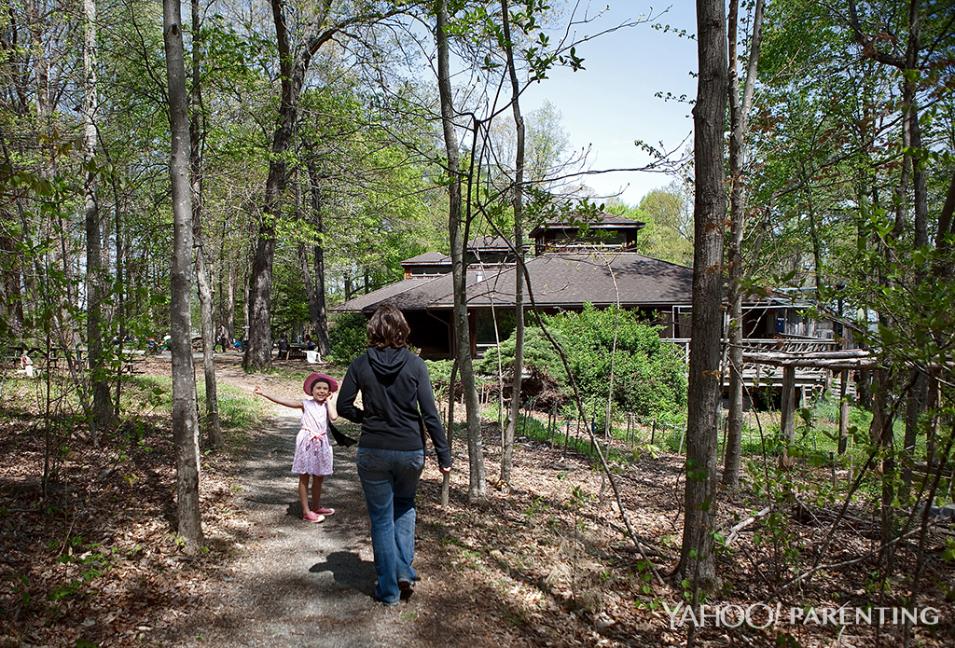
It’s 8:30 a.m. on a Wednesday and one of the calmest school mornings I’ve ever witnessed....

...“It’s not like we’ve come up with this scientifically evolved program to create the utopian child. We don’t have that — just really common sense: We put a lot of resources into the kids. The adults are not stressed out or struggling. We don’t have people who are pregnant and stuck with a couple of kids and are miserable, or even really well-off parents who have gobs of money but no time to focus on their kids, with a nanny who does not feel very empowered. So that’s not rocket science. But it is something we do well.”

It’s not perfect, of course. Kids can feel lonely or isolated due to not having enough peers, and some parents are troubled by the lack of racial diversity here, just for starters.

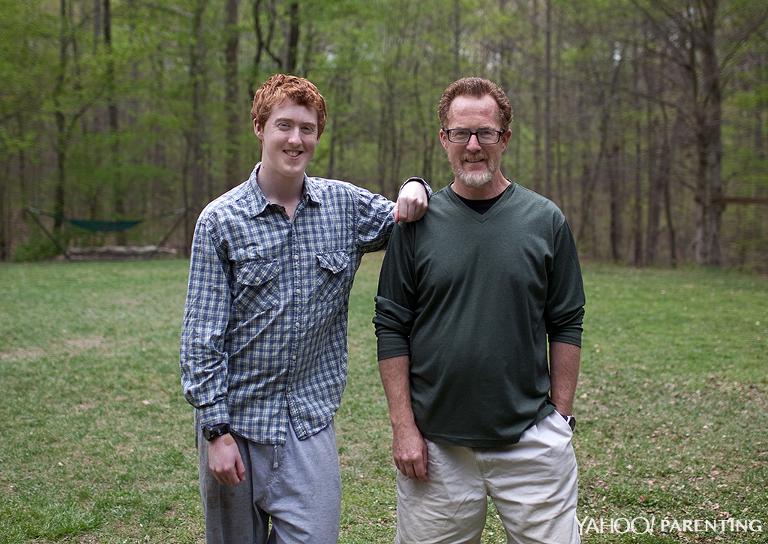
Rowan, 19, with his dad, Keenan.

But there are still plenty more ways Twin Oaks does right by its youngest residents: with intense communal support among parents; opportunities for the childless to form close relationships with kids; fairly seamless co-parenting arrangements following breakups; a refreshing openness regarding the fluidity of gender and sexuality; and a striking absence of the so-called “mommy wars.” Perhaps most impressively, though, is the enviable reality of an organic work-life balance.

It all adds up to something most parents yearn for but few find: a true village, in that it-takes-a-village sort of way....

----------------------------------

...But Adder’s attentions are divided in a way that may seem startling to the outside world: He also has another girlfriend — who in turn has her own girlfriend, as well as a toddler whom the two women co-parent together.

As it turns out, polyamory — being in a committed relationship with more than one person — is the norm at Twin Oaks (though plenty of couples are monogamous). And everyone here, it seems, takes it in stride — including the kids, say their parents, because it’s all they know. Many even count it as a child-rearing bonus.

“I think it makes a parent stronger at communication,” Claire, the mom of a 1-year-old named Grace, tells me one day. Claire, more than many at Twin Oaks, delivers beautifully when it comes to the expected, free-flowing hippie image: barefooted, long-haired, joyously mellow, and prone to allowing her milky nipples to slip out of her blouse in between Grace’s nursing sessions. “You really have to hype your communication skills to be in a poly relationship,” she explains. “And I think that’s a great thing to offer your family and your children.”

Twin Oaks has a long, strong history of thoughtful non-monogamy.... Today, that tradition continues — minus, many here agree, any confusion for the kids. Part of that is because every adult resident has his or her own bedroom, married or partnered or not, as a way to maintain a semblance of privacy within the context of everything else being shared.

As Angelica, a Brooklyn, N.Y., native who has no children of her own but is an active primary to several kids, tells me, “It’s not like parents are always sleeping in the same room every night.”

Every parent I speak with is quite open about his or her various permutations of non-monogamy. Summer and Purl are among the minority of couples who have legally married, for example, but they’re also polyamorous, and Summer — who landed at Twin Oaks after a rather privileged, conventional life in Connecticut, boarding school, and a brief stint at Oberlin College — has had a boyfriend for several years.

“Anya knows he is my boyfriend, someone special to me,” Summer says about her daughter’s understanding. “I don’t think I ever need to sit down and have a talk with her, like, ‘This is what this is,’ because this is just what it is.”...


Read the whole article (June 10, 2015).

Update the next day: One of the Twin Oakers in the article (Paxus) blogs about the huge public response to it pro and con, and the community's reaction, and some history and background.

One thing he says the article failed to mention: Twin Oaks has had a waiting list for the last 7 years. And longer for families. If you're looking for a good intentional community to join, you might look elsewhere. Or get your people together and study up on how to start your own. Hint: Network for a New Culture's Summer Camp East starts in less than a month....

[Permalink]

Labels: , ,


December 16, 2014

New York Mag’s 35th reason to love New York

“35. Because He and She and He and He and She and He and She and She Can Live in Sin Together in Bushwick”, in the new poly-friendly building designed and rented out by Open Love NY's Leon Fiengold. The place that was all in the news six months ago.

From the magazine's year-end roundup:


Photo: Kava Gorna

Kenneth Play, a Hong Kong–born, Brooklyn-raised 33-year-old personal trainer turned sex educator, is the house manager of the Villa — a three-story, socially networked, sex-positive, poly-supportive, self-selecting community in Bushwick. This is no scrappy “three in a room” flophouse. It’s luxe down to the last detail: slick open-plan kitchen, cowhide rug, marble counters, hot tub.

The building’s owner enlisted poly advocate and “hetero-flexible” real-estate broker Leon Feingold to fill the 15 rooms with a range of sex-positive, poly-supportive 20- and 30-somethings. Christopher Sands, a 34-year-old web developer from West Palm Beach, was a pioneer occupant; he has six dates with six different women lined up for the holidays. A 32-year-old female housemate doesn’t identify as poly but was sold on the idea of a community where sex isn’t seen as taboo. “Nobody resents you if they hear you experiencing pleasure,” she says.

“We geek out over sex in the same way foodies geek out over what they eat,” Kenneth explains, noting that it’s hard to find a roommate in New York who will put up with the noise, traffic, and unpredictability that may accompany a sexually adventurous lifestyle. It’s the anti–“smuggle your boyfriend into the bathroom, eat dinner in bed, angry notes left on empty milk cartons, tiny New York setup.” But that doesn’t mean it’s a free-for-all. There are rules, including a ban on passive-aggressive sticky notes. And “Villa on Villa” hookups are discouraged. “It’s like a work environment,” he says. “Don’t sleep with your colleagues. Our personal sex lives are epic enough, anyway.”


Here's the original (Dec. 14, 2014).

[Permalink]

Labels: ,


July 23, 2014

A poly home, just without the sex

The Atlantic

Not the street with the home described,
but a similar one nearby. (NCinDC / Flickr)
My post yesterday about the big poly article at The Atlantic led me to an Atlantic piece published ten days earlier. It's an example of how groups of friends are building tight-knit households that are the next thing to polyamorous, in order to beat the isolation and resource overstretch that increasingly bedevil harried nuclear families.

In fact, the "normal" household of Mom and Dad with no other adults is a recent historical aberration. Humans have lived in larger extended families and tribes for almost always. We're born to it. This is why a nuclear family can instinctively feel so diminished, lonely, and incomplete without you knowing why.

Setups like the one below qualify, to me, as the generalization of polyfamilies: they're based on friendship rather than romantic interconnections, but otherwise quite similar. Think "intentional community."


Two Couples, One Mortgage

Why my partner and I decided to buy a house with our friends, share our space and our lives, and all make a family together.

By Ari Weisbard

Last December, my partner Rebecca and I bought a rowhouse with another couple. Our wedding was this May. Next month, we’re expecting a baby — the other couple’s baby.

For most of our adult lives, Rebecca and I lived in houses full of roommates and loved it. Before our most recent move, we rented a rambling five-bedroom house with four friends. When we started talking about getting married, we realized our biggest fear was that we’d leave these important kinds of friendships behind and end up living in what she jokingly called a “love/torture cave of nuclear family loneliness.” Neither of us wanted that.

It turned out two of our closest friends... felt similarly, and we decided to do something different and move in all together....

Yes, all four of us are on the deed and, yes, we share the 30-year mortgage and food and maintenance expenses. No, there’s no division of the house into separate sections. And no, all four of us are not all having sex with each other. (Why do many people assume that if adults are willing to share a kitchen, they probably also want to share a bed?) We are just two couples who plan to live together and raise children in one household, hopefully for decades....

Many nights, when one of us stumbles home from work exhausted from a hard day, someone else has already done the shopping and cooked a great homemade dinner. When a pipe burst this February, we all took turns bailing out the basement. Once the baby arrives, we look forward to being crucial reinforcements for each other during those first several nearly sleepless months and trading off so each couple can have date nights. Living together with another couple also has made it easier to identify and counteract some of the sexist patterns that emerge in many households. Because we discuss chores as a group and work consciously together to establish our household norms and individual responsibilities, there’s less opportunity for traditional gender roles to establish themselves surreptitiously.

Living together seems to be a great financial move so far. With four adults splitting the mortgage and other costs, it is easier for each of us to save more of our income, which will give us the financial freedom to pay for childcare or reduce our work hours later, when we need more time and money for our families....

For many people, their romantic partner is the one person with whom they feel comfortable showing their struggles or weaknesses. While Rebecca and I certainly support each other in that way, it has actually been great for our relationship that we don’t try to be each other’s only source of support and amateur therapy....


Sounds poly to me. Read the whole article (July 11, 2014).

Here's a similar story about another platonic-quad household. Here's one about six adults, several of them divorced from one another and remarried to others, who all moved in together along with their kids and find it great.

I'll be posting more here about such all-but-poly households. The media are spotting a trend toward them "not seen since the 1970s," driven in part by the changing economy.

As I've written before, we can expect this way of life to increase in the coming century as resources become scarcer and more poorly distributed. People with good poly housemate skills will have an early advantage.

[Permalink]

Labels: ,