Polyamory in the News
. . . by Alan M.


September 23, 2021

How Not to Plan a Polyamorous Vacation. "Polylogues" play reviewed in NY Times. And more poly in the media.


Fodor's Travel is a mainstream middleclass travel-guide mag ("18 Reasons Why Big Cruise Ships Are Better Than Smaller Boats") that has served the bourgeoisie since our grandparents' days — says my wife Sparkle Moose who, in her youth, bicycled across France with a backpack non-Fodor's style and, with a girlfriend, rode a night train packed with drunken workers through communist Poland's coal country, kicking away drunks trying to climb into their upper berth. 

So either Fodor's is changing or the bourgeoisie is changing when Fodor's publishes this: How Not to Plan a Polyamorous Vacation. (Sept. 13)


It’s tough enough to plan a vacation with another couple. Here’s what happened when we did with our boyfriend and girlfriend—and how we’ll (maybe) do it better in the future.

Sandra Seitamaa / Unsplash 

By Mariah Douglas  

...We’re polyamorous and they’d been our primary relationship for about six months. I was bleary and exhausted from the drama when I abruptly awoke. Something was in our house. “Paul, wake up!” I hissed. “Paul! There’s something in the house.” We were both leaning over the balcony of the upstairs loft bedroom, squinting into the dark, when The Something flew at my head. It seemed a fitting conclusion to a truly implosive vacation: dive-bombed by a vengeful bat in the middle of the COVID panic.

The bat — which met an untimely demise at the business end of a badminton racket — symbolized a trip beset by group travel pitfalls. I don’t know if poly travel routinely includes these complications. ... But I do know that, if we do try it again, we’re much better prepared for the potential hazards.

Initially, this trip was planned as a beach frolic to Portugal. The other couple, let’s call them John and Cathy, told us they were so excited to go. ... [But when covid hit] we had to scale way, way back. This is how we shifted from Portuguese beach to West Virginian off-season ski cabin.

But we could still do a week together! And it would be so much fun! We found a place and sent it to them for approval. But then they weren’t sure about kenneling their dogs.... So we found a [different] dog-friendly place. Surely now all would be smooth sailing. Except, wait – right before the trip, Cathy couldn’t get a whole week off from work. So John and Cathy would come for four days. Um, okay. No, the four days wouldn’t be possible either. It would be three, they announced. No, two. They’d come for a weekend, arriving late Saturday and leaving early Monday.

Paul and I were confused, to put it mildly. ... Gaslighting is real, friends. Keep easily accessible documentation of your trip, including who’s paying for what (more on that in a bit). If you’re traveling with someone and they start blowing up the plans without regard, it’s probably time to rethink the trip.

[Lesson:] No Matter How Much You Like Someone, Everyone Needs a Financial Stake

This trip was our idea, so we did the legwork and we put down the money. ... Paul and I had brought a bunch of alcohol, groceries, citronella candles for the deck, sunscreen – you get the idea. John and Cathy brought a bottle of wine because, as they put it, they weren’t staying very long. ...

[Lesson:] Everyone Also Needs to Have (and Perform) House Tasks

...In the future, I’m not traveling without a clear expectation (and maybe a chore chart) delineating who is doing what and when it’s getting done. ...

[Lesson:] Set Reasonable Expectations—Including Respect

This last one? Totally on us. We didn’t see warning signs for what they were and clung to our belief that this trip would be a romantic escape, just as we envisioned it. We needed to recognize that our partners had trouble committing to plans and often failed to communicate. ...

Should we do this again, we’ll do it differently: putting everything in writing, checking in frequently, setting up a damn Venmo schedule. But we’ll also go into it with fewer puffy pink clouds in our eyes about both people and places. ...


What's interesting here is that their polyness is just treated as background; the article is about smart vacation planning with friends. The magazine could have cut the poly references and the story would have worked fine. But look at that title.


● The New York Times reviews, favorably, a new one-person play that just opened: In ‘Polylogues,’ Dispatches From Non-Monogamy (Sept. 22)


By Laura Collins-Hughes

...Written and performed by [Xandra Nur] Clark, and presented by the company Colt Coeur at Here [off-off-Broadway in Manhattan], “Polylogues” is a collection of monologues taken from Clark’s interviews with a wide range of people — some queer, some straight — who have practiced polyamory or, in a couple of cases, have parents who do.

Like Trudy, who recalls for Clark the time she casually mentioned her father’s girlfriend in front of a friend’s dad, then had to correct his assumption that her parents had split up.

“And I’m like: ‘No, no, no! They’re polyamorous!’” she says. “And then he looked at me funny. And I’m like, “Polyamorous, as in ‘more than one love.’”

There is plenty of talk of sex in “Polylogues,” but love is the tender element that flows through these often self-scrutinizing monologues. A thoughtful, layered, smirk-free show about people constructing their intimate lives outside socially accepted bounds, it makes a humanizing, live-and-let-live case for consensual, ethical non-monogamy.

“Non-monogamy interacting with male privilege, or interacting with capitalism, can, like produce some really, like, frightening dynamics,” says K, an interviewee full of regret for having once pushed an open relationship on a girlfriend, but endearingly happy with a new girlfriend and a series of other, overlapping partners.

...Clark performs the show wearing earbuds, listening to recordings of her interviewees as she speaks their words. A note in the script describes her as being “more like a medium than an actor, channeling real people into the room.” ... Without projections of the characters’ pseudonymous names...we would not be able to distinguish between them, or recognize individuals when they reappear. ... 

“Polylogues” is a curious, compassionate portal into a topic we most often see treated with prurience.


It runs through October 9.


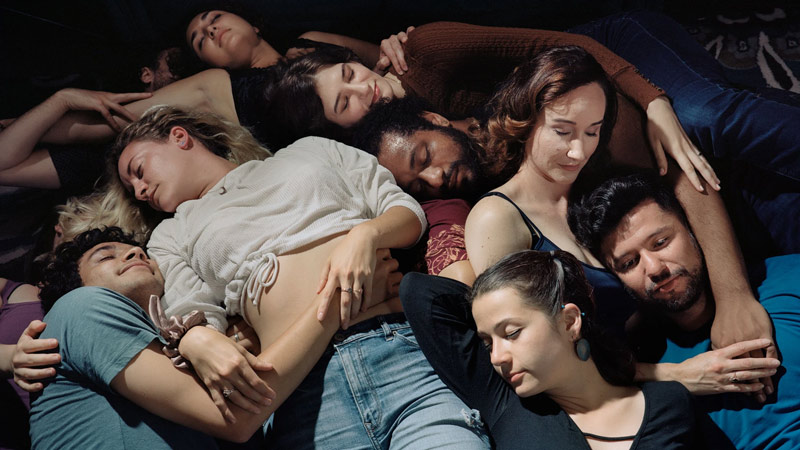
Eric Ruby spent the summer photographing the dyads, triads, and more that surround him, focusing on all the ways COVID-19 has changed poly life.

Eric Ruby photos
By River Black

I’m always hungry to glimpse the inner workings of love and to see real-life examples of people living in line with their hearts and values, especially in polyamory, where there are few established road maps. I was surprised when one of my most “out” polyamorous friends didn’t want to be photographed by my partner Eric Ruby with her long-term or more recent partners. With one, they were drifting apart as lovers, even though they were still “family”; with the other, she was on the cusp of transitioning the relationship toward something less romantic. ...

Another person I regarded as solidly poly, seeing them out at parties with their multiple lovers also in attendance, said they were reevaluating in light of reconnecting with a longtime friend across the country, and realizing there was more there. ... And yet, not reconsidering entirely—even as this friendship-turned-romance evolves in intimacy, they are planning to read Polysecure together, Jessica Fern’s 2020 book about how to create securely attached poly relationships. Surprising me yet again is the elasticity of how people continually redefine their relationship to being polyamorous and what that looks like for them.

The people most excited to be photographed were the larger groups; they really wanted to be represented and had found comfort and stability within their configurations. “We have matching All Love tattoos. It was really nice during the pandemic to live with multiple people—otherwise, I think I would have gone crazy,” said a member of a four-person polycule who have lived together for 10 years, with three relationships between them. The largest group excitedly showed us a visualization of their polycule, totaling 14 people, with lines representing marriages, divorces, lovers, platonic friendships, and “friendship plus.” Their relationship map was an explanatory tool for friends, new lovers, and, occasionally, even themselves.

A dyad texted later: “Relationships are a creative process in which, every day, people get to imagine how they want to be together. We enjoy that there are no givens or rules to ‘us.’ Because of this we are adaptable and we grow.” ...

Ultimately, it’s hard to tell which changes in people’s polyamorous love lives can be attributed to the pandemic and its pressures and which to the normal shifting of already-fluid relationships. For some, these past 18 months have clarified priorities, resulting in new flowerings and endings both painful and peaceful; for others, they’ve had a wide net to catch and hold them and a community in which to weather the storm.


● More covid-and-poly: Keep Them Coming: Polyamory in the pandemic in the alt-weekly KC Pitch, "Kansas City's independent source for news and culture" since 1980 (Sept. 20).


By Kristen Thomas

...Were polycules—that is, a group of people connected through a consensually non-monogamous relationship—stable or fragile because of all the time together during quarantine? Had they adjusted and found their footing? Are they dating safely or causing the virus to spread? I had conversations with some poly individuals to find answers. 

Turns out, the pandemic has given many folks a chance to explore poly relationships while being surprisingly safe. ...


● In the Poly 101 department, a sociologist explains the types of chemical bonds that create polycules: sexual, romantic, platonic, family-like, friendshippy.... What Is A Polycule? Understanding Polyamory Relationship Structures (MindBodyGreen, Sept. 20)


By Kesiena Boom

..."An unavoidable aspect of nonmonogamy is that people are engaging in a system of relationships that all impact one another," says Anna Dow, LCSW, a therapist who specializes in consensual nonmonogamy and practices it herself. "Having shared language for that system can add to some people's senses of security and belonging while also offering practical information about how their own relationship dynamics may impact other people."

...Navigating intimate relationships with more than one person means that it is especially important to be a thoughtful and active listener. Take the time to really understand and respect not just your own boundaries but everyone else's in the polycule.

"You may have heard that the golden rule is to treat others as you want to be treated, but somebody got that all wrong. To build healthy relationships what we really must do is treat others as they want to be treated," says Dow. ...


● In Women's Health: Growing Up In The Mormon Church, I Was Deeply Ashamed Of Being Polyamorous And Bisexual (Sept. 10). "One writer shares how she finally embraced her sexuality and came out to her parents." 


By Natalie Fuller

Growing up in the Mormon church, expressing your sexuality—having sexual feelings of any kind—is seen as taboo. ...

I knew even in high school that I was polyamorous and bisexual, even though I didn’t have the words to describe those feelings at the time. I’d make promises I couldn’t keep, like telling my boyfriends I wouldn’t kiss girls. Those relationships never worked out because I couldn’t be honest with myself or them. ...

In my experience, shame is like a sunburn: hot and tender to the touch, but eventually the dead skin starts to slough off. You end up rubbing and picking at it. It's a shedding process, of other people’s beliefs and judgements. It’s uncomfortable. But you shed and shed until your new skin comes through.

I first started picking at my sunburn when my older sister, who had already left the church, started taking me to African dance classes. I felt simultaneously embarrassed and excited looking at myself in the mirror, thrusting my open hips and making wild expressions. As I got older and left the church myself, I started collecting experiences that made me feel more like myself.

There was the freedom and childlike nature of my first skinny dip with friends; it felt like we’d never left the Garden of Eden. Then there was a trip to Maui, where I got my first taste of being with multiple partners at once. I moved to Oregon, and then Colorado, finding like-minded people along the way and building a community that accepted the real me. For the past year, I've been with two loving, long-term partners.

Still, I wasn’t out to everyone, including my parents. ...


●  The difference between polyamory and an open relationship is often deep, and sometimes it's unbridgeable. On HuffPost, My Lover’s Girlfriend Asked Him To Dump Me. Here’s What I Learned When He Did. (Sept. 17)


By Keyanah Nurse

“I really like you, but my partner is struggling with us being lovers. I’m caught between a rock and a hard place,” his message read. “Is friendship still possible for us?” 

Although I was disappointed, I wasn’t surprised. The signs were there, even from the first time I met him two years ago... [when] as he talked about his long-distance partner and I discussed my two local partners, I realized that our different approaches within the umbrella of ethical non-monogamy were incompatible.

My polyamory centered fully fledged relationships with multiple partners at the same time. I could introduce all my partners to my mom, go on vacation with any of them, post about them on my social media or have sleepovers. His open relationship, on the other hand, allowed only for short-term sexual and romantic connections that ended whenever his primary partner was in town. Not all ethical non-monogamy is created alike, I realized. The chasm between my polyamory and his open relationship felt too dangerous to traverse.

The author with her two partners
on New Year’s Eve 2020

...He admired my boldness as a Black polyamorous woman, often remarking how he wished for a similar freedom to build concurrent romantic relationships.

-----------------------

...When he asked to date again, I had doubts. But two years had passed. Within that time, his long-distance partner moved back to our city. They were also defining themselves as polyamorous, a change from the form of ethical non-monogamy he described when I first met him.

...Did our conversations about my polyamory sway him? As I explained to him over the years, the public visibility of both of my partnerships was central to my ethics and my politics. Having suffered in the past the indignity of being a “secondary” partner, I refused to reproduce an emotional hierarchy with my own partners.

-----------------------

...I beamed at his compliment as we sipped the whiskey I brought to his place. The heat radiating off our bodies pulsed in anticipation of answering a two-year question in the making. The next few hours were a mix of laughter, passion and indulgence. I always enjoyed our easy yet biting banter. As lovers, that banter gave way to a new intimacy. The answer to the question of us seemed to be: potential. What would happen next? Would there be an “us”? 

...When I invited him to spend the night at my place, he explained that it was not yet something he was ready for since his partner was now in the same city. I bristled at the restriction. 

...His partner sent a series of long messages to a group chat we made a few weeks prior. She apologized for appearing finicky and controlling. But ultimately she was uncomfortable with my friend developing independent relationships while she was in the same city. 

“I really thought things had changed and that she would be OK with dating separately,” he explained a few days later. “I’m sorry if I wasted your time.” 

I had been “vetoed.” ...


Read on. There's a twist.


Laura Boyle

● The number of books about polyamory is growing to the point where I no longer buy all the new ones — my collection now fills a five-foot bookshelf and this is getting expensive — but I just ordered a new one because of its author: Laura Boyle of the Ready For Polyamory podcast and blog. It's titled Ready for Polyamory: A Pragmatic Guide to Consensual Non-Monogamy. (It hasn't shipped yet, but she posts that it should go out by October 1.)


She says the book is "a selection of practical thoughts rooted in theory to get you over humps of difficulty in polyamorous relationships and identify what you want out of new ones, while simultaneously a book thorough enough that if you give it to someone new to this, they have a strong foundation to build on. I'm proud to say I think I achieved that."

From its Amazon page:


...With more than half the book dedicated to important conversations to have at potential pain points in relationships to avoid strife and have smoother sailing in your polycules, we address STIs, fluid bonding, jealousy, compersion, communication styles, compatibility on multiple fronts, and more. The idea of building your relationships with intention and not just because “That’s what comes next” is at the center of all the theory woven into the practical information contained here.


●  Do you live in Somerville, Mass.? Know anyone who does? Area grad student Diane Duan seeks to interview poly Somerville residents for a study on effects, if any, of the city's 14-month-old multi-domestic partnership ordinance. Email diane_duan (at) williamjames.edu.

_________________________
 Don't miss Polyamory in the News!
 SUBSCRIBE by a feed, or
 SUBSCRIBE by email

_________________________

[Permalink]

Labels: , , , , , , , , , ,


August 25, 2021

Poly-themed movie 'Ma Belle, Ma Beauty' opens in theaters. "How polyamorous people are dating again after vaccination." And other polyamory in the news


●  Remember the early press last winter about the indie movie Ma Belle, My Beauty? It just opened in theaters in the US and is getting some notice in major media.

– Here are excerpts from the long, positive writeup on the NBC News site, in its NBC Out section: 'Ma Belle, My Beauty' brings queer polyamory to the big screen (Aug. 19)


By Max Gao

...[Filmmaker Marion Hill's] “Ma Belle, My Beauty” — which won the Audience Award in the NEXT category at the 2021 Sundance Film Festival and premieres in theaters Friday (Aug. 20, 2021) — follows Bertie (Idella Johnson) and Lane (Hannah Pepper), two formerly polyamorous lovers who reunite for the first time in years at the insistence of Bertie’s husband, Fred (Lucien Guignard).

Bertie and Lane


Two years after Lane gratuitously disappeared from their lives in New Orleans, Bertie and Fred have gotten married and moved to Fred’s family home in the French countryside. ...Fred decides to enlist Lane’s help to get Bertie out of a creative and emotional rut. But when Bertie refuses to buy into Lane’s attempts to re-create their old carefree dynamic, Lane begins seeing a stunning Israeli ex-soldier named Noa (Sivan Noam Shimon), which quickly reignites dormant jealousies.

...Unlike traditional casting processes, in which writers or directors try to match actors with specific characters, Hill said that, while she had an outline for the story, she always intended to collaborate with actors to create characters that rang true to their own experiences. That meant “incorporating parts of their personality, their gender, their background, their race and culture into what was going on in the script,” she said.

[...Said Hill,] “The whole film is referring to this relationship they shared in the past and watching them kind of figure out how to be with each other now. They’re just in this room sharing the most powerful, intimate version of what they have, so that really influenced the lighting, and we wanted it to feel dark and almost chilling.”

In terms of blocking the scene, Hill said it was always important to emphasize the contrasting power and sexual dynamics between Bertie and Lane by showcasing “the subtleties of how their bodies are moving together, how they're speaking to each other, and seeing who is seeming really comfortable in what moment.” ...

“This is them in a vacuum, and there’s no one watching them,” she said. “That scene is our look into the depth of what they have, what they share.” ...

Hill said she also had to do some research about polyamory while she was writing the screenplay. ... “I think what was most eye-opening for me when I was learning about polyamory for the first time was how much of it is communication and is consent-based rather than sex-based,” she said. “I wanted to also kind of explore the beauty of polyamorous partnerships that might not be sexual, like the Fred and Lane relationship, which again comes out of tremendous trust and empathy and kind of the sense of family that, historically, we haven’t really seen when it comes to relationships involving more than two” people.


– And this review just appeared in the Washington Post (Aug. 24): This polyamorous romance, set in the South of France, captures the pleasures of late summer. The reviewer gives it only two stars out of four.


By Ann Hornaday

“Ma Belle, My Beauty” comes pre-drenched in the languid pleasures of late summer; for anyone looking for a respite from and a celebration of the season’s drowsiest dog days, it works a trick.

...Their band is scheduled for a European tour in just a few weeks, but Bertie has been avoiding rehearsals. In an attempt to jump-start her creative juices, Fred extends an invitation to Lane (Hannah Pepper), who was Bertie’s lover in a polyamorous — but decidedly mono-directional — relationship back in NOLA.

Mono-directional because, although Fred and Lane enjoy an easygoing friendship, it’s Bertie they both love. As the hot summer days wear on, the dynamics get dicier and more delicate, with Lane plainly longing to resuscitate what she and Bertie once had, Bertie harboring submerged yearnings and jealousies, and Fred — well, Fred’s just enjoying all the food, wine and music his community has to offer, with an occasional dip in the local river for refreshment.

At its best, “Ma Belle, My Beauty” perfectly captures the casually cosmopolitan rhythms of expat life at its most bohemian and low-key sybaritic. ... Reminiscent of the sun-kissed films of Eric Rohmer, “Ma Belle, My Beauty” is a movie best appreciated simply by sinking into its sensuous pleasures, rather than expecting narrative novelty or emotional fireworks.

Indeed, what story there is in “Ma Belle, My Beauty” turns out to be blandly conventional, despite its unconventional contours. The relaxation that Hill conveys so well eventually gives way to lethargy, as Bertie and Lane’s psychodrama plays itself out. Although Johnson and Pepper are terrific actors, Hill hasn’t given them much to portray as characters; the depths of their bond and betrayals are kept vexingly opaque.

Rather than a meditation on desire, “Ma Belle, My Beauty” becomes a portrait of how people simultaneously crave intimacy and keep each other at bay. Viewers may wish there were more to it, but what’s there is teasingly intriguing. “Ma Belle, My Beauty” may be a mere bagatelle, but it’s a diverting and attractive one.


Unrated. In English, French and Spanish with subtitles. Contains brief strong language, nudity and sexuality. 93 minutes.


– Trailer:


[Director ]Marion Hill ... feels stretched thin in the end product, and it’s the writing that ultimately suffers. The performances are wound tight and the setting is undeniably gorgeous, but Ma Belle, My Beauty feels uninterested in its characters’ motivations and their main source of conflict—how to manuever the complicated cogs of the polyamorous machine.


A Beautiful Depiction of Love in Its Many Variations

By Dan Skip Allen

I've been watching movies for quite a long time and I've seen a lot of films come out. Usually, you hear about great films because of word of mouth, but sometimes they slip under the radar. Ma Belle, My Beauty is one such film.

...[Marion] Hill demonstrates her ability to ramp up the tension throughout the film through various conversations of what the motivations between the women truly are. Why did certain people come back? To make up for previous mistakes or get into new relationships that tear down the previous ones? The dialogue works so well among all the cast. The actors can believe what they are saying. The passion that stems from it is incredible. 

This is one of the most realistic films about love and its many variations I've seen in years. ...


ScreenRant (Aug. 22):


Marion Hill Directs Delicate, Honest Romantic Drama

By Ferdosa Abdi

Director Marion Hill does a lot with a little to transport the audience to this place and to be with these characters through effective visual storytelling and sound design. It is as if Hill was a documentarian embedded amongst a lively community and just happened to have an interesting story unfold before her camera. ...

Hill does well to not force feed her audience the backstory for this throuple. Casual conversations between the characters reveal the three were in a polyamorous relationship — specifically, Bertie was dating Lane and Fred, who were not romantically involved with each other. Although Lane and Fred don’t ever get romantic and remain in a platonic friendship, there is mutual respect. For those who are unfamiliar with polyamory, this is perhaps the most straightforward depiction that doesn't try to justify any of these character’s choices or judges them.

...What’s beautiful about this film is the delicate and honest depiction of people grappling with their emotions and not necessarily going about their problems the “right” way. Many people are Bertie, bottling up tough emotions, withdrawing, and not seeking help. Many are Fred, outsourcing help, attempting to roll past any inconvenience with a smile on their face for the sake of those they care about. And many people are Lane, simply deflecting, running away, and being somewhat reckless with other people's feelings. ... This film is not just a love story, it’s a story about love.


The Daily Californian, the student newspaper of UC Berkeley (Sept. 1):


By  Chloe Forssell

One of the bigger disappointments in the film is the degree to which Hill misses the mark when it comes to the polyamorous relationship. Hill works so hard to create a script that doesn’t sensationalize a polyamorous relationship that the potential for deeper conflicts is zapped out of the narrative. There is no room for the relationship to breathe and no chance for nuances; this film could have broken ground, but instead, it fell flat. 


Hill herself says polyamory is “a world in which respect and communication and self-love are the driving force. Those are things people in all relationships should be thinking about more. For me, it’s expanded how I move through the world generally.”

 
----------------------------------------------


On to some other poly in the media!


Dating multiple partners was hard enough before a pandemic. With vaccines in arms, the community is adjusting to its new normal.

Kasia Popova /Adobe

...Now, with vaccines in arms, the community is starting to feel safe enough to start dating again.

"This time last year, every visit with a partner was a complex calculation of risk and timing," says Praveen, a Bay Area polyamory veteran of five years.

"We had to book Airbnbs out in the country to navigate one of my partner's testing schedules as an essential worker."

...Partners had to ask themselves tough questions: Do we want to continue our relationship virtually? Should we break up? When can I kiss you again?

Trust [is] the name of the game.... Nearly everyone asked variations of "Are you vaccinated? Do you want to come over, or should we go for a walk?"

But in many ways, the poly community was better prepared for these conversations than most.

Conversations about STD transmission are commonplace between non-monogamous partners. The preventative measures that stop chlamydia from coming home applied well to COVID-19. Frequent testing, open conversations and non-judgmental disclosure are the cornerstone tools for keeping all partners healthy and safe.

"We had a situation for a while where we all got tested for COVID-19 about every other week.  My primary partner and I would go once every two weeks. Our partners were both getting tests weekly," said Eric.... "We never spent time out of one another's homes. We got to be intimate quickly because there literally was nothing else to do but watch Netflix and have sex. Now we actually go out to places, have social gatherings and introduce them to our friends."

...For many polyamorous people, the transition back to dating is as difficult as stopping in the first place. Partners express increased intensity in feelings of jealousy or anxiety after a long period without change.

"We're all trying to put the constellation of our relationships back together while still being mindful that most of us are different than we were a year ago," says Rachel, an Atlanta-based queer and polyamorous dater....


●  Someone who never imagined that poly relationships would work for her found herself in the middle of them working: I am in a polyamorous relationship with my boyfriend and his girlfriend (HuffPost, April 23, recently reprinted other places). 


I never planned on it, but it’s where I am, and more and more it feels like family.

Placebo365/ Getty
By Rebecca Jane Stokes

For the past two years, I have been the third member of a polycule ... a cute name for a network of people who are connected through their romantic partners in a polyamorous relationship. In our case, my boyfriend has a girlfriend. She is not my girlfriend, but we do get along really well.

When I started dating my boyfriend, I was on the rebound. ... His profile was direct. He was in a polyamorous relationship with his live-in girlfriend of eight years. That was something Becca the Serious Dater would have viewed as a dealbreaker. But Becca on the Rebound thought, “Eff it, we won’t be together long enough for any of that to even matter.” ...

The joke was on me: Rob and I connected in a real way, and we decided to give the relationship a shot. I learned really fast that to Rob ― and to any polyamorous person worth their salt ― openness and communication are key. To that end, it was important to Rob that I meet his other girlfriend pretty quickly. After about a week of dating, he invited us both out to dinner where we got to know each other.

I anticipated a weirdness like none I had ever known before … but it didn’t happen.

I kept telling myself that the second this felt strange or bad I was done. It’s a mindset I still keep, and I’m still waiting to feel like this is all too much for me. Feels like I’ll be waiting a while! ... I’m living the non-monogamous life, and to be honest, it’s pretty different from what I expected.

I like to describe non-monogamous living as an umbrella. That umbrella covers all sorts of people who engage in anything other than monogamous relationships: swingers, polyamorists, those in open marriages, those in open relationships and more.

...When I stay at his place, I sleep in the same bed with him and his other girlfriend. He’s in the middle (in utter heaven). We all think female-male-female threesomes are hot, and we do from time to time have sex all together, though it’s more common for us to have sex separately, if adjacently, to each other.

We are all allowed to date whomever we want to date. If we are going to have sex with someone with whom we aren’t in a committed relationship, condoms are a must. If we plan on beginning a relationship, we introduce that person into the dynamic relatively quickly ― it just works easier for us. ... This is the relationship that works best for me, and I’ll talk about this stuff to anyone who will listen. 

...I have to say that when I want to talk about my boyfriend, I feel exceptionally spoiled to have another woman I can turn to WHO TOTALLY GETS IT! AND HIM! ...


Notice how she called polyamory just one thing under the umbrella of consensual non-monogamy, alongside "swingers, those in open marriages, those in open relationships, and more."

Good for her. I'm a lifelong word person; since 1973 the world has paid me a good living to edit text to be more precise, clear, and incisive. So I was long concerned that as the polyamory movement grew and popularized, the meaning of "polyamory" could blur and come unmoored from our movement's powerful ideas, leaving no word to google them by.

I'm less worried now, because media new and old — under the watchful tutelage and corrections by so many of you! — have been trained to get the concepts right: if it's polyamory it's fully informed, fully consensual, ands carries an ethos of mutual respect and good will throughout a romantic network, at least as the ideal. Nowadays the media usually get this right by themselves.


●  For instance, Lifehacker is a popular site for everyday shortcuts and explanations: The Difference Between Polyamory, Swinging, and an Open Relationship (May 21)


By Sam Blum

...Polyamory “is a form of consensual non-monogamy (CNM) with emotionally intimate relationships among multiple people that can also be sexual and/or romantic partners.”  The whole enterprise functions according to “shared agreements about sex and relationships” between the people [says ] Elisabeth Sheff...  “Dating as a polyamorous person means you’re not looking for just one person to share a romantic or sexual connection with.”  Obviously, this dynamic necessitates a lot of trust, communication, and consent between all parties. If jealousy starts to arise, which is understandable for most people, it’s likely to erode the trust necessary for such an arrangement to function, so experienced poly people in successful relationships become great at communicating what they want and need from everyone involved. ...

Open relationships are a bit different, in that the term usually applies to [less intertwined] sexual endeavors. ... Typically, open relationships function according to strict rules . ... 

Swinging typically involves a monogamous couple searching together for a sexual partner who isn’t involved in their relationship. ... Swinging can be a lifestyle unto itself. And in fact, many of its adherents refer to it as exactly that. ... While it definitely borrows some aspects from open relationships, swinging is purely transactional and, as a result, naturally thrives within its own particular communities.

“Swingers are typically heterosexual couples and individuals with a variety of forms of ‘swapping’ or exchanging partners.” ...

While all of these relationship categories are contingent upon the preferences of those involved, there’s one overarching theme uniting them: Trust. It’s imperative to be respectful and get the consent of everyone involved in any relationship, no matter how many people are involved. 


----------------------------------------------


And some random bits:

●  Sign of the times: Investment News, for financial planning advisers, presents An Atlanta adviser takes pride in serving polyamorous clients overlooked by traditional planners (Aug. 13).


●  Sara Valta, Finnish cartoonist whom we have seen before, has started a weekly autobiographical Polyamory Comics about her communal vee. That link is to the English version, but she's got a book of them coming out in Finnish.

BTW, the Queer Comics Database has a polyamory tag, though it's often applied for flimsy reasons.


●  So it's not just me and mine! I ran across this from Page Turner of Poly.Land: Most of the Polyamorous People I Know Are Some Degree of Demisexual (Jan. 4).


● The British tabloids, as they churn out endless happy-polyfamily profiles, aren't always just spotlighting the young. A middle-aged and elderly triad (56, 45 and 69) got featured in the Daily Mail: Woman who lives with a polyamorous couple reveals she has a 'sex contract' that schedules sex with the man on set week nights, his girlfriend on a Friday and dates as a trio on Mondays. They're in Portland, Oregon:

Cliff, Melanie, Charity


And okay... for the record... here some of the many other tabloid profiles since my last batch. I've long since quit trying to keep track of them all.


–  Inside the fascinating life of California woman who raised a son with TWO live-in lesbian lovers in the early 1900s after marrying a man to get pregnant. A California man found a century-old family photo and investigated his unusual forebears. He said he "wanted to shed light on lesbian erasure in family histories."

That's it for now. Love to you all.

_________________________
 Don't miss Polyamory in the News!
 SUBSCRIBE by a feed, or
 SUBSCRIBE by email

_________________________

Labels: , , , , ,


March 19, 2021

At the one-year mark, polyamory's many-sided Covid tales


Hannah Minn

With things finally looking up, here's a collection of stories on how people in polyamory have held up through the pandemic year.

It varies. Settle in for a read.

First off: The annual round of polyamory conferences and retreats remains on hold for at least a few more months  at least in person. Coming up online is Southwest LoveFest March 25–28, normally held in Tucson but this year on Whova, a virtual-convention app. No travel required!

But for something like 25 years now, real-life conferences have been a central, productive nexus of the polyamory movement  like conferences in just about every other field. Their suspension has been a big blow. Can't wait to get back!

Get your shots. Proof of vaccination is shaping up to be a requirement for many conferences and other big, crowded indoor events.


●  "Polyamorous relationships under severe strain during the pandemic" is the title of a long survey article being reprinted widely in mainstream media. It's by Riki Thompson, a sociologist and polyamory researcher. She published it on The Conversation, an open-source public journalism site for academics to tell about their work. The site's quality standards are high, and once an article gets on it, media of all kinds are allowed to reprint it for free. (Feb. 11).


The pandemic blew up some carefully constructed ‘polycules.’

By Riki Thompson 

...I decided to focus on how the pandemic had influenced the dating lives of my participants. ... One finding soon emerged: People practicing polyamory were facing a totally different set of pandemic-related dilemmas than those who practice monogamy.

At the same time, their experience navigating the complexities of having more than one partner put them at a particular advantage when it came to managing pandemic-specific dating issues.

(Yes, they used one of those feet pix.  EyeEm/ Getty)

Relationship networks – also known as “polycules” – can be complex and interconnected. ... 

...On a March 2020 episode of his “Savage Lovecast,” sex columnist Dan Savage declared that “poly is canceled” because of the pandemic, adding that “monogamy is where it’s at these days.”

In my study, some participants who identify as polyamorous seemed to agree with Savage’s assertion. They told me that they were “monogamous for now,” though not out of preference, but by circumstance. ...

People in Facebook groups devoted to poly relationships were discussing how stay-at-home orders advantaged some relationship types over others. Those with “nesting partners” – a live-in partner or partners – were automatically granted the right to maintain their relationships during lockdown. Meanwhile, those living apart were [often] expected to cut off connection for an indefinite period.

In my study there were also participants who have tried to retain some semblance of their preexisting relationships.

Because open communication is an important element of poly relationships, it’s common to talk about sexual health, sexually transmitted infections (STIs) and testing.

...As Dandelion, a 20-year-old nonmonogamous, nonbinary person, explained, “I think having to navigate STI conversations before COVID prepared me a lot to have those conversations.”

A 64-year-old poly man who goes by Special Sauce made a similar point regarding the coronavirus: “Conversations about risk and exposure to SARS-CoV-2 are just like conversations about safe sex and testing.”

Throughout the pandemic, we’ve heard about families and friends forming “pods” or “bubbles,” limiting maskless interaction to a small, predetermined group.

For many poly people, their pods and polycules do not neatly overlap. ... Curio, a 38-year-old solo poly woman, reported that members of her [housemate] household changed the rules in August when they realized they “needed to set people up to make informed and harm-reduction-based decisions, instead of saying a flat ‘no’ to everything.” They agreed that housemates would be permitted to connect with others beyond their bubble if the person they were seeing had received a negative COVID-19 test and quarantined until meeting.

Suedonym, a 35-year-old poly woman, described similar negotiations to protect an immune-compromised pod member; the group decided that “a person needs to be quarantined and asymptomatic for two weeks before being allowed into the pod.”

And yet the risks could be daunting, with some polyamorous arrangements reflecting a sprawling web of contacts. ...

In May, Poly Slut, a 45-year-old solo poly man, sketched a social network map of his and his roommate’s interconnected polycules. He quickly realized that it would have been impractical to adhere to safety guidelines, so in the end he put some relationships on hold to reduce risk.

In January, Ebullient Mommy, a 47-year-old married, poly woman, decided, sadly, to end “all in-person sleepovers with my boyfriend because … he chooses to spend indoor time unmasked with people that he and his other partner are casual acquaintances with and I’m not.” ...


●  Next up:  A long and unusually hopeful article recently appeared in the feminist Refinery29: How Polyamorous People Are Surviving The Pandemic  (March 8). In addition to more material like the excerpts below, it presents lots of on-target Poly 101 explanation for newcomers to the topic, making this a good one to share out.


Hannah Minn
By Elly Belle

Before the pandemic, Rachael, a 32-year-old sex and relationships coach, used to host a monthly potluck. “Everyone would bring their partners and friends,” Rachael said; and so would she....

Rachael prefers what she calls “kitchen table polyamory.” Her relationships with her partners don’t exist in seclusion, but in the community, meaning that each connection is in conversation with the others.

...Things were going smoothly until the pandemic, [Rachel] says, which “led to some new stressors to navigate with my nesting partner, since we were suddenly together almost all the time and we were both feeling burnt out and overwhelmed.” But, by identifying this as a problem, Rachael and her nesting partner started seeing a couple’s therapist, which helped them so much that Rachael says things are even better now than they were pre-COVID.   

For some, though, the problems come from not having a current partner. “I float between groups and prefer one-on-one interactions, so I never had a ‘pod’ or polycule,” says Dylan, a 26-year-old who has practiced polyamory for roughly seven years. ...

For many polyamorous people whose living situations dramatically changed when the pandemic hit, finding new activities to do with partners and new ways to spend time together has perhaps been the greatest challenge. But in many ways, it’s also brought people even closer to their partners, forcing them to be in a pod together for their own safety.

“It’s been really hard not to see so many of the people I’ve been really close with over the last several years because of COVID, and I’ve leaned a lot harder on my partners for support since they’ve been in my bubble,” Rachael said. But, “as rough as this year has been, having multiple partners in my bubble has allowed me to go to my girlfriend’s place when I need to get out of my house, and it’s meant some fun hangouts with all of us together, like getting to spend a snow day sledding with both my partners.” ... 

...Avery, a 24-year-old who has been practicing polyamory for about three years, is currently in a throuple with a married couple. Avery also has their own partner with whom they live and who isn’t involved with the other couple at all. Over the course of the last year, Avery has had to get used to many long distance dating techniques to keep communication with their partners alive. “Even though my partners aren't technically long distanced, we've utilized techniques such as video chatting, calling, and more in order to connect with each other since we are quarantined separately. I think these techniques may go away once we can see each other more often post-COVID,” Avery says. “But, it made me more open-minded to long-distance relationship techniques....”

“Being involved with a married couple is such an interesting experience alone, and I feel like I’ve learned a lot about having a shared relationship, but making it personal and special still. All of that while also having a separate live-in partner is a challenge, but also a beautiful thing in itself,” Avery says. ...

...I’ve personally practiced communication and providing affection by sending love letters across the universe and great divides of physical distance, all in hopes of staying connected and showing my partners I care for them despite not being able to hold them or physically show up in other ways right now. ...All of these are love letters and acts of service to me. 

...After all the struggles of the last year and all of the yearning, the most prominent feeling inside me now is not dread or even desperation for touch and affection. Instead, it’s hope and excitement about the new lessons, new feelings, and new partnerships blooming on the horizon — and all around me.


Bohdan Skrypnyk / Getty
By Shelly Baker

On March 15, the day before Gov. Gavin Newsom announced shelter-in-place orders for California, my partner of nearly five years left me and our life for someone else.

When a long-term relationship you never want to end, ends, no one tells you how to move through it. I wondered if there was a word for “knowing it is dead but living in denial,” because that was still the feeling I woke up with daily for nine months after that fateful week in spring.  

...Before COVID-19 took hold, my “polycule” had a rotating 6-7 people in it. I had two partners ― my life partner and a newer relationship that was fast developing, sparked from a friendship. And they each had dates of their own, some casual, others in a more serious capacity, and sometimes those people had dates, too. With polyamory, you must make the best of your dates’ choices, and I would be lying if I said it was always easy.

In non-monogamy, so often, you run up against the dilemma of “ideals vs. practice.” In theory, a relationship style that is all about love sounds like a beautiful path to take. But in practice, especially when you’re gay and everyone has abandonment triggers, the reality can unfold quite differently.

...Regardless of what relationship orientation you prefer, everyone says the same thing when you get dumped. Don’t isolate! Link up with other people, let your friends hold you, go out. But how do you do that in a global pandemic? 

It became immediately clear to me that I had been watching my entire last year on a split-screen, my perception of it on one side, the truth on the other. 

My remaining date and I were experiencing problems, too. While he was quarantining with his other partner and I was feeling immense levels of abandonment, I ended it. And so it was that I lost both partners to other people.

...I couldn’t even cry in a friend’s arms.

...Instead, I went to the clinic where I work long days in a mask, hoping I wouldn’t die, getting upset because I didn’t die, then coming home to cry, sleep and repeat. When you are grateful for your high-risk hospital job just to keep sane, something is severely wrong. 

...Despite my private hell, it seemed like every week, someone I knew was going through a breakup, job loss or moving due to COVID-19. I started wondering how other people were coping with being left during the pandemic. As winter rapidly approached, I felt the hole of sharing holidays with partners.

Slowly, I have begun to make sense of all of this. But I am also surviving this dual breakup and rejection during a period when all of my communities are being stretched thin. ...

...There are a few things I know for certain after this experience, the biggest being that if you are abandoned, romantically or by friends or family, it’s genuinely no marker of your worth. Scarcity culture has always been present if you’re LGBTQ+, but now it’s starvation culture, and everyone deserves compassion if you’ve got some to spare. ...


●  Speaking of starvation culture:  In societies where access to sex is a scarce commodity  meaning hard to come by  people obsess about sex. The same is true for trusted intimacy, sexual or not. In the polyam world these things are at least theoretically abundant. Many people in large polycules have remarked that with the sex-scarcity pressure off, it's easier to form deep platonic friendships without both parties worrying that this thing is supposed to end up in bed.

A trans woman writing in Refinery29 tells about how liberating this was for her to make deep friends in the poly world: What Being Single During The Pandemic Taught Me About Friendship (Jan. 18)


Vesna Asanovic / Refinery29
By Drew Gregory

Since childhood, I projected my trans womanhood onto crushes. I didn’t understand my gender, so I assumed my affinity for women was solely romantic. I thought that if I could just find my soulmate my gender confusion would disappear. Until I did — and it didn’t. Then I came out.

...The best date I went on [in 2019] was with Gaby. We didn’t hook up or catch feelings or go on some adventure; it was just coffee. But it began one of the most important relationships of my life.
After the date, Gaby texted me to tell me that they had a partner, Mal, and that they were polyamorous. This shifted my expectations, but only slightly. ... Gaby and I continued getting to know each other, and at some point we both confessed that we were better at finding hookups than platonic friendships. We clearly had an attraction. We clearly had a connection. But maybe dating wasn’t what was needed to best serve that connection. What if instead of hooking up, we asked each other, we did something far more vulnerable for both of us? What if we became friends? And so we made a pact not to have sex. Yes, that sounds like the first act of a romcom, but this one had a surprise ending: We kept our agreement. ...

...Before then, I had never allowed myself to be vulnerable, to open up emotionally, or to express my needs and wants in friendships — only in my romantic relationships. But with my new [poly] friends, I could be vulnerable. It became okay to cry, to talk about money, to make mistakes, to say no, to say yes, to say maybe. These friends taught me what it means to trust in a friendship. And through this discovery of queer family, I achieved a newfound independence. ...

...In spring 2020, Gaby and I lived within walking distance of each other, but we might as well have been in different states. They lived alone, but I lived with four roommates, all of whom continued to see their partners. I didn’t begrudge them this — if I was in a relationship, I would’ve wanted to see that person too — but it meant we weren’t totally quarantined, so I couldn’t safely see Gaby or anyone else. Meanwhile, Gaby was making plans to move in with Mal.

Suddenly, cracks began to form in my newfound revelation around community. Sure, it’s nice to think that as queer people we can prioritize our friends over traditional relationship structures. But with the pandemic limiting the number of people we could safely see, people were choosing their partners. And I was alone. ...

...My roommates let me know there was an option to get out of my lease early. I shared this news with Gaby and Mal. “Why don’t you just move in with us?” Mal casually suggested. I told them not to joke about that, and they said they weren’t. ...

...I started the pandemic wishing my friends could care for me like my partners used to. Turns out? They can.


●  During the worst months of the crisis, writer Natalie Davis published this pair of articles in Medium's burgeoning Polyamory Today section (which has grown to a couple hundred articles by 48 writers.)  My Husband’s Girlfriend Moved in with Us During the Pandemic (Dec. 15)


My husband’s girlfriend, Molly, moved into our house during the summer of 2020, in two, three and four week spurts at first, and now, perhaps, for the duration of the pandemic. She is not our unicorn. We do not have wild threesomes, or even tame ones. Molly is one of my husband’s three polyamorous partners, counting me. His other partner lives with her boyfriend about ten miles away.

...Eric and I are fully employed and while the world spins topsy-turvy during the pandemic; we are working remotely, or remotely working, depending on the day. We get together with our presumptively monogamous neighbors over fire pits at a safe social distance, complain about politics, and walk our neighborhood in large loops to get fresh air and retain what is left of our sanity — like anyone else. ...

...Molly, almost ten years my junior, lived a few miles away with her college-aged children. ...While Molly was mostly following stay-at-home orders, her children’s routines included working at a hospital, going to the gym, visiting boyfriends, and eating at restaurants.

The lifestyle of Molly’s household was inconsistent with the tighter lockdown practiced at our house. ... Molly was having a rough go if it, primarily because without a live-in partner, she was lonely for actual adult companionship and sex. ... Cue, Eric.

As Eric saw it, he and Molly had four options.

  -- He could accept the risks her household posed as the cost of polyamory, and they could see each other with no physical barriers, other than condoms. This would necessitate consultation with, and agreement by, the rest of our bubbled-in polycule,* whose members had lower risk profiles — and no kids.

  -- He could wait until the pandemic was over to see her at all.

  -- They could continue with the socially distanced visits — wine on the porch or a masked walk in the neighborhood.

  -- Or they could devise a plan that included coronavirus testing and quarantining, and could lead to Molly bubbling in with us.

...When Molly tearfully choked out last spring, “Eric, I need you to be my person. I do not have anyone else because of the freaking lockdown. Can you do that?” — Eric, man that he is, protector, hero, problem-solver, and co-owner — with me — of a relatively large house, was game.

... This was actually happening. My husband’s cute, engaging, fun, smart, sexy girlfriend, with whom he never had to talk about parenting, ceiling leaks, and whether the peanut-buttered attic traps caught any flying squirrels, was living with us, and all that entailed. She would be using my fridge, washing her lacy black panties in my laundry room, and sharing the entirety of my home. She would be sleeping in the guest room, whose floor was also the sound-porous ceiling of the master bedroom. She would be sharing my husband, in decibels I could hear.

When the bedposts banged the wall upstairs, how welcoming could I really be?

...Eric is “kitchen table” poly, which means he loves to have his partners and my partners, all around the metaphorical as well as physical table, as a type of chosen family. My default is usually to do my own thing with my other partners and let Eric do his, and have our streams cross less frequently. Covid changed that. ...

I reminded myself that I had agreed to this trial.

--------------------

...I found Molly sitting on the back porch with her coffee, crying. My shoulders slumped and I felt like what I was — an inconsiderate, jealous jerk. I desperately wanted to turn the clock back fifteen minutes.

“I told Eric that we needed to get up,” she sobbed. “It’s my fault. I was taking a long time.”
“Oh Molly,” I said as I sat down. “This whole thing is hard. Talking about having a partner move in, even someone as wonderful as you — and I do think you are wonderful –is light years from living it. Obviously, I know you and Eric have sex and am cool with that. I just don’t really want to walk in on it.” ...

...Each of Molly’s extended visits yielded increasingly less friction and more growth. I was also examining my relationship with Eric more closely, which led us to communicate with deliberateness, because, as Eric and I try to remember, “your lover is not a mind-reader.” This was exponentially true with three interconnected partners living under one roof and sharing two beds. ..

Our adventure continues.


Meanwhile, the pandemic played a big role in ending another piece of her poly life: My Partner Broke up with Me by Text, and I Never Replied (Jan. 7).


...I sent Wes photos of our Halloween costumes, outdoor treat table, and a ginormous inflatable lawn dragon we named Blaze. He, in turn, sent photos of his clever candy delivery chute from his porch to the sidewalk below, complete with a bell for kids to ring to trigger a treat avalanche.

Nonetheless, these concerted text exchanges were not enough to sustain our relationship. His last text to me was:

Hey… I wish I knew a less awkward and gentler way to say this … but I would like to break up. I really appreciate the effort you’ve been putting into trying to maintain our relationship, but I’m just not feeling the same connection and I’m not able to put in the same effort. I still like you (and Eric and the rest of the polycule) and would be happy to see you at a poly conference or whatever if events are ever a thing again.

He had not asked me a question like “can we talk?” He had not sought my input such as “how can we make this work better?” Rather, he had stated his course of action with finality. I stopped staring at my phone and took a 20-mile bike ride along the river. I mulled and rode, and rode and mulled. ...


●  Also during those worst months: How 3 Non-Monogamous Couples Pivoted During COVID-19, on Rewire (Jan. 26)


OneLineStock/ Adobe

By Annie Burdick

...What about those in open, polyamorous, and ethically non-monogamous relationships?... 

Lindsey*, 23, bisexual, and Greg, 25, bi-curious

...Their boundaries have shifted during COVID, as Lindsey and Greg have tightened their relationship's guidelines by a mile. For them, online dating has become the new norm, and neither has been on a physical date since the start of the pandemic. 

..."For the time being, Snapchat and FaceTime help us strengthen our emotional bonds with prospective partners until we're able to decide if it's worth testing out the physical bond, too," Lindsey said. ...

Matt, 26, bi/pansexual, and Leah, 25, queer

..."I had been having a difficult time with dating due to mental health issues and time commitments, so I wasn't particularly interested in meeting anyone new," Matt said. "There wasn't much of an adjustment to be made."

... Leah had been seeing people only casually, more of a friends-with-benefits approach than building meaningful connections. While she and Matt both had dated more actively before, they just happened to be in momentary pause from serious connections as the pandemic started. 

For Leah, this was a signal to let go of the casual relationships, which didn't feel worth trying to maintain as physical connections became less safe. 

Leah had friends with polycules who had contracted the virus, and this also influenced the decision to lean away from non-monogamy for the course of the pandemic. 

"What is most interesting is that I'm choosing to value existing relationships with people I care about, rather than spend the time and emotional energy to build new ones," she said.

Erin, 31, pansexual, and Ryan, 34, bisexual 

Erin and Ryan are nesting partners.... They are in a polycule with John, 29, who identifies as bisexual, and Lucy, 32, who identifies as non-binary and pansexual.

...The result is that each member has metas (short for metamour, the partner of your partner), and often a person's meta is also their active partner as well. In addition, Erin has queerplatonic partnerships that have developed since the pandemic began, and other members of the polycule have outside relationships as well. ... They're a "chosen family" and often spend quality time as a group.

..."None of us have veto power," Erin said. "We avoid using words like primary and secondary. We try to minimize couples' privilege as much as possible," she said.

Their boundaries prior to the pandemic were limited and dealt with sexual health. They've made adjustments during COVID to factor in the added risk of a larger network of physical relationships. ... 

"I imagine each of us having a decision-making formula that contains all the variables needed in order to make an informed decision. If a partner is showing me consideration when making decisions, (that) doesn't mean that the formula will equal a decision in my favor," she said. 

"The decision made should still be the authentic choice of the person. Consideration is simply knowing I was included as a variable in their formula at all.

During the pandemic, variables have "shifted in size and importance" for the polycule. ... Once more was known about COVID, they adjusted their assessment of which risks were worth taking to maintain the relationships outside of their household, with added cautions. 

Erin has created shared documents for the polycule outlining guidelines for health and communication expectations when podding with other households. Other documents help them equitably schedule time with various partners. They choose only to pod with other households who present a low risk. 

They agree to inform each other if they want to engage in risky activities with people from outside the pod, so that the other members of the polycule can assess if the risk is acceptable to them. If it's not, but that person decides to go ahead with the decision, they're able to quarantine in a designated part of the house before getting tested and reentering the group. This allows for the ever-important autonomy and safety. 

With all these changes, Erin says her relationships with some of the non-nesting partners have at times felt like long-distance relationships, despite being local. ...

"You can see them, but can't touch them. You have to schedule out visits far in advance," she said. "Each 'visit' feels like a special occasion." 

This has led to challenges in the lack of physical intimacy, but benefits in the strengthening of mental connections. ...


Laura Boyle

●  This episode of Laura Boyle's Ready for Polyamory podcast is Love in the Time of Covid, an interview with New England poly event organizer David Overton "on the effects of the COVID-19 pandemic and precautions against it on polycules and polyamorous relationships" (Jan. 9; Season 2, Episode 3).

In particular, they discuss how pandemic choices are exposing unspoken hierarchies in polyam group relationships.

For instance, whose word sets household safety practices when there's disagreement? 


[David's] household came up with carefully defined, science-based, case-number per population guidelines for seeing their partners from outside the household when it became clear the shelter in place orders were not just going to be "a couple weeks in March." So, we had an interesting conversation about the effects these guidelines have had on their extended polycule that I struggled to cut down to an hour-long podcast for you all. 


Relationship realities, such as the ones Covid is exposing, get handled well or poorly depending most often on whether everyone can freely and fearlessly discuss them, IME. No guarantees  but caring, gentle, fearless discussion  early and often  is consistently the best way to place your bets, I find, even if it takes a deep breath and a leap of faith.

And that includes facing up to facts that are present, both the group as a whole and you individually. "Facts are stubborn things," said John Adams, and trying to wish them away only leads to darker and darker places. Examples of facts hidden under rugs are sneakyarchy (hat tip to Page Turner for inventing the word), tolerance of abuse, and utopias that steam Casey Jones style to trainwreck because they are ideologically unable to self-correct.

Dear beloved people, may we come out of this year stronger or at least wiser.

From my heart,

Alan

_________________________
 Don't miss Polyamory in the News!
 SUBSCRIBE by a feed, or
 SUBSCRIBE by email

_________________________


[Permalink]

Labels: , , , ,