Polyamory in the News
. . . by Alan M.


April 10, 2020

Friday Polynews Roundup — The polyam world responds to the pandemic. Corona cuddling, boundary and distance setting, more.


It's Friday Polynews Roundup again — for April 10, 2020.


Polyam disputes over quarantining and infection control appear to be growing, judging from stuff all over. And a big online discussion about this is scheduled for Sunday afternoon (April 12).

Folks, this is a time when the polyamory movement must visibly stand up for its good values. The same way it has for many years regarding STI control: Advocating, and doing, diligent risk-avoidance based on scientific medical information. With explicit communication, and the disclosure that consent requires, around your own acceptable risk levels and risk-avoiding practices. Sharing your testing and STI history if any. And setting your own personal boundaries that others may not cross. In the covid-19 situation the demands and sacrifices we're making are much greater, the stakes are much higher, but the good news is we can look forward to a time when this will all be over.

The Polyamory Leadership Network, 11 years old last month, has been modeling good standards in the coronavirus time and is about to go more public about this. The PLN consists of about 220 organizers, activists, podcasters, authors, media spokespeople, therapists, legal professionals and others (not all currently active). Membership is by an application that includes essay questions; the existing members see the application and can accept or reject. The PLN's definition of "leadership" has always been deliberately anarchic: "People who do cool things without waiting for permission." But we expect high standards of anyone who wants to wear a poly "leadership" label, and we have expelled a few who fell short.

Now it's time to show what we've got.

In that regard Chrissy Holman, who's in the thick of the crisis in New York City, and other PLN activists are holding an online Polyamory and COVID-19 Town Hall, open to the wider community, this Sunday April 12 from 1:00 to 3:30 Eastern time. It will start with many brief presentations on various relevant topics (I'll be on for a few minutes about the media environment for us at this time), followed by Q&A discussion.

UPDATE: Register to join here. Or stream it on Facebook here, but you won't be able to participate in the Q&A.

Chrissy writes,


The info session and town hall are part of a bigger strategy. [I] and Brian M. Watson will be coauthoring a pledge note to the PLN that affirms distancing and a united media front.

[I and] other academics are coauthoring a bigger article modeling ideal COVID behavior in the polyamory community that will be shopped to major media. We'll need community leaders and organizers on deck to establish and support community norms that will keep our community safer while affirming our shared values of consent, autonomy, and efficient communication. Stay tuned for a link to that discussion.


---------------------------------------


Sometimes, like people in the rest of the world, polyfolks are displaying poor standards of social distancing and infection control in these critical weeks/months.


● Dan Savage and Tristan Taormino (she was a founding PLN member) tear into such people in Savage's column being printed in alternative papers this week, as I reported here last Friday.


● Another columnist who's fielding such questions is relationship therapist and sex educator Yana Tallon-Hicks. She writes poly-friendly advice for the half-century-old alternative paper the Valley Advocate of western Massachusetts. Her latest is about setting rules and boundaries around poor distancing behavior by one's partners or metamours: Polyamorous During a Pandemic (April 1)


Hi Yana,

I’m writing to see if you have any advice for the polyamorous community during the COVID-19 outbreak. ... My partner made plans with their other partner to meet up and hang out. My partner explained that they both feel it is unfair and unreasonable not to be able to be physically intimate because neither of them have symptoms. I’ve asked my partner to talk to their other partner about his contact with other people and whether or not he has been staying home and/or keeping physical distance from others.

However, that information doesn’t seem to give me peace of mind when I know that the two of them will be physically close and intimate. It feels like that negates the efforts we’re putting towards “flattening the curve” by self-isolating, not to mention I don’t have health insurance and have a newly restored fear of getting ill....

Admittedly... I’m having a hard time distinguishing the “real” threat of the pandemic (which I know you cannot assess!) [from] my desire to be affirmed and acknowledged through my partner’s choices.

Any advice you have on balancing what seems to a public health threat and a threat to self (insecurities) would be greatly appreciated.

— Socially Distant


Between [my] clients and friends, the topic of the unique COVID-19 snafus for folks with multiple partners has been a common one. Where’s the non-monogamy manual about how to manage feelings, logistics, and safer sex when a global pandemic may force you to choose who you self-quarantine with, separates partners indefinitely due to travel restrictions and shelter-in-place orders, or otherwise makes it less than possible to maintain the same equilibrium between partners that you once did?

From where I’m sitting... not having symptoms of COVID-19 is a non-reliable bar to set, as asymptomatic folks (especially those under 50) have been pinpointed as a big part of the transmission issue.

Sex-positive communities, especially those that overlap with non-monogamy and kink, are often (when doing things right) near-experts at practicing informed consent and allowing individuals to make their own risk-aware decisions about their sex and dating lives. But COVID-19 really throws a wrench in these works because the essential informed part of “informed consent” is rapidly changing with this [new] virus. ... We can’t really safely say “I’m not coughing with a fever so if we make out, I’m not likely to pass the virus to you.” We just don’t know.

Sure, it’s great emotional practice to wonder if your anxiety about the pandemic is snowballing with your anxiety about personal insecurity and to practice ways to address the insecurities. For example, is the line between “hanging out” and “hooking up” sort of arbitrary if the 6-foot social distancing rule isn’t followed?

However, it’s well within your relationship rights to set boundaries for yourself, especially around this very serious health concern. This boundary might look like, “If you choose to go to your other partner’s place, I’d like you to stay there for two weeks to self-isolate.” Or, maybe this looks like maintaining some amount of social distancing between the two of you once your partner returns home from their hangout.


Self-isolation and polyamory in the face of the coronavirus, in the Daily Hive for Calgary, Alberta (April 6)


By Guest Author

I moved in with my boyfriend and his wife this week to isolate with them during the COVID-19 pandemic.

Let me back up and explain that: I am polyamorous.

I have a consistent partner, my boyfriend Dylan. We’ve been dating for almost a year. Dylan has been married to Maddy for 11 years, and has another girlfriend, Jess, who he’s been seeing for over two.

Maddy has a partner named Aaron that she’s been seeing for over two years, and Aaron has a long-term partner he lives with named Tanya — we all get along pretty well. We’re a big, odd, amazing family that we all continually choose to be a part of.

“It’s complicated” doesn’t begin to explain the wide web of partners, cohorts, and beloved friends that I have in my life. We’ve celebrated Thanksgiving, Christmas, and all of our birthdays together. Our lifestyle is a little misunderstood, plagued by bad publicity and some predatory people using the word “polyamorous” to justify abuse.

But I’ve never felt anything but loved in this group. Dylan and Maddy take extra care to make me an equal partner. They (and their other partners) added me into discussions about buying a house together, they support my writing and schoolwork, and they’re a big part of my mental health support system.

So when the coronavirus pandemic started to affect Alberta and isolation measures were announced, we knew we had to have a big discussion. We arrived at a system of co-isolation that involved me moving into Maddy and Dylan’s studio apartment with them for the foreseeable future.

Here’s why: We needed to protect one of our own.

Maddy is in the high risk category. She’s on blood thinners and has a few conditions that mean she would be extremely vulnerable if she contracted the novel coronavirus. Dylan, Aaron, Tanya, Jess, and I were all walking infection risks.

If we followed the rules exactly, I wouldn’t be able to see Dylan, Dylan wouldn’t be able to see Jess, and Maddy wouldn’t be able to see Aaron. This was a problem because we all rely on each other for support and affection. That’s why we’re poly; we love our partners and want to support them to the fullest extent. All of them. Full stop.

I was a higher infection risk than the others. Before the pandemic, I lived with an ER nurse. That meant it felt like only a matter of time before [they] got infected, exposing me to the virus. If that had happened, there was no guarantee that I would be able to see Dylan, Maddy, or the rest of the group before a vaccine was developed [and became widely available; likely 2021 or later].

We undertook some rigorous sanitizing procedures in the meantime: Everything coming into Maddy and Dylan’s apartment was sanitized, hands washed, and every person had a shower and a clean set of clothes to change into. But the risk was still there.

Then we saw Chief Medical Officer of Health Dr. Deena Hinshaw’s update on March 25. Dr. Hinshaw laid out a possible plan for two cohort families to co-isolate. This would allow kids to play together, and parents to connect and support each other.

Why wouldn’t it work for us? ... Despite Maddy being high-risk, we felt that co-isolating with Aaron and Tanya, with appropriate sanitizing procedures, would be the best possible scenario in a very scary time.

So I packed a suitcase and supplies, said goodbye to my roommate, and took over a corner of Dylan and Maddy’s living room. ...

Like any relationship, we put in the time and effort to communicate, compromise, and support each other. We just have a lot more people to do all that with.

This kind of thing (co-isolation or polyamory) doesn’t work for everyone. It can be hard, complicated, and messy.

But sometimes it works, and if you can bunk down with the people you love in a time of isolation and panic, you may be all the healthier because of it.


● Last week I posted about other stories of polyfolks dealing with the pandemic. One of those was a Vice article, How People in Polyamorous Relationships Are Navigating Lockdown (April 1). Now its author, Daisy Jones, is seeking to collect many more stories for a larger documentary film, Love in the Time of Quarantine (Facebook page). Regardless of whether you're poly, mono, LGBT, straight, or anything else, this is from her pitch:


From the mundane to the spiritual, this film will capture love stories all around the globe as we find ourselves in this period of self-isolation.

This film is shot by YOU at HOME! (with our amazing virtual guidance of course!)

Want to be part of the film? Get in touch: quarantinelovestories@gmail.com


"Corona cuddling." Michael Rios, of the Center for a New Culture, often gives lectures on bringing "safer sex" up to a standard of "safe sex," defined as matching what people call "safe driving." If your chance of being injured or killed by getting an STI on a date is less than your chance of being injured or killed in your car driving to the date, you can call it "safe sex" if you're okay with the term "safe driving."

In both cases, it's done by combining several things, such as wearing your seat belt and not getting behind the wheel tipsy and not texting and watching out for possible crazies on the road and not speeding and not running stop signs. Similarly, a high level of safe sex can be achieved by combining several smart things — condoms and other fluid barriers, asking new partners for recent test results, washing before and after, avoiding people who show signs of being reckless, knowing early symptoms and being ready to see a doctor early, etc. — even though your sex-negative high school warned you away from relying on any of those things because any one of them, by itself, is not 99.9% perfect.

By that logic, your school would have also told you not to wear a seat belt because it provides only about 50% protection against death or major injury, not to bother about driving sober because a crazy could always T-bone you at an intersection regardless.... So why do schools urge "safe" driving? Because sex negativity is a thing, and driving negativity is not.

Anywayyyy, Michael's interesting mind led him to send me this letter and ask my opinion. Sarah has a deep need for touch. Posted with the permission of everyone named:


Sarah and I were in different locations when lockdowns started happening. I still have to make long shopping trips to replenish food for the [New Culture] community in West Virginia and to stock our General Store there, so I wind up overnighting in Arlington [Virginia] sometimes, where she is staying. Our visits are designed with Covid-19 in mind: Jonica and I have a separate room in Arlington, we have our desk area that no one else goes into, and we have a separate refrigerator in the garage where no one else goes. Before [Jonica and I] head to Arlington, we prepare our food in WV so we don’t use the Arlington kitchen.

Sarah has no one in quarantine with her to touch. We came up with Corona cuddling; see the attached photo.

Footsie touch at the Chrysalis household, Arlington, Virginia.

 
We are both masked, and our heads are about 8 feet apart. Only feet and shins; barefoot if desired.

Is this a good option? Sarah says it is surprisingly satisfying after having no touch for more than a week. It meant a lot to me as well.


I wrote back,


First, may I say that this picture with your explanation is the most endearing, and tragic, and triumphant, and memorable thing that I have seen in days?

[Edited.] That said, "co-quarantining" — two separate households seeing only each other — is not a good idea, say epidemiologists including a poly epidemiologist. The chance of unknown or unmentioned breakdowns of quarantine in one of the households is pretty large. The situation of what we know is changing, but as of now, catching the virus by merely breathing the same air as an infected person (via "aerosolized" particles, so tiny that they go through masks and stay in the air a long time) seems to happen but only rarely (April 3). According to that second reference, the great majority of known Covid-19 cases seem to be spread through the usual routes: by being near an infected person who coughs, sneezes or otherwise sprays droplets; or by touching a surface that an infected person touched or coughed or sneezed near in the last few days and then touching your face before you wash your hands.

Of course evidence could change. I'm guessing that if you're breathing the same house air already, foot cuddling with your heads 8 feet apart wouldn't add to the risk, though doing it outdoors on blankets might be better.


---------------------------------------


Meanwhile, at last, some non-pandemic poly-in-the-news this week:


● At Ottawa's Algonquin University, the Algonquin Times tells of discovering self-acceptance and the power of polyamory by way of a long-distance friendship and rugby: For some, polyamory can bring feelings of belonging and comfort (April 9):


Daniel Harris and Brendan Irwin

 
By Julien St.-Jean

...“I don’t believe in a way of living for everyone,” said Daniel Harris, 36, who has considered himself polyamorous for 12 years now. “You have to find what makes you want to be better, be more caring and be stronger. And for me, that’s polyamory.”

Harris is a life coach with LiveWorkPlay, a powerlifter who is a regular at Algonquin’s Fitness Zone, an aspiring writer, a rugby player with the Ottawa Wolves and is in three separate relationships.

...For Harris’ polycule, having multiple partners means that they have more people to love and support while being loved and supported more in turn.

“It almost feels kind of like a second family in that regard,” said Brendan Irwin, 34, one of Harris’ three partners. “It’s like a chosen family aspect. It gives you this sense of belonging and comfort.”

Harris speaks proudly and lovingly about his multiple partners, but he was not always this open about who he was. ...


● Lola Phoenix in London published an unusually long and detailed Poly 101 on Medium. It's full of blunt honesty: Thirteen Mistakes People Make When Trying Polyamory (March 27). This one should go into the toolkits that people compile for poly newbies, especially for mainstreamers steeped in unconscious dominant-paradigm assumptions that they haven't yet grasped that they need to examine and dump if they want to live successfully outside the dominant paradigm. The article gets this point across subtly, in ways that won't scare or alienate such people.

It's very long, almost 13,000 words. Here are the 13 mistakes.


So, you’ve decided to give polyamory or some form of non-monogamy a shot but you’re not quite sure where to start or you might even be wondering if you’re polyamorous or not. Maybe you have read a few things here and there or nothing at all. Or maybe you have started already, and you’ve done one of the things listed below.

Either way, welcome. I’ve been writing a polyamory advice column for about three years now and responding in various polyamory communities — and I see a lot of similar questions. So, I’ve tried to summarise some of the basic mistakes or pitfalls in polyamory that many people make when they’re getting started.

1. Making rules to stop emotions.  ...Many people will begin with one rule that’s simple: “I won’t fall in love with anyone but you” or “Other relationships will only be about sex but ours will be about love.”...

2. Choosing the wrong anchor. ...Your anchor is what you’re going to hold onto when the waters of non-monogamy get extra rough. Your anchor is what polyamory brings to your life. ...

3. Not expecting to be afraid.

4. Assuming all polyam people are compatible.

5. Assuming unhappiness is a failure.

6. Thinking a triad is safer.

7. Giving your partner "permission."

8. Forcing yourself to mingle with metamours.

9. Trying to be an emotional gladiator.

10. Making it a competition.

11. Closing or vetoing a relationship.

12. Ignoring inherent power imbalances.

13. Punishing yourself for feeling.


Go settle in for a long, honest read.


● Lastly, here's the UK-tabloid polyfamily profile of the week: Couple reveal how they formed a throuple with another woman after she sent them an Instagram message asking if they wanted a relationship - and says they're proof 'love has no limits' (Daily Mail online, April 9). They're an adorable-seeming unit in Scottsdale, Arizona. With pix, pix, pix.


Polyfamily Dave, Karla, Rebecca
From left: Dave, Karla, Rebecca

 
...Rebecca Grossman, 31, and Dave Gilbert, 37, who met through work 12 years ago, had been together for a decade when Karla Moreno, 29, sent them an Instagram message, asking if they would be interested in a relationship with her.

After a three-day date in March 2019, the trio became inseparable, and just eight weeks later, Karla packed up her life and moved an hour down the road to Dave and Rebecca's home in Scottsdale, Arizona.

Now, the trio are hoping to make their union official and start a family.

Rebecca, who identifies as bisexual, said: 'From that first date, all three of us were inseparable. We had this amazing connection.

Dave recalled: 'I was never seeking polyamory or a throuple relationship, and had always identified as monogamous.

'Rebecca introduced me to the concept, and once I'd opened up to the idea, I realized all the ways in which it added to my life rather than taking away.

...Meanwhile, retail assistant Karla, who is also bisexual, was having a similar problem. Having struggled to live monogamously, she had been in relationships with a few couples, but could not seem to strike the right dynamic.

...Having an extra person in the relationship also brings a diverse range of interests to the table, according to the throuple.

For example, Karla is a sports fanatic, so will talk to Dave about that for hours, whilst he bonds with Rebecca more over their mutual love of fashion.

All three share a king size bed every night, and do not have any rules when it comes to their sex life.

...The trio are hoping to get married this year. Aware that they will be unable to have a legal ceremony in the United States, they are currently researching to see if it is a possibility elsewhere in the world. ... If not, they will mark the marriage with a ceremony for all three of them in front of friends and family. They have not decided whether they will all have the same surname or use a hyphenated name.

...Rebecca, Karla and Dave have the support of their loved ones when it comes to their unconventional relationship. Though they were initially shocked, once they realized the strength of the bond between the trio, they were delighted.

Now, Dave's mother even has a WhatsApp group chat with Rebecca and Karla. The triad share their adventures on Instagram on @morethan2love. ...


That's Friday Polynews Roundup for now. See you next Friday, unless something big pops up sooner. Don't forget Sunday's poly town hall webinar.

[Permalink]

Labels: , , , , ,


October 26, 2016

Two poly advice pieces, a study in contrasts

As more of the public pays attention to what we're doing and considers getting on board, the media are offering more advice about how to do this thing. Often they repeat advice from the poly world (thank you, people!), but they can still come off as outsiders looking in, trying to explain something they don't really get.

Today we had a study in contrasts.

● The New York Times posted Dating experts explain polyamory and open relationships. It's a well-meaning piece, based on interviews with Eli Sheff, Dan Savage, and Karley Sciortino, and some of the advice is on target. But it's totally from a primary-couple perspective, and you sense that the author couldn't get past feeling that poly is Some Alien Thing. The article appears online in the paper's Fashion & Style section. Excerpts:


Dating experts explain polyamory and open relationships

Yes, they used this stupid cheaters-on-a-couch stock
photo we're all sick of. Couldn't the New York
Times
do better? Photographers, get busy!
(Getty images)
By Valeriya Safronova

Open relationships are one of those concepts that can inspire confusion. [Is the author confessing?]

To start, they are not the same thing as polygamy (that’s when you have more than one spouse). They are also not maintaining secret relationships while dating a person who believes he or she is your one and only (that’s just cheating).

Polyamorous open relationships, or consensual non-monogamy, are an umbrella category. Their expression can take a range of forms focusing on both physical and emotional intimacy with secondary or tertiary partners [no comment], though some relationships can veer toward strictly the physical and resemble 1970s-era swinging or group sex. [I'm restraining myself.]

To better understand open relationships, we talked to several experts. ... We distilled their thoughts into seven key points.

1. Open relationships aren’t for everyone. Neither is monogamy.

Among people who study or write about interpersonal relationships, there’s a concept known as sociosexuality, which describes how willing people are to engage in uncommitted sexual relationships. ... That said, a lot of people aren’t on opposite ends of the scale. Mr. Savage, who is in a non-monogamous marriage, said that when he first brought up being open to his husband, he rejected the idea. But several years later, it was his husband who suggested they try it.

“If I had put that I’m interested in non-monogamy on my personal ad, and my husband had seen that personal ad, he wouldn’t have dated me,” Mr. Savage said.

2. Polyamory is not an exit strategy.

Open relationships aren’t the way to soften a blow or to transition out of a committed situation....

3. Nor is it an option to just keep a relationship going.

“If it’s to avoid breaking up, I have never seen that work,” Dr. Sheff said. “I’ve seen it limp along for a few months. If it’s out of fear of losing the polyamorous person, that’s a disaster in the making. It’s like a lesbian trying to be happy in a relationship with a man.”

4. Rules and situations can change.

...“It seems boundless,” Ms. Sciortino said. “But actually, there are so many more rules in non-monogamous relationships than in monogamous ones. There’s only one rule in monogamous relationships.” ...

5. Prioritizing a primary partner is key.

...The problem with new relationship energy is that it can make a primary partner feel forgotten. “Your long-term partner can feel hurt if you’re taking your relationship for granted,” Dr. Sheff said....

“It’s emotional cheating that people want to protect themselves from,” Mr. Savage said....

So his pro tip? “Demonstrate that they are your first priority.” It’s called a primary partner for a reason.

6. Those sharing a lover can get along too. ...

7. Jealousy is present, but not unique.

“A woman once asked me, ‘Don’t you get jealous?,’ ” Mr. Savage said. “And I looked at her and said, ‘Don’t you?’ Monogamous commitments aren’t force fields that protect you from jealousy.”

Jealousy is a universal emotion that transcends sociosexuality states. ...

So what does she recommend? “Put yourself in their position,” she said. “If you can have sex with someone else and it doesn’t take away from your love and even enhances it, you have to allow [sic] them  the same freedoms.”

Dr. Sheff suggested taking a close look at the underlying causes of the jealousy: Is it insecurity? Fear? Maybe it’s even justified? “Sometimes jealousy is a signal that you really are being slighted,” she said.

Tips for confronting jealousy in open relationships are the same as in most other relationships: writing down your thoughts, talking out your feelings with your partner, seeing a counselor.

And that, all three experts were quick to note, may be the most important point to understand: In many ways, open relationships aren’t all that different from monogamous ones. The best way to feel comfortable is up to individuals and their partner(s).


Read the whole article (October 26, 2016).

Posts Chrissy Raymond Holman, president of Open Love NY, "Dear NYT, not every poly person does hierarchical. This erases relationship anarchism, solo poly and non-hierarchical poly."


● In striking contrast, also today Noel Figart — who's been dispensing solid advice as The Polyamorous Misanthrope for years and years — posted The Five Unbreakable Rules That Make Polyamory Work. She's serious about this. Excerpts:


1. Love

"If I speak in the tongues of men or of angels, but do not have love, I am only a resounding gong or a clanging cymbal. ... Love is patient. love is kind. It does not envy, it does not boast, it is not proud...."

The Bible may not be part of your tradition or beliefs, but this passage makes a significant point. Love is a big, honkin’ deal. No love, polyamory won’t work. I put this first because it is the most important. Love first.

And by the way, love and NRE are not the same things. NRE is fun and awesome, and love can often be. But sometimes it is boring and tedious. It’s as much cleaning up after someone who threw up in the night, as it is about walking down a beach hand in hand watching the sun set. I talk more about the dull and tedious side because the other side is easy. ...

And love is also a verb. If you’re sitting there feeling nice, that’s cool. But get up off your ass and do stuff. That’s where it’s love.

2. Be Honest

...If you need peace and quiet and can’t get it when you’re being honest, maybe you need to take a look at Rule Five. If you want to get laid more and think you can’t do it being honest, again, Rule Five is going to be important to you.

...If you modify the noun “honesty” with the adjective “brutal” then I think you might want to take a look at Rule Three and Rule One. Honesty is not incompatible with kindness and love. If you think it is, you need to work on your communication skills, cupcake.

To do an end run around the whole, “But what if she asks, ‘Does this make my butt look big?’ ” and she happens to be a bit broad across the beam, I want to offer this thought:

You can still be kind. You can ask, “Are you asking if that is flattering on you, or if it emphasizes your butt more than you like?”

That’s not dishonest, and it is also kind. You’re asking for clarification about what they really mean, and you’re not assuming.

For what it is worth, if you need feedback and you’re dealing with a partner who you know does their best to be honest (you fortunate thing you), you can help by making sure you’re asking the question you need to be answered. If you need reassurance that you’re loved, found attractive, valued or whatever, it is totally okay to ask for exactly that! And hey, since that’s what you want and need, it’s also…

Being honest.

3. Be Kind

...I get that you sometimes have a terrible day. But try, try, try to keep kindness in mind as your motivator for dealing with your loves.

...The thing is, treating a love well means that you’ll need to know your loves well enough to learn what makes them feel loved and cared for. ...

4. Own Your Own Shit

“Own your own shit” is a phrase that, like using "I" statements, can be perverted into a stick to beat people with. Y’all do know that’d be a spectacular way to break Rule Three to use this on people that way, right? Good.

Owning your own shit is really recognizing several things:

It means knowing that your past has probably taught you coping mechanisms that aren’t very loving. Check for them. Root them out as best you can. You won’t entirely. It’s a life-long project. ... But perfecting your character and your treatment of other people is an excellent project – one that will serve you well in all relationships, not just poly.

However, owning your own shit means you have to be able to identify your own shit, and not other people’s. This brings us neatly to…

5. Have good boundaries

Boundaries are what is in your locus of control. What do you choose to do? What behaviors will you choose to interact with, and what behaviors will you walk away from? What are you responsible for, and what isn’t really your responsibility or problem?

So, here’s a boundaries example. You’re at a fancy dinner, and the hostess is passing around a dish of asparagus. You loathe asparagus to the bottom of your being and do not want to eat any.

“Would you care for some asparagus?” asked the hostess.

You reply, “No, thank you,” and you pass the dish on to the guest on your left.

That’s boundaries in a nutshell. You didn’t like something, you said no, and you passed on it. Good boundaries. Interestingly enough, good manners. It’s amazing how often the two coincide.

This is, of course, simplistic and ignores the personal baggage that we often bring to relationships. Interestingly enough, [setting] good boundaries does sometimes mean [investigating] this. Kindness and love may require exploration. (Why do you feel unloved when I say no to your asparagus surprise? I love you, and I love your cooking. Can we talk about this?) But, that loving discussion actually can’t happen until the boundary is bumped up against. So, boundaries are crucial when it comes to loving effectively.


Read the whole article (October 26, 2016).

What a contrast.

---------------------------------

Update: For the person who asked "What's the contrast", it's the difference between treating poly relationships as Weird Things versus, you know, loving relationships. Or as Noel puts it in the comments, between a rules-based outlook (which will be incomplete, poorly adaptable, brittle) and a principles-based outlook (which will be deeper and more rooted, and adaptable to unforeseen situations).

[Permalink]

Labels:


May 19, 2016

Dan Savage on poly as a bed-death solution

Many alternative newspapers

Here's very common motive for going poly or opening a marriage, and an example of why people either love or hate Dan Savage:


Q: My husband and I have been married for 16 years. We have been polyamorous for the last five years. We are a bit mismatched sexually in many ways. Polyamory was our solution. For much of this time, my husband had a girlfriend. Before I go on, let me say that I adore my husband in all ways except sex. We are raising a child together and are a good fit otherwise. I no longer have any desire to have sex with my husband. Lots of men and women write in to complain about their partner's low libido. This is not the case. My libido is fine. I just don't want to have sex with my husband. Whenever we would have sex in the past, I would get anxious and try to avoid it. We each have our issues. He feels insecure and has trouble maintaining erections. I always felt desexualized — not by him, but when I was younger. Being a poly woman dating in my 40s has been incredibly empowering and sexy.

But my husband's experiences have been different. He is frustrated because it is hard for him to meet women, and his frustration is made worse by the fact that I don't want sex with him either. When he had a girlfriend, our sex life wasn't as much of an issue. What should I do? He's unhappy. I'm frustrated. Neither of us wants to divorce. Should I force myself?

Lady In Baltimore Isn't Desiring Obligatory Sex


It is a truth universally acknowledged — in the poly universe anyway — that a married poly woman will have an easier time finding sex partners than a married poly man. Some men in open/poly relationships present themselves as dishonest cheaters rather than honest nonmonogamists because women would rather fuck a married man who's cheating on his wife than a married man who isn't cheating on his wife.

Go figure.

Anyway, LIBIDOS, the answer to your question — should you force yourself to fuck your husband? — depends on your answer to this question: How badly do you want to avoid divorce? Because if your husband can't or won't pretend to be cheating, LIBIDOS, and if women won't fuck him because he's in an open marriage, your refusal to fuck him could wind up incentivizing divorce.

...Forcing yourself to fuck someone is tiresome and dispiriting, I realize, but you can always close your eyes and think about someone you'd rather be fucking — a time-tested stratagem employed successfully by millions of people in loving, stable, and sexually enervating/dead marriages.

And since you're off the hook when your husband has a girlfriend, LIBIDOS, you might wanna do everything you can to help him find a new one — a stratagem employed by tens of thousands of women in poly relationships. You don't want your husband stewing alone at home.... So help him craft messages to women he contacts online, go to play parties and poly mixers with him, and vouch for him to women he's interested in.

But between girlfriends, LIBIDOS, you'll probably wanna fuck him once in a while. Lube for you, Viagra for him, pot for you both.


The whole column at its home site (May 18, 2016).

[Permalink]

Labels: ,


October 18, 2015

"Accept niece's 3-way love life," says Ask Amy. And other poly advice columns.

Many newspapers

Mainstream advice columnist Amy Dickinson this week tells upset relatives to get over it:


Thinkstock
Dear Amy: My 30-year-old niece has lived with her boyfriend for three years.... My niece recently revealed that she defines herself (and relationship) as polyamorous — or open to additional sexual relationships outside the primary relationship.

According to my niece, she recently met and fell in love with another woman and now the three of them are all in a relationship together.

I explained to my niece that her choice to be polyamorous is personal and should remain private, as should any other sexual proclivity. Now I am accused of trivializing the love of her life and sexualizing her most sacred personal relationships.

My niece feels she must be open and honest about this situation. My bottom line is you get to bring one significant other (not two) to Christmas dinner. My niece does not understand this and is deeply hurt and feels rejected. The uncles and aunts and her parent (my brother) are up in arms about the whole thing and say they will not have their children around this depraved situation. Any thoughts?

— What is the World Coming To


Amy Dickinson
Dear WWCT: The world, apparently, is coming to this.

You have the right to lay down whatever rules you want when you are entertaining in your own home. Your niece is being open and honest and so you should be open and honest, as well as respectful.

You should not tell this adult how to live. She does not need instructions from you on what to keep private. Her life is her own business; where it intersects with your life is where you can make it your own business.

It might help if you see things this way: Your niece has formed a family with two other people. You can reject one or both of her family members, or you can choose to be inclusive, without really caring one way or the other how they work out their sex lives.

Her sex life should not be a topic of discussion at the holiday table, any more than you and your husband — or other family members — would be inclined to discuss their sex lives at the table....


Here's the whole column in one of its many newspapers (October 17, 2015).


-----------------------------

Meanwhile, in the Alaska Dispatch News, a sympathetic pair of columnists treat a poly/mono incompatibility question well:


Wayne and Wanda: My boyfriend wants to be polyamorous

Dear Wayne and Wanda,

My boyfriend of more than a year recently told me we should see other people. But he doesn't want to break up. In fact he said he's more in love with me than ever. But he said, fundamentally, after a lot of soul-searching and reading various books and talking to others in online forums, he has decided at heart he is a polyamorous person. As he explained it, this means we have a primary relationship but can choose to be involved with others, sexually, either individually or as a couple.

From my viewpoint, this came out of nowhere. I thought he was happy. He says he is but he believes living a "poly" lifestyle will allow him to reach a level of happiness he has never been able to experience. He said his strict religious upbringing prevented him from feeling free to explore this lifestyle but he has always felt deep down that monogamy is unnatural. He has asked me to try the "poly" lifestyle with him and said he felt like he could be honest with me about his needs and desires because I've proven to be so adventurous and open-minded.

The thing is, I am an open person and I consider myself pretty sexually liberated.... But this feels different and I don't know if I can share the man I love with others. He's framing it as a lifestyle and spiritual choice but I can't get past the fact that it looks like pre-approved infidelity. What should I do?


Wanda says:

These days, there is an evolving spectrum of normalcy when it comes to relationships. It's true that monogamous twosomes still rule the roost, but more couples are leaning toward "monogamish" arrangements where some form of sexual activity beyond the primary couple is acceptable. This ranges from duos who have a "don't ask, don't tell" policy on down to couples who have mutually agreed to take other loves either on their own, or together....

These arrangements, as you can imagine, are rife with potential for hurt feelings and jealousy. Polyamory cannot succeed without open communication and total alignment between partners....

But I would bet that no amount of pondering, reading and studying will make you emotionally OK with something that far outside your comfort zone. And that's OK. Your boyfriend says he's being true to himself and you need to do the same....

Wayne says:

Well, I’ll give him this: At least he isn’t cheating on you.... He’s asking you to take his hand ­— and perhaps the hand of another man and/or woman ­— and go on a sexual journey with him. And it sounds like this is going to be one heck of a ride.

He’s told you how he feels and what he wants. That’s actually admirable and refreshing in this day of Ashley Madison, Tiger Woods and other icons of unapproved infidelity. It shows he truly cares about you and wants you in his life. But it also reveals his deepest beliefs and I don’t think he’s going to change his mind or let you redirect his sexual views.

So, the decision comes down to how much you can handle. You could try to revive your adventurous past and give it a run with him. Who knows? Maybe you’ll enjoy it and maybe he’s right and all this sex with other people will make your relationship stronger. Or maybe the whole thing will make you sad, anxious and jealous. That would be heartbreaking. So would wishing him the best of luck in life and love, then moving on. But at least you’ll be true to your beliefs, as well.


The original.


-----------------------------

Gracie X, author of Wide Open: My Adventures in Polyamory, Open Marriage & Loving on My Own Terms (2015), gives advice on Huffington Post and elsewhere.


Is it Possible to Cheat in a Polyamorous Relationship or Open Marriage?


It happened to a good friend of mine. She called me up one night very upset. She and her husband had been polyamorous for over 10 years and she found out that he was "cheating" on her.... She told me that she and her husband had an agreement that they would not date within a 10 mile radius of their home. They also had an agreement that they would fully describe their marriage to anyone that they were considering dating.

My girlfriend found her husband corresponding with a woman less than 1 mile away. Furthermore, when she read his new profile page, on the website where he'd met the new woman — there was no description of their marriage or their agreements. She was rightfully pissed off. But what was interesting was when I started coaching her about her predicament, she was reluctant to call her husband out.

There is potential hazard when doing poly to become wary of appearing uptight. Polyamorous communities can have a culture of permissiveness, which can creep up on a person and you can feel like a jerk if you get upset about possible sexual transgressions. It's important at these times to use simple "I" statements to express your disappointment. Try not to shame the other person but ask direct questions about what happened.

What is interesting is that it took me 30 minutes on the phone to get my girlfriend to even admit how hurt and upset she was. She felt like a poly defector for feeling angry and betrayed.... When I arrived at their home her husband was contrite and embarrassed....


Read on (June 18, 2015). Here's more of Gracie's open and poly advice. "To send a question to Gracie X and receive her advice column, go to GracieX.com"

[Permalink]

Labels: ,


October 16, 2014

Poly Problems as seen by Dan Savage

Many alternative media

This week Dan Savage devotes his Savage Love column to readers' poly messes. Aside from his almost impossibly strict definition of "triad," I don't see much to disagree with. How about you?


Joe Newton
...And now the real problem: His desire to bring another woman into our relationship borders on obsession.... I have this fervent wish that he doesn't find someone. So do I sit back and hope that he doesn't find another woman, or should I be upfront with him and tell him that I'm not interested in threesomes anymore? I'm afraid that if he finds someone, my jealousy — which I work very hard to hide from him — will break us up.

Just Wants To Be Monogamous


Ask yourself which conversation will be more difficult:

A. After a frustrating and protracted search, your boyfriend finally manages to find a woman who's interested in being your "friend and lover," JWTBM. At that point you tell him you're no longer interested and he needn't have bothered.

B. You tell your boyfriend today — now — that you're not interested in bringing a third into the relationship.

...I would argue that having the conversation now would be preferable.... And who knows? An honest and open conversation about the state of your relationship — including the fact that you're dissatisfied with the once-a-week routine and the waning of D/s — may [reignite your] interest in a third. Would you feel differently if it turned out she wasn't for him, but for you?...

I'm not telling you that you have to agree to the third — if it's monogamy you want, then it's monogamy you should ask for — but keep your mind, your options, and those lines of communication all open.


I'm a middle-aged, fat, and happy gay man. My partner has a best friend, and they share everything — including our bed. Most weekends, we tromp through town together, watch TV together, and share waking and sleeping moments together. Recently I referred to us as "poly and in a triad," and I was shocked by my partner's response. He claims that we aren't a triad; I say that if we're sharing home, heart, and bed, we're in a poly relationship. Sign me...

Honest Accidentally Poly Person, Yep


Perhaps it's the triad designation that makes your partner uncomfortable. That particular label implies that you're all equal partners — not just equally attracted to each other and in love with each other (which three people rarely are), but equals on the emotional, social, and financial fronts as well, i.e., equally obligated to one another....


I'm a married 28-year-old male. My partner and I are conflicted over the level of openness in our relationship. She describes herself as "post-mononormative." I consider myself GGG....

I reject the polyamorous notion that love is limitless — when she has misinterpreted conversations and transgressed boundaries, it has always coincided with the neglect of our own relationship. I have given up seeking the moral high ground and just want to find a solution. Should I have polyamorous relationships of my own? Or should I focus on cultivating shared erotic experiences with my partner? And do her transgressions mean that the boundaries we've set are not explicit or generous enough?

Non-Normative Problems


I don't think retaliatory polyamory is healthy or sustainable.... And while you can focus on cultivating shared erotic experiences, NNP, your partner has made it clear that she needs — and intends to have — novel experiences that don't include you. And while her transgressions may mean the boundaries you've set aren't explicit or generous enough, NNP, it's likelier that your partner gets off on transgression. Some people do.

I think you're confused, NNP, and your confusion stems from the fact that your partner is negotiating with you about her nonnegotiable terms.... Accept her terms or divorce her ass, but stop deluding yourself.


Read the whole column, which is more nuanced than these excerpts. (Oct. 15, 2015).

[Permalink]

Labels: , ,


June 17, 2014

Dan Savage has Diana Adams exhort for coming out poly

Many alternative newspapers and websites


In his latest Savage Love column, sex and relationship writer Dan Savage takes a reader's question on whether to come out poly, then turns it over to Brooklyn queer-and-poly attorney Diana Adams, who's bursting to expound on the topic:


Q: I’m a fairly boring person by your column’s standards in that I’ve always identified as a straight male into typical relationships. I’ve realized, after multiple long-term relationships that were unsatisfying, that monogamy isn’t for me.... I’ve struggled to remain faithful in the past and don’t want to cheat on anyone. I just want the rules to fit me so that I don’t have to be considered a cheater. Do you think this detail is something I should disclose to my family and friends?... While polyamory seems to be more common today than in the past, I don’t see anyone who is publicly “out” as is the case with most of the queer community. I’m also not too deeply involved with that community, so maybe I just don’t see the activism happening.

— Pondering Over Life’s Yearnings


A: If you’re not seeing anyone who is poly and publicly out, POLY, then you’re not watching Showtime, which broadcast two seasons of Polyamory: Married & Dating, and you’re not paying attention to poly activists who are out — like Diana Adams, an attorney (dianaadamslaw.net) who specializes in nontraditional family relationships.

“I applaud POLY for considering boldly coming out as polyamorous to his family and friends,” said Adams. “We need more people to come out in order to destigmatize polyamory. I came out as poly in the national media six years ago, and I built my career as an attorney advocate for queer and polyamorous families.”

Adams recognizes that not all poly folks can be out—some work for conservative employers, some could lose custody of their kids—but she believes that poly people who can be out, should be out. “For those of us who have the privilege to be out, I encourage us to speak our truth, which will support a cultural understanding of healthy relationships beyond monogamy — and, of course, help us find like-minded partners. In POLY’s case, I urge him to learn more about poly first. Poly has become a major subject of media attention, with profiles of out poly people published practically weekly. Link up with groups like Loving More (lovemore.com) and Open Love NY (openloveny.com), and follow people like me on Twitter (@dianaadamsesq), and he’ll get tuned in to the nationwide activism that’s happening. He’ll also get tapped into resources for creating successful poly relationships.”

And a word about those successful poly relationships: Just like successful monogamous relationships, poly relationships have limits — both sexual and emotional. But instead of coming to an agreement with one partner about those limits, you have to hammer out agreements with two or more partners. So when you say you want to be poly so that the “rules fit you,” POLY, you better be using the plural “you” and not the singular.

“Poly may not be easier to maintain than his monogamous relationships,” said Adams. “Poly works for emotional ninjas who possess tremendous emotional awareness and communication skills to create their own agreements with their partner(s). If POLY is ready for that level of effort, poly may work for him so well that he’ll want to tell the world.”


Here's an original of the column, with additional readers' questions (week of June 17, 2014).

Update: Dan Savage follows up in his weekly podcast: Dan Savage Podcast Episode 400: How do poly people balance all those relationships? (June 24, 2014).

[Permalink]

Labels: , , , ,


December 5, 2013

Dear Prudence on inviting a poly family home for Christmas

Slate, many newspapers

It's the holiday season, and Dear Prudence takes a question about inviting a poly third to Christmas at the home of split-opinion parents. Among mainstream advice columnists Prudie (Emily Yoffe) has been somewhat unsympathetic to poly in the last four years, but at least she's now offering straight advice. And notice the part I've bolded.


My Two Lads

Dear Prudence (Emily Yoffe)
My daughter wants to bring her husband — and her boyfriend — to Christmas.

Dear Prudence,

Our daughter "Amanda" lives in another state and has been married to "Jacob" for several years. Theirs is an open relationship, and I have always known that. My husband, however has kept his head in the sand regarding this. My daughter has a boyfriend, "Tom,” whom Jacob knows about and has a great friendship with. They are all planning to come to our home this Christmas, but my husband insists that Tom (who has visited us previously) is not welcome. Do I tell our daughter, son-in-law, and daughter's boyfriend to make other holiday plans? My opinion is that they are all consenting adults, there are no children involved, and always behave appropriately in public.

—Stuck in the Middle With Him


Dear Stuck,

Perhaps a generation from now many families will be having a very polyamorous Christmas. But we aren’t there yet. I support your conclusion that your daughter and the men in her life are consenting adults and as long as they behave with decorum, what they do in private is none of your business. But they are also open about their open relationship, so I can understand your husband’s point of view that he attended Amanda’s wedding to Jacob, where she vowed to forsake all others, including every Tom, Dick, and Harry. Before you call your daughter, talk to your husband about the possibility of indulging in some denial and just treating Tom as a friend of the couple who has nowhere else to go for the holiday. If that doesn’t work, and your husband has no interest in getting presents for this trio (a boxed set of Peter, Paul, and Mary?), then contact your daughter and explain your dilemma. Do not open with a suggestion that she go elsewhere for Christmas. Tell her that her father is not yet ready to accept her unconventional approach to marriage, but that alienating herself from him won’t help the process. Suggest this year she come only with Jacob. Surely she knows there are simply occasions when she must make a choice about which man to bring.

—Prudie


Here's the original in its first place of appearance, at Slate (Dec. 5, 2013).

This set off a big discussion thread today on reddit/r/polyamory, which has over 16,000 mostly young members. Sample comment: "I don't like the implication that Amanda is the one who selfishly wants to have her cake and eat it. That sounds like the dad, who wants to see his daughter but not see her partner! He is the one who should grow up and start listening to his family."

While we're at it, here's a brand-new, actually knowledgeable advice column for alt-relationships: Dear Viny: Actual Advice for Alternative Relationships. She's put up seven pieces in the month since she started.

And here's my roundup of 11 advice columns by and for alt-relationship people a few months back.

[Permalink]

Labels: , ,


November 7, 2013

"Considering polyamorous possibility"

Louisville (KY) Courier-Journal

The the Kinsey Institute at Indiana University runs a sex-information website called Kinsey Confidential, and it publishes a weekly advice column by the same name that it syndicates to newspapers. This week's popped up in the mainstream Courier-Journal of Louisville, Kentucky, and it may appear elsewhere.


Considering polyamorous possibility

Getty Images
By Debby Herbenick

Q:I may be polyamorous and I think that it is coloring my read on other people. In particular, I am friends with a couple and I got the feeling during a recent visit that they were grooming me for the husband to make a move. He has always been very touchy-feely, but this time the wife made some odd comments kinda urging him to be more physically affectionate. I am unsure though and don’t want to ruin the relationship.

A: When you say you “may” be polyamorous, I’m assuming you mean that you are exploring the possibility that you may prefer, or be most inclined to, love and/or be sexually involved with more than one person at a time.... If you’re interested in being a part of more open relationships, you may want to explore books such as “The Ethical Slut” or “Opening Up: A Guide to Creating and Sustaining Open Relationships.”

...Reading one or both of these books may give you some thoughts to consider and some ideas about how best to approach the situation. As you likely know, one of the cornerstones of any health relationship — whether monogamous or open — has to do with communication. If you’re considering involvement with this couple, or wondering about it, communicating with them will be very important — out of respect for yourself, but also out of respect for their existing relationship and marriage....

Debby Herbenick, Ph.D., is a research scientist at Indiana University’s School of Public Health, the sexual health educator for The Kinsey Institute, and author of “Sex Made Easy: Your Awkward Questions Answered for Better, Smarter, Amazing Sex.”...


Read the whole article (Nov. 6, 2013).

My quibbles are about 1) forgetting the "knowledge and consent of all concerned" part of the definition, and 2) only recommending books, without mentioning the vast poly resources available quick and free on the web or how to find your local poly support group(s) for in-person advice.

The "polyamorous possibility" in the title echoes the term that Elisabeth Sheff coined a while back for when a person knows that consensual multi-relationships are even possible — a radical and perhaps threatening realization. Sheff wrote about this just a few days ago at her Psychology Today blogsite:


Fear of the Polyamorous Possibility

Coming to the realization that there is an option to have openly conducted non-monogamous relationships is what I call the polyamorous possibility. Once people become aware that there is middle ground between monogamy and cheating they have grasped the polyamorous possibility, and can never unthink it again. They may reject the idea or decide to explore it further, but the potential for themselves or their partner to initiate discussion of a polyamorous relationship exists in a way it had not before they became aware that polyamory is a social option. In my research, I have found that three common reactions follow realization of the polyamorous possibility....


Read on (Nov. 4, 2013).

[Permalink]

Labels: ,


July 14, 2013

Actual Poly Advice Columns!


As I promised a few weeks ago in a roundup of advice columnists fielding poly questions, here are some actual poly advice columns by people who live the life they're advising about.

In no particular order:

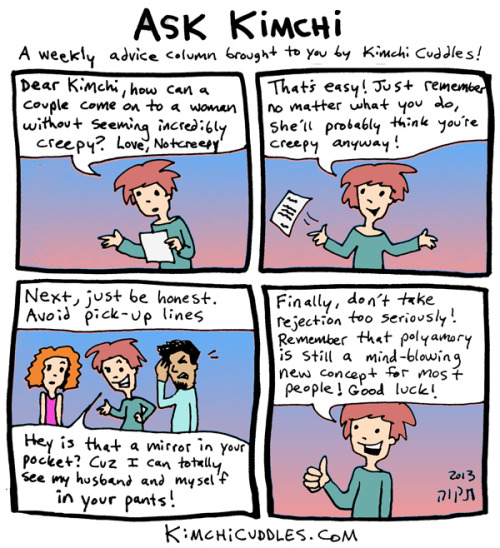
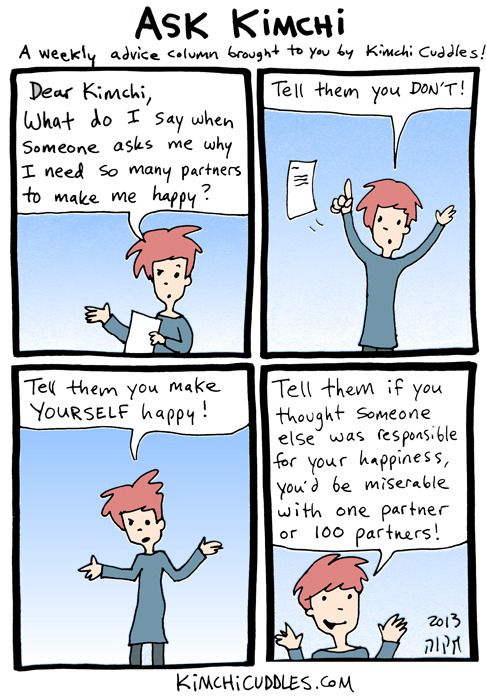
● The Kimchi Cuddles comic has started taking Ask Kimchi questions every Sunday:

(Used by permission)

● Goddess of Java, aka Noel Figart, has for nine years run one of my favorite advice sites, The Polyamorous Misanthrope ("wielding the stick of grandmotherly kindness"). It includes a category for reader questions, Ask the Misanthrope. She's lived many years of the good, bad, and ugly of poly life and dishes consistent good sense, sometimes when it's a clout upside the head. Yet she is helpful and kind to babes-in-the-woods, respectful of people's lack of knowledge as opposed to stupidity. Here are her 10 most popular columns last year. Here's her meta-advice post, Where Do You Get Your Polyamory Advice?


● Polycule often turns her Polycule blog into an advice column:


Q: I got my wife into polyamory. She eventually found another love. That's cool. What isn't is that his philosophy is not the polyamorous kind and keeps forcing mono values onto their relationship. He is also a "non-sexist" sexist who drops constant comments on how she does something very well "for a chick". They share few values. He plays mind games meant to take from our relationship! I don't want to affect her decisions, but... How do I protect myself while not disrespecting her?!!

A:
You’ll have to talk to her in a very patient, gentle, loving, and supportive way.

While there are some people who practice polyamory with the agreement that you can have a say in who your partner dates, I won’t be endorsing that.... However, you also have rights and freedom here, like the right to feel comfortable in your own marriage, and if outside factors (partners) are affecting that, you need to talk about it. The tricky thing is to talk about your feelings without putting her in a corner that’ll make her feel defensive or unsupported. Remember, these are YOUR feelings, NOT a commentary on her relationship, and there’s a fine line to be balanced to make sure you aren’t implying otherwise.

...Ask her when is a good time to have a talk about relationships, and make time for it.... Explain what makes you uncomfortable, that it isn’t a matter of wanting to get between her and her partner, but you have your own feelings to look out for.... Just because you think he makes inappropriate sexist comments doesn’t mean she has an issue with them. Just because you don’t think they share values doesn’t mean that bothers her.... Stick to talking about the things that affect you and your relationship with her, like the playing mind games to take her time away from you. Don’t make blanket statements like that, though; specifically talk about times it actually happened....

...The other issue you have here, and perhaps it was just poor word choice, is that you say you “got her into polyamory.” This may mean she’s not totally thrilled about it, which would drive her to a monogamy-minded person because she may be that way also....


Ask PolyAnna is an occasional feature at Lucar and PolyAnna's Looking Through.Us blog:


Q: As a “secondary” involved with a married poly man, how do I stay informed/involved in his serious medical condition (which will involve surgery) without stepping on anybody’s toes or seeming too pushy? I am concerned & scared & just need to be included.

A:
So… PolyAnna dislikes the ordinal number system when it comes to relationships. Does she have a better classification system in her head, yes, yes she does; does it work for everyone, no, no it doesn’t. That said, in your situation, what exactly does ["secondary"] mean? Legally, you aren’t his wife, so right there the law and some hospitals limit your visitation rights and access to vital information from the word go. This can be mitigated with legal documents or other formalized agreements....

That aside, I think your relationship with your partner’s wife will greatly impact how this situation functions. What are your existing relationship agreements? Is it time to modify those agreements?... If there is an uncomfortable truce, or a pretty thick wall of silence between you and your partner’s wife, I think this could prove a difficult situation. Are you all collectively out? Being public about your poly status will greatly impact this situation, now and going forward.

Once you sort that out, ask yourself, in very clear terms, what do I want and what am I willing to give....

...When people are dealing with serious medical issues, they aren’t always themselves. Periods of stress can make or break relationships. If all else fails, and you feel fairly confident that you aren’t going to make a tense situation worse, and your best efforts to help plan ahead for the day of surgery are rebuffed, come by during normal visiting hours. Bring something nice for your partner and his wife, bring something to eat, drink, occupy the time. Offer to take a walk with her, even if your relationship has been rocky at best, make the offer and be prepared for the door to get slammed, but offer. Be prepared, too, for her to say yes. Sometimes when people see love, really see it, when the going gets tough, they respond accordingly. For some, seeing really is believing.


● On the UK's Polytical website is Ask Polly. We are told, "Polly has scarlet hair, big green glasses, and is made almost entirely of cats."


Dear Polly,

How do I come out to my moderately conservative parents?

I’ve just spent the Christmas break biting my tongue whenever my love life and plans for the future come up, and it was driving me up the wall....

I have an established partner whom they know, and I’ve just started a second relationship. I’m thinking about bringing my established partner into the conversation, so they can communicate to my parents that they’re happy with the arrangement.

...Previous attempts to bring up the subject of non-monogamy in an abstract, ‘I’ve got this friend’ way have been met with disapproval: the words ‘immoral’ and ‘disrespectful’ were used and Mormons were alluded to.

Yours, Pathologically Honest


I’m inclined towards advising people to think twice before coming out. [But] here are a whole bunch of tips that can make your life easier if you decide that you do want to come out.

Have you come out before, for example, as queer? How did it go?...

Phrase this as something you’ve decided, for yourself, after lots of careful thought and conversation. Don’t let it turn into a debate about whether polyamory as a lifestyle is morally right or wrong: this is about you and your choices, and coming out is about getting them to understand and respect that....

If your established partner is a primary, emphasise that. Phrase it as being an open relationship, and that your partner is really important, and that you still intend on being with them long-term (if you do.) The idea here is to... surround your primary relationship with a white picket fence.

Don’t introduce too much new terminology....

If you have, you could mention that you’ve met and spoken with other people for whom this kind of thing has been working well for decades.

Be available to answer their questions: make plenty of time to do so, show that you’re adult and responsible and that you’ve thought a whole lot about this (and say that explicitly too.)

They probably haven’t come across open, honest, ethical non-monogamy before, and they’ll immediately associate the idea of open relationships with the occasional horror stories and rumours they’ve heard.... Don’t take this too personally: your aim is for them to hear and accept your choices. [Then] give them some space.

How To Support Yourself And Stay Safe

I’ve been recommending that you bend the truth and omit facts quite significantly, and occasionally that you lie. I know doing this just isn’t an option for many people. If you come out, out all the way, and tell them everything… it might be quite a lot for them to take. They may take it badly. Your relationship with them may change irreparably. I’m sorry. This is really hard.

I’m now going to say a bunch of what will sound like pretty scary stuff....

Are you dependent on them in any way, for example, financially? If you’re going to come out, get independent of them or be ready to become so quite quickly. They might cut you off. They might disown you. They might take it so badly that you won’t want to engage with them again. I’m sure they’re lovely, but you just don’t know. Be prepared to break up with them over this.

Think about physical space and safety. If you’re coming out in their house, do it on a day when you won’t be staying that night. Having your established partner there with you can really help keep things calm. Have a bag ready near the door in case things go badly and you need to leave. Keep your phone and wallet in your pocket in case you have to leave before then. Don’t be afraid to just walk out if they respond badly....

Beforehand, make arrangements to phone, or have coffee with, a friend who understands stuff immediately afterwards – take space to rant about all the awful stuff they said, to relax and de-stress.

Lastly, I’ll emphasise again: you don’t need to come out. This isn’t something you owe it to them to do.


Read the whole post.


Poly Pipeline includes "Dear Poly Dude" and "Dear Poly Chick" answers to readers' questions. For example:


Dear Poly Chick,

What do you think when you hear someone say, “I am poly”?


My instinctual reaction is, “poly what?”... My mind goes into a whole flurry of possibilities. Since most poly people are unique in their own way (we’re all unique snowflakes), I try not to make any assumptions of what their particular experiences of being poly are.... I tend to ask a lot of questions: How many partners do you have/want? What type of living situation or relationship structure(s) are you in? How long have you been poly? How did you come into polyamory? What does being poly mean to you?...

So, in a sense, I suppose my mind stays relatively blank, allowing the other person to slowly fill it with information as they see fit....


Heed that. Two people can mean very different things by "You're poly?! So am I!", aided and abetted by the Wishful Thinking Fairy applying her invisible blindfolds to both.


Ask Jennvicious is new anarchist advice column, "Life coaching and social etiquette for radical subcultures." She occasionally takes poly questions:


YOU WARN ABOUT THE DIFFICULTY OF OPENING UP A RELATIONSHIP THAT HAS BEEN MONOGAMOUS. I'M CONSIDERING BRING UP THE SUBJECT WITH MY PARTNER OF TWO YEARS. HE HAS SAID BEFORE THAT WOULD NOT CONSIDER A NON-MONOGAMOUS RELATIONSHIP, BUT HE KNOWS THAT I'VE BEEN IN PRETTY HEALTHY NON-MONOGS IN THE PAST. TO START, I JUST WANT OUR COMMUNICATION TO BE MORE OPEN.

- ANONYMOUS

My warnings stem from my (educated, I’d like to think) opinion that polyamory only works when both partners are committed both to that relationship model AND to each other. Not in that I-bought-you-a-ring-and-filed-a-paper-with-the-government sort of committed, just committed to respecting each other’s needs, taking responsibility for our own feelings, and not cutting and running at the first sign of trouble.

It is very difficult to change to polyamory when one person in the relationship just isn’t excited about it. I would be curious as to why your partner has stated his opposition to it before. Maybe he has a really good reason, like a raging jealousy issue that he is unable or unwilling to control.... But maybe he’s just been burned before, or feels insecure about his partner not caring about him as much if they have other partners, or just basically doesn’t trust that he will get his needs met. Those are issues that you might be able to work together to address....

...You might also start talking about minor attractions you both feel to other people. This isn’t about acting on those attractions, it is more about acknowledging something that I think monogamous people sometimes forget: being in a relationship with someone does not mean that you never feel attracted to anyone else. It sometimes feels really healthy to get those feelings out into the open in a relationship. It also might bring up some of those issues of insecurities and things like that.... It’s kind of like practicing.

The most important thing, if you value your current relationship, is to take this whole process very slow. Give your partner the opportunity to think about things that he might get out of having an open relationship. Read things about polyamory together and talk about them.... Talk about things you’ve learned from your past experiences.... Ultimately, open relationships should be about creating our own models of relating to each other that work for each of us, not about forcing people to adapt to our whims.


Ask Polyamory Paradigm, an occasional blogger, invites you to "ask questions and find advice on polyamorous relationships or life."


My quad has just become a triad! Help!

My wife and I recently joined with another couple to form a MFMF quad. The two women are involved with each other lightly, along with being involved with both men. Things went well for a short time until I started to experience some jealousy. I initiated a conversation with my wife about slowing things down (she is falling deeply in love with the other guy) and things blew up. My wife is now staying with the other couple and nobody is talking to me! What should I do?

Your wife is deep in NRE (New Relationship Energy) so I'm not entirely surprised your conversation blew up. Most people in the middle of NRE seem to interpret anything negative or questioning of their new relationship as an attack and attribute it to jealousy, envy, or other negative drivers which they perceive as *your* problem, not theirs.... Focus on negotiating with your partner in a way that continues to support their new relationship.

As I see it you have two choices at this point: you can either support your spouse, or you can "drop a bomb" on things.

Dropping a bomb [means] you would ask your wife to discontinue her involvement in what is now a triad. Being in NRE, she is probably going to explode and reject the idea entirely. This is probably the quickest way to end your marriage and even if it doesn't, you haven't worked through the issues, you have avoided them.

Supporting your spouse is much more complicated and difficult. Probably the first thing to examine is why you feel left out? You have each attempted to have a relationship with someone new. Hers worked, yours didn't. Although it sucks we all know it happens, right? So the real question becomes: is it okay for your wife to have a relationship without you?

If you are practicing a more traditional form of polyamory the answer is probably Yes.... If you are able and would like to remain friends with the other couple, let her know that. Explain that although you feel hurt, rejected, disappointed, and are in emotional hell, you recognize her right and desire to continue her involvement with the other couple and support her completely.

The next part can be a bit tricky. Let her know that while you support her, you also need to feel supported. The other couple may not be able or willing to provide you any support right now, but you rely on her, as your wife, to support you in times of need. Ask her to try and divide her time fairly between you and the triad [DING DING DING! say I; "fairly" is a null concept in these things  --ed.] Suggest creating a calendar so you aren't surprised by time she wants to spend with the other couple. Communicate to her that what you are trying to accomplish is a negotiation that meets both your needs, and your only goal is to continue having a beautiful relationship with her while supporting her new relationship with the other couple....

And finally, go get your own life....


Modern Poly ("The pulse of the polyamory movement") is a big online magazine and resource center that's been making big strides lately. It had an Advice section with a past column by Annie Ory, Hey Annie!, and Ask RaeRay.


● Angi Becker Stevens, who does The Radical Poly Agenda, has started a Q&A section and has just asked more people to send their Qs.


● At the women's magazine xoJane, columnist Cathy Reisenwitz writes, From Shared GCals to GPS Tracking, I'm Answering All Your Polyamory Questions! (July 9, 2013). xoJane claims to be "The fastest growing women's lifestyle brand on the Web," with 2 million monthly readers.

Update December 2013: Here's a new one that just sprang up: Dear Viny: Actual Advice for Alternative Relationships.

-------------------------------

While we're at it: Many discussion sites welcome newcomers sharing their situations and asking for help. Some of my favorites are Expansive Loving, particularly for those with a spiritual bent; Polyamorous Percolations, a friendly, supportive site where Polyamory in the News got started (hence my holdover coffee-theme logo); and Loving More's LoveList, with lots of longtime good people.

An up-and-coming site for advice is, believe it or not, the Reddit Polyamory subreddit, which at 14,000 members has become (I think) the largest poly discussion site on the internet outside Fetlife. Reddit has a reputation for harboring more than its share of internet ugliness, but this subreddit is an oasis of goodness by and large. The demographic is young.

-------------------------------

Also, many static sites offer excellent advice for anyone in the poly world. Some high points:

● I always direct people to Franklin Veaux's More Than Two. For couples thinking of opening their relationship, I often suggest they go there, read the essays in the right-hand sidebar together, maybe aloud, and discuss them with each other as they go along.

● Anita Wagner Illig's widely used jealousy resources belong in this list, in particular her Making Peace with Jealousy in Polyamorous Relationships workshop handout. Anita has long run the Practical Polyamory site.

● Jessica Burde runs Polyamory on Purpose, "the practical side... to deal with all the fun, insane, wonderful hassles of day-to-day in a polyamorous relationship." Scroll down to the Categories in the left-hand sidebar. She recently published a book, Polyamory and Pregnancy, and is now working on the next in her Polyamory on Purpose guidebook series: The Poly Home. For this she's currently asking for stories and input.

● Who'd I miss?

-------------------------------

P.S.: Of course there's nothing like a supportive community of real-life people. Find your local poly discussion/ support/ social group starting here.

For a schedule of bigger conferences, gatherings, and campouts, see Alan's List of Polyamory Events.


[Permalink]

Labels: ,