See a good story I've missed? Email me at alan7388(at) gmail(dot)com.
February 18, 2021
Exciting poly-rights law project coming, seeks your stories for media push
This announcement and call for volunteers comes from alternative-family activist and attorney Diana Adams of the Chosen Family Law Center.
Poly in Public: A Media Training for
People with Stories of Discrimination
Founded by Harvard Law School LGBTQ+ Advocacy Clinic and the Chosen Family Law Center, the Polyamory Legal Advocacy Coalition is made up of long-time advocates for the rights of polyamorous communities who are supporting the passage of laws in various states to recognize polyamorous families.
We are seeking polyamorous people to speak to news and media publications about their personal experiences to fight for change.
Particularly, we are looking for people who can share stories about:
· Health insurance coverage & health care access- inability to cover more than one partner
· Housing discrimination
· Hospital visitation issues with more than one partner
· Employment discrimination
· Child custody challenges
· Any other challenges with lack of recognition of more than one partnership
Join us for a free workshop Friday February 26th from 12:00 - 1:30 pm EST, where you can learn more about our work and have help thinking through how and if you want to share your story. It's most helpful to hear stories from people who would be comfortable sharing their names and faces if possible, but we are also open to hearing from those who wish to remain anonymous. Here's a helpful article by Executive Director of Chosen Family Law Center Diana Adams on how to decide whether it's safe for you to come out publicly as poly.
If have a story to share and/or want to RSVP to learn more, please email contact@chosenfamilylawcenter.org with 'Poly Media' in the subject line.
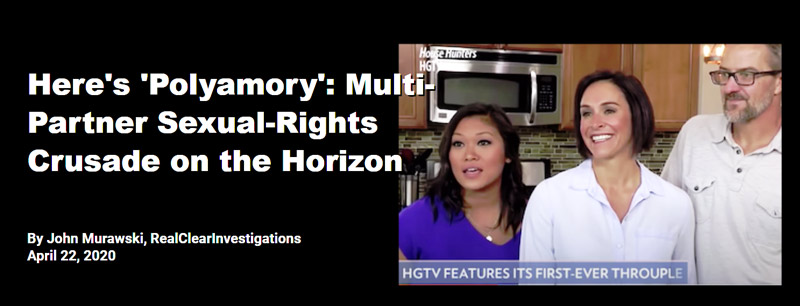
They're noticing us: "Multi-Partner Sexual-Rights Crusade on the Horizon"
A few weeks back a journalist named John Murawski showed up asking polyamory activists for interviews about their ideas on poly rights and possible legal initiatives. Some, including me, were suspicious. He was working for RealClear Investigations, a branch of the nonprofit RealClear media organization. The respected Media Bias/Fact Check service, aggressively neutral, ranks RealClear Investigations as right of center: "These media sources are slightly to moderately conservative in bias. They often publish factual information that utilizes loaded words (wording that attempts to influence an audience by using appeal to emotion or stereotypes) to favor conservative causes. These sources are generally trustworthy for information, but may require further investigation."
Murawski's article is out, and it's a good piece of journalism, neither overtly hostile nor supportive but a broad, straightforward overview of our civil-rights situation and what some of us hope to do about it. It's a hefty 3,000 words long.
Interestingly, though, it has been picked up by a number of extreme-right and militant-Christian sites. That's because it shows that there is indeed a movement gathering for polyfolks' civil rights in employment, housing, medical, child custody, and other discrimination cases — and an particular, because RealClear Investigations (as a nonprofit) lets anyone reprint its original content for free.
Note that the headline stinks. Polyamory is a real word and a real thing that doesn't need quotation marks. And the story is not about sexual rights; those have been largely guaranteed since Lawrence v. Texas (2003). It's about employment, housing, and other public-sphere civil rights. A headline writer got nasty.
Also, a key fact that Murawski seemed to miss: The vast majority of what the poly movement is doing is about general public understanding and acceptance, not legalities. If that is achieved, and it's slowly happening, the need for formal legal remedies dwindles.
Since they're giving the article away free, here's the whole text for the record. Settle in for a read. I haven't pasted in the many reference links; for those see the original. The highlighting is mine.
By John Murawski
It was only a few months ago that someone last treated Cassie Johns like a freak.
During a doctor’s office visit in February, she was asked to list her emergency contacts. Johns, a preschool teacher in Seattle, wrote down two people — Chris and Joan — and identified both as her “partners.” They are two of the four romantic interests Johns has been involved with for many years.
“‘Oh, that’s so dirty,’” Johns recalled the receptionist saying. “And the receptionist literally stepped back from me, in a doctor’s office.”
Johns, 58, is a polyamorist. She follows a non-monogamous lifestyle in which multiple partners give each other consent to date and have sex with others. Johns’s longest polyamorous relationship has lasted 36 years, twice as long as her former marriage to a polyamorous man. She talks openly about her partners to her preschool students and others.
But her forthrightness has a price.
“I have lost jobs, I’ve lost an apartment, I’ve lost a car loan,” because of her lifestyle, Johns said. “I’ve lost friendly relations with neighbors.”
Despite the acceptance of campus hook-up culture and Tinder-arranged trysts, more intentional forms of consensual non-monogamy – which can include polygamy, polyamory, open marriages, group marriages, swinging and “relationship anarchy” – are highly stigmatized. Such behavior is widely considered to be abusive, immoral, or emotionally stunted. People in such relationships not only face rudeness and public shaming, they also lack legal protections against discrimination in employment, housing and child custody disputes.
Polyamorists distinguish their lifestyle from cheating and adultery because, they say, it hinges on the consent of all parties, and can involve unmarried people. Activists say such behavior is more common than many people presume. Some studies suggest that as many as a fifth of Americans have engaged in consensual non-monogamy at some point in their lives. The studies show that at any given time, an estimated 4% to 5% of the population is in a consensually non-monogamous relationship.
While the coronavirus pandemic and social distancing are expected to put a temporary damper on polyamory, those numbers could rise if the social disincentives were removed – in part because some adulterers and cheaters could become consensual non-monogamists.
Activists are moving to dismantle the legal and social barriers, and say their goals are beginning to take shape.
They are laying the groundwork to have their cause become the next domino to fall in a long line of civil rights victories secured by trans people, gays, lesbians, women and blacks. Not too long ago, those marginalized groups were also viewed as unnatural, depraved or inferior, until negative judgments became socially unacceptable and often illegal.
The aspirations of non-monogamists don’t sound like such a moonshot in an increasingly tolerant society where a transgender man can menstruate and experience childbirth, and Pete Buttigieg, a gay man married to another man, can make a serious run for U.S. president.
"The parrot symbol of polyamory, or relationships
in which multiple partners give each other
consent to date and have sex with others."
As the topic breaks into the mainstream, some churches are beginning to grapple with the issue, and polyamorous students are forming university clubs and organizing events. Last fall polyamory got attention, some of it sympathetic, when California Rep. Katie Hill, was forced to resign over allegations she was having an affair with a campaign staffer in a “throuple” with her then-husband. A recent TV episode of “House Hunters” featured three adults searching for a home to build their polyamorous nest, and Hollywood celebrities are opening up about their polyamorous lifestyles as well.
“There is plenty of evidence that consensual non-monogamy is an emerging civil rights movement,” said Heath Schechinger, a counseling psychologist at the University of California, Berkeley, and co-chair of the Consensual Non-Monogamy Task Force, recently created within the American Psychological Association. “I’ve heard from a number of people advocating for relationship structure diversity over the past 20 years who are elated about this issue finally gaining traction.”
Activists are already working with elected officials in more than a dozen local governments, especially in California, to expand local anti-discrimination ordinances to include a new protected class, “relationship structure,” said Berkeley psychologist and poly activist Dave Doleshal.
Most efforts are at the informal stage but the city of Berkeley did consider a formal proposal to extend protections in housing, employment, business practices, city facilities or education to swingers, polyamorists and other non-monogamists. The proposal stalled last year amid concerns that it would have required employers to provide health insurance to numerous sexual and romantic partners outside of marriage.
Undaunted by that setback, advocates continue to generate a body of ideas and theories that normalize non-monogamy as a form of positive sexuality — and possibly an identity — following a script followed by other marginalized groups. Their efforts have led to reassessments of non-monogamy in the psychological and legal fields, contending the relationships are emotionally healthy and ethical, and thus forging a social movement with a shared identity, shared vocabulary, shared history and a shared desire for full recognition.
And, yes, there is already a polyamory pride flag.
Over the past two decades, nearly 600 academic papers have been written on the subject of non-monogamy, according to one count, including an assessment of the benefits to children in polyamorous families. Such research creates a body of scholarship to counteract ingrained social attitudes that poly advocates call prejudices and misconceptions. At the same time, the field has spawned more than 50 books, mostly written by women, said Kenneth Haslam, 85, a retired anesthesiologist and polyamorist in Durham, N.C., who helped create the polyamory history archive at the Kinsey Institute in Bloomington, Ind.
Brian Watson, author of “Annals of Pornographie: How Porn Became ‘Bad’” (2016), is co-authoring a book on non-monogamy throughout history. He said it will feature 50 to 100 prominent figures, such as Victor Hugo and Virginia Woolf, and is deliberately modeled on earlier works about famous gay people.
Just as women’s rights grew from feminist legal theory and LGBTQ rights from queer theory, non-monogamy is also developing its own historiography, scholarship and theoretical frameworks.
Still, it’s not easy to pinpoint a polyamorist profile. They are less likely to identify as heterosexual or to conform to gender norms, but academic studies and anecdotal evidence don’t tell a single story. While some non-monogamists consider themselves neo-pagans, anarchists or socialists, others are libertarians or outwardly conventional suburbanites. Some studies say the lifestyle attracts more men, others say more women; some say it appeals to affluent whites, others say a polyamorist’s average annual income is under $40,000.
In the legal arena, sympathetic scholars are arguing for the extension of legal reforms adopted in family law in recent decades in response to the continued erosion of the nuclear family, which is no longer America’s dominant family structure.
At least a dozen states now recognize or allow for the possibility of a child having more than two parents, an accommodation for surrogate parents, grandparents, stepparents and other nontraditional families, according to a February legal article by Edward Stein, a professor at the Benjamin N. Cardozo School of Law at Yeshiva University in New York.
These expansions of the legal concept of family are potential pathways for non-monogamous families to win legal rights of their own, Stein said. Another potential legal opening could be the existing precedents in domestic partnerships and civil unions that were set up locally for gays and lesbians before same-sex marriage was legalized nationwide in 2015. In both cases, legal victories for one group could be extended to another group, a common way that legal developments happen, he said.
The first steps would likely have to be decriminalizing of adultery in the 38 states that don’t distinguish between consensual and non-consensual non-monogamy. The prohibition of adultery is comparable to anti-sodomy laws whose repeal by the Supreme Court in 2003 cleared an obstacle for recognizing gay marriage, Stein said.
“I think what we will see is a lot of chipping away at the edges of some of the restrictions we put on what a family is and what a family does,” said Janet W. Hardy, who has written on polyamory for more than 20 years. “When the legal challenge comes – and it will – I don’t think it will be from people who identify themselves as poly. I think it will come from blended families and some of the other ways that we are reforming around the idea of family that are legally challenging.”
One such example was a recent effort by Hartford, Conn., authorities to evict eight adults and three children living as a single family in a 6,000-square-foot mansion.
The combined family was not polyamorous, said their lawyer, Peter Goselin, but shared financial, domestic and child-rearing responsibilities. In 2014 the city alleged a violation of its zoning rules for single-family homes, but after two years of litigation, the city dropped its case.
The joint owners and residents of the home claimed a constitutional right to define a family. The octet’s lawsuit against the city includes a brief history of communal family living, from Iroquois longhouses, which housed up to 20 family units, to the communes, cooperatives and collective households of the 19th and 20th centuries.
“They saw the implications of it,” Goselin said. “Privately they said to me we know this would be encouraging to a lot of people who are in polyamorous relationships.”
Advocates say that the warnings against the perils of non-monogamy echo the now-debunked concerns about same-sex marriage.
“All of the well-known objections made against multi-person intimate relationships can be made against same- or opposite-sex monogamy as well, resulting in an indefensible double standard,” Ronald C. Den Otter, a political science professor at California Polytechnic Institute wrote in a 2015 article in the Emory Law Review. “Sadly, many two-person intimate relationships are dysfunctional, and a closer, more brutally honest look at them should not inspire confidence in their superiority.”
Once changes get under way, things can move quickly. The rise of the modern gay rights movement in the mid-20th century led to a decision by the American Psychiatric Association in 1973 to remove homosexuality from its list of mental disorders (gender dysphoria was de-pathologized in 2012). Those medical reversals are seen as analogous to the American Psychological Association’s creation last year of its Consensual Non-Monogamy Task Force, formed to destigmatize such relationships and explore changes in public policy.
Schechinger, the task force co-chair, said it’s much easier to stereotype and hate a marginalized group when people in the normative majority operate by stereotypes and misinformation.
“That’s part of what the task force is seeking to accomplish – to gather empirical data, promote accurate information about CNM relationships, and ask if these relationships are causing harm or are not,” he said. “And what are the implications on society for promoting a one-size-fits-all model versus promoting people being in touch with what’s the good fit for them.”
As with the debates over human nature during the gay rights struggle, non-monogamy advocates are also raising the possibility that desiring multiple sexual partners is less a lifestyle choice and more of a sexual orientation. But there can be little doubt that non-monogamy, the norm in the animal kingdom, is natural, and that monogamy is a cultural ideal that developed in humans.
But the yen for sexual variety and adventure competes with an equally insistent bugbear: jealousy. And some believe that “green-eyed monster of jealousy” is the more powerful force, making it unlikely that most people could tolerate consensual non-monogamy for their partners and accept it is a social norm.
“In the long run there’s going to be some resistance because it’s threatening to everybody else, because they recognize the desire for multiple partners is something they have, too,” said David Barash, a zoologist and a professor emeritus of psychology at the University of Washington in Seattle, and author of “The Myth of Monogamy: Fidelity and Infidelity in Animals and People” (2001). “They recognize it touches something within themselves that they’d rather keep hidden. And something in their partner that they don’t want to acknowledge, either.”
Kay Hymowitz, a scholar at the conservative Manhattan Institute, is also skeptical. Her concern is the unintended harmful consequences of disrupting long-established social norms developed to ensure that men commit to rearing their own children, and that powerful, wealthy men don’t hoard women and create a deficit of available options for other males. “Normalizing consensual non-monogamy will become yet another way to ‘privilege’ male desire,” she said. “I know, I know: There are women who believe strongly in consensual non-monogamy [and who] may truly be happier in those relationships than they would be in vanilla relationships. Good for them. But they are a small minority.”
Hymowitz said that the individual rights of polyamorists, swingers and commune members have to be weighed against the greater social interest, and that case has yet to be made.
“You’re creating one more arrangement that will be less stable for children and less permanent,” she said. We have enough problems as it is keeping couples together.”
Nonetheless, longer life expectancies, greater personal freedoms for women, dating apps and the internet are transforming sexual expectations and sexual opportunities, said Elisabeth “Eli” Sheff, CEO of Sheff Consulting in Chattanooga, Tenn., which specializes in sex and gender minorities, and provides expert witness services and relationship coaching. She’s also the author of the 2014 book, “The Polyamorists Next Door: Inside Multiple-Partner Relationships and Families,” based on a longitudinal study of more than 500 polyamorists.
“We don’t live in a monogamous society. We live in a society in which people pretend monogamy is the norm,” said Johns, the Seattle polyamorist who offered the poly mantra that it’s possible to romantically love more than one friend just as it’s possible to love more than one child.
Non-monogamy has a long history, more ancient than King David’s multiple wives and concubines in the Old Testament. Today’s non-monogamists often cite as their inspiration novelist Robert Heinlein’s treatment of the subject in his 1961 sci-fi classic “Stranger in a Strange Land.” Gay men are sometimes hailed as trend setters because they are accustomed to flexible “monogamish” marital arrangements that allow for outside dalliances.
One of the primary texts associated with the contemporary movement is Janet W. Hardy and Dossie Easton’s 1997 “The Ethical Slut” which lays out the best practices for what advocates hold up as consensual, ethical and responsible non-monogamy.
“I don’t think it has ever had the groundswell that it has now,” said Hardy, who now is running into polyamorous adults brought up by polyamorous parents. “A lot of us are second-generation now.”
Poly activists point to many parallels between earlier movements that were born underground and operated under the radar: secret clubs, insider argot, referral networks for poly-friendly therapists, doctors and lawyers. The National Coalition for Sexual Freedom’s Kink and Poly Aware Professionals referral list includes about 300 lawyers, said Susan Wright, the Baltimore-based organization’s executive director.
The world of polyamory overlaps with the subculture of kink and BDSM, which refers to the erotic practices of bondage, domination, submission and sadomasochism. As a sign of the movement’s maturation, some now embrace the kind of middle-class respectability that made gay marriage palatable to mainstream society.
“We’re a very boring and respectable couple!” polyamorist Carrie Ichikawa Jenkins beamed to The Chronicle of Higher Education in 2017. Jenkins, a University of British Columbia philosophy professor, has a husband and a boyfriend, both of whom teach at UBC. The Chronicle article paints a portrait of the polyamorous triad in domestic hues befitting Norman Rockwell: “On the wall hang sepia-toned photographs of someone’s relatives. On the front porch are a swing and a coffee table with an ashtray on it.”
The civil rights concerns of the non-monogamous and other minorities are dissimilar in some ways. Unlike earlier civil rights movements, non-monogamy has the potential of affecting a majority of the population, since membership in the group is theoretically open to everyone.
“In a way, poly is a deeper threat to the dominant culture than gay culture,” said Geoffrey Miller, a polyamorist in an open marriage and a psychology professor at the University of New Mexico.
Miller, a member of the APA task force, compares the state of non-monogamy movement to gay rights in 1966, in the calm before the storm of the Stonewall Riots, the 1969 protests that launched the modern gay rights movement. The closeted movement had about 50 organizations in the late 1960s but exploded to 1,000 by the mid-1970s, said John D’Emilio, a retired professor at the University of Illinois, Chicago, who taught on the history of sexuality and the LGBTQ movement, and is co-author of “Intimate Matters: A History of Sexuality in America” (1988).
Conservatives had long warned that redefining marriage to allow same-sex unions would throw open the door to allowing any kind of marriage, from polygamy to incest. Those arguments reached a crescendo when gay marriage was winding its way through the legal system, en route to the 2015 ruling by the U.S. Supreme Court to legalize same-sex marriage. In that 5-4 decision, Chief Justice John Roberts wrote a dissenting opinion warning of what was to come.
“It is striking how much of the majority’s reasoning would apply with equal force to the claim of a fundamental right to plural marriage,” Roberts wrote. “Why would there be any less dignity in the bond between three people who, in exercising their autonomy, seek to make the profound choice to marry?”
Princeton professor of jurisprudence Robert George was among those who warned of the slippery slope. In a 2015 article, he predicted that the civil rights challenges were inevitable, but initially judges would “swat away on procedural grounds the first few constitutional challenges to marriage laws.” Gradually the legal objections will give way to the force of logical consistency.
He told RealClearInvestigations in an email that this process is often characterized by indignant dismissal of the logical implications, followed by total capitulation.
“Of course, advocates of revising the law denounced us not only as ‘bigots’ but as ‘scare-mongers,’” George said. “There was, they insisted, no ‘slippery slope’ from same-sex marriage to polyamory. The two concepts had nothing to do with each other.
“I could see that this was nonsense — often disingenuous nonsense,” George said. “So I am not in the least surprised to see what is happening now. We have quickly gone from, ‘It will never happen,’ to ‘You’re a bigot for thinking there is anything wrong with it.’”
CBS explores anti-poly stigma in one-hour documentary "Speaking Frankly: Non-monogamy"
[See post-show update at bottom (scroll down).]
This evening (Sunday October 27), a 1-hour doc about people practicing consensual non-monogamy will air on CBSN, the 24/7 digital streaming service of CBS News. Speaking Frankly: Non-monogamy will play at 8 pm, 11 pm, and 2 am ET. CBS chose this topic to lead off its new 6-part "Speaking Frankly" series.
They've already put up the 23-minute main body of the documentary and the three segments of studio discussions that follow it. You can watch the complete hour of the show's material here:
The webpage is titled Not just "one big orgy": Fighting the stigma of consensual non-monogamy (online October 24, 2019). The preview features mostly open couples and triads, as well as some of our best talking heads (including Diana Adams and Elisabeth Sheff), discussing problems poly people have in finding safety and acceptance in the wider world.
It's interesting to see here that Helen Fisher, famous researcher and author on the nature of romantic love, has finally recognized that polyamory is a real thing. She used to dismiss it as impossible due to her theories about human exclusivity. It's nice to see a social scientist change their theories to fit reality rather than blow off a reality that doesn't fit their theories.
My overall impression? The show looks to be good for us. It explains the concept well to the many people who are still, even now, discovering us for the first time. But because it centers the stigma problem, many of the polyfolks spotlighted come off as kinda defensive or even scared.
Excerpts from the transcript:
By Jessica Kegu and Jason Sinverstein
"One big orgy." [Could a clickbait lead sentence be more obvious?] That's the stereotype about the lifestyle of consensual non-monogamy — an arrangement where committed partners openly agree to have sexual relationships with other people.
But people who have practiced non-monogamy for years say it's not all wild sex — or even all that wild. It takes a lot of work, and it carries a lot of stigma. There can be serious consequences for the family life and even careers of those involved.
"Many people are trying to create families in different kinds of ways. And a lot of people see that as dangerous," Diana Adams, a Brooklyn-based lawyer who represents polyamorous families, says in the CBSN Originals documentary, "Non-monogamy."
She advises clients in non-monogamous relationships to be careful about telling their employers. She's seen some lose their jobs over it.
...Mahdy, a man who lives in Brooklyn, New York, had to end his marriage to keep his relationship together. He is part of what's called a triad or thruple — a polyamorous relationship between three people who are all actively involved with each other. But because it's illegal to be married to more than one person, only two people in his triad can be married.
Mahdy, who did not want his last name to be used, met his first partner about 14 years ago and married her in 2011. One year later, the couple met another woman, and the three formed a triad. But it could have fallen apart after the second woman ran into problems with her immigration status, he says.
Mahdy had to divorce his wife to keep their triad together. CBS News
For her to remain in America, Mahdy and his wife divorced, and the wife married the second partner. It kept them all together — but he is still reeling from the ordeal.
"Dissolving the marriage … that was really, really difficult for me," he says. "I don't have the legal protections I had when me and my first partner were married. In fact, I don't think I've had health insurance since."
---------------------------
For many people in non-monogamous relationships, there's nothing strange about their arrangement. It's just romance — plus one or two other people, or more.
"People think that there's this magical thing happening all the time," says Brooke Houston of Kansas City, Kansas, who has been in a triad for more than a year. "And half the time we're just chilling. Whoever has the energy for a big orgy 24/7, let me know. Tell me your secret," she joked.
CJ George, Brooke Houston, and Brandi George. CBS News
In 2018, Houston formed a triad with CJ and Brandi George, a couple who have been in an open marriage for four years. She has a sexual relationship with both CJ and Brandi — sometimes individually, and sometimes all together.
...Brandi said that years ago, someone wrote an anonymous letter to the school district where she works as a teacher, outing her for being in an open relationship. ... "I was terrified that I would be let go from my job or that I would have people that wouldn't accept me," she said. "My students, like, they give me oxygen, they give me life. And so to have that taken from me would have just like devastated me. So I was just very aware that that could happen and that I would have nothing. And how could I provide for my kids if I don't have a job?"
Some non-monogamous people can't be open about their situation at all. ...
...Last year, the American Psychological Association created a task force on consensual non-monogamy to promote awareness and understanding of non-traditional relationship structures.
"Finding love and/or sexual intimacy is a central part of most people's life experience," the APA website says. "However, the ability to engage in desired intimacy without social and medical stigmatization is not a liberty for all."
People who engage in or support non-monogamous relationships argue that it's simply an option that should be available for those who choose — just as monogamy should be an option. And for now, they're just asking for acceptance.
"It's never gonna be equal for us," Mahdy said. "I only ask that people don't interfere with what we have."...
● Here's a 5-minute promo about the show with host Tanya Rivero, titled The challenges of polyamory and non-monogamous relationships. The blurb with it: "The new CBSN Originals documentary 'Speaking Frankly: Non-monogamy' explores a way of life that's more common than you might think. But maintaining a non-traditional relationship carries stigma and presents some special challenges. Executive producer Adam Yamaguchi joined CBSN with more on the story."
● Another video: Rivero interviews Diana Adams, founder of Diana Adams Law & Mediation and the Chosen Family Law Center. Adams gets a solid 10 minutes to stay her stuff, and damn, is she good at this! This is the best interview I've ever seen her do. (BTW, her haircut make it clear that these news videos were filmed at a different time than the main documentary.)
The video's webpage: Legal hurdles in non-monogamous relationships (online Oct 24). "Attorney Diana Adams discusses the legal hurdles that can sometimes impact those in consensually non-monogamous relationships, including issues related to child custody, immigration and health insurance." Unfortunately, I find no transcript of it.
● Rivero also sat down with Elisabeth Sheff for this segment, called "Children of Polyamorous Relationships."
"Dr. Eli Sheff, an expert on children in polyamorous families, discusses what these children report about growing up as part of a non-traditional family unit."
● Another news video by Rivero: "Dr. Amy C. Moors, the co-chair of the American Psychological Association's non-monogamy task force, discusses the state of research around non-traditional relationships and polyamorous families."
Watch for updates here after the show itself airs.
-------------------------
UPDATE AFTERWARD: Well, the full 1-hour version tonight consisted only of the videos above: The 23-minute in-the-field documentary I called the "preview," followed by the in-studio discussion videos, one after the other with ads between.
Impressions? I have to say I come away with a less-good, possibly even dark view of the show after watching the whole thing in one go.
I realized one difference: This time I was paying more attention to the background music. Much of it was chosen to be sad or ominous, to go with the problems people were saying they faced (fears of job discrimination, coming out to family, child custody, etc.) Was the background music supposed to evoke sympathy... or did it lend an air of problems and sadness about trouble to the whole subject of multi-relationships?
At least, I see that that's how skeptics may take it. I'll be interested in your reactions.
One thing, though: When I first posted about the show, I said it looks like a link you might send your parents. I've taken that out.
That scare headline, "There's a dark side of polyamory that nobody talks about"
That attention-getting headline going around comes from an article that appeared Tuesday in Business Insider, one of the several Insider sites. The "dark side" turns out to be other people discriminating against polyfolks. Hey, yoohoo! People do talk about that. A lot. See "coming out." And "child custody cases."
There's a dark side of polyamory that nobody talks about
"Polyamory takes many different forms." (Marco Piunti / Getty)
By Lindsay Dodgson
– Polyamory is not a legally protected status, like being straight or gay. You can lose your job for being polyamorous. Courts can use it against you in child custody proceedings. – Polyamory and non-monogamy take many different forms. – For instance, egalitarian polyamory means not having a primary partner at all, and there are many asexual people who are polyamorous.
About five years ago, Cameron Mckillop was talking to a friend at work, when an older woman came up to them and abruptly put an end to their conversation.
"[She] loudly told the other girl to stay away from me or I'd take her back home and make her another one of my wives," Mckillop told INSIDER.
"The friendship never really recovered, and after that most of the women in that class and then on the call floor wouldn't interact with me. Also, the older lady would always look daggers in my direction whenever I was near her."
Mckillop is polyamorous, which means he has multiple partners. Polyamory and other types of non-monogamy are an alternative to what Amy Gahran, a writer and editor based in Boulder, Colorado, calls the "relationship escalator."
...Gahran told INSIDER, "As young as 12 or 13 I was imagining relationships that worked in very different ways." ...
But although awareness has come a long way in the 20 years Gahran has been in the non-monogamous community, there are still misconceptions. And these misconceptions can lead to judgment, abuse, and even legal problems.
"Being polyamorous in particular, or otherwise consensually non-monogamous, at least in the US, is not a protected status," Gahran said. "It is something you can get fired for. It is something that can jeopardize child custody arrangements, it can complicate divorce proceedings, it can complicate people's ability to get access to jobs or education."
Gahran now lives as a solo-polyamorist, meaning she has more than one lover at a time, but leads an independent life and doesn't consider herself to be part of any couples. She also practices egalitarian polyamory, which means there are no primary or secondary partners in her relationships. ...
The rest of the long article wanders off to discuss the various kinds of polyamory, the ethics of primary-secondary relationships, how polyfolks deal with jealousy, and so forth (Feb. 19, 2019).
------------------------------
While we're on the subject, here are some substantive things about anti-poly discrimination. The first two are by Eli Sheff:
● Remember, you don't have to come out to be a good person. People who have to stay closeted need to build ways ways to cope with their situation in a healthy manner — as Liz Powell, an officer in the army for five years and now an independent queer and poly therapist, explains in text and video.