Polyamory in the News
. . . by Alan M.


May 19, 2015

"Equality and polyamory: Why early humans weren't The Flintstones"

The Guardian


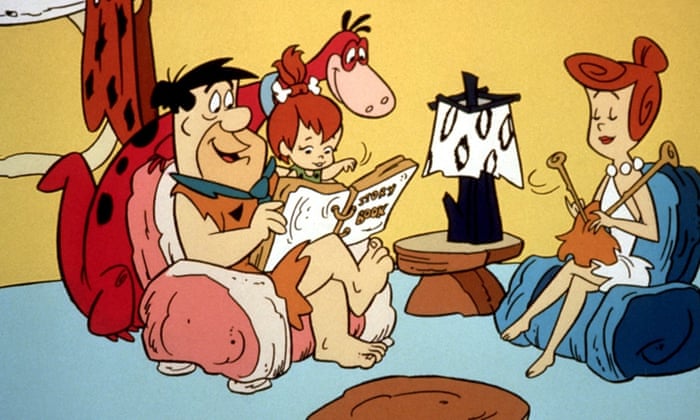
Caption: The “standard narrative of prehistory” presents the idea that, like Fred and Wilma, men have always gone out to hunt/work and women care for home and children. (The Guardian / Everett Collection / Rex Features)

The year 2010 marked a turning point for the polyamory movement, partly due to the publication of Sex at Dawn by Christopher Ryan and Cacilda Jethá. More on this later. Memorably, the book zinged anthropology's "Flintstonization" of stone-age families — the timid, ridiculous assumption, never really stated or defended, that our prehistoric ancestors, who shaped our inherited traits, evolved in 1950s nuclear families like Fred and Wilma Flintstone.

And only had across-the-hedge chats with Barney and Betty Rubble.

This morning's Guardian uses the Flintstonization zinger to begin a long report on some new research just out. The article then takes a wider look at the likelihood that we are literally born and bred for multi-partnering.


Equality and polyamory: why early humans weren't The Flintstones

A study released last week presented evidence that prehistoric men and women lived in relative equality. But is the truth even further from the nuclear narrative?

By Simon Copland

Last week, scientists from University College London released a paper presenting evidence that men and women in early society lived in relative equality. The paper challenges much of our understanding of human history, a fact not lost on the scientists. Mark Dyble, the study’s lead author, stated “sexual equality is one of the important changes that distinguishes humans. It hasn’t really been highlighted before.”

Despite Dyble’s comments, however, this paper isn’t the first foray into the issue. In fact, it represents another shot fired in a debate between scientific and anthropological communities that has been raging for centuries. It’s a debate that asks some fundamental questions: who are we, and how did we become the society we are today?

Our modern picture of prehistoric societies, or what we can call the “standard narrative of prehistory” looks a lot like The Flintstones. The narrative goes that we have always lived in nuclear families. Men have always gone out to work or hunt, while women stayed at home to look after the house and the children. The nuclear family and the patriarchy are as old as society itself.

The narrative is multifaceted, but... can probably be traced back to Charles Darwin’s theory of sexual selection.

The Guardian / Everett Collection / Rex Features

...Yet, for centuries many have questioned the logic, and the biology, of the standard narrative.

The first real splash in this arena came from the anthropologist Lewis Morgan, and his book Ancient Society [1877]. In the book Morgan presented the results of his study of the Iroquois, a Native American hunter-gatherer society in upstate New York. The Iroquois, Morgan observed, lived in large family units based on polyamorous relationships, in which men and women lived in general equality.

Morgan’s work hit a broader audience when it was taken up by Friedrich Engels (most famous for being the co-author of The Communist Manifesto) in his book The Origin of Family, Private Property and the State. Engels drew on Morgan’s data, as well as evidence from around the world to argue that prehistoric societies lived in what he called “primitive communism”. Other anthropologists now call this “fierce egalitarianism”: societies where families were based on polyamory and in which people lived in active equality (i.e. equality is enforced).

Morgan and Engels were not painting a picture of a “noble savage”. Humans were not egalitarian nor polyamorous because of their social conscience, but because of need. Hunter-gather societies were based largely on small roaming clans where men engaged in hunting, while women’s roles focused around gathering roots, fruit and berries, as well as looking after the “home”. In these societies community was everything. People survived through the support of their clan and therefore sharing and working within their clan was essential. This crossed over into sex as well.

Polyamory helped foster strong networks, where it became everyone’s responsibility to look after children. As Christopher Ryan states: “These overlapping, intersecting sexual relationships strengthened group cohesion and could offer a measure of security in an uncertain world.”....

-------------------

On top of Dyble’s study last week, new anthropological and scientific evidence backs up this challenge to the standard narrative. In 2012 Katherine Starkweather and Raymond Hames conducted a survey of examples on ‘non-classical polyandry’, discovering the phenomenon existed in many more societies than previously thought.

In another example Stephen Beckman and Paul Valentine examined the phenomenon of ‘partible paternity’ in tribes in South America: the belief that babies are made up from the culmination of the spermatozoa of multiple males. This belief, which is common in tribes in the Amazon requires polyamorous sexual activity by women, and that men share the load of supporting children.

And then there is the example of the Mosua in China, a society in which people are highly promiscuous and where there is no shame associated with this. Mosua women have a high level of authority, with children being looked after by a child’s mother and her relatives. Fathers have no role in the upbringing of a child — in fact the Mosua have no word to express the concept of “father”....

Read the whole article, with many links (May 19, 2015).

It includes a sidebar link to a Guardian article about modern polyamory: Being polyamorous shows there's no 'traditional' way to live (Aug. 20, 2013).

Five days ago The Guardian published another story on Dyble's research: Early men and women were equal, say scientists. "Study shows that modern hunter-gatherer tribes operate on egalitarian basis, suggesting inequality was an aberration that came with the advent of agriculture." (May 14, 2015).

-----------------------

More on the significance of Sex at Dawn:

Sex at Dawn made quite a splash in the summer of 2010 and briefly got onto the New York Times bestseller list. It drew on anthropology, primate studies, and human anatomy to built a case that nuclear-family monogamy is unnatural to our species, dating only from the invention of agriculture and settled property about 10,000 years ago. The previous 99% of our evolution as a species shaped us to live a naturally polyamorous life of "fierce equality" between the sexes, living and interbreeding in hunter-gatherer bands. This remains the pattern in the few surviving hunter-gatherer societies today that continue their prehistoric way of life.

Some anthropologists and others criticized Sex at Dawn for cherry-picking its evidence, misrepresenting some of it, and overstating its case. However, its core argument has held up pretty well.

The book's impact on the poly movement was immediate. We had always labored under the dismissive criticism — and the self-doubt it raised in our own lives — that what we were doing could never really work because everyone knew that happy polyamory was contrary to human nature. I wrote at the time that Sex at Dawn


blows away the conventional wisdom that multiple relationships are unnatural or cannot fit with how humans are built. In fact, it reverses the human-nature argument 180 degrees.


It followed The Myth of Monogamy by David Barash and Judith Lipton (2002) and other works and research trending in the same direction. Since 2010, it's the remaining innate-monogamy defenders who've been thrown back on their heels, and polys have become the ones confident and on the offensive. To continue:


For most of the polyamory movement's 30-year history, advocates who have sought to give poly a theoretical foundation have generally turned to New Age or spiritual philosophies, involving things like the limitless nature of love, the spiritual heart of the universe, and other concepts that I find fairy-taley and unproductive. By unproductive I mean that theories built on them never seem to lead anywhere predictive or useful, as a good theory must.

Ryan and Jethá have now given us a theoretical underpinning that is concrete and evidence-based. They make the case that polyamory matches what human nature actually evolved to be. Seen in this light, the modern, ethical, egalitarian version of poly offers a path to a saner future — in which humans are not so perpetually conflicted with themselves, and are less driven by the insatiable needs and neuroses that in many ways are causing us to ruin the world.


[Permalink]

Labels: ,


January 26, 2020

In Israel, a family of three adults are declared the children's equal parents.


Another step for polyfamily recognition: An Israeli judge, guided by "the best interest of the children," has granted a woman and her two gay male living partners equal co-guardianship of their children. Erez Benari from Seattle tells us,


This broke yesterday and hasn't been officially translated to English yet. An Israeli thrupple asked to legalize their non-traditional union by approving all 3 adults in the family (2 guys, one woman) to hold "legal guardian" status of their 2 children. Each of the men had a separate child with the woman, and now each of the dads is officially a father to both kids, as is the mother.

Hopefully, this is a first step towards a legal union between the adults.


The original article (Jan. 23, 2020) in Yedioth Ahronoth, reportedly Israel's largest-selling newspaper. Google Translate turns the Hebrew into English as follows:


The judge ruled: Mother, Father and Father

Orr, Gil and Glee formed a family and sought to register as co-parents of the two children born to them — each man as another guardian of a child who never came from his seed.

By Yoram Yarkoni

The Tel Aviv Family Court recognized triple parenting — a new family unit that includes Mom, Dad and more Dad as guardian. The two children born to three are officially siblings.

The state is in principle opposed to recognition of a family structure of three parents. ... The judge who recognized triple parenting is Yehoram Shaked. The decision that gave the three parents equal status to their children reads: "The children were created and born into a situation where they have three parents. Rejection of the lawsuit will have one and only meaning for the parties: Continued disobedience and conduct that does not benefit the minors or the whole family."

Judge Shaked further stated that when considering the best interests of the minors, the good of the whole family must also be taken into account. In the past, Shaked has made a decision on triple parenting, in another case with other legal circumstances, but is prohibited from [publicizing] and cannot [give details] about it.

...[The two men] living together wanted to have children. They contacted Glee, whom they knew, and together decided to start a single family with three parents. The pregnancy process took place abroad.

...The three parents' attorneys, attorneys Haggai Kalei, Danielle Jacoby, Carmel Ben Tzur and Carmit Mizrahi, argued that the request to add a guardian to each child came to reflect the reality in which the children live from their day of birth and that they consider themselves brothers for everything. The parents' attorneys said: "In the State of Israel there are thousands of families where children are born prematurely and intentionally to a loving family unit that includes three parents. In the LGBT community, this family structure is particularly common. But so far, the court has not given a proper response regulating the rights of these family [units]."

Itai Notak, a member of the Tel Aviv City Council and who assisted in the struggle of the three parents, said: "Life is stronger than conservative perceptions that our lives must not be waged."

Attorney Dalit Yaniv-Messer, a family law expert, said: "The importance of providing guardianship to a non-biological parent is that it has the right and duty to care for the minor's needs like his biological parents."...


This recalls a similar landmark ruling in Newfoundland, Canada, in April 2018.


Update February 11, 2020: Erez writes about another, similar case:


Another precedent set in my home country of Israel. A throupple of one man and two women has received a "Common law partner" recognition by the court.

The man, referred to as "R" in the article, was recognized as a common-law partner of one woman, but felt his connection with the 2nd woman ("N") was strong, so he took it to court with lawyer Shiri Robbins Golan. N says she signed a partnership contract with R because has has multiple financial assets and she wanted him to feel comfortable with their relationship, and not be concerned about her motives (as in, being financial rather than romantic).

Original article in Hebrew.


[Permalink]

Labels: , ,


September 15, 2017

The Guardian: "A moment that changed me: turning my back on monogamy"


Today The Guardian online posts a poly story in its "A moment that changed me" series. It's another in the paper's many positive looks at the polyamory phenomenon over the years (the last one). This matters; the Guardian's site was reportedly the world's second most popular newspaper website as of early 2016.


A moment that changed me: turning my back on monogamy

Brought up believing in romantic exclusivity, relationships caused me crippling jealousy. Then my husband and I embraced polyamory.

‘Polyamorous people are not born with non-monogamous attitudes — some of us have to work at it’. The author and her husband. Photo: Stephanie Munro 

By Stephanie Munro

...About two years ago Andrew and I found polyamory becoming part of our collective consciousness in a way that is hard to explain. We are incredibly alike and often come to the same conclusions independently. ...

...But there was one sticking point: I felt sick whenever I imagined him with anybody else. And you do have to imagine these things, it’s how you prepare for big changes. ...

...I bought a couple of books about polyamory and I tried my best to get through them, though I found the sanctimony hard to swallow and gave up within a couple of chapters. I was, however, completely absorbed by a passage on jealousy. After all, polyamorous people are not all born with non-monogamous attitudes — some of us have to work at it. In order to stop feeling threatened by others and unlearn the commandment to love one person and only one person, I had to finally understand that there is no spoon. I had to reject the construct altogether and trust in love.

When I was growing up I believed that I would meet somebody special, The One, and that we would be so in love that we wouldn’t need anything from anybody else. ... I can still invoke the sense of panic I felt when I discovered texts or emails from a partner to other women. It was like something had been taken from me, I had nothing to hold on to and no ground beneath my feet. It all stemmed from the fear that if someone else attracted the attentions of the person I loved, then it was all over.

Put simply, non-monogamy is about changing your perceptions. The reality, of course, is less simple: altering how you see something that has felt so important and true for so long is hard work. ... We stayed up late, talking for hours about exactly what we would want. ...

...Opening up your relationship is a complete remodelling of partnership and of fidelity. ... Escaping jealousy and embracing polyamory is one of the most rewarding things I have ever done. When I finally let go of monogamy, I realised I had so much more room for love and compassion. Not just for others, but for my husband, and for myself.

Stephanie Munro is a freelance writer working for the Guardian’s online community team.


Read her whole story (September 15, 2017).

[Permalink]

Labels:


July 3, 2017

Building poly awareness, country by country. Poly-in-the-media lists outside the US?


When the histories of the modern polyamory movement are written — tracing how, in just a few decades, the concept went from literally unthinkable to a relationship option eventually known to all — one of the characters in the tale will be Green Fizzpops (not her real name) in South Africa.

She was, as far as I know, the key person who made it her mission to build the movement in her country. She started South African Poly, and its ZApoly discussion list, well over a decade ago, collected a coterie of members and fellow activists, and persisted for long years when the returns were few. Now poly in South Africa seems to be gaining force.

One thing that she's done is maintain a list of poly coverage in South African media. The list is reprinted below with permission.

I'd love to find such lists for other countries, or regions, or languages, to link to here and maybe repost. This website is being archived at the Kinsey Institute Library. So a reprint of your material here will help preserve it for researchers forever.

If your country or language does not already have such a list, maybe this is the universe telling you to create it. And if your country or language has nothing yet to list... well, you have a mission.

Cheers,

Alan

--------------------------------------

South African media articles related to polyamory

Articles

Documentaries

Interviews

Audio

Video


[Permalink]

Labels: ,


April 6, 2012

"Open relationships: The people making it work"

The Guardian

In its April 6th weekend edition, The Guardian — one of Britain's and the world's major liberal newspapers — just published a 2,500-word feature article on open relationships done intelligently. Maybe the paper decided a counterpiece was in order to all the sad celebrity breakups and lowlife crime drama that fill anyone's mailbox who has a Google News Alert set for "open marriage." The article is also on the Guardian's website, which gets 4 million visitors a day worldwide.

The article starts in the usual sort of way but then has some interesting twists.


Open relationships: The people making it work

By Arianne Cohen

...Like most open couples, we began with dozens of rules: who should call who when, what partners would be OK. But it quickly became clear that these attempts at control were aimed at avoiding jealousy, and that most negative feelings were not jealousy at all: they were my own fears – that he would leave me, or that I wasn't the epitome of sexuality in his eyes....

As I became more secure in the relationship, the rules faded away, leaving just one: no surprises, which means pre-scheduled dates and no sudden, "I just slept with Susie!" announcements....

...We rarely see each other's partners; some people do it differently. Claire, a small business owner and amateur musician, and Bill, a technology consultant from Oxford, frequently socialise together with their lovers. They are in their mid-40s and have been together for 24 years. She has a boyfriend, Chris, of seven years; Bill has a girlfriend, Julie, of eight years, who is in a long-term relationship with her partner George. "From an emotional point of view, it's been pretty straightforward for the last many, many years," Claire says. Bill and Chris sometimes attend Claire's performances: "People probably wonder why I keep turning up to my gigs with two blokes. They've never said anything, naturally."

The relationship works so well that Claire struggles to think of recent friction. "Two years ago, there was a moment when Bill ran up and said, 'Julie's pregnant.' And I said, 'By George, right?' And he said, 'Yes.' That was the right answer."...

Both George and Julie have other lovers, and an extra bedroom devoted to the purpose; as far as the child will be concerned, these are just Mum and Dad's good friends.

The assumption that Bill or Claire would be racked by jealousy is called mono-normative thinking – an assumption made by monogamists....

What is most intriguing, though, is that despite Claire's laid-back attitude, she keeps her relationship choices a secret. "My family – we're pretty private people in that regard. It's not their business. They have met our partners socially, but not had them introduced as such. I devoutly hope my parents know nothing at all."

This seems to be a particularly British take on non-monogamy: comfort with the act, mixed with a compulsive need for privacy....

...Non-monogamous relationships are surprisingly common and the numbers are increasing, according to Darren Langdridge, a clinical therapist, professor at the Open University and co-author with Meg Barker of Understanding Non-Monogamies.

...A large minority of non-monogamous adults are midlife divorcees who, after long-term monogamy, are keen to try something else.

..."I think," Max says, "that people look at us and see whatever they are afraid of. So they say, 'You must feel so jealous.'...

Lori Smith, 36, a university administrator [and partner Jon]... began a five-year habit of monthly [swinging] parties. By 2006, Lori found that the parties were "wearing thin, not quite as exciting. Jon was spending time with a woman he'd met on Facebook. And it was fine, just sex" – but very different from their swinging agreements. "We thought, well, what's the difference if we wanted to go further and have a romantic relationship instead? We had big long chats about how we'd feel. We wanted to have the discussion beforehand, not when one of us came home and said, 'I've fallen in love.'"

Lori decided to begin calling herself "polyamorous" – a term that means pursuing multiple consensual love/romantic relationships. It's a subset of non-monogamy, the blanket term for more than one sexual partner. The term polyamory is only 20 years old, and has entered the lexicon because it emphasises love: it's much more socially acceptable to talk publicly about multiple loving relationships than multiple fuckbuddies. The polyamory movement is driven by grass-roots activists – around 200 people appeared at London's PolyDay last August.

In the US, polyamory has a hip connotation, and suffers from an epidemic of promiscuous people hiding behind the word. In the UK, polyamorists tend to be more hidden. "What I see in the [UK] movement is it's the radical fringe – people with pink hair and tattoos," says Deborah Taj Anapol, a clinical psychologist and author of Polyamory In The 21st Century. "These are people who don't mind being judged or excluded from mainstream society – in fact, that's their intent. That's all fine, but I'd like to see a quicker normalisation." Which is why many non-monogamous Britons won't use the word. "It seems to be a loaded term," Lori says. "For a while we said non-monogamous, but now we just say 'poly'."

Once Jon and Lori decided to be polyamorous, Jon joined the free dating site OkCupid, known for its large non-monogamous contingent, and began enjoying weekend dates with a woman who lived just outside London. Lori dated a photography classmate, but struggled more than Jon with the situation. "Once a month Jon's girlfriend came around, or we'd all go out for dinner. And we got on fine, but I just felt really uneasy when they were spending time without me. I couldn't wrap my head around it, so I saw a therapist." Lori realised she suspected that the woman would hurt Jon. "I realised that I needed to let go, let him explore this for himself."

Jon now has a different girlfriend of a year, Amanda. Lori asked to meet her a few weeks in – and discovered that they got on well. "We meet for coffee or lunch a few times a week. At the start, we both thought it was a bit strange, but now not at all. We love each other, but not in a romantic or sexual way. We're best friends." Jon spends Wednesday nights at Amanda's house; she visits most weekends. They have all had sex together, but not often. "When all three of us sleep in the same bed, it's just sleeping. It's nice to spend time together and not have to have sex be part of it."


Read the whole article (April 6, 2012). And join the comments.

[Permalink]

Labels: ,


July 22, 2011

Advice columns, mainstream and alt

The Guardian (UK)

The Guardian is one of Britain's (and the world's) leading daily newspapers, known for its liberal voice and best known lately for breaking the Rupert Murdoch "hackgate" story.

Every Friday in a back section it prints a reader's love-and-life question, with the best answers that other readers have provided for it online. Below is the question it published today, July 22nd (paper issue only).

Interesting that our problems are being treated so normally these days.


Should I tell my parents about my polyamory?

My husband and I are polyamorous; we are both in multiple sexual relationships. My family (apart from my siblings, who are bemused and fascinated) are unaware of our arrangement. Given that it has been a feature of our relationship from the start, and isn't going to change any time soon, I would like to tell them. My parents are fundamentalist Christians and will not understand. I want to be honest about the way I live and the people that I love, but I know that telling them will be upsetting, and that they may cut off contact for a while, possibly for ever. My mother will also blame herself, despite the fact that my polyamory is as innate as my bisexuality. Should I bite the bullet, or stay quiet for the sake of family harmony? My husband's family know about our other relationships, as do some of the families of our other loves.


Here's the original query, with all 70 reader responses. I wonder which the editors chose to print? Can someone in the UK let us know? (Look in the G2 section.)

Update next morning: That was quick; a reader has sent us the five excellent replies the Guardian printed. See the comments at the end of this post.

------------------------------

Elsewhere in advice columns... Atlanta's alt paper Creative Loafing recently offered this less-than-inspired item:


Does feeling poly mean marriage has failed?

by Michael Alvear

My husband and I have been married for four years and we have two children younger than 2! Within the last year, we've begun exploring an open relationship. I am bi-sexual. Recently, I've found myself seriously falling for a woman I'm seeing. It has been a struggle to determine if A) My feelings are just part of the excitement, B) It is a symptom of something larger in my relationship with my husband, or C) Maybe I should just be single and give the marriage thing a rest. Thoughts? Suggestions? How many poly couples have you seen that survive in the long run? I guess I'm just questioning the nature of our choices and whether it is truly freedom or rather a patch for underlying issues. Or if I'm just overthinking it and should revel in the fact that I can have my cake and eat it, too.

— Bi-fuddled


Dear Bi-fuddled,

OK, a woman walks into Van Cleef & Arpels and falls in love with a diamond necklace. It's expensive: $400,000. She tells the jeweler, "I know how I can buy this at your full price, but I need you to play along....

...My point, and I do have one, is that sometimes a wife needs a lover to get what she really wants. In your case, the "jewelry" is sexual and emotional fulfillment. And the only way you're going to get that is through your husband and your girlfriend.

If you're in a mutually agreed-upon open relationship, I'm not exactly sure why you're writing. Seems to me you're feeling a little guilty that you put the keys into that shiny new Vulva and drove it off the lot, leaving your husband wondering what the hell happened.

I think you have a bigger concern than deciding between your husband and your girlfriend: Your kids. Your guiding principle should be to maintain a stable home. It doesn't matter whether you do it in a hetero, homo or bi relationship — or whether you do it in a monogamous, nonmonogamous or poly setting. Your sexual and emotional fulfillment should not come at the cost of a stable home for the kids.

That said, my first question is whether everybody involved knows who's involved. It's worth remembering what "polyamorous" means: having more than one intimate relationship at the same time with the full knowledge and consent of all parties.

Can poly couples survive? Yes, if they adhere to the defining characteristics that mark long-term viability: ethics, honesty and transparency.

I have a feeling you've not been totally honest with either your husband or your girlfriend. You need to take each of them (separately!) to a sexy cool restaurant like Buckhead's Tantra and have a sensible convo to get the poly ball rolling....


Why "separately!" I ask? So you can tell each of them something different? Preventing this likelihood — and preventing the suspicion of it — is exactly why to have discussions as a group. The whole difference between polyamory and just having affairs is in closing the loop!

Read the original (July 18, 2011). It's not too late to leave a comment (and remember, late comments are important because they stay visible longer).

[Permalink]

Labels:


June 16, 2011

"In Praise of Monogamy" from a poly viewpoint

The Guardian (UK) and elsewhere

Clarisse Thorn ("There she is: a Chicago-based, feminist, pro-BDSM sex-positive activist"; logo at right) must have loads of readers at Feministe, judging by the flood of traffic I've gotten from there since she linked to one of my posts. The link was in her recent article In Praise of Monogamy, written from a poly perspective. She also posted the article on AlterNet.

And now it has been picked up by the website of the Guardian in England, a leading progressive daily newspaper. The Guardian's editor claims that its website is "the largest English-language paper on the web apart from The New York Times." The article appears as part the site's Comment Network, "a selection of the best comment from our partners across the web."


Monogamy's got a lot going for it

From jealousy management to social acceptance, there are many advantages to a monogamous relationship choice.

Clarisse Thorn for Feministe

There are lots of different ways of approaching non-monogamous relationships, such as:

• Polyamory: Usually emphasises developing full-on romantic relationships with more than one partner. Lately I've been pondering and working on a number of tricky questions about implementing polyamory. (I've been researching polyamory since my teens, but only in recent years did I decide to actively pursue it.)

• Swinging: Usually emphasises couples with their own close bond, who have relatively casual sex with other partners. (Another difference between swinging and polyamory is that swingers tend to be more at home in mainstream culture, whereas polyamorists tend to be geeky or otherwise "alternative". Here's a great long piece on poly culture versus swing culture.)

• Cheating: One partner does something with an outside partner that wasn't accepted or understood in advance.... Just in case it needs to be said: I never advocate cheating, ever....

Yet one thing that often gets lost in conversations about all these options is the advantages of monogamy. Of which there are many. Although I don't currently identify as monogamous, I had a very strong monogamous preference for years.... And lately lots of my monogamous friends have been getting married....

A few advantages of monogamy (this is not a complete list).

• Jealousy management

Some people experience jealousy more than, or less than, or differently from other people. Plenty of people in non-monogamous relationships experience jealousy – and handle it just fine, through open-hearted communication. Often, jealousy is managed through very detailed relationship agreements.... [And] there are also plenty of people who appear to lack the "jealousy chip".

And then there are plenty of people who experience so much jealousy, who feel that jealousy is such a big part of their emotional makeup, that the best way to manage it is simply through monogamy....

• Focus

There's an oft-repeated joke among polyamorists that "while love may be infinite, time is not". And sometimes, I've found it a little difficult to "switch gears" to a different partner. New relationship energy can be a little harder to manage in the polyamorous context than it is in serial monogamy....

• Societal acceptance

Straight up, monogamy is the western societal default. In some ways this makes monogamy hard to understand and communicate about – because there are so many assumptions and built-in expectations, and folks don't always agree on those expectations.... Usually, however, being the societal default makes monogamy easier.

...When you're monogamous, you never have to articulate your weird relationship structure to your parents. You rarely have to think outside the box about relationship problems, and you can go to any western advice columnist or therapist and be sure that they'll recognise your relationship as legitimate. (Those of you who like privilege checklists might enjoy this monogamous privilege checklist....)

• Some people just like it better

Occasionally, people will toy with the idea of an "orientational" element to polyamory or monogamy: some folks just plain feel aligned with monogamy or non-monogamy....

Personally, I always think it's really key, during any sex-positive critique, to emphasise from the start that whatever you like is cool as long as the actions you take are consensual. I know people who act all apologetic for being monogamous, usually because they've been overexposed to "polyvangelists" who argue that non-monogamy is "better" or "more evolved". This is silly. Liking monogamy doesn't have to be justified, as long as you don't turn around and claim that non-monogamy is bad and wrong. And liking monogamy is a perfectly awesome reason for preferring monogamy!


Read the whole article (June 15, 2011).

Also well worth a read is her earlier article, My top questions about dealing with multiple lovers:


Polyamory is a form of consensual non-monogamy in which people have multiple lovers, and are honest with each other about doing so. I have a lot more theoretical exposure to polyamory than personal experience, but I’ve been gaining more personal experience over the last year. It’s often interesting, sometimes painful.

Some recent experiences are making me think I am not nearly as smart or as on top of my emotions as I like to believe I am.... [But] one thing I think I’ve figured out is what I want....

...My preference for polyamory presents some challenges, and questions that I worry about. Such as:

1. What are my responsibilities towards my partners’ other partners? A lot of poly people will tell you that if you get into a relationship with, say, a married polyamorous man, then you must also expect to interact with his spouse.... I’m totally fine with this, but on occasion I’ve felt like I was getting sucked into the couple’s problems....

Yes, it is certainly my responsibility to communicate with my partners’ other partners and to be friendly with them. But I need to set boundaries on that....

2. When is it actually the best time to start talking about polyamory and setting out relationship definitions?

...I feel like I talk to a lot of people who think they want a supposedly “polyamorous” relationship because they see it as a no-strings-attached free-for-all, and that’s definitely not what I want. Or I talk to people who back away from polyamory for the same reason. I see polyamory as being about more commitment to relationship negotiation, not less....

This is a hard thing to communicate in a small dose, though, especially if I’m dealing with someone who has minimal exposure to the concept. On the other hand, having a Serious Conversation about polyamory on the first date is a bit much.

3. Is it a good idea for me to get involved with guys who ultimately want monogamy?...

4. Some people see polyamory as a sign of commitment-phobia.... I feel pretty okay with believing in commitment in the context of polyamory. But my potential partners might not be.

...Some days, I get nervous that the guys who are going to be willing to talk about and process relationships in the depth that I’m looking for, with a degree of acknowledged emotional commitment, are all monogamous. Then I remind myself of how many awesome polyamorous men I know, and also that I’m falling for stereotypes yet again, just by having these fears.

5. Other questions:

How open am I to casual relationships that don’t seem to be going in an emotional direction, given that I don’t have to give up on more serious relationships to have them?

How does being poly change breakup dynamics?

In the absence of monogamy, are there different signifiers that a relationship is serious — or is getting serious? How can I get better at both giving and reading those signifiers?

6. Sigh.... Relationships are hard, and hacking the expected models makes them hopefully more fulfilling … but also so much more complicated....


Read the whole article (April 11, 2011). Many people's comments there expand on these questions.

[Permalink]

Labels:


July 20, 2016

"Polyamorous in Portland: the city making open relationships easy"


I've been away at New Culture Summer Camp East in the woods of West Virginia, blessed and bedazzled by beloved community yet again, which is why I haven't put anything up here in the last two weeks. Heaps of material have piled up! Let's start with this.

The Guardian, one of the world's great progressive newspapers — based in the UK but pushing aggressively into the US — clearly has its eye on polyamory as An Important Development. It has reported on poly repeatedly and sympathetically over the years. Yesterday (July 19, 2016) it published this:


Polyamorous in Portland: the city making open relationships easy

In Portland, Oregon – one of America’s most sexually tolerant cities – it seems you can’t throw a stone without finding a consensual non-monogamous relationship

Tamela Clover, Jeff Lords and Gaile Parker are a polyamorous threesome living in Portland. They are in a ‘V’ dynamic, with Jeffry as the pivot person. Photo: Natalie Behring for the Guardian.

By Melanie Sevcenko

When Franklin Veaux was 10 years old, his elementary school English teacher read his class a story about a princess being wooed by two princes. “I thought, princesses live in castles, and castles are big enough for all three of them, so why does she have to choose one?” he said.

Throughout his life, Franklin – now 50 and living in Portland, Oregon – has never chosen one. In fact, he’s never had a monogamous relationship in his life, even while he was married for 18 years. “Monogamy has never connected with me, it’s never made sense to me,” said Franklin, who took two dates to his high school prom and lost his virginity in a threesome.

...Polyamory is the practice of intimate relationships involving more than two people with the consent of everyone involved. In recent years, polyamory is working its way to becoming a household term. Researchers have estimated that 4 to 5% of Americans practice some form of consensual non-monogamy....

And in Portland – home to swingers’ clubs, the most strip bars per capita, and annual porn festivals – it seems you can’t throw a stone without finding a poly relationship. Although there’s no official data supporting an exact number, various Meetup groups boast a few thousand members each, while other Facebook groups have hundreds.

“Portland is an amazing place if you’re poly, oh my god,” laughed Franklin....

Polyamory in the public eye

...This spring another show, hailed as television’s first polyromantic comedy, also launched. You Me Her follows married couple Jack and Emma – attractive, suburban and professional – as they enter into a polyamorous relationship with grad student Izzy. Unsurprisingly, the show is set in Portland.

...Since airing You Me Her, [its writer-creator John Scott] Shepherd has been contacted by a number of members of the poly community. “They appreciated the creative decision to go with so-called ‘normal’ people who never thought they’d do something like this,” said Shepherd, whose show has been renewed for a second and third season. “That creative conceit seemed to reflect their experience: they don’t see themselves as ‘sex people’.”

Julie Jeske is a Portland-based counselor who works with couples identifying as poly. “Because Portland is more progressive in general, it may be easier for someone who is exploring what others may consider an alternative lifestyle,” she said. “There is more information and more support, less stigma.”

Making it work

Portland is home to numerous groups, classes, meet-ups and mailing lists dedicated to polyamory or non-monogamy, including Franklin’s Portland Polyamory Outreach Group and a student group founded by Tamela Clover, 30, a psychology and mathematics major.

“I realized pretty early on that I wanted freedom and I also wanted to be an ethical person, so I didn’t want to make commitments that I couldn’t keep … But I didn’t have a word for what I wanted,” said Tamela, who lives with her partner of seven years, Jeffry Lords, 39.

Jeffry has another partner – Gaile Parker, 31, also a psychology major – who he met on OkCupid 14 months ago. All three are in a “V” dynamic, with Jeffry as the pivot person. Gaile and Tamela are not romantically or sexually involved; they refer to each other as a metamour – the partner of one’s partner – which is similar to a family bond.

...“If you want someone to be an equal partner, I at least want them to be compatible with what I consider to be my tribe,” said Tamela. “I don’t want someone who’s going to cause a lot of discord in my other relationships.”

And then there’s the issue of jealousy....


Read on. The story is getting a lot of attention on Portland-area sites and blogs. It's also going around the religious right, as another sign that the whole world is going to hell (as it always is).


● Also recently appearing on the Guardian's website, in its "A Letter To" section ("the letter you always wanted to write"): A letter to my family – I wish I could tell you I’m in a ménage à trois (July 9).


...So we set out on a “sparkle sustaining” exploration.

...Emma and I spend time together as a couple; Emma and my husband spend time together as friends; and we all hang out as a family with our son and dogs. And yes, Emma and I have sex. My husband often joins us. My husband and I have the best sex we’ve ever had. The sparkle has turned into a raging fire.

I feel surrounded and blessed by love – not only do I bask in my husband’s but in Emma’s too. Our baby son and dog also adore her.

The sad fact is, however, that I feel I can never tell you – my family and friends – about her. About how happy she makes me and the rest of my family, how she’s strengthened the bond between my husband and me and given me a new zest for life and love.

...Would there be fewer affairs, divorce and broken families if it were deemed acceptable to live in happy tribes of multiple partners?...


[Permalink]

Labels:


September 25, 2018

"All you need is loves: the truth about polyamory"

The Guardian —a major progressive daily paper based in the UK but circulated worldwide — has run feature stories on polyamory for many years, and today it's out with another. I presume this means the topic is a click bringer. The story bobbles a couple of definitions (can you spot them?) but it's basically on-target and quite positive. It gets my Show Your Parents tag.

Following the main article, four people tell of their personal experiences.


‘There’s so much joy in being poly’: (l-r) Laura, Alex and Mike, who are in a ‘polycule’ along with William (not pictured). Photograph: Linda Nylind for the Guardian

 
More and more young people are abandoning monogamy in favour of open relationships. But is it really that easy to turn your back on jealousy? And what about all the admin?

By Sirin Kale

Alex Sanson is nervous. She is hosting a dinner party this Friday, and wants it to go well, because her lovers are coming – all of them. “Cooking for one person you fancy is hard enough, but three of them is even more stressful!” says Sanson, who has brown hair, an open, friendly face and a bookish air.

...Dinner-party jitters aside, things are going swimmingly for Sanson, who works in marketing. “There’s so much joy in being poly,” she says. “It’s lovely not to burden one person with all your stuff. You just spread it all out.”

Polyamory, also known as consensual non-monogamy, seems to be growing in popularity among young people, though with no definitive figures it’s hard to know how much of this is a matter of increased visibility. It comes in many shapes and forms, from open relationships (where in layperson’s terms you “cheat” on your partner, but they are aware and do not mind, and do the same to you), to solo polyamory, where you identify as polyamorous, but are not currently in multiple relationships. But all those involved reject monogamy as stifling, or oppressive, or simply not to their taste.

“It’s not as complicated as people make it sound,” Sanson insists. If you are unsure whether polyamory might suit you, try this simple thought experiment: does the thought of your partner in the first flushes of romantic ardour with another person fill you with contentment, lust, indifference, or murderous rage? If it’s the last one, best to swerve polyamory. (There’s a term for the warm feeling polyamorous people experience when seeing their partners with someone else: compersion.)

...“The thing I’ve always disliked about monogamy and marriage,” Sanson adds, “is the idea of owning another person and them being your other half or somehow completing you, like you weren’t complete before you met them. What I love about polyamory is that I’m my own person and no one owns me. I don’t own any of you, either. We’re all free.”

Polyamory is having a cultural moment right now, with celebrities such as Will Smith and Jada Pinkett-Smith speaking about being non-monogamous, and the BBC drama Wanderlust depicting a middle-class couple as they open up their relationship.

...“Things are changing rapidly,” says Janet Hardy, the co-author of the polyamory handbook The Ethical Slut. “More people are getting the idea that it’s possible to be happy and healthy without being monogamous. What I’m seeing among young people is that they don’t have the same need to self-define by what they like to do in bed, or in relationships, like my generation did. Everything’s out on a big buffet, and they try a little of everything.”

Polyamorous people reject the end game of romantic monogamy, and disdain so-called “relationship escalators”.... Still, being polyamorous isn’t just a carefree romp. It requires you to unpick the messy yarn of human emotion, and that most familiar knot of all: jealousy. Perhaps the biggest myth of all about polyamorous people is that they don’t feel jealousy. “Jealousy is a part of human nature,” says 27-year-old William Jeffrey, a member of Sanson’s polycule. “You still feel it. But I’ve found with every jealousy I’ve ever had while being polyamorous, I’ve been able to trace the jealousy back to an insecurity about myself. When I figure out what the insecurity is, I can overcome it.”

...Is jealousy only ever the result of insecurity? “I’d say that’s too simplistic a view,” says Hardy. “I don’t think there’s one emotion you can call jealousy. I think jealousy is an umbrella we put over all of the emotions we find difficult that we want to quell by changing someone else’s behaviour.” In her introduction-to-polyamory workshops, Hardy asks participants to write a thank-you note to their jealousy. “It exists for a reason. Jealousy tries to protect you from something.”

...The polyamorous people I interview effortlessly manage packed schedules. Jeffrey, for instance, will meet once a week to play a Buffy the Vampire Slayer role-playing game with Scoins and the fourth member of their polycule, Laura Nevo. He also has a weekly date night with his live-in partner, as well as seeing Sanson and Nevo once a week.

While shows such as Wanderlust depict polyamory as a tumescent bonk-fest, in reality polyamorous people spend most of their time doing the deeply unsexy business of talking about their feelings. Sanson credits polyamory with giving her more emotional self-awareness. “Polyamory has allowed me to be more introspective, think about the motives behind what I’m doing, identify emotions more accurately and be explicit about how I’m feeling about things.”

...And monogamous people can learn from polyamory. Twenty-three-year-old Aliyah, who uses they/them pronouns, was polyamorous, but is currently in a monogamous relationship. They credit polyamory with giving them a healthier outlook on monogamy. “The way I was taught monogamy wasn’t healthy,” Aliyah says. “I’d have this constant paranoia of being cheated on.”

Polyamory made them better at monogamy. “I learned that monogamy doesn’t have to be as strict as we conceptualise it growing up,” they explain. “Before I felt that deep love should only be reserved for romantic connections. But being polyamorous taught me I have so much love for my friends, and that doesn’t have to be explored in a sexual context.”

As polyamory becomes more visible, it won’t be seen as such a tear in our social fabric, but as an ordinary and unremarkable thing. ...


Read the whole article (Sept. 15, 2018). It's also in today's print edition, under the title "The Rise and Rise of Polyamory," with a promo box at the top of the front page:


● Here are three previous articles that appeared in the Guardian this year:

'What were her knickers like?': the truth about trying an open relationship (September 8).

My son is trans and polyamorous – here's what I learned from him (February 9).

‘Discovering my true sexual self’: why I embraced polyamory (January 20).

[Permalink]

Labels: , ,


September 11, 2007

Poly in South Africa

The Sunday Times (Johannesburg)

I just got alerted (via health-worker friends recently returned from southern Africa) to this item that appeared in a major South African newspaper three months ago (June 18, 2007):


Cliches barred and convention challenged

Rebecca Pointer’s four-year-old daughter raised some eyebrows when she recently drew her family tree at playschool.

Pointer and her husband are polyamorous — and have for the past two years shared their home in the Cape seaside suburb of Muizenberg with another man, the father of Pointer’s eight-month-old son.

Pointer, 37, who was raised in Krugersdorp and studied journalism at Rhodes University, is not averse to challenging convention.

In fact, this is what she set out to do with Bitchpress, a small publishing house she co-founded with Pierre Norton, and which was launched at the Cape Town Book Fair yesterday....


Read the whole article (short).

South Africa, in some ways a very liberal place post-apartheid, has an organized poly scene. Here are some other positive local articles listed on the South African Polyamory site:

  • Forget monogamy -- we're polyamorous, 13 November 2005, Mail & Guardian

  • How To Share a Lover, 10 May 2005, Health 24

  • Bringing a new meaning to sharing, 12 April 2005, The Star

  • Sex talk: Speaking of Open Relationships, 2005, Gmax.co.za

  • Many loves better than one, 21 May 2003, Mail & Guardian


  • Labels:


    September 29, 2018

    "Polyamory in the context of capitalist culture"


    "All polyamory participants talk as if they are living in a social vacuum, unaffected by the wider social order, writes Sydney Peiris."

    It's only a letter to the editor — following the Guardian's publishing of All you need is loves: the truth about polyamory four days ago — but I think it's worth attention. This elephant is frequently in the room.


    Polyamory in the context of capitalist culture

    Alexandra, Mike and Laura are in a polyamorous relationship and featured in Sirin Kale’s G2 article. Photograph: Linda Nylind for the Guardian   

     
    In your article (‘There’s so much joy in being poly’, G2, 25 September) one person declares: “What I love about polyamory is that I’m my own person and no one owns me. I don’t own any of you, either. We’re all free.” It seems to me this represents the vision of the human in capitalist culture: the unfettered, autonomous, rational, economic man. All polyamory participants talk about their feelings as if they are living in a social vacuum, unaffected by the wider social order in which they live. Kathleen Lynch, the Irish educationist, argues that our education system too enshrines the rational autonomous subject. Instead she advocates education for nurturing affective relationships and the recognition that we are profoundly dependent and interdependent on others for much of life. Relationships, whether monogamy or poly, are vitiated by the values currently celebrated in capitalist culture: narcissism and hedonism.

    Sydney Peiris
    Wolverhampton


    The letter (Sept. 29, 2018).

    The title of the original article, of course, is a takeoff on the Beatles' "All You Need Is Love." I'm with Abbie Hoffman, who said, "But it is not. And this is basically the flaw in Beatle politics. All you need is justice." 1

    ------------------------------------------------

    1 The Cambridge Companion to the Beatles, p. 239.

    [Permalink]

    Labels: ,


    January 20, 2018

    "Discovering my true sexual self: why I embraced polyamory"


    The Guardian, one of the world's major newspapers, profiles a wife and husband who opened their marriage. The story appears today in its Weekend magazine (UK print edition) and online worldwide.


    ‘Discovering my true sexual self’: why I embraced polyamory

    My husband and I were together for 12 years and had two children – but while he was happy with one person, I needed more.

    Anita Cassidy with her husband, Marc (right), and her partner, Andrea.
    Photo: Laura Pannack / Guardian

    By Anita Cassidy

    It was the hardest thing I’d ever had to say to my husband, Marc. Three years ago, I sat down and told him: “The idea of having sex just with you for the next 40 years – I can’t do it any more.” But I had come to realise that my life was built around something I didn’t believe in: monogamy.

    We had been together for 12 years and had two children, now nine and seven. I love being a mother and I set the bar high from the start – cloth nappies and cooking from scratch. But I needed something more in my emotional and sexual life.

    Marc’s reaction was remarkable; he agreed to support me and open our marriage to other partners, although it wasn’t really what he wanted. We started counselling to try to identify the best of what we had, to save it and protect it. Sex is a big part of a relationship, but it is only a part. We didn’t want it to scupper us.

    If that sounds difficult, it was. I don’t think we could have done it if we hadn’t spent most of our marriage reading, talking and exploring together.

    ...I became convinced that traditional relationships are like an air lock. You meet someone. It’s amazing and it’s rare, and then you lock it; you shut the windows and doors, and you try desperately to keep it all to yourselves. Then the air turns sour because there’s no oxygen.

    ...People who choose to be polyamorous often do so after delving deep into themselves and their desires, so it runs close to the kink scene, which was also something I wanted to explore. There’s a temptation to think that, had Marc and I explored these things together, our marriage might have worked without opening it up. I’m not sure that it would have, though, given that he wasn’t into it. It can seem quite intimidating, but I was so ready for it. The first time I went to a fetish club, I felt like I was at home – that I’d found my people.

    I now have a partner of two years, Andrea. We work as a couple, but we also have sex with friends. He’s the only partner I have introduced to my children. I love Andrea and I’m very lucky to have him, but I don’t want to live with him – we both value our solitude too much. He and I can flirt with other people and ask for their number, but I still feel jealous sometimes. He went away with another woman and, yes, it was difficult.

    Meanwhile, Marc and I realised we were no longer compatible. I had changed too much. We still share the family home and parent our children together. We still get on. We have counselling together, we spend Christmas together – we are still reading and learning as we used to. We wanted to keep all the bits that worked.

    We have had to learn so much about communicating better, and I think the children have benefited from that. We have explained that Dad needs one person to be with and Mum needs more people to make her happy. The talk is ongoing; we won’t wait to sit them down when they are teenagers, expecting them suddenly to get it. Understanding polyamory is complicated, but monogamy is fraught with ambiguity, too.

    ...Monogamy, meanwhile, feels more like a competition where you need to bag someone before anyone else does. None of that applies in a poly setup, which is incredibly liberating. Think how strange it would be to have only one friend. You can’t get everything from one platonic relationship. Why would you try with one lover?

    ...Put it this way: I don’t see myself sitting on a park bench at 80 with one other person. I’d like to be part of a group of people, a community. ...


    Husband Marc also gets his own say. He is supportive but sounds ambiguous about whether he's going to stick around for this forever. Read the whole article (January 20, 2018).

    [Permalink]

    Labels: ,


    June 15, 2012

    OpenSF as covered in a local paper

    San Francisco Bay Guardian

    With people still bubbling from OpenSF in San Francisco (see my previous post), the city's long-established alternative newspaper the San Francisco Bay Guardian publishes an article about the conference on its website:


    Your love: Open SF conference teaches, showcases polyamorous community

    By Kelly Lovemonster

    Photo caption: Porn marrieds Maggie and Ned Mayhem shared their story of multi-generation polyamory at OpenSF.

    In my San Francisco, it’s not uncommon to know someone who identifies as polyamorous, or who participates in multiple loving and intimate relationships.

    In fact when I talked to Pepper Mint, conference organizer for OpenSF, he told me that the non-monagamous community in the Bay Area has finally reached a critical mass. His reasoning? Over the weekend of June 8, Open SF was attended by over 500 of the poly-curious and practicing.

    As his community expands, Mint thinks it is necessary to recognize the multitude of voices that compose polyamorous San Francisco. “I feel it is important to highlight our similarities while acknowledging our differences,” he told me as we sat on the floor outside of one of the many conference rooms at the Holiday Inn where OpenSF was in full swing around us.

    The weekend started with the Pink play party at Mission Control. There was a keynote address from trans-identified sex educator Ignacio Rivera and trans-gendered health educator and social justice activist Yoseñio V. Lewis. The two also hosted a lecture entitled “Kink, Race, and Class.”

    The lecture sought to inspire dialogue about how race, racism, and class appear in the world of kink. It was one of many unique talks over the weekend that both celebrated and critiqued the diversity and spread of the polyamorous community. Other offerings available to OpenSF attendees included “Sex Work and Non-Monogamy,” “Fat Sluts, Hungry Virgins,” and “Trans-Queering Your Sex.”

    In another hallway that weekend, Sonya Brewer -- who facilitated the “Cultivating Healthy Boundaries” lecture on Sunday -- suggested the conference was well attended due to Mint’s effort to include a diversity of individuals, including sexual minorities and other oppressed groups on the planning committee....

    Mint described himself to be a straight-leaning bisexual with some gender variance. I watched him push back his shoulder-length purple hair to kiss one of his female lovers hello as he confidently navigated our interview and managed the conference.

    When I asked him to describe his poly structure Mint said, “I have a partner that I live with, two girlfriends, and a number of lovers.” He was raised in a polyamorous home, and talked openly about how his childhood environment help him grow into a healthy, sex-positive community leader. “When creating a sex-positive polyamorous space there is an importance to two things; skills -- communication and transparency -- and building community connections. People who participate in community usually succeed in polyamory.”

    For my own itinerary, I settled on two lectures: Kathy Labriola’s “Unmasking the Green-Eyed Monster: Managing Jealousy in Open Relationships” and “Second Generation Poly,” a panel featuring porn couple Maggie and Ned Mayhem and members of their family....

    Maggie Mayhem -- dressed in a fluorescent orange space suit, a representation of her “out-of-this-world situation” -- sat on a panel with partner Ned, his father, and his father’s “second partner” (a non-hierarchical term, Maggie clarified for me later.) They discussed negotiating boundaries at sex parties, raising children with more than two parents, and the stigma many parents of sex-positive children can encounter. Mayhem encouraged the audience to, “Be the author to your own happily ever after.”

    I left OpenSF feeling newly inspired, and informed about the diverse landscape of the Bay Area’s poly community. The conference encouraged its participants to create doctrines of love while keeping a critical and open perspective. And it provided a place for the polyamorous to come together. “People who try to create their own non-monogamy usually fail,” said Mint. “People who participate in community usually succeed.”


    Read the whole article (June 14, 2012).

    A reporter for the GLBT paper the Bay Area Reporter was also there, and it will probably have a story.

    Also, the Life on the Swingset podcast folks recorded their OpenSF session on Progressive Swinging, and they've made it into Swingset Episode #77. Listen here (59 minutes).

    [Permalink]

    Labels: ,