Polyamory in the News
. . . by Alan M.


March 25, 2017

Poly challenge: "I’m 90 percent honest with my boyfriend. The 10 percent lying is why we work."


Buried by the Washington Post's Trumpcare coverage yesterday was this provocative piece on their website, the latest offering by bi & poly writer Zachary Zane.

A poly mantra has always been "total honesty especially when it's hard." In real life, does that actually make sense? What do you think in this case?


I’m 90 percent honest with my boyfriend. The 10 percent lying is why we work.

By Zachary Zane

...But how honest should we be with our partners? What is the truth, really? And how destructive — or benign — is a lie once in a while?

...Is purposefully not bringing up a topic, because you know is would upset your partner, lying?

...I’m about 90 percent honest with my partner, and it’s the most forthcoming relationship I’ve ever had. Part of this has to do with the fact that we are polyamorous, meaning we carry on multiple close romantic relationships simultaneously. For a polyamorous relationship to thrive, you need to be upfront and honest as much as possible. Bottling up your jealousies and insecurities simply does not work. Lies end up becoming compounded the more people that are involved.

But the other reason I’ve been so honest with my partner is because Jason really does a good job at not only encouraging honest communication, but not being upset when I am brutally honest. I think this is in large part why our 14-month relationship has been so successful and why I’m still so happy to be with him. Nevertheless....

I think the 10 percent lying... is a large part of what keeps us together. I never tell any big lies. I don’t lie when I’ve had unprotected sex with another person. That’s a matter of his physical safety. I do, however, lie about little things when the truth conflicts with other qualities that I value, such as compassion or loyalty.

For example, Jason doesn’t need to know when I’m imagining my ex because I’m having trouble finishing during sex. I think it’s okay to lie when he asks: “What were you thinking about when your eyes were closed?” I will say, though, that when this happened repeatedly, I told him I wanted to spice up our sex life. ... I attacked the root of the issue: sexual satisfaction, in this case. I told him we needed to change how we’re having sex.

Nevertheless, I sometimes do lie to him repeatedly about an issue. I lie when I have fun going out dancing without him. ... I lie about the good times because I know that he has serious fear of missing out. I don’t want to encourage him to go out more when he’s getting sick all the time. If I have to lie to get him to stay home and rest, because I know that’s what he needs, then I’m going to do just that. ... This isn’t something that has to do with the dynamics of our relationship. This has to do with him and only him. His struggles with FOMO. His inability to rest when that’s what his body needs. Since this doesn’t have to do with us, I feel comfortable lying more consistently about it.

Then there’s what my friends and family members think of him. Of course, I don’t tell him their thoughts exactly. I bring up only the insights that affect us both....

...Ironically, this type of lying is founded more on trust than deception. While I know [he] lies to me about certain things, I do, however, trust that Jason knows when it’s appropriate and when he should tell me the truth.

...I trust that he’s lying for me, and not for him. Just as I’m doing for him.


Read the whole article (March 24, 2017).

I honestly can't disagree with this — other than to wonder what he's not telling us readers either, perhaps for our own good but more likely to make a tidy story and make his relationship look a certain way.

Reddit/r/polyamory commenters were often harsh. There you'll find,

"I'm against directly lying to people when they ask you a question. (Which is touted in the article). If you want to know what I'm thinking, ask and I'll tell you. Don't want to know, then don't ask."

"I have real problems with white lies, half truths, and minimizing honesty to save my feelings."

"I find this sort of lying to be a little bit condescending. 'You can't take care of yourself in the real world, so let me reshape it a little bit for you.' "

"Maybe it's just because I've had a lot of bad experiences with situations where someone told 'white' lies, but this would be a huge red flag for me."

"White lies... tend to cause drama in the long term while avoiding pain in the short term, in my experience."

In my own case, my close metamour (he tells people I'm his "boyfriend-in-law") is a bit neuro-atypical and wired for Radical Honesty. When the four of us are together he'll sometimes burst out with "Alan, you're babbling again! Stop babbling!" or "You talk really well when you don't know what you're talking about." He's called me his best friend. Many people would drop him. I find his blurt-it-out honesty only slightly bruising and actually refreshing — because I always know where things stand. I know that if he's not expressing annoyance, I don't have to worry about hidden lurking problems.

Update two weeks later: Well, the article author and Jason just broke up. It was a nice, amicable dropback to friendship (he says), but still a breakup. He writes about it at the end of another autobiographical piece on the Washington Post blogsite: After cheating on my partner, I wondered: Was monogamy right for me? (April 10, 2017).

[Permalink]

Labels:


November 16, 2018

Who are polyfolks, really? "A lifestyle for white liberals"?


A year ago Rolling Stone stirred up buzz with a feature story saying millennials are flocking to polyamory (although claims of a youth-poly wave are exaggerated, according to actual surveys of young people). Now Rolling Stone reports on two recent surveys that gathered data on who polyamorists are — although one of them, apparently, used an extremely broad definition of the term.

The story is by bi-and-poly writer Zachary Zane, who you may remember from several earlier stories.


On the National Mall during the Equality March for Unity
and Pride in Washington, June 2017. (AP/Shutterstock)

 
Who Really Practices Polyamory?

For years it’s been brushed off as a lifestyle for white liberals — but new research suggests ethical non-monogamists are much more diverse.

By Zachary Zane

When my boyfriend suggested I move in with him and his wife, I laughed directly in his face. It was one thing to date a married man, it was another thing for all of us to live together in a cramped apartment. ... Still I gave him — and subsequently polyamory — a shot because I loved him, and he loved me… and her.

That’s really all polyamory is — being open to the idea of loving more than one person and having a serious relationship with multiple people at the same time. ... Still, polyamory doesn’t have to be “all or nothing” — there’s been a growing notion that like gender and sexuality, polyamory can exist on a spectrum. And one doesn’t have to equally support their partner(s) when it comes to them being sexually and romantically involved with others. [Uh-oh. That ain't poly in my book. –Ed.]

...While there’s this notion, summed up by the title of an article in Medium: “Polyamory is for Rich, Pretty People,” there’s been no hard evidence to prove this theory.

Now, however, thanks to the research of Dr. Rhonda Balzarini and her colleagues at the University of Western Ontario, we know who’s more likely to be polyamorous. In her paper, published [online] in the Journal of Sex Research this past June, Balzarini compared the demographic backgrounds of 2,428 polyamorous individuals and 539 monogamous ones by asking participants to take an online survey. ... Dr. Balzarini looked at all the usual demographics: age, race, education, sexuality, etc. ...

Balzarini was able to draw three... major conclusions from the data.

For one, bisexual and pansexual participants were much more likely to report being in polyamorous relationships.... Half of bi/pan people reported being polyamorous compared to only 36 percent of heterosexual individuals. [Wait, 36 percent of America's hetero normals call themselves poly? That alone says the study's definition was too broad to mean much. –Ed.]

Second, polyamorous folks were significantly more likely to report being divorced than monogamous respondents. ...

Third, as she wrote in her paper, she wanted to test popular assumptions... “that polyamorists are more likely to be white, bisexual and politically liberal than the rest of the population.” ...  There were barely any differences between groups when it came to education, political affiliation and ethnicity. Only slightly more people who were in a poly relationship reported having a bachelor’s degree or higher and identified as Democrat. There were no major differences between groups when it came to ethnicity, except that respondents in poly relationships were significantly more likely to identify as “multiethnic” and “native.”

Folks in polyamorous relationships actually reported being in a lower income bracket that those in monogamous relationships, opposing the idea that all polyamorous folks are bored, rich suburbanites....


However, some of that contrasts markedly with the 2012 Loving More survey of 4,062 self-identified poly people. That survey found, among other things, a strikingly higher education level than average. It looks like a more accurate description of Balzarini's sample pool is simply be "non-monogamous." This gives it away:


Whereas Balzarini dichotomized relationship style to be either polyamorous or monogamous, more and more research is viewing polyamory to be on a spectrum with varying degrees. ... In September, Dr. Anne-Laure Le Cunff, a doctoral candidate at the Institute of Psychiatry, Psychology & Neuroscience at King’s College London, posted a working paper that surveyed 509 individuals who self-identified as polyamorous, monogamous, or ambiamorous (people happy to be in either a monogamous or polyamorous relationship.) “The most surprising finding was that women are overall more comfortable with the idea of non-monogamy than men,” said Le Cunff. “From a cultural standpoint, I did not expect those results.”

...“Poly [and] monogamy existing on a spectrum means people can start building more balanced relationships and have healthier conversations,” Le Cunff says. “Seeing polyamory and monogamy as two polar opposites that cannot co-exist has historically made these discussions more difficult than necessary.”


Here's the whole Rolling Stone story, with more interesting tidbits (online November 12, 2018).

Balzarini's full research report is behind an academic paywall, but here's the abstract.

Here's Le Cunff's paper (abstract and link to the full pdf).

--------------------------


P.S.:  It's not just polyamory that Millennials aren't rushing to embrace. The Atlantic's December cover story is Why Are Young People Having So Little Sex?  (Cover illustration at right.) "Despite the easing of taboos and the rise of hookup apps, Americans are in the midst of a sex recession," it says, millennials in particular.

BTW, in that article's list of eased taboos we read, "Polyamory is now a household word." Congratulations to all of you over the years who helped to make that happen. Or at least to make it plausible enough for a serious major magazine to say it!

[Permalink]

Labels:


December 2, 2016

"What if we thought of monogamy as a spectrum?"


Zachary Zane, a writer on bi and poly topics, gets another thoughtful piece into the Washington Post or at least its website:


What if we thought of monogamy as a spectrum?

By Zachary Zane

iStock
...That’s when I learned that I didn’t have to like men and women equally to be bisexual. I learned that sexuality was a spectrum, and my point on the spectrum wasn’t fixed. My attractions to various genders could evolve. In fact, it’s completely normal, and even somewhat expected that my attractions to all genders change over my lifetime.

In my queer theory class in college, I also learned that gender, too, is on a spectrum. Some of us don’t view ourselves as strictly male or female. We can be both, neither, or somewhere in between, a.k.a. bigender, agender or genderqueer.

This led me to ask the question: Since sexuality and gender aren’t living in a binary anymore, does monogamy have to be?

...YouGov recently conducted a study testing the idea of a monogamy spectrum. YouGov asked respondents questions using a seven-point spectrum (0-6), like the Kinsey scale. A zero on the YouGov scale indicated completely monogamous, whereas a six on the scale indicated completely non-monogamous. The researchers asked participants about their ideal relationship style, and their current relationship style.

Interestingly, only 51 percent of people under 30 reported that their ideal relationship would be completely monogamous, compared with 58 percent ages 30 to 44, 63 percent of individuals 45 to 64, and 70 percent of individuals 65 and older.

(Click for larger view)

The study revealed two important findings. First, millennials like myself are less interested in monogamy than our elders are. Second, millennials don’t view monogamy as all or nothing. ... And even though we were brought up in a society that aggressively pushed a monogamous agenda — teaching us that our goal in life is to find our One True Love — we’ve begun to reject this notion.

...Many millennials also have embraced the true meaning of feminism, and neither men nor women want to be limited by traditional gender roles. Monogamy often perpetuates traditional gender roles, whereas a non-monogamous relationship more often doesn’t have the same prescribed script as monogamy. This allows for individuals in non-monogamous relationships to create the roles for themselves as they see fit.

...Partners will have to discuss and decide together. ...


This is what poly activists all along have been trying to insert into mainstream relationship culture. Relationship choice. Instead of assuming that monogamy "goes without saying" as we were raised to assume, discuss your needs and expectations when a relationship starts to look serious. And if non-monogamy is what you want, exactly what kind do you mean?

Couples getting serious didn't used to think they needed to find out whether they both wanted children, or would both follow the same religion, or other important things they were taught "go without saying." To their lasting misery.

America's divorce rate has declined in recent years, after the marriage rate plummeted over the last 45 years (source). The modern ethos of discussing important compatibility issues before marrying is surely part of the reason why. Add mono vs. poly to the list of things to discuss.

The whole article (December 1, 2016).

[Permalink]

Labels:


July 31, 2016

"Why Polyamory Cured My Jealousy and What I Learned"

The Good Men Project

The huge poly literature on jealousy (for example) generally agrees that you should find the root of your jealous reaction, figure out what it's telling you, and use it. Ideally with the help of your partner(s). Don't imagine that you should, or can, just make it go away.

But there's no rule of psychology that some people don't successfully break. Here's the story, published Friday, of a very high-jealousy guy who joined a poly relationship and watched the green monster just turn into a puddle and disappear.


Why Polyamory Cured My Jealousy and What I Learned

These 4 factors could transform any relationship.

Getty Images

By Zachary Zane [not him in that generic photo]

I was that jealous boyfriend. Not the angry type. Not the one who would shove a stranger for casually glancing at his girlfriend. I’m way too passive for that type of alpha nonsense. No, I was more the cross my arms, look down, and quietly sulk jealous type.

...It was toxic. It was all-consuming. It was like a virus that swept through my body. My jealousy would strike with no warning, and nothing I did could ever calm the beast.

My girlfriend told me to relax; she said I have nothing to worry about. She told me over and over again that she loves me. She told me I need to trust her. But no matter what she said, I was still a jealous mess. And at least once a week, we had some talk, which ended with her reassuring me that my jealousy was irrational and unnecessary.

I felt like a child – constantly needing reassurance. I felt inadequate. I was annoyed with myself. I desperately wanted to be the secure boyfriend my girlfriend deserved.

We ended up breaking up. For this reason among a dozen others.

Three months later, I met my current boyfriend at a gay, underground, leather bar. My friend who I went with joyously proclaimed that he had met another bisexual man.

“You must meet!” he said, while dragging me over to the other side of the room.

It was slightly awkward because we had nothing in common to discuss, besides, “Oh you’re bi? Me too! Cool.”

After getting over the awkward greeting, he introduced me to his boyfriend, but told me he lives with his wife and girlfriend. My eyebrows rose.

“Oh really?” I said.

I had never met someone who was openly polyamorous. Sure, I had met plenty of people in open relationships. But to love three people at once, and to live with two of them?...

...I figured there was no way in hell this could turn into something serious.... But one date led to two. And two led to a dozen more. Before I knew it, we were seeing each other daily....

We’ve now been dating nearly eight months, and next month, I’ll be moving in with him and his wife.

Ironically, now that I date someone who dates (and is married to) other people, my jealousy has vanished. It wasn’t even something I had to purposefully work on. Polyamory naturally alleviated my jealousy issues. Here’s how.

#1 — There’s no fear of betrayal

When I grew jealous over my ex, my fear wasn’t, “Oh God, if she sleeps with someone else, how would I ever be able to sleep with her again?” It was, “What would I do if she lied to me?”... But when you’re polyamorous, that’s not something you have to worry about – because... no trust is broken.

#2 — I never fully trusted myself

I was never able to fully trust my ex because I never fully trusted myself. I was afraid I might get drunk and cheat on her. Or even worse, I’d develop an emotional connection with another person....

#3 — If he wants to spend time with me, it’s because he wants to spend time with me

...He could be boning, cuddling, or eating dinner with someone else – but he chose to do it with me....

#4 — We communicate openly about everything

In order for polyamory to work, you need to be honest about what you’re doing and who you’re seeing. Otherwise, your relationship(s) are doomed to fail. So we tell each other everything, and I trust him fully....

In the end, I realize it wasn’t polyamory that helped me get rid of my nasty jealousy issues. It was honesty and communication – things that you can have in a monogamous relationship.... We often tell white lies to our partner because we want to spare their feelings, or because we don’t want to make a “big deal” of something we deem inconsequential. But in hiding our feelings, we plant seeds of doubt, which eventually grow to be full trees of mistrust. ...


Read the whole article (July 29, 2016). Zachary Zane, of Boston and Provincetown, wrote about his MMF poly relationship last month for Cosmopolitan and about the couple-centeredness of OkCupid's unicorn-hunting feature for Pride.com in January. He regularly writes on bi issues for the Huffington Post and elsewhere.


A couple more jealousy items while we're at it:

● Beyond Jealousy: A Spiritual Approach to Polyamory (Oct. 2, 2015), adapted by Dr. Anya from her book Opening Love (2015).


...I awoke from the dream, heart pounding. I had to reflect for only a few moments, because the meaning of the dream was obvious: There was, and is, still fear in my heart. I fear for human beings. I still sometimes doubt whether humanity is ready to be reborn to a new paradigm of love and relationship....

To begin to view our friends, family, and even our lovers and partners as free beings can be difficult.... The fear of abandonment is strong within most human beings. [But] the mental illusion that a person “belongs” to us is simply that: an illusion....

When enlightened teachers say they have gone beyond jealousy, what is it that they mean? Do they really mean that they never feel jealous? Does it mean they are somehow blocking or lacking very basic human emotions?... Is it possible? To answer these questions and to begin to understand the phenomenon of going beyond jealousy, one must first realize what jealousy truly is....


● Thoughts from KK about when jealousy is your internal problem, rather than your gut reacting to a real outside problem that your brain hasn't seen yet: Where Jealousy Comes From (Jan. 18, 2015):


There have probably been thousands of articles written on jealousy in polyamorous relationships. And I’m sure I’ve read every single one. But most leave me feeling like something is missing. So here’s my detailed analysis based on my own research, education and experience in the matter. ...


And to close,

Soliloquy and Baxter, at KimchiCuddles.com, are based on
real-life former partners of the artist. (Used by permission.)

[Permalink]

Labels:


June 8, 2022

Kitchen Table polyamory – or Garden Party, Parallel, or a polyfamily? And other polyam in the news.


●  A Poly-Styles 101 article has popped up on The Body ("the AIDS/HIV resource for 27 years," with scores of partner organizations): Kitchen Table and Garden Party Polyamory: What Is the Difference?  (June 2)


Happy Pride Month  (iStock/FG Trade)

By Gigi Engle

What’s really special about polyamory is its commitment to nuance. There are so many different polycule (romantic network) configurations based on relationship style and boundaries, which makes it a highly customizable way to love. And for some, this is very appealing.

...Different terminology for one’s style of love can help people build the relationship they want within their specific lifestyle....“There’s no one-size-fits-all approach to building a polycule,” [says] Ryn Pfeuffer, a sex and relationships writer.... “It’s hard to predict how a particular dynamic will impact us emotionally.”

...Enter two related but separate kinds of polyamorous relationships: kitchen table polyamory (KTP) and garden party polyamory (GPP).

KTP relationships refer to when [members of] a triad, quad, or polycule all have close relationships with one another. In GPP, the members of the group do not have close relationships with one another, but metamours (your partner’s partners) do choose to come together to celebrate big events in their partner’s lives.

...This contrasts with parallel polyamory, wherein metamours don’t interact with each other. “Still, everyone is aware of each other’s existence in parallel polyamory,” [says Zachary] Zane. “No one is lying to each other, [though] the metamours [may not] have any form of relationship with one another.”

...The way to know which kind of polyam is right for you takes open and honest communication about how you want to live and love as a polyamorous person. Every single human in a polycule deserves to have their boundaries respected, a thing Zane tells us is crucial in order to have successful ethical non-monogamous (ENM) relationships. No kind of polyamory is better than any other. It’s about learning what you want and what you don’t want. All love is good love, as long as everyone is treated with dignity and respect. ...


A glaring absence here is the next step along the closeness spectrum, family-style polyamory. Some threes, fours or more bond to share their lives together, regardless of whatever are the sex links within the group. (Many long-term, cohabiting triads and quads are all hetero.) Some polyfamilies consider themselves to be group marriages — sometimes holding totally wedding-y commitment ceremonies and using language like "my husbands."

When you ask a bunch of polyfolks — at a convention workshop, for instance — to describe the life-setup of their dreams, the most common ideal you usually hear is close polyfamily embedded in a larger community. At least among con-goers.

But as T. S. Eliot said, "Between the idea and the reality, falls the shadow." It's hard enough for two people to find each other as excellent serious partners. It's exponentially harder for three or more — and then someone may realize this isn't quite what they wanted after all. Which must be respected no matter what. "Let your relationships be what they are," goes the old poly wisdom, and appreciate them for what they are — regardless of your ideal.


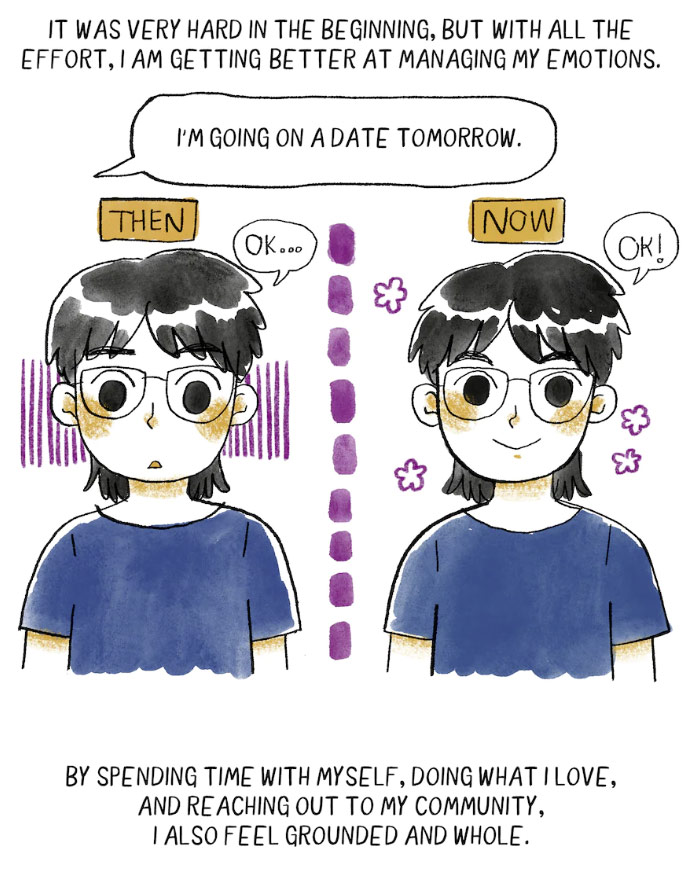
●  Remember Book Karnjanakit? She's the cartoonist from Thailand, now in Baltimore, who got published in the Washington Post's women's magazine The Lily last October with the illustrated I used to think there was one way to have a relationship. Then I discovered polyamory.

Now she's back, and on the Post website itself: How I overcome jealousy in my polyamorous relationship (May 29). Here are panels 1, 6, 8 and 9 of the 10:


●  Three days earlier, the WaPo's in-house advice columnist Carolyn Hax fielded a fret from an elderly mom: Parent has ‘grave misgivings’ about daughter’s polyamorous marriage (May 26). Her advice is good IMO.


Our only child, a daughter in her early 40s, married, with two young children, recently told us she had a polyamorous marriage. She hinted about it frequently for a year and then I asked her directly. The issue seems to have now completely dictated a shallow level of communication between us. She sent me a bunch of articles to read about the wonders of polyamory. [I hope this site helped! –Ed.]

Nick Galifianakis / Washington Post

...Grave misgivings fill my head and heart. She is very sensitive to anything that feels like criticism and always has been thin-skinned. The children are pre-hormone so I assume this is going undetected on their level. She has told me I need to practice acceptance.

I am concerned about the future. We do whatever we can to love and support the grandchildren, but I don’t know how to navigate the future with the knowledge I have. ... 

— Concerned

You treat her as your daughter. Which means, override your impulse to judge her and navigate the future by the usual standards. Care about her, trust her to manage her own life, and don’t offer advice unless asked.

...She is wrong on one point for sure; you don’t “need” to accept anything, any more than she “needs” to conduct her marriage to your standards.

...Frame it this way: IF your concerns for the future are founded, then your maintaining a solid relationship with your daughter and her children will be of utmost importance.

And the path to a solid relationship with your daughter is, all together now: to care about her, trust her to manage her own life, and not offer advice unless asked. I.e., wipe the judgy off the face.


●  India is the non-western country where modern egalitarian polyamory has caught on most firmly. Lots of past examples in Indian media (scroll down). Here are five more, starting with this one just out:

–  In Feminism in India, When My Partner And I Decided To Date Other People — Navigating Polyamory In Delhi  (June 6). It's long. Excerpts:


Intimacy in our minds is neatly fit into monogamy versus exclusively physical intimacy, although I wanted something which transcended these. 

Shreya Tingal for Feminism In India
By Shardha Rajam

When my partner and I decided to start seeing other people, I was excited. I had wanted to do this for a long time and knew in my heart that monogamy did not appeal to me. ...Quite apart from the physical intimacy, I wanted to experience what I did not know how to verbalise back then.

...Once we started... I realised that my partner and I were navigating through very different realities. While he had trouble getting women to trust him as a stranger in a misogynistic city, that was the only impediment he faced. For me, online dating applications often meant creepy men showing up at my doorstep unannounced. Men telling me I was, “cheating on my partner” and giving moral lectures about it. And, of course, men who did not understand consent.

...I thought of connecting with known men, hoping the common circles would enforce some degree of accountability and prevent non-consensual behaviour. ... However, known men were often disrespectful of consent too, and this regularly gave rise to more complications with respect to confidentiality.

...I was also not keen on verbalising my desire for the kind of intimacy I wanted, given our culture’s swift dismissal of any non-physical intimacy as clinginess without probing a blurred, more ambiguous form which fit into neither category.

...The Indian urban landscape has rarely been a space for women to exercise their sexuality — from my mobility to my clothes, to who my partner was with, and my own profile on a dating app — everything was open for questioning from different avenues, and masked as “safety concerns”. 


But it got better.


Although it did result in some unpleasant experiences, being non-monogamous introduced me to affectionate and genuinely caring people — people who were unabashed about their vulnerabilities, and did not hide behind cautious banter. As an ambivert myself, romantically meeting people encouraged me to move far out of my comfort zone — and introduced me to people I would simply not have met otherwise.

I met journalists, graphic designers, artists, photographers, lawyers and MBA graduates, PhD candidates, and legal researchers. My experience also reaffirmed my belief that romantic love need not be restricted to one partner — it was beautiful each time I found the intimacy I craved, and as I watched people unravel their own defences, each time I listened to realities and insecurities I would not have imagined them having, I formed a rapport deeper than friendship.

Shardha is a lawyer whose areas of interest include gender, social inequality and feminist legal studies. She can be found on LinkedIn and Twitter.


–  In the Deccan Chronicle, The new trend is Polyamorous Relationships (May 7, 2021):


By Nivi Shrivastava

...Designer Aman Bajaj, 43, who identifies himself as heterosexual and polyamorous, explains: “Polyamory is an evolutionary process for me, and each day I learn something new by accepting my true feelings for people. ... I feel polyamory is absolutely natural and everyone is polyamorous to some extent. ... It is also about acknowledging your true feelings and being mindful and respectful about the way other people feel.

Thirty-four-year-old Anika Verma, working in the creative and gender development sector... identifies herself as pansexual and polyamorous. ... “It’s all about accepting your feelings and acting on them with respect and trust. ... I had too much love to give and I didn’t want to lie about it or cheat.... Once I communicated this to [my husband] and my family, we made an arrangement to never hide anything from each other.”

“The most important factor about polyamory is to build trust and let the relationship grow organically with your partner,” says Aman.... in acknowledging your true emotions.”


–  In the Assam Sentinel, Indians Speak On Open Relationships And Polyamory (Jan. 18):


...Open relationships and polyamory are gradually buzzing in college campuses, Reddit threads as well as in therapy sessions. ... Polyamory is the situation when partners can engage in multiple sexual relationships with the consent of all the people involved. It is ethical and responsible non-monogamy where no one is in a single committed relationship. But, in a largely conservative society like India, there is a considerable taboo attached to these concepts. ...

Harsh and Yashika feel that any individual should not be judged for their choices and have cited that people have the right to do whatever they feel like doing within the parameters of the law. Yashika feels that many people are trapped in this bubble that one can only ever love one person. ...


–  In the Free Press Journal of Mumbai, Unlocking Your Intimacy: Three is not a crowd! (Jan. 23). This thoughtful, informed advice to a reader could have appeared on any good poly-community blog or discussion site. 


By Aili Seghetti

Q: My husband and I have been in an open marriage for two years. I really want my husband to meet my partners and do stuff together but he is not very keen. He prefers meeting partners without me and I often get jealous. I feel he is keeping things secret. What should I do?

Ans: You want to practice ‘Kitchen Table’ polyamory, while your husband prefers ‘Parallel’ polyamory. Both are ethical non-monogamy preferences based on your personality traits, attachment styles and the current relationship you have with each other.

Sometimes couples open up their relationships because they have a strong need for independence. When partners feel that they need space and time for themselves, it is usually a sign that they have merged too much with each other. For any relationship to last you need to maintain a delicate balance of connection and autonomy.

Currently your husband enjoys his relationships running in parallel, no interactions between metamours. It is great he is expressing his need for autonomy and his boundaries. What are yours? ... Speak about a middle ground with him.... It would be interesting to see what exactly you want to know about his lovers. This will be a great opportunity for you to understand where your insecurities lie. ...

The writer is an Intimacy and Relationship Coach, Founder of The Intimacy Curator, an organisation promoting self-discovery through emotional and sexual well-being (www.theintimacycurator.com)


– And in ED Times ("Economy Decoded"), a youth publication, What Does Gen-Z Think About The Rise In Polyamorous Relationships?


Polyamorous relationships are relatively new to India but the possibility of having a consensual, non-monogamous relationship is catching on.

India has seen a rise in the number of polyamorous relationships recently, so we asked some individuals about their opinion, here is what they said.

[Two opinions out of many:]


Sticker for cohabiting polyfamilies

●  Meanwhile, the amount of poly-themed merch even just on Etsy has exploded. Search there on polyamory polyamorous metamour polycule and you get 703 shirts, flags, stickers, pins, cards, hats, earrings, pendants, coffee cups, Christmas tree ornaments....


I remember when this little pin seemed to be the only one you could find at all. It's from 2005. My first. Thank you Jak and Karawynn, the vendors.


●  The TikTok vids have become uncountable. The quality pyramid is what you'd expect, so here's Ali Wunderman's 10 Polyamory Experts to Follow on TikTok, as published in Cosmopolitan.

●  The annual round of polyamory conventions, retreats, campouts, and other gatherings is starting to open up again in hopes that the pandemic recedes. Some conferences remain online in whole or in part; many have a proof-of-vaccination requirement and/or other Covid protocols. See Alan's List of Polyamory Events for the next 12 months, frequently updated.   

------------------------------------------------------------

And the wider picture. Shit will get real. 

We polyamorous people are a small, weird minority of social-rule breakers. Some people call us a threat to society — because by living successfully outside their worldview, we expose its incompleteness. Our freedom to choose our relationship structures, and to speak up for ourselves about the truth of ourselves, is just one way we depend on a free and pluralistic society that respects people's dignity to create their own lives, to access facts, and to speak of what they know.

Such a society is only possible where people have the power to govern themselves, combined with legal structures that are at least supposed to protect the rights of all.

People and communities who create their own lives, and who insist on the democratic structures and legal protections that enable them to do so safely, infuriate and terrify the authoritarians who are growing in power around the world and in our own United States.

Such rulers and would-be rulers seek to stamp out other people's freedom to choose their own lives — by intimidation, repressive laws, inflammatory disinformation and public incitement, or, eventually, artillery.

For what it's worth, this site has received more pagereads from Ukraine over the years (56,400) than from any other country in Eastern Europe.

For now, you can donate to Ukrainian relief through this list of organizations vetted by the Washington Post, or many others. (Avoid scams.)

----------------------------------

But that is only the start. For those of us born since World War II, this is the most consequential war of our lifetimes.

(See also, for instance, Tom Friedman's I Thought Putin Invaded Only Ukraine. I Was Wrong.)

The coming times are going to require hard things of us right here. We don't get to choose the time and place in history we find ourselves born into. We do get to choose how we respond to it. Buck up and be ready.

Need a little help bucking up? Play this. Loud. Another version.

More, you want? Just some guys near Kharkiv the other day helping to hold onto a free and open society, a shrinking thing in the world. (The tossed grenade seems to have saved them.) Maybe your granddad did this across a trench from Hitler's troops. For you, and for us. Even if he didn't realize it at the time.

Bravery takes other forms. For instance. And this. Or cartoon animator Oleg Kuvaev. His Masyanya was a popular family series in Russia for years, South Park style. Then, after the start of the war in February, he put out Episode 160. The raucous, oval-headed mom dumps the "no politics" rule ("So this is the result of your No Politics!" says her partner. "It's our fault.") and toward the end she barges in on Putin and presents him a blistering lecture and a hara-kiri sword to solve his problems. No spoilers what comes next. English subtitles. Kuvaev is out of Russia, the series remains up via overseas backups, and Russian authorities have implied they will hunt down the backups and wipe them. Don't drink any polonium tea, guy.


Remember, these people say they're doing it for us too. They are correct. The situation is going to get worse before it gets better. The global fight between a free, open future and a terrible return to the dark past past that is shaping up, including in our own country, is still in its early stages (start at the 3rd paragraph there).  The outcome is uncertain, and it will determine the 21st century and the handling of all its other problems.

----------------------------------

BTW, it's safer to say a thing if people around you say it too. What this audience is chanting in St. Petersburg is Khuy voinyeh, "Fuck the war," potentially worth a 15-year prison sentence.


Some person in that crowd started it. Maybe you can be a first mover too. Or the first reactor to a first mover, just as crucial. When the moment appears, remember not to flinch. We'll have a better idea after the election. Whatever else you do, vote.

 
_________________________
 Don't miss Polyamory in the News!
 SUBSCRIBE by a feed, or
 SUBSCRIBE by email

_________________________

[Permalink]

Labels: , , , , , , , , ,


June 20, 2018

Playboy: "Are Some People Just Slapping the 'Poly' Label on Their Cheating?"


Playboy is still around (who knew?), and a writer for it weighs in against what I've long thought is the greatest threat to the future of our movement: the misappropriation of our big idea's defining word.

I think the threat is receding. The actual precepts of modern polyamory — ethical, honest, equal, and respectful toward everyone involved — are becoming widely recognized in society. Stories like this, which address the problem head-on, are part of why.


Are Some People Just Slapping the "Poly" Label on Their Cheating?

Drekhann

By Sophie Saint Thomas

“I had been spending time intimately with someone on multiple occasions when I learned he had a girlfriend,” says Melissa Vitale, a New York City-based publicist. He said that his relationship was open and that he was “ethically non-monogamous.” As it turned out, Vitale’s lover’s girlfriend was not aware that he was sleeping with others under the false label of ethical non-monogamy. “I later found out that he was full of shit. He's just a small man who cheats on his beautiful girlfriend,” Vitale says.

New York magazine reported in 2017 that 20 percent of Americans had practiced polyamory at some point in their lives. As a side effect of the normalization, are more people not only misusing the term, but using it as an excuse for bad behavior — therefore stigmatizing non-traditional relationships and stomping on the hard work advocates have done to help normalize such relationships in the first place?

Anyone who has spent time on a dating app recently has likely noticed a rise in people identifying as ethically non-monogamous and polyamorous. The Latin translation of polyamory is “many loves,” and polyamorous people don’t just have sex with, but date and love more than one person. Polyamory is a form of ethical non-monogamy, but the two words are not interchangeable. Ethical non-monogamy is an umbrella term for open relationships formed on consent, trust, and honesty, and includes polyamory, swinging, and relationships in which a couple is emotionally exclusive but occasionally sleeps with others.

Historically, such communities are marginalized compared to the monogamous norm. While monogamy still reigns supreme, in recent years, ethical non-monogamy and polyamory have become more normalized and even trendy, thanks to books such as The Ethical Slut by Dossie Easton and Janet Hardy, More Than Two by Franklin Veaux and Eve Rickert, and Sex at Dawn by Christopher Ryan and Cacilda Jetha. All of the above titles should be required reading for anyone entering an ethically non-monogamous set-up.

The increasing acceptance of polyamory is great news for those who have long had to keep their relationship structure in the shadows. “What is better than having more love in your life? One thing we lack in society is love,” says sex therapist David Ortmann on the pros of the rise of polyamory. However, open relationships are not for everyone. Depending on your attachment patterns, monogamy may be the best option for you. “With polyamory becoming trendy, people are putting it on their dating profiles, without any sense that it’s more than just fucking a lot of people. It requires a tremendous amount of communication and empathy, compassion and honesty,” Ortmann says.

We’re reaching a point culturally where there are enough people being non-monogamous that folks are starting to use that label inappropriately, and that’s going to happen with any label.

We see non-monogamy within “monogamous” relationships in the common practice known as cheating. Some people who cheat get off on the secrecy and sneaking that accompanies seeing someone behind their partner’s back. “Sometimes people get off on lying, that is their fetish,” says sex therapist Dr. Denise Renye. If you’re in an open relationship and wish to integrate secrecy into your sexual encounters, you can consensually negotiate that with your partner. “Most things are possible as long as consent is present. If the consent is not present, this completely clashes with the principles of ethical non-monogamy,” Dr. Renye says.

However, some folks seem to have attended Burning Man once, learned the word “polyamory,” stuck it on their Tinder bio, yet continued to date in a manner that involves non-consensual lies and secrecy. When they’re called out, they throw up their hands and say, I told you that I was poly! “They are attempting to sugarcoat their cheating styles. I do not necessarily think that people always know what they are talking about,” says sex educator Jimanekia Eborn.

Some folks, such as Vitale’s lover, may use words like “ethically non-monogamous” to cover up bad behavior. Others may simply be brand new to the poly lifestyle and in need of an education. “Do you even know who you are? Or do you know what kind of relationships actually work for you? You can also be hurting yourself in the process,” Eborn says. ...

Zachary Zane, a New York City-based writer, dated a woman who identified as poly, but did not live by its principles. “She would start dating someone new and completely forget about her previous partners. While all of us in the poly world cut a partner some slack when they start dating someone new and are in the midst of NRE [a poly expression for new relationship energy, or the giddy rush of joy you experience when you first start seeing someone], she never seemed to get over the NRE — until she found someone new and then forgot about her previous partner(s) altogether,” Zane says.

...You can avoid such misunderstandings by taking the time to think about what you’re truly looking for: one partner, multiple partners, or just multiple partners until you fall in love? ...

“A lot of us have been trained from the mainstream model to not ask tough questions about what realistically are you looking for, what are you available for, and what does your model for this kind of relationship look like?” says sex-positive psychologist Dr. Liz Powell. If you’re in a period of your life in which you want to be poly, but feel you may end up in a monogamous set-up one day, one argument is that it’s better to just identify as single. ...

The plus side to identifying as open or poly, even if you may not always be that way, is the transparency. If you tell multiple partners that yes, there are others, and no, it won’t just be you right now, you don’t have to worry about hurting feelings with false pretenses. However, if you’re dating other poly people, you do have a responsibility to talk about what that word means to you. While it can be flexible to you, it may be a lifelong lifestyle to another, and vice-versa. ...

“We’re reaching a point culturally where there are enough people being non-monogamous that folks are starting to use that label inappropriately, and that’s going to happen with any label,” Dr. Powell says. There’s a term known as “poly preaching,” which refers to poly people taking on an enlightened attitude that they date the way that humans are meant to — that it’s more intelligent than monogamy. While that is true for some, it doesn’t mean that poly people don’t mess up. And they should be allowed to.

“I think non-monogamous communities sometimes like to think of themselves as these like beautiful utopias full of enlightened people, who never have relationship drama. They only have relationships made completely of love and free of jealousy and fear. And that’s just not real. I’ve been non-monogamous on and off for 18 years, and I still have issues sometimes. We are all imperfect, messy humans,” Dr. Powell says. The key to being an ethical messy person, and not a harmful one, is honesty.


The original article (June 11, 2018).

[Permalink]

Labels: ,


January 16, 2022

Solopoly stories in the media this week, how to tell your own story and get paid, and more.


Fifteen years ago I was saying that this consensual multi-relationship thing really turns heads, and that media were beginning to wake up to the fact. Well yup. Here it is 2022 and they can't get enough. 

●  A Gen-Z targeted site called Screenshot ("New conversations for and from the new generation. ... learn what we can do for your brand") spotlights a rising music/TV personality and influencer: How Willow Smith’s solo polyamory may have paved gen Z’s way into ‘relationship anarchy’ (Jan. 11)


Willow Smith / Instagram
By Svetlana Onye

Through solo polyamory—that is, having multiple intimate relationships while maintaining an independent single freedom—women are experiencing a self-love like no other. ...

Willow Smith, pop punk singer and black alt-girl icon, has openly talked about belonging to the polyamorous community while routinely sharing Instagram posts on what polyamory is all about. More and more women seem to be defying the status-quo of what a relationship should look like, and as ‘relationship anarchy’—don’t worry, I’ll explain soon enough—becomes a more common reality for the younger generation, it seems that it’s time to seek relationships that work for you.

...The singer appears to have never shied away from the topic and shares daily posts about solo polyamory in particular and what loving multiple partners entails. With a follower count of 9.7 million fans, it’s clear that the youngest Smith wants to educate people on a mode of loving that is often stigmatised.... One of those followers who Smith successfully educated was myself. 

...It is unsurprising why this particular style of polyamory has become increasingly popular among women, specifically women of colour (WOC). Self-titled ‘Sex Positive Asian Auntie’ Jayda Shuavarnnasri, a sexuality and relationship educator, shared similar sentiments on her own platform, telling her followers that being solo poly meant that she is “experiencing myself, centring myself and choosing myself every day.” ...

...What we are seeing with the younger generation today are rapidly evolving ideas of relationships. From platonic partnering to solo polyamory, relationship anarchy is truly in action as many continue to redefine the boundaries of friendships or the openness of love.


●  Have you, a non-famous non-influencer, thought of telling the world your poly story and maybe getting paid a bit? Lots of outlets are probably interested. Online magazines in particular are always hungry for content. Find a few that look promising, write and ask.

For instance, Jessica Renaglia just got her first-person story published in Australia's MamaMia ("a women’s media company to make the world a better place for women and girls"):  'I have a loving male partner and a girlfriend. This is how we make it work.'  (Jan. 11). Frankly, it reads to me like she just narrated it into her phone and did some cleanup. But it definitely got her story across to readers.

MamaMia pays for original short pieces like this, as told at the bottom of their submissions page. According to the crowdsourced WhoPaysWriters.com, MamaMia was paying $0.07 per word as of 2019. Not much, but not bad for something you can write off the top of your head.

Update: And, one thing can lead to another. That little piece got her profiled on the site of Australia's 7News, the country's most-watched TV news service: Inside a polyamorous relationship, by Australian woman who dates boyfriend and girlfriend at same time (Jan. 18). If she wasn't an influencer before, she is now.


●  Or you can interview other people about their stories. Zachary Zane, a successful freelance writer on queer and poly relationship topics, just placed this piece in the mass-circulation Men's Health (or at least its website): Here's How Solo Poly Compares to Other Kinds of Polyamory (Jan. 12). WhoPaysWriters.com indicates that as of a few years ago, Men's Health was paying 25 to 50 cents a word.


...“Solo poly is a relationship type where a person chooses not to have any primary partners—more specifically, partners that we get on the relationship escalator with,” explains Zhana Vrangalova, PhD.... Solo poly people have no desire to “live together with a partner, get married, have kids, join finances....”

...It's also different from "dating around" the way a non-poly person might. When someone is simply "dating around," they typically have a string of connections until they find the "one" and proceed to settle down with them. A solo poly person has no desire to settle down with one (or multiple people) anytime soon.

...We spoke to four people who proudly identify as a solo polyamorist: Jack, 34; Collin, 39; Phoenix, 33; Carlos, 26. Here’s what they had to say. ... 


And on it goes for another 1,000 words, question by question, with good, articulate interviewees providing most of the content.


Dainis Graveris

●  Similarly, in the Philadelphia Weekly Dr. Timaree Schmidt just interviewed several local CNM-ers. One of them describes a spectrum of metamour-relations terms that's gaining traction, in addition to the well-known "kitchen table" and "parallel." The two new ones seem to have originated with the Multiamory podcasters.

The article: Multiple Ways To Have Multiple Partners (Jan. 13). She's interviewing Shay Au Lait, "a Philly burlesque producer and theatre artist" who provides these descriptors, with links:


  • Parallel Poly– all the partners acknowledge each other’s existence but live entirely separate lives.
  • Garden party poly– partners are able to engage in friendly interactions at social functions or on social media, but don’t share a great deal directly.
  • Kitchen table poly– named after the idea that all one’s partners would be able to comfortably sit around the kitchen table; the assumption that metamours would be friends with each other.
  • Lapsitting poly– a more engaged version of kitchen table poly, where metamours in a polycule develop entanglements and relationships of their own.


But I prefer "Snuggle Pile Poly" to "Lapsitting." I find sitting in laps uncomfortable and awkward for both parties, but I was meant like a puppydog for friends-and-lovers snuggles.


●  It's hard to get a random sample of the multi-relationship experiences that people in the broader world have had, outside the streetlight glow of the self-identified poly movement with its collective culture (however diffuse) of shared experience and wisdom, values, advice and best practices.


We asked the members of the BuzzFeed Community to share their stories and advice about their experience being in a three-person relationship (aka a throuple). Here are some of their most engaging and insightful replies. ...


The 15 experiences are rather more bad than good; a number of the people blundered into avoidable known messes. There's a need for wisdom-sharing before people do this! Those of you who can educate, please keep it up.

Note: Buzzfeed asks for more group-relationship stories at the end of the link above.


●  Meanwhile, jumping way up the media scale, the New York Times "Social Q's" columnist, Philip Galanes, gives well-meaning advice to the upset mom of a poly daughter: My Daughter’s Married Boyfriend Shouldn’t Join Us on Vacation, Right? (Jan. 13). Galanes sounds all poly-positive and everything, but I see an elephant in the room trumpeting for attention.


My 30-year-old daughter is in a polyamorous relationship with a married man. She brought him home for the holidays, and while he was charming, I felt uncomfortable. (This may have been triggered by my husband’s infidelity that led to our divorce.) Now, my daughter tells me she would like to bring this man on our family trip to Greece this year. It may be petty, but I don’t want to foot the bill for another woman’s husband. And I don’t see any way this relationship can lead to my daughter’s happiness. ... 

MOM

...Let’s put aside the trip to Greece and the specter of your cheating ex. Unlike him, people in polyamorous arrangements usually set ground rules with their partners for opening their relationship to others. (No one is cheating!) Try to understand, as best you can, what your daughter likes about this arrangement and how it satisfies her.

As a show of respect, read up on polyamory before you broach the subject with her. Then ask questions. I am not suggesting that you set aside all of your concerns — only that you try to respect your adult daughter’s decisions. ...


All well and good, but the gaping black hole in this picture to me is the boyfriend's invisible wife. "No one is cheating!" writes Galanes. Well then, the daughter could just call the wife and ask "Here, I'll hand the phone to my mom and you can clear it up for her." But if daughter asks the guy "Let's call [wife] so she can explain to Mom" and he stalls and fidgets and sweats, well...

Science says there are 43.7 gazillion guys these days whose idea of "poly" is "My wife and I are in a poly relationship but she mustn't find out."

Trust but verify. Does the daughter even know?


●  On a happier note regarding poly inter-relations, Metamour Day is coming up!  Metamour Day ("celebrating polyamory's most distinctive relationship") is February 28th, Valentine's Day times two. This year the National Coalition for Sexual Freedom (NCSF) is taking the lead to make it a Thing across social media on the big day. And, artists and graphic designers, they are calling you:

The Facebook link to share.

My own post for Metamour Day last year. Let's get some fresh art.

 _________________________
 Don't miss Polyamory in the News!
 SUBSCRIBE by a feed, or
 SUBSCRIBE by email

_________________________

[Permalink]

Labels: , , , ,