Polyamory in the News
. . . by Alan M.


August 29, 2022

Movement for a better polyamory flag enters the home stretch


Grim and confusing?

Last year a group of volunteers under the name PolyamProud launched an ambitious project: to see whether the sprawling, disorganized global polyamory movement wanted to vote on a new polyamory flag —given the widespread dislike expressed for the current flag with its angry colors and confusing letter pi. ("Some math or engineering society?")

PolyamProud hopes to spotlight some new design that will win the kind of widespread enthusiasm and buy-in that made the Rainbow Flag the instantly recognized symbol of LGBT pride that it is.

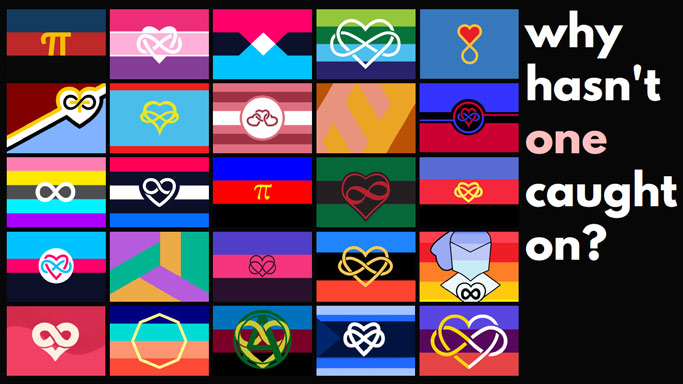
Dozens of new polyamory flags have been offered in recent years, more all the time. The PolyamProud team set out to collect as many as possible, assemble a globally representative selection committee of poly activists, designers, and vexillologists (flag buffs), have them do a preliminary cut for clarity, distinctiveness, and principles of good design — and then hold a worldwide popular vote on the finalists in November 2021.

The project lost momentum and the date slipped. Now the project is fully back on track, has moved far along, and the public vote will open this November 1st.

Interest is big. Some 20,000 people have signed up to be notified when the voting opens in 63 days. Another indication: After the PolyamProud people announced the project, my own 2020 post The Polyamory Flag Is a Grim, Confusing Failure. Let's Do Better (which they referenced) took off and has since become the third-most-read post on this site. It now gets more reads each week than when it was fresh (31,100 to date).

If you've been planning to send in a flag design, hurry up. The submission deadline is August 31st.

From their website:

PolyamProud.com


PolyamProud.com


Here's how we're different: 

– Nearly 20,000 voters. A year of effort has resulted in nearly 20k polyamorists signed up to vote on our new flag.

– Flag selection committee. A small group of well-known polyamorous people will choose the candidate designs.

– Inclusion focus: Diverse, intersectional non-monogamous identities will have a direct hand in the process.

– 25+ expert consultants. Authors, researchers, therapists, coaches, activists, and more will all contribute to the design.


Ambitious or what?


...Along the way we’ve necessarily had to make some adjustments to the process. This has come about due to a combination of worldwide challenges (the pandemic among them) and the impact it’s had on our team, volunteers, experts, and committee members.

...From the designs we receive, the advisors and then the [selection] committee will choose their preferred options, which will then be tweaked or adjusted with the assistance of the experts and vexillologists we have helping us.

...We’re in the process of finalising an email subscription service which will be robust enough to email everyone [a notice] the day voting opens.

The voting platform itself has been custom-built by PolyamPirates, and will be hosted by them on a separate server. When voting opens, the candidate flag designs will appear in random order to each voter, so none of the options will have visual priority. We at PolyamProud won’t have access to the results until voting is closed. To ensure the integrity of the results every voter gets just one opportunity to vote: this will be tracked by email verification and a bot filter.

We've been building connections with folks who are ready to promote the vote leading up to and during the voting period (1-23 November, 2022). There's going to be a significant surge in promotion from us at that time, so keep an eye out on our social media feeds [ instagram, facebook, twitter ] as well as the website.


------------------------------------------
Of course nobody can get anybody to use a flag they don't want; there's nothing "official" in this sprawling community of cats. But that's not the point. The point is to see if a lot of people would like to coalesce around one new design and use it. The old one is certainly showing its age. It was created by one person on a whim in 1995, with a deliberate intent to hide its meaning at a time when the poly movement was tiny and closeted.


We didn't want to create another addition to the slush pile of online designs. So, we got in touch with other groups that had done it before us, took lots of notes, and got started.

Turns out, the way to unite the community behind a single design was to unite the community to choose a design that suits it best.

No flag will ever be a perfect fit. But we can work together to choose an emblem that feels and works better for more of us.

We think it's worth a shot.


Co-organizer Kristian tells us, "We and our advisors are incredibly excited about the candidate designs being presented to the committee. They’re original and thoughtful, and they feel more representative of 21st century polyamory and non-monogamy than any designs that have come before."

Voting will be ranked choice (instant runoff)  so if your first choice gets eliminated, your second choice enters the count, then your third. 

Sign up to vote, and stay tuned.


---------------------------------------------


●  In other poly-movement news, the annual cycle of polyamory conferences, retreats, and other events continues to reassemble as people hope covid will be less of a thing. See Alan's List of Polyamory Events for what's on in the next 12 months so far. Tell me if I missed something.  

The covid protocols for these events range from strict to apparently lax. In July I went to the Center for a New Culture's very poly-friendly Summer Camp East in the mountains of West Virginia and stayed on for a while afterward. To attend, you needed to send proof of full vaccination with boost and also the negative result of a PCR test taken no more than 48 hours before arrival. We were also asked to take extra infection precautions for the previous week. Then we had a rapid antigen test on arrival, daily rapid tests for the next two days, then every other day for the next four days. Tonsils as well as nose.

It worked. Of the 300-plus rapid tests done onsite, the positivity rate was zero point zero. Nor did any of the 65 of us show symptoms, nor was a case reported in the week after it was over. When screened this thoroughly with 100% compliance, a big group event in an isolated location seems to be safe — even with close contact among most of the people for many days.

That event was definitely for the careful, otherwise I wouldn't have gone.


●  In more news of the movement: The new Polyamory Foundation has posted a list of its first grants. The foundation was created to help fund expenses for projects that advance polyamory education, awareness, and community. 

_________________________
 Don't miss Polyamory in the News!
 SUBSCRIBE by a feed, or
 SUBSCRIBE by email

_________________________


[Permalink]

Labels: , , , , ,


July 4, 2021

Folks get serious about a new and better polyamory flag


The old one

A year ago I published a screed titled The Polyamory Flag is a Grim, Confusing Failure. Let's Do Better. Repeating many other people, I said its colors are harsh and foreboding and its central letter pi only prompts a huh? (Some math or engineering society?) The flag "fails to declare for us, fails to inspire, fails to do a flag's job."  I posted some of the alternative flags that people have created, and gave some history of the early poly movement and its symbology.

That article struck a chord. It became my most-read post of the last 12 months, and its hit rate has been increasing. It's now averaging 500 new reads a week, mostly through Google searches for "polyamorous flag", "poly flag" and so on.

Dozens of people's new polyamory flags are floating around. A few have gained some traction. But no consensus has formed up around any design — one that will display poly presence, pride, and attitude with clarity and verve, in a way that both we and the world will instantly recognize.

Why do we need that? Look at the social power of the rainbow Pride Flag, which the LGBT world grabbed up almost from the moment Gilbert Baker created it in 1978. It did a great deal for the visibility and normalizing of LGBT, and it still does. 

And, look at the recent explosion of other new identity-pride flags: trans, ace, pan, genderfluid, bi, and more. These have won hearts in their communities and a lot of favorable mainstream-media notice for those identities (even for instance in the white-picket-fence Reader's Digest).

--------------------------

Now folks are launching an initiative to see if the polyamory community is ready to coalesce around some new design that will stir us to make it our proud standard.

Sarah "Mack" Flury and Kristian Einstman, based in Chicago, are going about this project from the ground up, showing smarts about how such an effort might actually work in this disparate, independent-minded herd of cats we call the poly movement.

Their first goal, they say, is "to create a committee of some of the most influential voices in the community, networking worldwide." They explicitly want to keep this from becoming an American-centered project. "Our goal," says Einstman, "is to create a flag that is recognizable and representative worldwide.

"We have collectively formed @PolyamProud, a volunteer coalition dedicated to establishing a definitive and representative visual identity for the polyamorous community."


They hope to launch a worldwide discussion among all who want us to have "a definitive and representative visual identity," as Einstman tells us. The eventual committee may create and offer designs of its own guided by known principles of vexillology (flag study), and it may consider design entries by additional people. He continues,


We have no intention of trashing the old flag and its history and its role in getting us as far as we've gotten. But there is a real, pressing need in the community to have a single flag that serves us all well.

A flag is a way of proclaiming visibility, so that people who are not yet out can see where there is a place they can go, can see that there are other people like them. 


"We want to make it clear that we are not the committee and none of our team will be on it," says Einstman;


We’ll be releasing information about committee member qualifications on our site within the next month or so, but our main goals are to have the committee members represent a wide range of socioeconomic, racial, cultural, and non-monogamous backgrounds, as well as varied levels of education and areas of expertise.

Our plan is to present designs to a small committee of (no more than 12) representatives from polyamorous communities worldwide. The committee will review options and select two to four designs to be presented to the public for the final vote.


Flury and Einstman say they want to announce the winner of the public vote with full social-media fanfare on November 23rd, Polyamory Day. "We also want to get it into the hands of merchants" who manufacture flags, shirts, stickers, coffee mugs, all the usual stuff. They hope to recruit publicists who will build media interest as the day nears.

--------------------------

Want to help make this happen? Do you have skills, expertise, or time & energy to contribute? Once again: @PolyamProud on Instagram. They're also on Twitter. Their GoFundMe.

Here are slides from an early presentation they've worked up.


 -----------------------------------------------------------------


I'll keep reporting on the project as it advances.

_________________________
 Don't miss Polyamory in the News!
 SUBSCRIBE by a feed, or
 SUBSCRIBE by email

_________________________

[Permalink]

Labels: , , , , , , ,


July 27, 2020

The polyamory flag is a grim, confusing failure. Let's do better.


So here's a years-long peeve, and boy howdy, am I not the only one. The polyamory flag stinks. It confuses, it fails to communicate a message other than Huh?, and its colors loom angry and foreboding. "Some math or engineering society" is what usually comes to people's minds. It fails to declare for us, fails to inspire, fails to do a flag's job.

But we keep using it decade after decade, ever since Jim Evans proposed it in 1995 against no competition. It seemed like a good idea at the time.1 Maybe it was, when the self-identifying polyamory community was small, insular, and (as Evans later explained) mostly trying to keep hidden.1, 2

From a typical recent discussion on reddit/r/polyamory (161,000 subscribers):


"The flag everyone is happy to see burn."

"New rule for this sub. Who ever posts this flag shall be banned. It is fugly."

"Every time it's posted, everyone hates it, so everybody just stop using it. It's no longer our flag."

"Can we please throw that flag out now?"

"Slowly takes walltacks out of the poly flag hanging on my wall I just learned everyone hates."


Another discussion on reddit/r/polyamory.

Fortunately, many people have created new polyamory flag candidates. At least two of them IMO would be excellent if enough folks decide to adopt them as the new standard.

At right are a few of the alternatives that people have put into the public domain on Wikimedia Commons. Take a look at the hi-res versions there, with the creators' names, dates and descriptions. And maybe add one of your own.

Here are more new candidates, sorted by keyword "polyamory" from the geeky site reddit/r/QueerVexillology. (I know this brings up the old debate "Is poly queer?", but there they are.)

And here's what an internet-wide image search brings up for "polyamory flag."
 

My own favorites are the two below. Both use our universal infinity-heart symbol, which is by far the most widely recognized emblem of polyamory today.3


This first one is by Emma @HECKSCAPER, created September 2019. It seems to be catching on, and it's my fav. Here's its Wikimedia Commons page. Emma tweeted that the Evans flag left her "so visually offended that I had to make my own version using the infinity heart instead, while maintaining the general meaning of the chosen colors." She made the colors lighter and less severe, and the central disk is bold, happy and airy. But shouldn't it be just a little larger for better proportioning?


This one is by Monroe of RatLab Art, August 2016. Its Wikimedia Commons page. Wrote Monroe, "I redesigned the polyamory flag bc the old one seems a little jarring to me. I like the original meaning behind the colors, though." Again the colors are more muted than the original's. The infinity heart is proudly center stage and grabs you from a distance. I might prefer a brighter gold rather than tan, keeping Evans' original symbolism that went with the gold color for the pi.1

So, how can we get a new flag into wide use? By using it! The ultimate decider will be the wisdom of the crowd. If you have a favorite, or design one, promote it (like I just did!) and see if other people pick it up.

I bet in a few years we'll be using a new poly flag that most of us are happy with and that carries our message proudly and well.

Update: Another interesting new proposal, skipping the infinity heart, from reddit/r/polyfamilies user TheGreyBandit. 

Update: A new Facebook thread with more proposed designs.

Update, June 15, 2021:  An organized initiative is starting up for a new and better polyamory flag and other symbology. Sarah at PolyamProud writes,


I recently read your article on your distaste for the polyamory pride flag. I noticed that you have seen the reddit post by TheGreyBandit and his new ideas on the Polyam flag. I am currently working with him and several other Polyam people who all agree with you. We have collectively formed @PolyamProud, a volunteer coalition dedicated to establishing a definitive and representative visual identity for the polyamorous community.


Update, November 23, 2022: The winner of that new-flag competition


-----------------------------------------

1.  In August 2016 Jim Evans wrote about his thinking behind the flag when he created it 21 years earlier. Among other things, he says that he kept its meaning deliberately obscure because people were more closeted then. And he used the letter pi partly because he could simply copy it from a font into Microsoft Paint, while drawing an infinity heart in Paint would have been challenging "given my limited abilities."

From Evans' post: 


Tuesday, August 23, 2016
Polyamory, Pride Flags, and Patterns of Feedback

...I've been polyamorous, or "poly" for short, for nearly all of my adult life. A little over 20 years ago, I lived in the Pacific Northwest, and for the first time in my life, I experienced first-hand the struggles and celebrations of what is now known as the LGBT community. One thing that struck me was the imagery and symbolism those communities used to rally around, identify other members, and publicly announce their membership in the community. The pride flag was one image that made a huge impression on me. At that time, the poly community didn't really have similar symbols to use, so I took it upon myself to create one. Here's what I made up, and released into the public domain in the late summer or early fall of 1995.

Here's the text I wrote up describing it to the first mailing list I shared it with. It's become the canonical description of this particular flag:

The poly pride flag consists of three equal horizontal colored stripes with a symbol in the center of the flag. The colors of the stripes, from top to bottom, are as follows: blue, representing the openness and honesty among all partners with which we conduct our multiple relationships; red, representing love and passion; and black, representing solidarity with those who, though they are open and honest with all participants of their relationships, must hide those relationships from the outside world due to societal pressures. The symbol in the center of the flag is a gold Greek lowercase letter 'pi', as the first letter of 'polyamory'. The letter's gold color represents the value that we place on the emotional attachment to others, be the relationship friendly or romantic in nature, as opposed to merely primarily physical relationships.

Now, here are some things to understand. Clearly, I'm not a visual artist. My tools for creation at the time were literally limited to Microsoft Paint, running on Windows 3.1. Nevertheless, the flag design managed to limp along, with little fanfare. My friends and I used it, and thought of it as quirky and something that could be used in the way other pride flags were used, as a symbol to rally around and for identification.

Fast forward 20 years. Apparently, this thing called the World Wide Web happened, and let all sorts of people communicate and discover things they'd never known about before. New polyamorous people began to discover the flag existed. One would think that people might think it was an interesting idea, given its intent. One would be wrong. The flag has been called vile, no good, hideous, disappointing, ugly, and many other negative things.

One of the issues frequently brought up is that the color scheme is garish or unpleasing. That's subjective, and I can't argue with their perception. I still think there's value in the color symbology, if not the actual RGB values I used when creating it.

Many people seem to take issue with the pi symbol as obscure. There were specific reasons for choosing it at the time. First, I specifically avoided imagery that included a heart. The leather pride flag, which predates the design of mine, includes a heart, and I was trying to avoid confusion, given that community was there first. The "infinity heart" was not yet as widely accepted a symbol for polyamory, and would have been challenging for me to incorporate given my limited abilities in the visual arts. The letter pi was readily available on computer typographic platforms even in those days, so I chose that.

Also, at the time, I was more concerned with "in the closet" polyfolk, and was far more in the closet myself than I am these days. I wanted a symbol that could be used relatively anonymously, that could let people who were in on the symbology connect, without it being too specific.

Additionally, there was already a rich history of existing pride symbols using Greek letters, the use of lambda as an LGBT symbol being a concrete example. I was hoping to evoke similarity and solidarity without being too explicit or derivative. Finally, the fact that the "poly" in polyamory is a Greek root seemed to indicate that would be a natural choice. In retrospect, perhaps a lemniscate ("infinity symbol") would've been a better choice, but nobody spoke up then.


--------------------------------------------


2.  In the history of the modern polyamory movement, one person stands above everyone else in bringing the small early community out of its shell of secrecy and fear of public notice. That was Robyn Trask, who acquired Loving More magazine and its gatherings in 2004 to rescue it when it was on the brink of extinction.

The common view in the polyworld up to then had been that all the news media are sensationalist and nasty and incapable of treating this thing we do accurately. There were examples of that. But few in the community seemed able, or willing, to see the difference between a scandal-seeking hack and the serious writers and editors who would soon be producing excellent, seminal feature articles about us for the likes of the Washington Post and New Scientist.

Robyn has always said that her motivation is to help people like her own younger self: lost and ashamed in a monocentric wilderness, with no idea that another way is possible. On taking over Loving More, Robyn realized that only the mass media could reach most such people and let them know that there's a whole community they can join, one that has amassed a great deal of practical polyamory expertise. She says that early on, she set a goal for Loving More "to make polyamory a household word."

She started sending out press releases to news media. Within two months of acquiring Loving More she got her hometown Denver Post to run a 2000-word feature story on the concept and on local polyfolks who volunteered to be interviewed. The 700 Club, the showpiece program of the Christian Broadcasting Network, invited her on and she bravely accepted. They treated her with surprising respect, giving her a chance to explain, in her pleasant and folksy way, that multiple loving relationships with everyone's understanding and consent are actually possible and really happening  to more than a million Christian viewers.

She sent out a press release before the 2005 Loving More conference at Ramblewood in Maryland, the first conference under her leadership, and welcomed onsite a reporter and photographer from the Baltimore Sun, which was then one of America's great newspapers. She introduced them to everybody at the beginning, they agreed in front of the crowd to hard rules she set around everyone's privacy, and they left after one day. The result was a major, excellent feature article in the Sun, later reprinted elsewhere. It was surely a life-changer to some readers who had thought they were the only ones in the world.

Good media like that began to change attitudes in the poly community about what was possible  especially if you chose intelligently who to deal with, researched their employers' biases and motives, and learned basic tricks for dealing with the media successfully. Such as memorizing and rehearsing your key talking points beforehand, presenting yourself well in the eyes of the audience, saying nothing that you don't want used even if it means a long silence while you think (they'll clip that out), and how to walk away from a trap.

The more news stories and TV interviews that poly people did, the better informed the media themselves became going into interviews, and the easier it got. This required many intelligent, good-hearted, quick-witted, very out polyfolks who were ready to go on camera and to talk to writers. But our movement had people like that! By about 2012 "herd journalism" had taken hold: If your competitor runs a story about an interesting new topic that grabs people's attention, you have to do it too. 

-----------

As it happened, that Loving More conference at Ramblewood was my own first. I'll always remember stepping out of my car in the parking field and walking toward the gaily decorated registration table, my heart pounding with an awareness that in a few moments my life would change forever. (I was right.)

Within weeks of the conference and that Baltimore Sun article, I started doing the project that became Polyamory in the News. My original intent was to capture and highlight how the mainstream world was actually treating us, and what we could do about it. That was roughly 4,000 articles and broadcasts ago as individually documented here, plus many more that I've surely missed.

It worked. Fifteen years later just about the entire Western world knows about us — and has learned that for some people, multi-relationships can work joyously all around, when carried out in the right environment of abundant communication with work on serious self-knowledge and relationship skills. "The polyamorous possibility" has become widely known.

It's so much better now — thanks to all you dedicated, great-hearted volunteers who are working in ways large and small, year after year, for a powerful idea.

--------------------------------------------


3.  The infinity heart as a symbol for polyamory arose in the mid-1990s. The very first was the one at right, created and put into the public domain by Brian Crabtree. New versions quickly appeared (now there are hundreds), and by about 2010 the infinity heart had pushed the once-dominant4 poly parrot nearly to extinction. . .

. . .such as Ray Dillinger's parrot from 1997 or before, at left, one of the first. For years it was the familiar logo of the alt.polyamory Usenet group, the first large poly-specific discussion site on the web. The site was created (with no graphics) on May 21, 1992, by Jennifer L. Wesp, who had just invented the word polyamory in a Usenet discussion independently of Morning Glory Zell-Ravenheart (who first published a form of it in May 1990). See "Polyamory" enters the Oxford English Dictionary, and tracking the word's origins. (Though it's often called the first internet poly site, the alt.polyamory list was predated by the "Triples List," founded around 1989 and hosted by Sun Microsystems, recalls Howard Landman, August 2020.)

In 2002 Alex West posted a history of polyamory symbols, documenting things back while the movement was still young.

--------------------------------------------

4.  For instance, alt.polyamory had a very old FAQ page (undated but still in a version of the site "last modified June 1997"), including,  "There are several proposed symbols of polyamory, of which the most common seems to be the parrot.  As parrot pins and other ornaments are relatively easy to find, this symbol seems likely to catch on over the others."

Labels: , , , , , ,